Monday, July 14, 2014

Fears for life of Iranian trade unionist

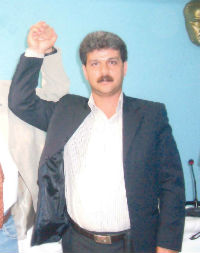
INTERNATIONAL demands are being renewed for the release of Iranian bus workers' leader Reza Shahabi. The campaign has been given fresh urgency with the news that Shahabi is seriously ill after a hunger strike in prison.

Below are two of the calls going out for Rez Shahabi's freedom.


Free Reza Shahabi now!
Reza Shahabi – an Iranian labour activist member of the executive committee of the VAHED Bus Union - has been on hunger strike for almost 40 days in prison in Iran. According to the latest reports from Tehran, his protest is now having grave physical effects on him and he has become paralysed down the left side of his body.

Shahabi has spent the last four years in prison, accused by the Islamic state in Iran of “gathering information and colluding against state security, spreading propaganda against the system and ‘Moharebeh’” (translated as “enmity against god”). Over the last few years, his state of health has deteriorated markedly. Vindictively however, the authorities have not allowed him access to appropriate medical treatment.

Shahabi is an anti-war, anti-imperialist worker activist. In his defence, Hands Off the People of Iran is joining forces with the veteran labour activist, Ali Pichgah (a former leader of Iran's oil workers’ strike) to call for his immediate, unconditional release.

As a matter of urgency, Reza Shahabi now needs hospital treatment. His life is being endangered by the Iranian authorities’ refusal to allow him proper medical care. We hold the government of Iranian president Hassan Rouhani directly responsible for Reza Shahabi's life. This brave working class leader has taken a stand against capitalist exploitation and oppression in Iran – as well as any attack on the country by the west or Israel - and it is incumbent on all anti-imperialist/anti-war activists to support Shahabi in these extremely difficult days, when he is putting his life on the line for his beliefs.

What you can do:

  • Support the demand of Hopi and Ali Pichgah for the immediate release of Reza Shahabi! Publicise this protest widely!
  • Email your name/your organisation to Hopi at office@hopoi.info and we will add your details to the protests we are coordinating (please indicate whether personal capacity or not)
  • Invite a speaker from Hopi to a meeting of your organisation to explain our anti-war/anti-imperialist work and the situation of the working people in Iran
  • Write to the European embassy for Iran (notify us if you do):
Ambassade de la Republique Islamique d'Iran
4 avenue d'iena
75116 Paris, France

In solidarity,

Hands Off the People of Iran
Yassamine Mather, Persian contact – 07590 429 226
Mark Fischer, Hopi secretary – 07950 416 922
Hopi, PO Box 54631, London N16 8YE
www.hopoi.org, office@hopoi.info

__._,_.___

Posted by: Hands Off the People of Iran <office@hopoi.info>


__,_._,___


Iran: Free jailed trade union leader Reza Shahabi now

In partnership with the International Transport Workers Federation (ITF), a global union federation representing some 4.5 million transport workers in around 700 unions in over 150 countries worldwide.

Reza Shahabi, treasurer of the Syndicate of Workers of the Tehran and Suburbs Bus Company, has been in custody in Iran since June 2010 on charges that result solely from the legitimate representation of his union members. Reza Shahabi is suffering from a number of health problems, which appear to result from the brutal treatment he received when he was arrested. Unions and other organisations, including the ITF and Amnesty International, have made numerous appeals for his freedom, and for him to receive the medical attention he needs. The ILO has stated that it, 'Urges the Government to secure without further delay Mr Shahabi’s parole, pardon and immediate release from prison, the dropping of any remaining charges.' Tell the government that no worker should be imprisoned for his or her trade union activities, much less be treated in a way which amounts to deliberate torture, and demand that Shahabi is released immediately and unconditionally from prison.

Labels: , ,

Monday, December 23, 2013

Disgrace and MacShame

 THIS Christmas, spare a thought for prisoners. If like me you've chortled again at Ronnie Barker's wily ways of surviving in the Christmas edition of "Porridge", be assured that the powers that be, in keeping with this government's bid to be the nastiest within living memory, have decreed prison life should be neither comedy nor a holiday.

A friend reports that people in prison can no longer receive parcels.

''Under the rules, families are prevented from sending in basic items of stationery such as cards, paper or pens to help people in prison keep in touch with their friends and families and wish them a happy Christmas. They are also prevented from sending books and magazines or additional warm clothes and underwear to the prison. Instead people in prison are now forced to pay for these items out of their meagre prison wages to private companies who make a profit from selling goods to prisoners.
The Prison Reform Trust has been contacted by women prisoners who cannot get hold of enough clean underwear to keep them hygienic during their period. 

Rates of pay for those working average around £10 a week and can be as little as £2.50 a week for a prisoner who is unable to work - out of which they must pay for phone calls, TV rental, stationery, reading material and any additional food, clothes and toiletries they may need. It costs 20p a minute to call a mobile from a prison phone during the week; and 9p a minute to phone a landline.

The advice team has also heard from prisoners working outside in the community on release on temporary licence, but who are not able to get hold of enough clothes to keep them warm during the cold winter weather.
"

I'll probably be saying more on this, and hope I'm not the only one.

Meanwhile, to cheer us up, let us consider one particular celebrity facing Yuletide behind bars. Former Labour MP, Minister and Privy Councillor Dennis MacShane is 65, but he won't be needing his pensioner's bus pass for a little while. He has been sentenced to six months' imprisonment after admitting making bogus expense claims amounting to nearly £13,000.


MacShane, the former MP for Rotherham, pleaded guilty last month to false accounting by filing 19 fake receipts for "research and translation" services. Today, he became the fifth ex-MP to be jailed in relation to the 2009 expenses scandal. He was also ordered to pay costs of £1,500 within two months.
Others have received stiffer sentences.

MacShane described how signatures on receipts from the European Policy Institute (EPI), a "charity" he ran,  had been faked, as from an invented "general manager".  One letter dated October 2009 described how he drew funds from the EPI so he could serve on a book-judging panel in Paris.

MacShane described how signatures on receipts from the European Policy Institute (EPI) had been faked.

MacShane's expenses claims had been under scrutiny for four years, but evidence was hidden behind parliamentary privilege. Police could not prove any wrongdoing without the correspondence, and dropped their inquiry in July 2012 before reopening it in November last year when the letters emerged and the cross-party standards and privileges committee recommended a 12-month suspension from the Commons.

The judge, Mr.Justice Sweeney, accepted that MacShane had not been motivated by personal greed. 
But passing sentence  he said MacShane had committed a "flagrant breach of trust" and had no one to blame but himself. The dishonesty involved was considerable and was repeated many times over a long period," the judge said. "The deception used was calculated and designed to avoid suspicion falling on your claims."

He ruled that McShane should serve half his six-month sentence, and might leave earlier.
 Flanked by two security officers, MacShane said "cheers" as the sentence was delivered, adding "quelle surprise" as he was led from the dock.

Before we get all soft 'cos it Christmas and start grieving that we can't post Denis a parcel, let's consider his form. And hear what people say. Poet and broadcaster Mike Rosen is not a vindictive fellow, but his comment was:

"Little story for you. Denis McShane has got 6 months prison. He's someone I was at university with him and knew him when he worked on the student newspaper. I got a traineeship at the BBC and straightaway he sold this as a story to the papers (the Express, I think) as dangerous lefty gets taken on at the BBC and I think there was a question in the House about it."

Mike had done well at Oxford, and trained at London Film School, but whatever promise he showed at the BBC that first year his career was put on hold, and he was blacklisted for years before he ever found his way to his present niche as children's poet. Meanwhile Denis had taken his step to success.

McShane worked for the BBC from 1969 to 1977, and changed his Polish surname, Matyjaszek,  to his mother's maiden name at the request of his employers, but that was just a start. He was fired by the BBC after using a fake name to call the radio phone-in programme he worked on at the time. During the call, MacShane accused leading Tory Reginald Maudling of being a crook, with the MP threatening to sue as a result.

 From 1978-79 McShane served as president of the National Union of Journalists, and then in 1980 he obtained a position as political director of the International Metalworkers Federation, a job which lasted till 1992. This enabled him to back Solidarnosc in Poland, from where he was deported after participating in a demonstration.

He was elected Labour MP for Rotherham in 1994, and after the 2001 general election, he was  appointed Parliamentary Under-Secretary of State for Foreign and Commonwealth Affairs, with responsibility for the Balkans and Latin America. In 2002 he denounced President Hugo Chávez of Venezuela as a 'ranting, populist demagogue', comparing him to Mussolini. This was during the attempted military coup to depose the democratically elected president. After it failed he had to overcome the Blair government's embarassment and make it clear that Britain deplored the coup attempt.

In November 2001, an article was published in the Observer under the name of Birmingham Perry Barr MP Khalid Mahmood's name, supportive of the war in Afghanistan, and headlined "The Five Myths Muslims Must Deny".  A few days later however, it was revealed that the article had not been  written by Mahmood, but by MacShane. Mahmood agreed to put his name to the article after Lord Ahmed of Rotherham had refused.

In 2003 MacShane fully supported Tony Blair's war on Iraq, which as we know was based on lies about WMDs, every bit as deceitful as any MP's expenses claims, but with deadlier results, for which neither Blair nor his accomplices have faced justice. 

It was also in 2003 that the minister criticised the Muslim community for not doing enough to condemn acts of terrorism. He demanded that Muslim community leaders choose between "the British way" of democracy and Islamic terror.  This ultimatum was not just resented by Muslims but criticised by the Jewish Socialists' Group (JSG), who recalled how antisemites incited anti-Jewish hostility on the back of Zionist terror in Palestine in the 1940s. The JSG condemned the notion of collective guilt as well as the onus placed on minorities to prove their suitability for "the British way".

Not everyone has been so fastidious about "friends" or raised inconveniant memories. When MacShane's actions forced him to resign his seat, Martin Bright wrote in the Jewish Chronicle that his "fall from grace has been a blow for those who share his concerns about extremist politics, whether it is radical Islamism in the Middle East, neo-fascism at home or the rise of ultranationalist groups in Eastern Europe." He has described MacShane as "one of" the Jewish communities "greatest champions".


McShane was chair of the inquiry panel of the All-Party Parliamentary Group against Anti-Semitism, which reported in September 2006, going along with the same equation of antisemitism and anti-Zionism which the European Union has since dropped. In March 2009, he became chairman of the European Institute for the Study of Contemporary Antisemitism, which was involved in the hounding of Jewish academic Brian Klug last month.
http://www.randompottins.blogspot.co.uk/2013/11/posse-in-pursuit-of-brian-klug-its.html

 The Rotherham MP, longstanding member of the Labour Friends of Israel,took the shooting of some Jewish schoolchildren in Toulouse, France as an occasion to attack his old union,complaining  "There is little media or political concern when the National Union of Journalists or the University and College Union back boycotts of Jewish journalists or Israeli academics."  As I pointed out at the time there were no such boycotts. The UCU considered boycotting Israeli academic institutions, and the NUJ sent a resolution to the TUC discussing an economic boycott.

One might expect MacShane to get his facts right as a professional journalist, as well as a former NUJ president. Instead he made the same blurring of distinctions as in a different way had been made by the illiterate Toulouse gunman. But as was said in his expenses case, the ex-Minister was very careless in his paperwork.

On 8 September 2009, MacShane helped set up a series of secret meetings between then Tory Defence Secretary Liam Fox, his friend Adam Werrity, Britain's ambassador in Tel Aviv, Matthew Gould, and senior Mossad officers. The object of their discussions was war on Iran. Fox resigned in 2011 following controversy over his relationship with the lobbyist Werrity.

And now MacShane is sent down. Some bloggers are saying the £13,000 he was done for was just a fraction. I'd say expenses fiddling was only the least of the damage he could have done. If MacShane has got off lightly, so in a different way have we.  


Labels: , ,

Sunday, February 24, 2013

Two Deaths in Security State

ARAFAT JARADAT and Ben Zygier came from different backgrounds, and were on opposite sides in the Israeli-Palestine conflict. Both have died in the custody of the Israeli state, in Arafat's case it appears directly, and in Ben Zygier's at least indirectly, at the hands of the security services which Zygier had served.
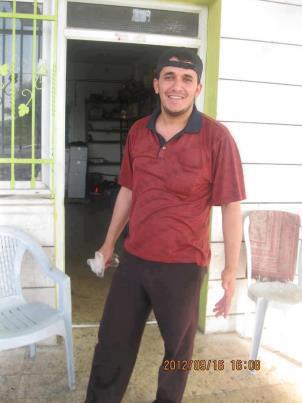
 
 jaradat_arafat   ARAFAT  JADARAT

Arafat Jadarat was born on January 14, 1983, and had just turned 30.  He is from Sa’eer, a village near Hebron. He is married and has two young children, a three year old and a two year old. Arafat and his wife Dalal were expecting their third child in June. Arafat was in his first year at Al Quds Open University.

Arafat was taken from his home on February 18, and was held in interrogation in Jalameh Detention Center, and then was transferred to Megiddo Prison. His brother says the Israelis who came for Arafat told him to "say goodbye " to his children. He was accused of throwing stones.

The family say when he was arrested, he did not suffer from any health conditions or problems. The lawyer from Addameer (Palestinian Human Rights Group) also reported that he did not complain from any pain except slight pain in his back.

Arafat Jadarat, 30, died in Israeli custody on Saturday, allegedly from a cardiac arrest.
Palestinian Authority Minister of Detainees Issa Qaraqe said Jadarat died after being interrogated by Israeli forces and demanded an international investigation into his death, which has caused outrage in the West Bank and Gaza.

Over 4,000 Palestinian prisoners have staged a 24 hour hunger strike on hearing of the young man's death.

There have been marches in protest in Gaza, and Israeli forces in the West Bank clashed with demonstrators in Hebron, Beit Ummar, al-Arrub refugee camp, and Tulkarem, with soldiers firing tear gas and sounds grenades at demonstrators, locals said.

An Israeli army spokeswoman said that "hundreds of Palestinians threw rocks and burned tires in Hebron, and security personnel responded with riot dispersal means."

The Palestinian Ma'an News Agency says more than 202 detainees died or were killed in Israeli prisons since 1967; dozens of detainees also died after they were released due to diseases they encountered in prison or due to complications resulting from extreme torture and bad conditions in prisons.

Ben Zygier, Australian-born, was arrested exactly three years ago, on February 24 2010, according to some reports, and died later that year in a high security cell in Ayalon prison, yet it is only now that we are starting to learn about him, and questions are being asked about why he was there, and what really happened to him.

This is because until recently he was only referred to, if at all, as "Prisoner X". The Israeli news site Ynet posted an article in 2010 saying that a mystery prisoner was being held in total seclusion, in the special cell originally built for Yigal Amir, who assasinated prime minister Yitzhak Rabin, and that not not even the guards knew of the prisoner's identity.

The item was soon taken down by YNet, and Israeli media were warned against touching the story.

Such was speculation that normally well-informed US blogger Richard Silverstein accepted a story from a "confidential Israeli source" that the man Israel had secretly detained was Iranian general Ali-Reza Asgari, allegedly kidnapped by the Mossad. This may have been deliberate disinformation planted to divert attention from the real prisoner's identity, enhance Mossad's prowess, and sow jitters among the Iranians. When spy ops give way to psy ops...
 
Meanwhile the Association for Civil Rights in Israel sent a letter to the Israeli Attorney General  Yehuda Weinstein, protesting the conditions of "Prisoner X"'s detention. The chief legal counsel for the Association, Dan Yakir, wrote: "It is insupportable that, in a democratic country, authorities can arrest people in complete secrecy and disappear them from public view without the public even knowing such an arrest took place." Weinstein's deputy replied that, "The current gag order is vital for preventing a serious breach of the state's security, so we can not elaborate about this affair".

Actually, this was not the first time the Israeli state had held someone a prisoner in secret. The scientist Marcus Klingsberg was an earlier "Prisoner X", detained for years because he had allegedly passed secrets to the Soviet Union. What Klingsberg may have known about was Israeli research on biological warfare.

Before this there was Avri Elad, imprisoned in 1954 after 11 Israeli agents had been captured in Egypt for "Operation Susanna",  a series of bombings of which the Israeli government denied knowledge, leading to the "Lavon Affair", when different ministers and officials blamed each other.
There may have been other cases about which we still don't know.

Exactly what Ben Zygier did or was accused of doing, that led to him, a Mossad agent, being locked up by his own government, we still don't know. It may be just a coincidence that he was arrested three years ago on the same day, February 24, that the police in Dubai revealed that four of the Israeli agents who had entered Dubai to murder Mahmoud al Mabouh, a Hamas official, were travelling on Australian passports.

On March 23, 2010, the British Foreign Secretary expelled an Israeli diplomat after the UK's Serious Organised Crime agency found evidence that Mossad had used fraudulent British passports. On May 24 the Australian government expelled an Israeli diplomat after concluding that there was "no doubt Israel was behind the forgery of four Australian passports" related to the assassination. Similar action was taken by Ireland.  There is no suggestion that Ben Zygier was part of the hit team sent to Dubai, but strong evidence that he wa sinvolved in procuring fake Australian passports.

 In April 2012 Australian journalist Trevor Bormann received a tip about the secret prisoner while on a visit to Israel. His ten month long investigation's findings brought to Australian Broadcasting Corporation(ABC)'s Foreign Correspondent programme this month revealed that Prisoner X was Ben Zygier, who held dual Australian and Israeli citizenship, and had an Australian passport in the name of Ben Allen, though he also used other names, including the more Israeli-sounding Ben Alon.  Like Arafat Adarat he was married with two children.


On December 15, 2010, the former Mossad agent was found hamged in his cell at Ayalon. His body was quietly transported to Australia, for burial at the Chevra Kadisha Jewish Cemeterey in Melbourne.

Ben Zygier was born in Melbourne in 1976. His parents were prominent members of the Jewish community, his father being head of the B'nai Brith Anti-Defamation Commission. Ben joined the left-wing Zionist youth movement Hashomer Hatzair, and in 1994 he "made aliyah" (immigrated to Israel) with a group of fellow Australians and joined Kibbutz Gazit.   

 But according to some reports he had also while a young man, become involved with the "Community Security Group" in Melbourne, which like the Community Security Trust (CST) in Britain recruits volunteers and provides security for the Jewish community, but like CST is said to have Mossad links and be trained by the Israelis. Possibly the trainers also act as talent scouts for the agency. . http://www.spiegel.de/international/world/case-of-israel-agent-ben-zygier-shows-methods-of-israel-s-mossad-a-884141.html

 At any rate, Zygier appears to have joined Mossad after serving in the Israeli army. He was part of a team which set up an electronics business in Milan, supplying equipment to Iran among other countries, and thus having a cover not only for despatching agents but for obtaining intelligence on Iranian requirements and perhaps sabotaging Iranian projects?

 According to a report in the Sydney Morning Herald, Zygier was investigated by the Australian Security Intelligence Organisation (ASIO) for allegedly using his Australian passport to spy for Israel. He was reportedly questioned by ASIO during a visit to Australia. He also reportedly visited Iran, Syria and Lebanon with his Australian passport. In 2009, he briefly returned to Australia to obtain an MBA at Monash University.

The ASIO is one of the intelligence agencies that have collaborated with Mossad in the past, as with the CIA, but it is possible the use of forged Australian passports for an assassination in Dubai was a step too far, considered as damaging to Australia's interests. There are suggestions that the ASIO was able to use information obtained from Ben Zygier to tip off the Dubai police about what had happened, though this tip was plainly provided after the killing had been accomplished.

 If this was the only information which Zygier gave away, his treatment by the Israeli authorities appears severe. His lawyer Avigdor Feldman says Zygier was offered a plea bargain which would have reduced his sentence, but chose instead to have a full trial. Would the state have offered a plea bargain if the prisoner had committed a serious offence like treason? And would Zygier have chosen to go for trial, risking a longer sentence, unless he felt confident that he could prove his innocence, or that whatever he had done had been justified?

What if it was the State, and specifically its security and intelliegence organs, which, having held Zygier for so long in seclusion and secrecy, felt threatened by whatever it was that might come out when he had his say in court?

It can hardly have been about the Dubai killing, or the passports, because that horse had got well and truly away before they shut the stable door.

What if Zygier, the well-brought up young man from a respectable family and Hashomer Hatzair idealist had come upon something really dirty during his work for Mossad, such as to make him think again about what he was doing, and at very least, become The Man Who Knew Too Much?

So. we are asked to believe that after deciding to go for trial, and four days after the birth of his second daughter, whom he would never see, Ben Zygier decided to commit suicide. Although the Association for Civil Rights in Israel never succeeded in getting the case of "Prisoner X" opened to public knowledge, it did get a judge's inquiry into his death.

Explaining how Zygier could have hung himself while under surveillance, the judge finds that Zygier took a sheet into the bathroom, as though to wash it perhaps, then attached it to a bar of the bathroom window and hung himself, out of camera vision. She also notes that trace amounts of a tranquilizer were found in his blood (he would not have been tested until hours after his death, since the security services went into his cell, and would not allow other police and prison staff in until they had finsihed whatever it was they were checking). There were also bruises on his body.

By a coincidence, Mahmoud al-Mabouh was also administered a tranquiliser, before he was smothered with a pillow.

The judge's report, which has been released though the Israeli attorney general would have preferred it filed away from public gaze, says: "Though the deceased was found hanged in the bathroom of the cell, this does not negate the theoretical possibility of active intervention on the part of another person who intentionally caused his death in this way.”

The Australian government, which was apparently informed back in February 2010 that Israel was holding an Australian citizen, has said it will hold a full investigation into Ben Zygier's death. An Israeli newspaper, supporting the government, has chosen to focus  on alleged "Australian antisemitism". Presumably it would rather that other governments show no concern about the fate of their Jewish citizens?  But many Israelis, at home and abroad, and Australian Jews, despite an initial bewildered silence, are demanding the whole truth and posthumous justice for Ben Zygier.     

This might also help win justice for Arafat Jadarat, and for his people.


http://www.spiegel.de/international/world/case-of-israel-agent-ben-zygier-shows-methods-of-israel-s-mossad-a-884141.html

http://www.richardsilverstein.com/2013/02/21/judicial-post-mortem-zygier-tranquilized-before-death-body-bruised/

Marcus Klingsberg - another "Prisoner X"

http://www.nytimes.com/1993/07/23/obituaries/avri-elad-67-figure-in-israeli-spy-scandal.html

Labels: , , , , ,

Tuesday, February 12, 2013

Prisoner Without a Name, Among Prisoners Without Number

AYALON PRISON
SAMER ISSAWI in 'critical ondition'
'PRISONER X'?  BEN ZYGIER found hanged in cell.

ISRAELI aircraft have made flights over Gaza and forces been alerted in preparation for hostile action if a Palestinian prisoner on hunger strike in an Israeli prison should die.
Samer Issawi was reported yesterday to be in a critical condition after 195 days on hunger strike.
Fadi Abedat, a lawyer for the Palestinian Authority's Ministry of Prisoner Affairs, visited Issawi at Ramle prison clinic.

Issawi has severe leg, kidney, head and chest pains and a slow pulse. He is unable to move or sleep, the ministry said in a statement.The Israeli Prison Service has isolated hunger strikers from each other and guards frequently raid their cells, Issawi told the lawyer.

Palestinian Prisoner Society lawyer Jawad Boulos, who also visited Issawi, said the detainee's weight had dropped to 46 kg and he was struggling to speak.

Issawi is being held under administrative detention, a practice which the Israeli state inherited from the  British Mandate's Emergency Powers and uses to detain Palestinians without bringing any criminal charges against them and without a trial.

Issawi has thanked all who support him in his fight and said he would not quit his strike until Israel met his demands.

The prisoner was released in the October  2011 prisoner exchange agreement between Israel and Hamas, which secured the release of Israeli soldier Gilad Shalit from Gaza. But he was rearrested on July 7 and accused of violating the terms of his release by leaving Jerusalem. Israeli prosecutors are seeking to cancel his amnesty and detain him for 20 years, the remainder of his previous sentence. Another prisoner died on January 21, shortly after being released from prison, and Palestinians blamed ill-treatment and denial of medical attention. Speaking after the death in hospital of former prisoner Ashraf Abu Thurai, who had been held for six years and suffered muscular dystrophy making him unable to walk, Dr. Atallah Abu Al-Sabah, Minister for Prisoner Affairs urged the International Red Cross and other bodies to cooperate in an investigation of the treatment of prisoners.

Abu Thurai had contracted a virus which entered his lungs and caused him to enter a coma.

According to several sources, nearly 1,200 out of the 4,600 Palestinian prisoners in Israeli jails suffer from various illnesses and are victims of medical negligence. They include 20 prisoners permanently residing in the so-called Al-Ramla Hospital, 18 prisoners suffering from dangerous and malignant diseases such as heart disease, cancer, kidney failure, and 85 disabled prisoners who suffer from mobility, mental, and sensory disabilities.
.
Palestinian prisoners held by Israel include elected representatives and children, Today their numbers were increased by another 17 detained in the West Bank, among them Raafat Nasif, a prominent Hamas leader released from an Israeli jail just two months ago. Nasif has spent a total of 12 years in Israeli prisons.

Witnesses said that more than 25 military vehicles swept into Tulkarem to arrest Nasif. They used explosives to blow down the door of his home and sent in dogs to search it. Others arrested in Tulkarem were Ammar Badawi, Mosab al-Ashqar, Abdullah al-Khalil and Ammar Omeer. The first three are members of the Islamic Bloc, the student wing of Hamas.

In Nablus the Israeli occupation forces detained Mothana Ishtea, Osama Yamen and Waleed Aseeda, also members of the Islamic Bloc, along with Mosa Yamen. Further south, in the Hebron neighbourhood of Beit-Amer, local sources said that the Israelis broke into Tariq Maria’s house and searched it, damaging personal property in the process, before arresting the 19 year old.
Other men arrested in this latest stage of the campaign against Hamas activists were Mohamed Hijazi, 19, and Monjed abu-Akar, 23, both from Aida refugee camp near Bethlehem; and Rajab Moteer, his brother Mohamed, former prisoner Mo’az Moteer and his cousin Motasem from Kalandia refugee camp north of Jerusalem.

Hamas has accused the Israelis of trying to sabotage the Palestinian reconciliation process by these arrests. A spokesman for the Israeli Army told MEMO, however, that the arrests are "routine" in the "fight against Palestinian terrorists".

While "the only democracy in the Middle East" was carrying on with such "routine" measures in the occupied territories, some international attention turned to another prisoner's death, so mysterious that his identity had not been known even to his guards. "Prisoner X" was found hanged in a high-security cell in a prisoner near Tel Aviv, late in 2010.

There were various rumours, even tales that he was an Iranian general. Officially, the Israeli authorities did not even admit the prisoner existed. As for what he did, or was alleged to have done, to cause his incarceration, this remains a mystery.
 
Now an Australian Broadcasting Corporation (ABC) programme,  Foreign Correspondent, says its investigations have revealed that "Prisoner X" was Ben Zygier, an Australian Jew, who used the name Ben Alon in Israel. His body was flown back to Australia for burial..

Watch the full Foreign Correspondent report on Prisoner X on iview.
The cell where he died, at Ayalon Prison in the city of Ramla, was a special secure unit originally built for Yigal Amir, the assassin of  prime minister Yitzhak Rabin.

The ABC programme says Zygier became its occupant in early 2010. His incarceration was so secret that it is claimed not even guards knew his identity. Israeli media at the time reported that this Prisoner X received no visitors and lived hermetically sealed from the outside world.

When an Israeli news website reported that the prisoner died in his cell in December 2010, Israeli authorities removed its web pages.

An Israeli court order prohibiting any publication or public discussion of the matter is still in force; Israel's internal security service, Shin Bet, has effectively blocked any coverage of the matter.

Foreign Correspondent says Zygier was 34 at the time of his death and had moved to Israel about 10 years earlier. He was married to an Israeli woman and had two small children.According to the programme he was recruited as an agent for Mossad.

He "disappeared" in early 2010, spending several months in the Prisoner X cell. The Association for Civil Rights in Israel criticised the imprisonment and wrote to Israel's attorney-general.
"It's alarming that there's a prisoner being held incommunicado and we know nothing about him," wrote the association's chief legal counsel Dan Yakir.

The assistant to the attorney-general wrote back: "The current gag order is vital for preventing a serious breach of the state's security, so we cannot elaborate about this affair."


Zygier's apparent suicide in prison adds to the mystery. He was found hanged in a cell with state-of-the-art surveillance systems that are installed to prevent suicide. Guards reportedly tried unsuccessfully to revive him.

His body was retrieved and flown to Melbourne. He was buried in Chevra Kadisha Jewish cemetery in the suburb of Springvale on December 22, seven days after his death. His family has declined to speak to the ABC, and friends and acquaintances approached by Foreign Correspondent in Melbourne have also refused to comment.He was reported to be the son of Geoffrey Zygier, the executive director of the Victoria Jewish Community Council and one of the leaders of the Melbourne Jewish Community.

Despite gagging orders on the Israeli media,Knesset members raised the issue today. Arab Knesset member Ahmed Tibi and Zehava Galon from Meretz both criticised the silence, and demanded the issue be opened, while Dov Kheinin of the Communist-led Hadash wanted to know why the Justice Minister said it was outside his jurisdiction, and wondered how many more "disappeared" prisones were being held in Israel.
SAMER ISSAWI'S sister and father with his portrait.  Ben Zygier's parents would not speak to media.
   
http://www.news.com.au/world/israels-prisoner-x-an-australian-report/story-fndir2ev-1226576643901
http://www.richardsilverstein.com/2010/06/13/the-strange-case-of-israels-mr-x/

http://www.richardsilverstein.com/2013/02/12/fallout-from-zygier-case/

http://www.haaretz.com/news/diplomacy-defense/justice-minister-reports-that-australian-committed-suicide-in-israeli-prison-must-be-checked.premium-1.503124

http://www.middleeastmonitor.com/news/middle-east/5217-israeli-detention-campaign-against-hamas-activists-continues

http://www.maannews.net/eng/ViewDetails.aspx?ID=564459 

http://www.mintpress.net/palestinian-prisoner-samer-issawi-in-critical-condition-interview-with-sister/ 

http://www.middleeastmonitor.com/news/middle-east/5076-death-of-former-prisoner-highlights-medical-negligence-in-israeli-prisons

http://electronicintifada.net/content/i-was-determined-live-dignity-says-freed-hunger-striker-akram-rikhawi/12186

http://electronicintifada.net/blogs/adri-nieuwhof/half-israels-palestinian-child-prisoners-are-held-illegally-outside-west-bank

Labels: , , ,

Monday, June 18, 2012

Footballer wins freedom pledge

https://fbcdn-sphotos-a.akamaihd.net/hphotos-ak-snc6/s480x480/168533_10151020019626291_1141512779_n.jpg

Hearing the good news in RAFEAH, Mahmoud's older brother Imad.


Demonstration in ROME at headquarters of Italian Football Federation, and below, schoolgirls in RAMALLAH with pictures of Mahmoud al Sarsak


PALESTINIAN footballer Mahmoud al Sarsak has ended a record-breaking 93 days on hunger strike in an Israel jail after winning an agreement that he will be released on Tuesday, July 10.

His lawyer Mohammad Jaberein said al-Sarsak agreed to end the fast during his visit today. Israeli prison authorities asked al-Sarsak to eat something in their presence to ratify the deal, after which he took a piece of chocolate from the lawyer, Jaberein said.

The footballer, from Rafeah in the southern Gaza strip, had been held for three years,without charge or trial, when he commenced his hunger strike.

Under the deal al-Sarsak will visit a civilian hospital for treatment tomorrow, but the same day will return to Ramle prison clinic until his release on July 10, the lawyer added.

Physicians for Human Rights - Israel say the clinic is not equipped to treat long-term hunger strikers or manage the health risks when they return to eating, and has called for transfer of hunger strikers to civilian facilities.

The 25-year-old soccer player from the Gaza Strip has been imprisoned by Israel without charge or trial since July 2009. He is the the only prisoner held so far under Israel's Unlawful Combattants Law which allows detention without trial for an unlimited period.

Al-Sarsak joined the local soccer team in his Rafah refugee camp at 14, becoming the youngest footballer to play in the Palestine Liga A at the time. The midfielder attracted the attention of a German coach while playing for the Palestine national team in Norway.

The first step was to play for a team in the West Bank. But Israeli security arrested him on July 22, 2009, at the Erez crossing from the blockaded Gaza Strip, the only route to Palestinian territory in the occupied West Bank.

His hunger strike attracted attention and support for his cause not only in Palestine and among campaigners in Israel, but internationally. Demonstrations and petitions in Europe brought in
Eric Cantona and FIFA President Sepp Blatter to add their voices to those calling for Mahmoud al Sarsak's release, and the International Federation of Professional Footballers. An Israeli conscientious objector in military prison has joined the Palestinian hunger strike in solidarity.

It was reported that Eric Cantona called upon the UEFA to cancel plans for Israel host the 2013 European Under-21 Football Championship due to its violation of human rights, and especially due to the ongoing imprisonment of Mahmoud al Sarsak. “It is time to end the injustice, and insist upon standards of equality, justice and respect of international law – like we demand from any other country,” said Cantona.

In Israel, Yaniv Mazor - sentenced to 20 days in prison for refusing to do his reserve service - started a hunger strike of his own while in military prison, in solidarity with Palestinian detainees. Mazor’s attorney Michael Sfard told Haaretz journalist Amira Hass that Mazor’s goal is to raise awareness on the issue of administrative detention – and not to secure his own release.

http://www.foa.org.uk/statements/cantona-and-kanout-call-for-release-of-mahmoud-sarsak

Labels: , , ,

Monday, May 14, 2012

Round One to Steadfastness and Unity


OUTSIDE Ramle prison, May 3, for those INSIDE
(Mahfouz Abu Turk / APA images)


PALESTINIAN detainees held in Israeli prisons have agreed to end a month long mass hunger strike held to draw world attention to their plight and demand just treatment from Israel. In what appears to be a victory for the prisoners' steadfastness and unity, they have obtained significant concessions in negotiations which the Israeli authorities were not keen to hold.

Prisoner representatives from each of the political factions agreed to the deal in Ashkelon jail, prisoners society chief Qaddura Fares said in a statement. Israel's internal security service Shin Bet confirmed the deal, the Israeli news site Ynet reported.

Many Palestinians are detained without charges or trial, under laws Israel inherited from the British colonial mandate. The hunger strike brought world attention to this, and brought prisoners relatives and thousands of sympathisers out to demonstrate in support. This unity across the spectrum also succeeded where the Palestinian Authority had not in forcing Israeli auhorities to negotiate with those to whom they said they would not talk.

Senior Hamas official Saleh Arouri, who was a member of the negotiations team, said Israel agreed to provide a list of accusations to administrative detainees, or release them at the end of their term. In comments to the Hamas-affiliated new site Palestine Information Center, he said that under the Egypt-brokered deal Israel agreed to release all detainees from solitary confinement over the next 72 hours.

Israel will also lift a ban on family visits for detainees from the Gaza Strip, and revoke the "Shalit law," according to the official. (The "Shalit law" restricted prisoners' access to families and to educational materials as a collective punishment for the five-year captivity of Israeli soldier Gilad Shalit in the Gaza Strip. Shalit was freed in October in a prisoner swap agreement).
http://www.maannews.net/eng/ViewDetails.aspx?ID=485770


Around 2,000 prisoners joined the mass hunger strike launched on April 17, demanding improved prison conditions, as well as fairer treatment. There was concern at first that not enough people were demonstrating outside the prisons, and that the Israeli authorities might remain hard-faced and ruthless in their willingness to see a human tragedy. Israeli government spokesman Mark Regev said on TV that there was nothing to be done if people were prepared to "commit suicide in the name of Islam".

In fact, as he well knew, this was not about Islam, and the demonstrations which did grow in sympathy with the prisoners drew support from all sections, including secular groups and Christians.

There was concern particularly for the lives of two prisoners who had gone on hunger strike ahead of the mass protest and by last week had gone without food for 77 days.

“At this stage of a hunger strike, death can happen abruptly. Something can happen to the heart and this is the fear now,” said Hadas Ziv, public outreach coordinator at Physicians for Human Rights-Israel (PHR-I). “If the political authorities will decide not to do anything and not to release them on grounds of medical condition,” she added, “eventually death may occur, if nothing happens in the really, really near future.”

On 7 May, the Israeli high court rejected an appeal by Bilal Diab and Thaer Halahleh, Palestinian prisoners on day 77 of their hunger strike. The two men were challenging the fact that they are being held under Israeli administrative detention orders without charge or trial. With no intervention by Israel’s highest court, Diab and Halahleh’s conditions were only worsening by the day, Ziv said.

Ziv said that the Israeli Prison Service has placed every possible obstacle in the way of PHR-I doctors who are trying to examine the hunger strikers. The organization had been forced to appeal to Israeli courts in order to gain access to the prisoners. The PHR spokeswoman said the authorities were acting on the wrong perception that if Israel isolates the prisoners it could win the struggle and it can break the hunger strike. “I think that this is such a short-sighted and horrendous policy and I think that if independent doctors, lawyers and family visits would have been enabled, one would have seen a resolution that could have saved lives.”

It is estimated that Israel has arrested and detained over 750,000 Palestinians since it began occupying the Gaza Strip and the West Bank including East Jerusalem in 1967.


It is not clear whether Diab and Halahla have accepted the prisoners' agreement, which includes their release at the end of their detention term. Their lawyer says both refused to stop their strike unless they were immediately released. A prisoners society lawyer Jawad Bulous is heading to the prison hospitals to discuss the deal with hunger-strikers.

PLO official Hanan Ashrawi applauded the deal and said it proved the power of non-violent resistance. "The Palestinian prisoners in facing the Israeli Prison Authority is a victory not only for them and their families, but also for the millions of Palestinians living in the occupied Palestinian territory and in exile," Ashrawi said in a statement. "The hunger strikers' courage is magnificently inspiring, and their selflessness deeply humbling," the official added.

She also thanked Egyptian mediators, the international community "and people of conscience worldwide" for supporting the strikers.

The prisoners' readiness to suffer and risk their lives has brought more world media attention to Palestinian peaceful protest than they are used to, perhaps because of its scale. What must be worrying the Israeli government now, as it heartens Palestinians and those Israelis who wish to see peace with justice, is that the steadfastness and unity shown in the prisoners' fight is an indication of the popular struggle coming in the "third Intifada". This may prove to be its opening round.

Labels: , ,

Saturday, April 17, 2010

Shackled in Iran: trade unionist, journalist and film maker need our support


http://rushprint.no/blog/wp-content/uploads/Panahi-i-Berlin.jpg

JAFAR PANAHI

FIRST arrested five years ago for leading Tehran bus workers' fight for decent pay and conditions, Mansour Osanloo was released after an international campaign, and allowed to leave for an international transport workers' conference. But after he returned, as soon as it judged the fuss had died down, the Iranian regime had him arrested again.

Clinging to office after disputed elections, and hugging the spotlight by appearing to defy Washington with his nuclear policy and backing for Middle East militancy, President Ahmadinejad has simultaneously kept to the guidance of Supreme Leader Ayatollah Khamanei, in his policy of suppressing workers' rights and independent organisation, privatising the economy, and keeping down pay and welfare costs to please the IMF.

Mansoor Osanloo remains in jail, despite reportedly suffering multiple illnesses, including eye and heart conditions, back trouble requiring surgery, and skin trouble. So on Tuesday, April 13, when the Tehran bus drivers' leader had to be taken before the coroner’s medical commission, the prison officers were not taking any chances. They made him wear handcuffs and shackles. These were tightened during the trip to hospital, so that Osanloo arrived with his ankles bleeding.

The medical examination had been requested by doctors concerned whether Mansoor is really fit to serve his prison sentence. Three times now the coroner has declared him medically unfit. The recommendation has been communicated to the Revolutionary Court, the Enforcements unit, as well as Rajai-Shah prison officials. The law requires that prisoners who are declared medically unfit to serve prison sentences be released to undergo treatment in medical facilities outside prison.

Not only has this trade unionist been denied medical treatment, but he has also been subjected to long periods in solitary confinement. Then at the beginning of March after coming out of solitary he was attacked by a fellow-prisoner armed with a knife. The assailant turned out to be a former Revolutionary Guard in jail for murdering his wife.

Osanloo is currently detained in Ward 5, known as the addicts’ ward, where most inmates are addicts and many suffer from contagious diseases such as HIV or hepatitis.

During their dispute five years ago the Tehran bus workers just refused to collect fares. In continuing to hold this workers' leader as a supposed "threat to the security of the state" are the Iranian authorities hoping he will die in jail, or do they simply figure that his incarceration and ill-treatment will serve as a deterrent to other workers from daring to organise?

Jailing the messenger

Osanloo was originally sentenced to five years, but an Iranian journalist who reported on workers' struggles has reportedly received a sentence more than twice that for communicating with international media. The mother of Iranian journalist and human rights activist Abolfazl Abedini says he has been sentenced to 11 years in jail.

Abedini, aged 28, had been detained several times by security forces in the last five years. He was arrested on March 3 in the southwestern city of Ahvaz after his home was raided. His family said he was beaten by members of Iran's Revolutionary Guards Corps as he was taken away. His family learned later that he had been found guilty of "spreading propaganda against the regime through interviews with foreign media."

Eyvazi said she recently wrote an open letter to judiciary chief Sadeq Larijani demanding justice for her son, but had received no reply. "What crime has my son committed that he deserves to be tortured?" Eyvazi wrote in her letter to Larijani. "Is it a crime to defend the rights of workers at the Haft Tapeh Sugarcane Factory, Tehran bus company workers, or the Iranian Teachers Syndicate?"

...and the film maker

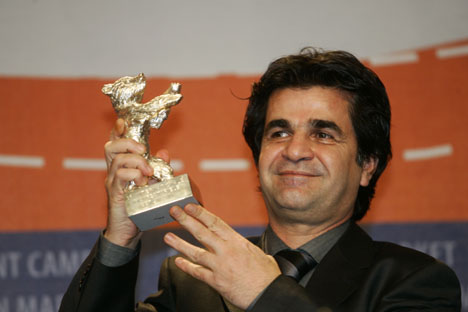
Meanwhile, there is no news about another communicator, and a celebrated one, arrested over a month ago, film maker Jafar Panahi. His films include The Circle (winner of the Golden Lion prize at the Vienna film festival in 2000) and Offside (2006), about young women detained when they tried to get in to watch the World Cup qualifying soccer match between Iran and Bahrain. Panahi has still not been charged with any crime. Twice offered bail, he has refused out of solidarity with all those incarcerated for taking part in the mass demonstrations against the regime that shook Iran since June 2009.


His detention is just the latest harassment Jafar Panahi has suffered from the clerics' regime. He has been unable to travel abroad since wearing a green scarf – the colour adopted by the democratic opposition movement – at the Montreal Film Festival in 2009. He was also arrested briefly after attending the memorial service for student Neda Agha Soltan, who was murdered by regime forces during a demonstration. Earlier the ministry of culture and Islamic guidance had announced he would not be allowed to make another film until he ‘re-edited’ earlier films, and he was unable to work for a year.

There is a clear theme of social criticism in his work. In a 2007 interview with the LA Times, Panahi described himself as “a socially committed filmmaker” who operates in the context of a brutally oppressive society: “My movies are about limitations and restrictions, and these are restrictions that I’ve personally experienced.” However, those are minor relative to “the greater restrictions that Iranian women are suffering”, he said.

The prison authorities are piling on the pressure. His wife, Tahereh Saeedi, was only allowed to meet him on March 31 – almost a month after his arrest. She reports that his interrogators continually cover the same ground: “They keep asking him the same questions in order to find contradictions in his comments,” Saeedi revealed in a radio interview.

Hands Off the People of Iran (HOPI), the solidarity movement set up by left-wing Iranian refugees and their supporters in Britain to oppose both the Islamicist regime and the threat of imperialist war, is putting Jafar Panahi's release at the centre of its campaign for the freedom of political prisoners in Iran. Moshé Machover, a member of the HOPI steering committee, says: “Jafar Panahi has taken a brave stance. He stands shoulder to shoulder with those brave participants in the mass movement of opposition to the theocratic regime that have been arrested. Now we must stand shoulder to shoulder with him.”

Machover continued: “Our most effective act of solidarity with the inspiring movement for radical change that has filled Iran’s streets is to ensure that imperialism does not launch another disastrous military adventure in the Middle East, this time against an Iran which is pregnant with radical, genuinely democratic change from below”.

Left-wing Labour MP John McDonnell, a supporter of HOPI, said: “The world must make its voice heard in demanding that Jafar Panahi is released without charge along with all those incarcerated for nothing more than demanding basic civil liberties and democratic rights. These violations of basic human rights must not be allowed to go unnoticed and without protest.”

HOPI is urging people to:

* Send emails, faxes and letters of protest to the embassy of the Islamic Republic of Iran, 16 Prince’s Gate, London SW7 1PT; info@iran-embassy.org.uk; 020 7589 4440. Don’t forget to send us a copy.

* Sign our statement ‘Freedeom for Jafar Panahi and all political prisoners’: http://hopoi.org/?p=1163

* Put on showings of Panahi’s films: The wounded head (1988), Kish (1991), The last exam (1992), The circle (2000), Crimson gold (2003) and above all Offside (2006). We have been given official permission to show his films, so we can help you to get hold get a copy of the film and DVDs to sell. We can also provide a speaker to introduce the film

* Order Hopi’s ‘Free Panahi’ postcards. Get people to sign the cards and return them to us asap – we will forward them to his family in Iran to show our solidarity. We ask for a donation of £5 or more for 30 cards to cover postage and printing costs.

* Order the A4 bulletin we have produced to highlight Panahi’s case (as well as the ongoing threat of a military attack and increased sanctions). We ask for a donation of £5 or more for 30 bulletins to cover postage and printing costs

*Get your trade union branch/organisation to sponsor this important campaign.

* Financially support the campaign: please use the Paypal button on our home page www.hopoi.org or send cheque/s to Hopi, PO Box 54631, London N16 8YE

I hear HOPI is planning to show one of Jafar Panahi's films in London next month, and hoping for some celebrity guests. Any profit from the showing will go to help political prisoners and the workers' movement in Iran. I will keep readers posted.

Labels: , , ,

Wednesday, January 13, 2010

How the good tailor became a statistic

BOUBACAR BAH was a tailor from Guinea, who came to the United States hoping for a better life, following in the steps of a seafaring relative who had arrived in New York in World War II.

With his skills, Boubacar obtained work sewing dresses for a posh clothes store called L'Impasse. He shared an apartment with other immigrants, in Flatbush, Brooklyn. People liked him. On Sundays he would go and visit cousins who had a house in the Bronx. He was able to send money home to his ailing mother and other family members back in Guinea.

After living and working in America for eight years, Boubacar thought he would go back to Guinea for a holiday, and see the folks he had left behind. It was when he returned from this three months trip, in May 2006, that he ran into trouble with the immigration officers at Kennedy Airport. They told him his green card application had been rejected while he was away, and that he no longer had permission to re-enter the United States.

While an immigration officer hired by his friends tried to re-open the application, Boubacar Bah spent nine months in detention. Then one morning in the Elizabeth Detention Center in New Jersey, at about 8am, according to the records, Mr.Bah fell near a toilet, hitting the back of his head on the floor.

He was taken to the facility's medical service, where he became incoherent and agitated, textbook signs of an intracranial injury. He was handcuffed and shackled, and he began yelling in his native language. He was ordered to calm down, and when he did not, was written up for disobeying orders and was taken into solitary confinement in shackles. As this was taking place, Mr. Bah uttered his last known words in his native tongue: "Help! They are killing me!"

Shortly after this, the video record ends (guards claimed the camera's battery failed). Mr. Bah was taken to an isolation cell and locked in at 9 AM. According to the guards, he appeared to be sleeping for the next ten hours, but at 7:10 PM, he appeared to be breathing heavily and foaming at the mouth. The nurse on duty at that time refused to come see Mr. Bah. More than fourteen hours after the initial incident, while on rounds, an ICE nurse found Bah unconscious with vomit around his mouth. The nurse attempted to revive Bah with smelling salts and failed, and brought Bah back to the medical unit on a stretcher. At 11 PM, someone at the ICE detention facility called 911.

When Mr. Bah arrived at the hospital, it was quickly determined that he had a fractured skull and hemorrhages at all sides of his swelling brain, and he was rushed into surgery. Back at the ICE center, the coverup began.

The following day, the ICE center at Elizabeth reported the cause of Mr. Bah's injury as "brain aneurysms" - corrected a week later to "hemorrhages" with no mention of the skull fracture or fall. Meanwhile, Mr. Bah's friends and family were ignorant that Bah had been injured for four days after the incident, only learning of it when another inmate at the facility called Mr. Bah's roommate to inform him.

It was another day before the facility disclosed Bah's location to the family, where a guard told them: "This guy, you have to fight for him. This guy was neglected."

Alerted by a lawyer, a New York Times reporter began making inquiries.

Michael Gilhooly, a spokesman for Immigration and Customs Enforcement, told the Times that without the inmate's full name and eight digit Alien Registration Number, he could not check the information. But according to records obtained now by the American Civil Liberties Union and the Times, Gilhooly instead notified his superiors at the agency about the reporter's inquiry, and Gilhooly and other managers in Washington and New Jersey conferred repeatedly on how to conceal the circumstances of Mr. Bah's injuries, as well as how to avoid having the agency responsible for paying for Mr. Bah's continued care. Among the conspirators was Capt. Nina Dozoretz, CEO of Correctcare Consultants LLC and formerly the Division of Immigration Health Service’s Associate Director, which put her in charge of the over 20,000 inmates in ICE custody.

They considered sending the dying man back to Guinea to avoid responsibilities. Then they decided to release him to his relatives on "humanitarian", compassionate grounds. Boubacar Bah died in a coma on May 30, 2007, a few days before he was due to be sent home.

Boubacar Bah was just a tailor. Just an immigrant. Just another statistic.

The New York Times says its investigations over two years have uncovered wholesale cover-ups by officials. "Documents, obtained over recent months by The Times and the American Civil Liberties Union under the Freedom of Information Act, concern most of the 107 deaths in detention counted by Immigration and Customs Enforcement since October 2003, after the agency was created within the Department of Homeland Security.

http://www.dailykos.com/storyonly/2010/1/9/14544/56481

http://www.nytimes.com/2010/01/10/us/10detain.html

They do say that if you want to know the truth about any society you must go into its prisons.


Thanks to Sue Pashkoff for drawing my attention to the Daily Kos blog with Boubacar Bah's story

Labels: , ,

Sunday, March 25, 2007

Kidnapped in Kenya

AFRICAN EXPRESS AIRWAYS
passenger manifest for flight FY-AXF,
from Nairobi-Mogadishu, one of several
such documents obtained by Reprieve

MORE than 60 people, including at least four women and six children, have been taken from Kenya and are thought to be held in secret locations in Ethiopia and Somalia. The captives include UK, US, French and Canadian nationals. But, unlike the British embassy staff who went missing in Ethiopia's Afar region earlier this month, they have not been the focus of nightly news coverage on TV, nor have we have heard of "round-the-clock" diplomatic efforts to free them.

The five Brits taken then were released after 12 days "in good health", and said they had been well treated by their captors. There are fears the 63 people taken from Kenya may not be so fortunate.

Two rights charities, Reprieve and Cageprisoners, say they are deeply concerned for the fate of the prisoners, "believed to be held in secret detention in Somalia and Ethiopia, apparent victims of a mass rendition operation from Kenya involving nationals of at least 16 states: Canada, Comoros, Ethiopia, Eritrea, France, Kenya, Oman, Rwanda, Saudi Arabia, Somalia, Sweden, Tunisia, United Arab Emirates, United Kingdom, United States, and Yemen. Among the 63 are least four women and six children. The 63 prisoners were apparently transferred with no observance of any judicial process, and are at serious risk of torture".
Many of those taken were seized in joint US, Kenyan and Ethiopian operations on the Kenyan/Somali border in December 2006 and January 2007. They were initially transferred to detention facilities in Kenya where they were held without charge for up to three weeks. Then according to flight manifests obtained by Reprive and Cageprisoners the 63 were taken from Kenya to Somalia, and some were then moved to Ethiopia.
A British citizen transferred to Somalia in the early hours of Saturday, February 10 described the journey:

"We were woken up late in the night on Friday and told to pack our bags. We just had a few things like toothbrush, socks, t-shirt. From there we were put in the back of a mini-van and driven to an airport. Before the gates were checkpoints with Kenyan soldiers. It looked like a military place but I saw BA and Emirates airplanes there too. We remained in the vehicle. Many other cars were coming.
"Most of the officers were not in uniform. One of the men there was the one who had interrogated me in the first police station. They called him the Major. He popped his head in when I was speaking to a police-man who was bald with a prostration mark. We remained there for a while. More vehicles and police vans kept coming - around 10 vehicles in total. We could see that people were being held in the back of the vans but it was very dark so we could not see how many.
"This was when the bald Kenyan with the prostration mark was talking to us about pre-destination. It sounded as though he was trying to prepare us for something. Francis [the Kenyan anti-terrorist officer] was there as well.
Francis came to our vehicle and he had a bit of paper in his hand. I saw on the bit of paper it had a column with names. I saw my name, and the names of the other British citizens. The next column said "nationality" and opposite our names were 'British'. At the top of the next column it said 'ticket date-booked'. In the next column Francis put a tick. Then he moved onto the next vehicle.
"'Prostration Mark' came to our vehicle. He said to us: whatever happens to you just understand why this is taking place. Other vehicles started driving towards a small jet. Not like a passenger airplane. There were big metal cargo containers with UN written on them next to the jets. Everyone was handcuffed and blindfolded and put on the jet by Kenyans. Our hands were behind us and it was too uncomfortable to lean back.
There were thirteen prisoners on the flight. There were also Kenyan intelligence officers on the plane, but Francis was not one of them. We flew for the whole night and landed in the morning, in daylight, on a runway. I was taken off the jet still blindfolded. I could hear the other prisoners being taken off the jet at the same time, and I could see a little through my blindfold. When I was off the plane I could hear loud Somali voices. I did not hear any Swahili voices. These two facts made me believe I was in Somalia. I was put in the back of a truck with the other 12 people who had been on my plane. I could see the uniform of the officers escorting us through my blindfold. I knew they were Somali not Kenyans as they were wearing Somali army clothes and blue army hats. All I could hear was Somali being spoken".
Kamilya Tuweil, a United Arab Emirates citizen and Arabic/Swahili translator whose case is cited by Reprieve had travelled to Kenya on with an African business associate, Milly Mithouni Gako, and two Omanis. They were staying at the Eden Lodge Hotel in Mombasa where they were arrested by Kenya anti-terrorist police on 10 January - allegedly after refusing to pay a $5,000 bribe. The four of them were taken to police stations, then released within a month -except for Kamilya. On 27 January Kamilya phoned Millie at 3 am to say "They have come for me".
Millie did not hear from her again. But Kamilya's name appears on a flight manifest dated 27 January for African Express Airways flight 5Y-AXF from Kenya to Somalia (depicted above). Back in Dubai, her children wait for more news, or better still, their mother to return.
Meanwhile, Reprieve says that the names on the manifests they have seen include nine women and five children.
Reprieve and Cageprisoners are demanding that the Kenyan and Ethiopian governments and the Transitional government of Somalia make full public disclosure of what prisoners are being held, and where, and allow access for international humanitarian organisations, diplomats and lawyers.
They are also calling on those governments whose nationals have been taken prisoner to make effective representations for their release and return home.
At least one of these governments probably knows more than anyone else about what is going on. A 24-year old US citizen, Amir Mohammed Meshal, now held in Ethiopia, was able to tell Kenyan human rights activists while held at Kileleshwa police station in Nairobi that his interrogators included American FBI agents. A British citizen who was held at Kileleshwa also reported that FBI men were working with Kenyan officers and had threatened a prisoner with torture if he did not give them the information they wanted.
Bush's "war on terror" has extended its tentacles to the north-east corner of Africa, bringing with it American "freedom" - that is, freedom for American agents and their stooges to do what they want with anyone they don't like the look of.
For the full story about this frightening affair visit:


Labels: ,

Monday, December 18, 2006

The Mysterious Mr.Mughrabi


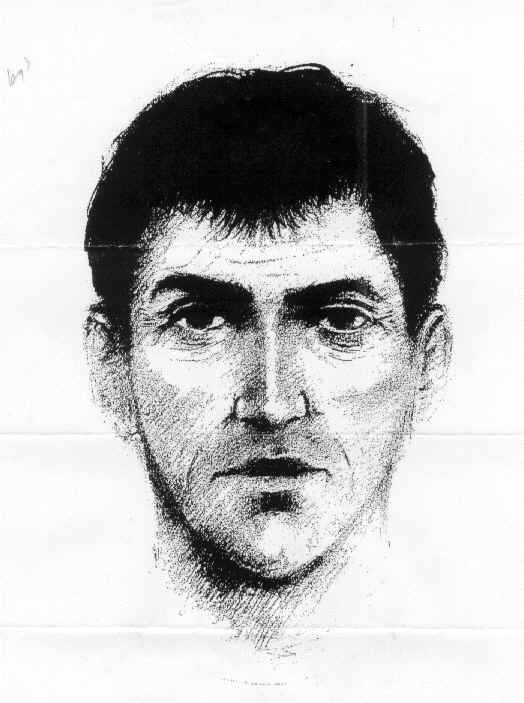
THIS is the mystery figure involved in the 1994 London bombings, for which two Palestinians, both claiming innocence, are half-way through a 20 year sentence. The portraits are of
RIDA MUGHRABI, as described separately by Jawad Botmeh(version on left) and Samar Alami (version on right). Close enough to be the same man. But police were not interested.

SAMAR Alami met Rida Mughrabi in the spring of 1992, at a lecture in London on the Middle East. He also attended various political discussions and poetry readings at the Arab Club in London.

Apparently Mughrabi was from the West Bank. He had been detained by the Israelis in the late 1970s, had taught at a refugee camp in Jordan and had been involved in fighting Israeli forces in occupied southern Lebanon during the 1982 war. Samar, and then Jawad, were impressed by his seeming experience and knowledge of resistance.

Samar and Jawed had mixed feelings about the "peace process" which the 1993 Oslo Accords were supposed to open up, promising Palestinian "self-government". Samar had hopes of using her studies on Water Resources, a vital issue in the region. Jawed started a business to send high-tech products for development in the West Bank. But fearing to place too much hope in the Oslo deal, they had also secretly experimented amateurishly with home-made explosive devices, and use of radio-controlled model planes, seeking a modern equivalent of David's slingshot which Palestinian villagers might be able to use against the heavily-armed Israeli Goliath.

They wanted to keep this their secret. But in 1993 Mughrabi began discussing methods of resistance open to Palestinians inside the Occupied Territories. He knew a lot about electric and electronic aspects of military surveillance. He seemed to have direct experience in the field during the Israeli invasion and occupation of Lebanon. Indeed, Mughrabi told Samar that he had been doing some experimenting of his own and what he was giving her was the product. She thought that he had actually been performing his experiments for the same reasons as she and Jawad had e.g. directed at what could be done inside the Occupied Territories. (The Popular Front for the Liberation of Palestine, with which Samar and Jawad sympathised, had decided decades before to carry out no more operations in overseas countries).

Later, piecing together what he told them, it seemed Mughrabi had left Lebanon in the early 1980s after falling out with the PLO and with Arafat's opponents, and then came to Britain via Cyprus. In the mid-1980s he moved to Saudi Arabia, then Kuwait, but when Iraq invaded he returned to Britain and went to live in Birmingham.

Jawad Botmeh had a hobby. He had started buying and selling cars while still an engineering student. Friends and acquaintances often sought his advice. So he was not surprised when Rida Mughrabi contacted him on June 14, asking Jawad to come with him to a car auction. They had been on such trips before. They drove up to Northampton together later that day, but did not find anything worth buying for the £1,000 that Mughrabi had to spend.

The following day they went to an auction in Milton Keynes, and this was where Mughrabi bought an Audi. This was to be the car used in the Israeli embassy bombing, though by then it was equipped with fake number plates. The car used in the Balfour House bombing was a Triumph Acclaim, also with false plates, but traced back to an auction in Birmingham on June 13, where it was bought by a man calling himself "George Davis".

Jawad Botmen had not been at the Birmingham auction, nor had Rida Mughrabi said anything to him about having bought another car. But when police started enquiring about those car auctions they became interested in a distinctive old white BMW seen at the auction in Milton Keynes. Trawling though the owners of old white BMWs they came up with Jawad Botmeh. In fact while driving up to Northampton with Mughrabi on June 14, Jawad had overtaken a police car, and was stopped on the M1 for speeding, having to show his licence. Evidently he was not being as careful to avoid attention as someone might have been who knew the significance of what seemed a casual car-shopping trip.

The fingerprints and handwriting on the purchase documents of both cars, and the descriptions of the purchasers as given by witnesses, match none of the defendants. There is no trace of the people who bought the cars and neither is it known where they were stored and made into car bombs.

But Jawad had been at the wrong place with the wrong person. He was put under sustained police surveillance from September 1994, at least, onwards and then arrested at home in January 1995 in a dawn police raid. On January 17 police acting under the Prevention of Terrorism Act raided the homes of four other people of Palestinian origin who had been observed to be his 'associates'. Their homes were searched without any legal representatives being present. One of his friends was also arrested by the army while she was on holiday in Israel. Those arrested in Britain included Jawad's friend Samar Alami, his friend and business partner Mahmoud Abu-Wardeh and Mrs Nadia Zekra whom he only knew slightly because he sometimes used to play football with her son.

Jawad and Nadia were charged with conspiracy to cause explosions in the United Kingdom. They were detained as 'Category A'prisoners, imprisoned in London at Belmarsh and Holloway respectively. The others, including Samar and Mahmoud, were released without charge and allowed to go home.
Successive police swoops over the next few months concentrated on the same group of people. Samar's sister and Jawad's wife Elizabeth were among those arrested. Jawad's friend who had been detained in Israel was arrested when she returned to Britain, she was detained until the next day but then released without charge.

In March 1995 Samar was arrested again by the Anti-Terrorist Branch, in a 7.00am raid. She too was charged with being involved in the conspiracy and was remanded in custody at Holloway prison, where she met Nadia for the first time. Samar's sister was also arrested, but later released without charge, and their shared family home was again searched by the police without anyone being present.

Samar was released on bail a couple of months later in May. More than fifty letters were written in support of her bail application and the judge granting it said that he had never seen such serious and significant tributes to any single individual. Nadia was also released on bail in May.

But then, in June, Samar was arrested again after the police investigated a small locker unit at Nationwide Storage in west London. This locker contained a small quantity of TATP explosive powder, a little more made into two tiny basic explosive devices, two guns, some chemicals, timers, electronic circuitry, an aerial, some political books and magazines and various other items. The three timers were linked to an order of six bought under a false name in May/June 1994 and as the judge confirmed, "There is absolutely nothing to connect any of these defendants with the purchase of the timers."

Once again, Rida Mughrabi was involved. He had met Samar in central London one afternoon, at the end of June 1994, and given her some boxes. He said that he no longer needed the products of his experiments because he was leaving England. Samar felt uncomfortable, and unsure what to do, did not feel she could say no and so she accepted them. "I guess I was a bit naive." she said at the trial, "I never felt threatened by Rida Mughrabi. I didn't take nearly enough precautions."

Samar and Jawad used a little of the TATP Mughrabi gave them to make up two little 'bomblets' on 15 July. But Samar was about to join her parents in France on holiday two days later and she and Jawad did not have time to try them out before she went, so she rented the locker on 16 July to store them safely. When the bomblets were discovered by the police they were not in any state to have ever gone off and the two metal rods stuck into the TATP had corroded and were useless.

Samar had returned to Britain after that holiday in France, just as she also returned from her trip to Lebanon later in the year to carry out some research for her MSc thesis. She made no attempts to escape from Britain, despite having every opportunity to do so -- hardly the actions of a guilty person.

The chemicals in the locker turned out to have been part of a much larger order collected from Hays Chemicals in Birmingham in June 1994 by someone giving the name 'G Davis' - more or less the same name used in the car purchase. The contents of this locker unit became a major part of the prosecution case despite the fact that nothing in the locker has ever been connected with the Israeli Embassy or Balfour House explosions. The explosive used in the bombings has never been identified, but both British and Israeli government scientists ruled out TATP, which experts say is not suitable for car bombs.

Jawas and Samar had been reluctant to talk about their experiments or involvement with explosives. Even if they got off they feared being deported, and becoming marked targets for the Israeli But once they came to realise they had been set up, named Rida Mughrabi, and talked about his involvement they found the authorities were not interested. The police did not even ask for a detailed description. It was left to their solicitor, Gareth Pierce, to arrange for a portrait to be compiled. When it was, after Samar and Jawad had each been in separate prisons for over a year since the trial, their descriptions ennabled the sketch artist to draw two faces, similar enough to be the same man, who was clearly involved in the bombings.

As lawyer Daniel Guedella comments in his pamphlet "Justice Denied", "The police admit that the case is not 'solved', that the actual bombers have not been caught. So it is odd, to say the least, that they have so little interest in Rida Mughrabi".
http://www.freesaj.org.uk/

Could it be that they were told not to follow up this trail for fear of where it leads? Perhaps by whoever had decided to do nothing with the information which the intelligence services had before the bombings took place? We don't know. But whatever the bigger picture, it looks like those in power would sooner keep two most likely innocent people in prison than pursue the real culprits, or the truth, which may be "undiplomatic". Those happy to refer to Jawad and Samar as "the embassy bombers" and retail lies about them being "linked with Hizbollah" are helping in the conspiracy.

Labels: , , , ,