Friday, April 04, 2014

Juliano Died a Martyr, but his Work goes Marching on


 'My dream is that The Freedom Theatre will be a major force co-oporating with others in generating a cultural resistance carrying on its shoulders universal values of freedom and justice'           

JULIANO MER KHAMIS

THREE years ago today, on the afternoon of April 4, 2011, Juliano Mer Khamis stepped out of the Freedom Theatre in Jenin refugee camp, occupied Palestine, where he worked. He got into his old red Citroen car, with his baby son Jay, to go home.

As he set off, a man in a balaclava came out of an alleyway and told him to stop. The man then shot Juliano five times, before escaping back down the alley, throwing away his mask. Juliano, the theatre director, was killed, though Jay survived. The killer has never been caught. Nor is it known for sure who was behind this murder and what the precise motives were, though Juliano's friends and colleagues have their suspicions, and they are not the only ones.

Juliano Mer Khamis was 52 when he died, the same age as union leader Bob Crow, and like Bob at the height of his career when taken from us. Though the two men came from different countries and backgrounds, both were loved and are sadly missed; and both were hated by reaction, because though they worked in different ways, both were men of the Left.

Juliano Mer Khamis was an Israeli citizen, and his mother was Arna Mer Khamis, who came from a Zionist family and served in the left-Zionist fighting force the Palmach (as did Ariel Sharon). In the 1948 war she drove a jeep. It was only after the war, when the forces of the new State were used to clear Bedouin in the south, that the young woman began to ask herself what she supported, and look for other ideas.  This led her to the Communist Party, and it was at a party conferene that she met Saliba Khamis, who came from a Greek Orthodox family. He was active in the party in Nazareth, where it came to lead the city council, and he wrote article for the party paper al-Ittihad. 

Arna had been a teacher, but was sacked for marrying an Arab. Welcomed by her new family, she was less well regarded by her Jewish relations, and badly treated in hospital when Juliano was born in 1958. After her death from cancer in 1995 it was almost impossible to find a cemetery where she could be buried.

Although Saliba Khamis was a communist in politics he was not so progressive or liberal as a Dad. Juliano later said he first learned about politics ‘at the end of my father’s belt’. As a youth he tried to identify as an Israeli, serving in the army with his peers and joining the paratroops. For a time he tried dropping the Khamis from his surname.  But he could not close his eyes to the crimes and casual brutality of  the Israeli military, and his breaking point came when he was ordered to beat an elderly Palestinian man at an army checkpoint. Juliano refused, and punched his officer in the face instead. He was thrown in the slammer for refusing orders, and then dismissed from the forces.

Juliano's subsequent career had its ups and downs, from acting on stage and in films to bumming around at home and abroad, drinking, experimenting with drugs, and sleeping on a beach. He was brought to a more stable life when he met Mishmish Or, an Israeli costume designer, from misrahi (Eastern Jewish) background, moved in and became stepfather to her 2-year old daughter Keshet. Then he was persuaded to follow in his mother's footsteps, working in Jenin.

Arna was working with Palestinian mothers, trying to maintain education after the Israelis had closed schools. She took toys and banned literature to people's homes. She taught art, and invited Juliano to teach drama. In 1993, they started the children's theatre, on the top floor of Samira Zubeidi’s house. Juliano was there constantly, directing rehearsals, and filming his mother and the children for what became Arna’s Children. Samira Zubeidi was shot by an Israeli sniper. The theatre on their house was demolished. But by then Juliano Mer Khamis had become a fiend of Zakharia Zubeidi, her son, who went on to become commander of the Al Aqsa brigade of Palestinian fighters.

In 2004, Juliano brought out the film Arna's Children, which showed how the children of the camps, growing up under occupation, became fighters and martyrs. People in Jenin celebrated, and among them Zakharia Zubeidi. But afterwards, he and Juliano Mer Khamis discussed the fate of the second Intifada, and how Palestinian society and culture could resist and rebuild, rather than depend on its armed heroes.  They decided to restart the theatre.

Not everyone liked what they did. Some distrusted co-operation with any Israeli, even one like Juliano who declared himself "100 per cent Jewish and 100 per cent Palestinian" and had been on the run with their own. They resented any distraction from "armed struggle", though Juliano never condemned the fighters, and Zubeidi could hardly be accused of cowardice. Then there were those in the Palestinian Authority who didn't like anything critical of their own collaboration or corruption,and may well have taken umbrage at what young Palestinians were making of Orwell's Animal Farm.  Last but not least, there are conservative religious elements, those who object to any modern culture in their society, and are scandalised by talk of teenage boys and girls acting together on stage, and tales of immodest dress, drink and drugs - not pausing to ask where these tales originate, and whether the occupiers might be stirring the pot.

All the same there is a gap between dislike and deciding to kill somebody, and it is not often that Palestinians attack someone who comes in solidarity. Juliano was careful not to cause unecesessary offence to religious people. But as with Vittorio Arrigoni, the Italian solidarity activist murdered in Gaza, suspectedly by a salafi group, there are religious fanatics, possibly not even Palestinian, for whom the concept of solidarity against the Israeli occupation is meaningless, compared to their desire to impose their own reign of terror under the banner of religious "purity".

Whatever the circumstances of Juliano Mer Khamis' martyrdom and the motives of the murderer, or whoever sent him, it has not stopped Juliano's work. Besides its many fans and supporters in Palestine, the Freedom Theatre has won friends and admirers overseas, and a UK Friends group is preparing fundraisers and a tour in Britain.


http://www.thefreedomtheatre.org/

http://www.thefreedomtheatreukfriends.com/

http://www.lrb.co.uk/v35/n22/adam-shatz/the-life-and-death-of-juliano-mer-khamis

http://en.wikipedia.org/wiki/Vittorio_Arrigoni


ARNA IN LONDON   at a vigil on the steps of St.Martin le Fields, near Trafalgar Square, remembering Palestinian children killed during the first Intifada. The woman in white with the red flower is Arna Mer Khamis.


Labels: , ,

Monday, February 03, 2014

Kemal's Village

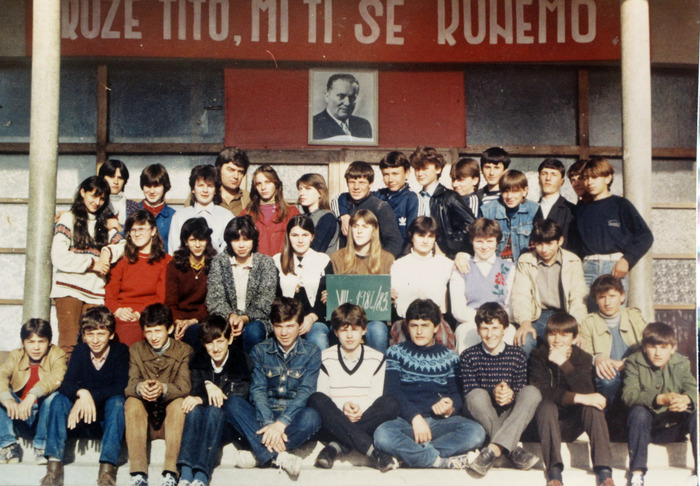
My mixed school class of Serbs and Muslims. We all look the same.

KEVLJANI, in north-west Bosnia, looks a peaceful place, a pretty village whether in the sun or Winter snow. There was a time, as Kemal Pervanic recalls, when he and his friends at school thought only of their happy future, and what they wanted to be,

That's them in the lower picture, under the portrait of Tito, whose partisans first declared Bosnia and Hercogovina a republic, and who proclaimed the watchwords 'Brotherhood and Unity'. As Kemal says, some of the children in this picture were Serbs, and some were Muslims, but if you try to spot the difference you can't because "there wasn't any".

Then things changed. Some of the causes lay far from Kevljani, but their terrible consequences in 1992 affected everybody in the vicinity. As armed Serb nationalists erized control of the area, homes were destroyed, people forced to flee, or beaten, raped and killed.

Young Kemal had dreamed of what it might be like one day to study amid the dreaming spires of Oxford, never thinking that he would end up on that city's streets as a refugee, after surviving the nightmare of the concentration camp at Omarska. To add to the trauma of that Serb-run camp, some of the guards who beat and tortured prisoners were not a foreign force, or imported thugs, but locals,who had turned upon their neighbours. Two of them had been Kemal's teachers.   .

Some of Kemal's friends and relatives did not survive. Nearby Kevljani a mass grave has been uncovered with some 342 bodies, some identified as local people, others brought there from elsewhere. In this small corner of North West Bosnia over 1000 persons remain unaccounted for.
When I first met Kemal almost twenty years ago he was busying himself at an office near Victoria, helping other Bosnian refugees find work or education, and telling those who longed to return home that they'd do better to get some training if they were going to take part in reconstruction. He kept up a cheerful exterior and did not have much to say about his own experiences.

But he did write a book, The Killing Days, and for the past couple of years he has been working on a film, Pretty Village, about Kevljani and its people. The film has alreday had a preview showing at the Frontline Club.  but it will hopefully be completed by the end of Mrach, and ready for distribution and showing.


http://www.indiegogo.com/projects/254180

It is a film about what happens to ordinary people, about cruelty and death, but it is also about their will to overcome obstacles and rebuild. For nearly ten years Kevljani was a ghost village. Survivors, of the killings and camps, were not allowed to return till early 2000. A few have decided to come back, but on their return they face the daily trauma of how to live amongst people who watched as their loved ones were killed or actively participated in the violence.

Part of their struggle is for remembrance. Survivors wanted to create a memorial on the site of the biggest massacres conducted at The Omarska Iron Ore Mine, now owned by Arcelor Mittal, the sponsors of The London Orbit. The company, in collusion with Serb run local authorities continue to deny them the right to create a memorial to the victims of the war.

The film asks what draws these people back to this place of suffering and how do they deal with life in the midst of their tormentors. It aims to raise awareness of these issues and why reconciliation remains a distant dream. It also looks to the future and asks what can be done to heal the wounds of this terrible conflict.

The film makers - Kemal Pervanic, and director David Evans, - are not hoping for Oscars or big bucks backing or profit with this film, but say it will be used for educational purposes and copies of the film will be sent to schools, government agencies and international policy makers in an attempt to spark a public dialogue about these issues. 


They are also hoping that by kick starting a dialogue between two communities in one corner of Bosnia they can help in healing, and contribute towards both groups eventually coming together to build a better, shared future in the region. 

Last week it was Holocaust Memorial Day, and as one who believes that "Never Again!" must mean Never Again to Anyone, and we must remember all, I was pleased to see that Kemal Pervanic had been invited to speak at an event for this occasion. This week I have been belatedly pleased to learn that I could contribute, however modestly, to the making of this film, and I am happy to publicise it best I can and encourage others to do so. 


http://www.indiegogo.com/projects/pretty-village 

http://vimeo.com/52739204 

http://theforgivenessproject.com/stories/kemal-pervanic-bosnia/ 

https://www.kickstarter.com/projects/1594913223/pretty-village 


FOR A BETTER FUTURE TOGETHER
photo by Kevac

Labels: ,

Wednesday, July 03, 2013

Puppets and Puppeteers

SHOWING HOW TO PULL THE STRINGS? Netanyahu with Baroness Ashton and Blair

PUPPETEERS and actors involved in the Israeli version of the Sesame Street show have protested against the Israeli authorities' banning of a Palestinian children's puppetry festival. Israel’s Ministry of Public Security last week ordered the temporary closure of the Hakawati Theater, the Palestinian national theater in east Jerusalem, canceling a children’s festival set to feature puppet shows and plays.

“I think every boy and girl deserves to see puppet theater,” says Ariel Doron, who provides the voice of Elmo in the Israeli version of the childrens TV show.  “There is no sense to this.” Together with  Yousef Sweid, who plays an Arab Muppet on the show, he has created a Facebook group named Puppets4All calling on Israel to permit the festival. Other Israeli Sesame Street puppeteers, along with a number of actors, uploaded photos to the Facebook group holding puppets and signs protesting the closure.

 http://www.washingtonpost.com/entertainment/tv/israeli-sesame-street-actors-protest-israels-closure-of-palestinian-puppet-theater-festival/2013/07/01/c4f2c5f8-e263-11e2-8657-fdff0c195a79_story.html

I have signed an online petition which Ariel Doron started and am persuading friends to sign it. It says every child has the right to enjoy puppet shows. A simple thing to ask.

It seems the Israeli government decided the puppets were a threat to security and stopped the festival so as to assert its sole authority over the  entire Jerusalem area, in line with which Arab families are increasingly being displaced from the city. Israeli police spokesman Mickey Rosenfeld said organizers of the Hakawati theatre illegally received funds from the Palestinian Authority government in the West Bank.

Having illegally annexed the eastern half of Jerusalem and much of its environs, taken in the 1967 war, the Israeli state is determined to block any chance of Palestinian claiming part of the city as their capital in a peace settlement.

It is not only the Israeli government that has taken its malice out on children. While the new Israeli version of  Sesame Street, “Rechov Sumsum” includes a Muppet of Arab origin, and characters representing Israel’s diverse Jewish immigrant population, its Palestinian counterpart “Sharaa Simsim,” which sought to offer positive role models to Palestinian children, was taken off air last year after the U.S. government cut funding. This was one of many programmes hit as Washington stopped funds in order to punish the Palestinians for appealing to the UN for recognition and statehood. The childrens' show may return to Palestinian TV next year if local funds can be obtained.

So much then for America's wish for peace and goodwill and commitment to the so-called two-state solution, and any semblance of equal rights, s well as the pretence that the Israeli government is even interested.

Meanwhile as US Secretary of State John Kerry goes to and fro, supposedly relaying messages between Palestinian president Abbas and Israeli Prime Minister Benjamin Netanyahu about resumption of talks, Netanyahu authorises yet another settlement expansion in the occupied Palestinian territories. "Don't watch their mouths, watch their hands" remains even more valid for understanding politics than for studying puppetry.

While they have banned one sort of puppet show in Jerusalem, it appears another less amusing piece of puppetry has been performed behind the scenes in Brussels. As US-based columnist and blogger Max Blumenthal tells us:

"Secretary of State John Kerry and Israeli Prime Minister Benjamin Netanyahu succeeded in blocking a statement by European Union member states that would have included sharp criticism of illegal Israeli settlement activity and of the general direction of the peace process. Kerry and Netanyahu depended on Catherine Ashton, the High Representative of Foreign Affairs for the EU and a proxy of Quartet Special Representative Tony Blair, to prevent EU member states from delivering the statement at a June 24 Council gathering in Brussels.

In the past year, several European governments have issued declarations calling for a new diplomatic approach to Israel. In April, the Dutch Advisory Council on Foreign Affairs released a report in April that recommended “calling [Israel] to account for violating the law,” and urged reconciliation between Fatah and Hamas.

Meanwhile, Irish Tanaiste (the country’s foreign minister) Eamon Gilmore has vowed to use Ireland’s position as President of the EU Council to advance a comprehensive boycott of products from Israeli settlements. And in recent weeks, Irish Palestine solidarity activists have gained traction in local district councils with proposals for settlement product bans, sparking a retaliatory campaign of lawfare and intimidation by Irish pro-Israel groups.

At the EU Council meeting last month, the foreign ministries of the United Kingdom and France planned to advance a united EU call for labeling Israeli settlement products and a condemnation of Israeli abuses of Palestinians living in the West Bank’s Area C. Release on the eve of Kerry’s trip to Jerusalem, the statement would have offered a dramatic rebuke of Washington’s business-as-usual attitude. But the EU ministers were stymied by Ashton, who had just met with Netanyahu at the Prime Minister’s office in Jerusalem.

During the meeting, Netanyahu told Ashton that if she did not block the EU statement, she would open the door for “laying the responsibility for failure on Israel’s shoulders” while giving the Palestinians “a blank check.” Despite Netanyahu’s plans to authorize 930 new homes in the East Jerusalem settlement of Har Homa, Ashton acceded to his request.

Days later, in Brussels, she announced (PDF) that she was “completely supporting John Kerry's efforts” -- even though she did not know a single detail about what Kerry planned to do when he arrived in Jerusalem. “He will tell us all about these proposals when he's ready to do so,” Ashton promised.

Ashton is fairly typical of the layer of one-time liberal "lefties" and peace believers who wound up in the entourage of Blair, the so-called peace envoy and war criminal. During the 1980’s, she was treasurer for the Campaign for Nuclear Disarmament. (But then wasn't B-liar himself a member?). . In the 90’s, she rose through the Labour Party ranks with New Labor.  In 1999, Blair made her a life peer, entitling her to a seat in the House of Lords.

Within a decade, Ashton had secured an appointment as Europe’s top diplomat, giving her control of the EU’s foreign service and a generous salary of around $41,500 a month. Before this, she had no experience in international relations and had never been elected to office.

Since entering the job, Ashton has demonstrated her fealty to Blair at almost every turn. According to a source familiar with proceedings inside the European Union External Action Service (EEAS), which advises Ashton, she has repeatedly stopped meetings to wonder aloud, “What would Tony think about this proposal?” Ashton and Blair joined forces last year to stifle the Palestinian Authority’s campaign for statehood at the UN, a futile maneuver that pitted them against almost the entire EU. She has since worked to eliminate the position of the EU special envoy to the peace process, a move seemingly aimed at further marginalizing European influence. Ashton’s suppression of the EU Council conclusions at Brussels in June represented the culmination of her efforts to keep the US and Israel in the driver’s seat, with Blair playing the third wheel.

Having successfully suppressed European dissension that might have disrupted Kerry’s public relations strategy, Ashton was off to Bahrain, where three EU-Bahraini dual nationals languished in prison for their role in peaceful protests that were violently crushed by the autocratic regime. Seated beside the Bahraini Foreign Minister Khalid ibn Ahmad Al Khalifa at a press conference, Ashton and her counterpart “underlined the importance of further strengthening EU-GCC ties,” according to Bahrain’s official news agency.
http://mondoweiss.net/2013/07/catherine-ashton-blairs.html

(GCC -Gulf Co-operation Council, the Saudi led reactionary alliance -RP)

Doesn't it make you proud of Britain's role in the European Union and the Middle East, and the kind of people whom the Labour Party is still harbouring?

I sometimes feel my friends who worry about European Union .influence on British policy should look at it the other way round occasionally.

As for the more entertaining kind of puppets, the Israeli closure of a Palestinian theatre and prevention of a children's festival undermines those defending Israel as a "democracy" and claiming that a boycott offends against cultural freedom. But on the other hand, looking at the way those Israeli puppeteers have raised their voices for their Palestinian fellow-artists, I think some of the energy expanded on a "cultural boycott" could be more usefully and justly directed aganst certain British and American politicians and institutions.  .


Labels: , , ,

Friday, July 13, 2012

One man freed on bail, one man still in jail. Authorities feel threatened by Freedom Theatre

http://www.greenyourope.net/wp-content/uploads/Nabil-with-his-daughter-Mina-on-her-first-birtday..jpg

NABIL AL RAEE released , but tagged and under house arrest. Seen here with daughter Mina on her first birthday.


ZAKARIA ZUBEIDI still detained without charges at Jericho prison.

First the good news. Nabil Al-Raee, the Artistic Director of The Freedom Theatre in Jenin, has been freed from Israeli military detention, after starting a hunger strike. Nabil had been held for over a month, having been taken from his home in the early hours of the morning by the Israeli military.

After putting it around that they were questioning Nabil about the murder last year of Freedom Theatre co-founder Juliano Mer-Khamis, - a subject on which he would have willingly told everything he knew without needing to be arrested - the Israeli authorities held him without charges, and without access to lawyer or family. Having failed to produce any evidence of "illegal activity" even to convince a military judge, they eventually came up with a charge of assisting a "terrorist", that is supplying food and cigarettes to Freedom Theatre co-founder Zakaria Zubeidi.

Zakaria Zubeidi is a respected figure in Jenin, as well as a colleague, and Nabil remarked that he had only helped him as any local person would. A former commander of the Al Aqsa Martyrs Brigade who fought the Israeli occupiers and also criticised Palestinian leaders, Zakaria Zubeidi accepted an amnesty from the Israelis in 2005, handing over his guns to the Palestinian Authority(PA), and joining Juliano Mer-Khamis in founding the theatre, to develop cultural resistance.

“The theatre is an important project,” said Zubeidi. “ It can bring the children together under one roof, give them the possibility to dream, develop them and lighten their psychological burden.”

He did not abandon his aim of liberation, but placed no faith in the Palestinian leadership, accusing them of selfishness and corruption, and saying that a new generation would have to come forward. Nor did Israeli politicians give up their calls for Zubeidi to dealt with as a terrorist.

On December 29, 2011, Israel rescinded Zubeidi's pardon for unstated reasons. Zubeidi stated to Ma'an News Agency that he had not violated any of the conditions of his amnesty. He was advised by PA security officials to turn himself in to Palestinian custody lest he arrested by Israel's security forces. A week before Zubeidi was notified about the cancellation of his amnesty, his brother had been arrested by the PA.

Now Zakaria Zubeidi remains in Palestinian Authority custody, having been held without charge and kept in prison at Jericho since May 13.

Nabil Al Raee is not genuinely free either, despite petitions from international artists, a resolution from the European parliament, and his own hunger strike. He has only been released on bail, and must remain under house arrest wearing an electronic foot chain until his next trial at the end of the month.


http://www.greenyourope.net/2012/07/12/the-artistic-director-of-the-palestinian-freedom-theatre-was-released-after-five-weeks-in-israeli-jail/

http://www.counterpunch.org/2012/07/13/the-bravest-theater-in-the-world/

Labels: , ,

Sunday, July 08, 2012

Theatre director on humger strike

http://disordininquieti.files.wordpress.com/2012/06/nabil_alraee.jpg
NABIL AL-RAEE in working environment

JENIN Freedom Theatre's artistic director Nabil Al-Raee, held prisoner by the Israeli occupation forces, has begun a hunger strike to draw more attention to his plight, and pressure for his release.

"I don't understand why I am here, [in detention]. There is no reason for them to keep me here." Nabil said on Thursday, announcing his intention to start the strike.

The Palestinian director was taken from his home by armed troops at 3 am on June 6. For two weeks he was not allowed to communicate with his lawyer or have any contact with his family. Nor were any charges made against him.

The Freedom Theatre's co-founder Juliano Mer Khamis was shot dead outside the theatre in April last year. No one has been brought to justice for the murder, and theatre staff had voiced concern that not enough was being done to investigate it.

At first the Israeli authorities put out the story that they suspected Nabil al-Raee was witholding information that could lead to the identification of Juliano Mer Khamis’ murderer. But Nabil's colleagues refused to accept this. Managing director Jonathan Stanczak said the Israeli authorities were waging an intimidation campaign to deter people from joining.

Three weeks before Nabil was arrested the Israeli security service Shabak (also known as Shin Bet) had called nearly half the theatre staff into interrogation at an Israeli army base near Jenin. ,Everyone had complied, including Nabil and his wife Micaela.

"We were very clear that we want to participate and contribute to any investigation regarding the murder of Juliano, but we strongly oppose the means and methods they used to conduct these interrogations," Stanczak said. During the interrogations staff were not just asked questions relating to the murder but about the activities of the Freedom Theatre, and things happening in the Jenin refugee camp.


Later, n a court hearing after Nabil's arrest, the Israeli prosecutors claimed that Nabil was involved in “terror activities”. Then in a recent court hearing the military judge declared that no evidence of any illegal activity had come up during the almost one month of interrogations and that Nabil would be released.

However the prosecution was given a 48 hour period to appeal, and last week it put forward a third accusation against Nabil. This time he is accused of possessing guns, and of helping a wanted person (Zakaria Zubeidi) as well as three other wanted but unnamed persons. The help Nabil is accused of rendering Zakaria – who years ago was granted amnesty by the Israeli authorities – is that he has driven him in his car and given him food and cigarettes. In response to these accusations Nabil declared that he was starting a hunger strike.

Micaela Miranda, Nabil’s wife, who attended the court hearing on Thursday, said “This farce started with them accusing Nabil of being involved somehow in the murder of Juliano, then they accused him of terror activities and now it’s something else. Every court hearing we go to there’s another accusation, it’s ridiculous and it’s obvious that they are trying to find a justification for having kept Nabil incarcerated for so long.”

Founded on a vision by Juliano Mewr Khamis mother, Arna, of creating a safe haven for Palestinian children to find respite and develop artistic skills, the Freedom Theatre, situated in Jenin refugee camp, has more than once been trashed and its workers harassed, by Israeli occupation troops.

At the same time its activities drew resentment from conservative and oppressive elements within Palestinian society, and during tours abroad to raise support, Juliano Mer Khamis sometimes ran into misguided opposition from self-claimed supporters of the Palestinians who thought he was "normalising" the occupation by practising cultural "collaboration".

Juliano Mer-Khamis made clear that, on the contrary, his theatre's work was not intended as an "alternative" to resistance, taking the place of Palestinian struggle, but as a contribution to it. This work has ranged from raising youngsters' morale, self-confidence and ability to express their view, to providing practical skills training with cameras abd video. The Freedom Theatre has attracted enthusiastic audiences and participation from children, and praise from seasoned militants.

So naturally it has also atracted enemies.

Jonathan Stanczak believes the accusations against Nabil al-Raee are part of the Israeli occupying force’s attempt to destroy The Freedom Theatre.

“Maybe they thought we would break down when Juliano Mer Khamis was assassinated, but we kept on and now they are trying to suffocate us slowly but surely by harassing our employees, members and supporters with various accusations, one more absurd than the other. This systematic harassment has gone on for a year now, it’s enough!”

An international campaign has been launched with support from artists and intellectuals who admire the Freedom Theatre's work, and 56 members of the European Parliament recently signed a letter urging EU High Commissioner Catherine Ashton to take action. Petitions are also being circulated.

http://www.thefreedomtheatre.org/aboutus-staff.php

http://www.aljazeera.com/indepth/features/2012/06/201261165349126599.html

Online petition:

http://www.thepetitionsite.com/464/514/564/freedom-for-nabil-al-raee/

Labels: ,

Monday, April 23, 2012

Globe MPs' letter gives the game away

https://blogger.googleusercontent.com/img/b/R29vZ2xl/AVvXsEjldWP-We4j1tnOpNrF01tqG5yc_HSSp2II45X_jcBv37Z5hd5DZJnpCKIbgQKPQTKhP9evT8rblqQ6Up9w_QgzvVIkiZZ_O9NzJqAAdlWcole8_FxPxdvcpdx7Ad9N-F45ESta/s1600/louise_mensch.jpg

LOUISE MENSCH MP

A GROUP of MPs who have lent their names to a letter defending the Globe theatre's invitation to Israel's Habima theatre for a Shakespeare festival have perhaps unwittingly blown the cover on the pretence that this was purely about cultural freedom from political interference, or that those opposing the invitation were merely motivated by prejudice.

In their letter, published in the Guardian on Friday, April 20, the MPs write:

We notice with dismay that dozens of prominent members of the UK theatre and film industry are calling for a boycott of Israel's national theatre, Habima, in London's Globe to Globe festival, on the grounds that Habima have performed in established cultural halls in two large Israeli settlements (Letters, 30 March). It is widely accepted that any peace accord is likely to result in the larger settlement blocs, on land close to the 1967 line, becoming part of Israel, through a process of land swaps; a concept that has already been endorsed and reiterated by international leaders.

In any case, Habima's cultural contribution to the festival ought to be celebrated and enjoyed away from the politics of the region. ....(boycott activity) gives a green light to those who wish to promote the delegitimisation of Israel. It does nothing to help the Middle East peace process which will be solved when leaders on both sides can reach agreement on a two-state solution.

http://www.guardian.co.uk/world/2012/apr/20/israel-iran-mordechai-vanunu

Among those signing the letter along with John Whittingdale MP, who is chair of the Commons committee on Culture, the Media and Sport, is Louise Mensch, the Tory MP for Corby, who was also signatory to a previous letter along with playwright Arnold Wesker, actress Maureen Lipmann and other celebs, linking the boycott call with attempts to delegitimise Israel, the Jewish people and the Hebrew language, and claiming that it demonstrated continuing "persecution" of Jewish people and Israelis in Britain.

http://www.guardian.co.uk/world/2012/apr/10/we-welcome-israel-national-theatre

At the time the most charitable assumption we could make was that the signatories were ignorant of the real issues, concerning Habima and its performance in illegal settlements, as they managed to ignore this, just as they feigned ignorance of the fact that the call to oppose the Habima visit came from people in Israel, and was supported by respected artists here and in the United States, many of whom happened to be Jewish (unlike Mrs.Mensch, nee Bagshawe, who is a Roman Catholic).

Incidentally, Louise Mensch is no starry-eyed believer in freedom of expression for everyone. After the riots she wanted social networks like Facebook and Twitter closed down during periods of disturbances, much as they might be in China or Iran. As for the Occupation movement (in London, not the West Bank she appears to think people have no right to condemn capitalism if they enjoy its "benefits", e.g. purchasing a coffee. Presumably they should also not wear clothes. But we should not call the MP daft, after all some people voted for her.

Now at least the MPs are admitting they know about the settlement issue, even though they appear to think that plonking a fortified town like Ariel down amid a hostile population, 17 kilometers east of the Israeli border, and then using it to claim the land as part of Israel, is part of a peace process, and perfectly compatible with a "two state solution"!

Israeli prime minister Binyamin Netanyahu could not have put it better. Only he has called Ariel "the capital of Samaria", so perhaps by "two states" they mean one State of Israel within its pre-1967 borders, (to which President Obama said it should withdraw - though he seemed to withdraw his remark for Netanyahu's visit); and a settler state of "Judea and Samaria", i.e. the West Bank. Israel demands recognition as "democratic and Jewish", the settlers would not bother with any "democratic" nonsense.

Netanyahu is also on record (though he tried to deny it) as saying that Israel ought to take advantage of a Middle East war to expel the Palestinian population.

The Palestinians don't get a look in for the British MPs' letter, any more than they would at Ariel. For the writers it is supposedly enough that the land swaps" - based on settlements which are against international law - have been accepted by "international leaders". Perhaps they should tell us more.

The issue of Israeli expansion and settlements was thrust into the realm of cultural expression and theatre two years ago, when a new cultural centre was opened with Israeli government support in the city settlement of Ariel.

Dozens of Israeli theatre actors, playwrights and directors signed a pledge that they would not have anything to do with this project, seeing it as part of the government's effort to "normalise" illegal settlements and Netanyahu's claim that Ariel was an an "integral part of the State of Israel". They saw this as an obstacle to peace, and their objection as a matter of conscience, even if it meant loss of patronage and income.

Ariel settlement (photo by <span class=ARIJ) &lt;/a>&lt;/p>&lt;div class="> category IMEMC News http://www.imemc.org


http://www.imemc.org/article/59342

Despite threats to withold funds, and denunciation as "draft evaders and traitors", the list of objectors grew, and was reinforced by some 150 academics supporting the actors. Among those who added their names were playwright Yehoshua Sobol, whose Holocaust play "Ghetto" has been peformed in Britain, and writers David Grossman, Amos Oz and A.B.Yehoshua. Their letter said:

"We, the undersigned, express our support and solidarity with the theater artists refusing to perform in Ariel. Freedom of creation and freedom of opinion are the cornerstones of a free and democratic society. Not too long ago, we marked the 43rd anniversary of the Israeli occupation. Legitimization and acceptance of the settler enterprise cause critical damage to Israel's chances of achieving a peace accord with its Palestinian neighbors."

Bringing up the rear, in November 2010 a group of education students from Beit Berl College informed the college administration that they would not be willing to complete their teacher training with a project at an educational facility in Ariel. "We will not teach beyond the Green Line (pre 1967 border) the students said. They were supported by the student union though not all its members agreed, and the principal said he would have to respect the students' decision.

"Meanwhile, " as Ha'aretz had reported on August 31, 2010 , "some 300 persons gathered yesterday outside the Habimah Theater in Tel Aviv to protest its decision to perform in Ariel when its new cultural center opens this November.

Participating in the protest were MKs Dov Khenin (Hadash ), Nitzan Horowitz and Haim Oron (Meretz ), actors Hana Meron, Oded Kotler, playwright Yehoshua Sobol, former MKs Yael Dayan and Zahava Gal-On, and former editor-in-chief of Maariv Doron Galezer."

MKs means Members of the Knesset. And I'd choose the wisdom of these Israeli artists, writers, academics and members of the Knesset over the conditioned knee jerks of some British Zionist hacks who have got the needle stuck, or Tory members of parliament airing their ignorance.

That said, and whatever one thinks of the Habima row, the Tory MPs may have done us a favour in talking about what "international leaders" are ready to endorse. It could be they are echoing what some of their leaders are too shy to come out with openly, or what the Israeli government is assuming they will accept. The world is a stage, and not all the actors perform in theatres.


http://www.haaretz.com/print-edition/news/150-academics-artists-back-actors-boycott-of-settlement-arts-center-1.311149

http://www.haaretz.com/culture/actors-boycott-on-settlement-cultural-center-will-tear-israel-apart-1.310682

http://www.ynetnews.com/articles/0,7340,L-3983888,00.html

http://www.ynetnews.com/articles/0,7340,L-3986308,00.html

http://www.richardsilverstein.com/tikun_olam/2010/11/06/israeli-cultural-figures-appeal-to-actors-to-boycott-ariel/

http://www.israelnationalnews.com/News/News.aspx/139522#.T5T8Y9UdWtM

http://jews4big.wordpress.com/category/globe-theatre/

http://www.guardian.co.uk/world/2012/apr/20/israel-iran-mordechai-vanunu

And for some light relief (unless you're one of the voters of Corby), Mrs.Mensch on an Ocupation she did not support:
http://www.youtube.com/watch?v=3252FSW7OC4

Labels: , , , , ,

Friday, April 13, 2012

WAR IN THEATRELAND: Netanyahu's misguided missiles programmed with ignorance and lies

IT might have been a blast from the past, but it had the impact of a damp squib. Playwright Arnold Wesker was wheeled out on Wednesday's Guardian letters page heading signatories to a letter saying "We welcome Israel's national theatre".

Delighted that the Globe theatre has invited the Habima to perform The Merchant of Venice in London, the writers extol the Hebrew theatre's virtues in standing up to oppression (a century ago, in Russia) and exploring "the challenges faced by the Jewish people", describing it as "a symbol of the cultural success of the State of Israel".

They go on to claim that now, as in the past, "there are those who wish to oppose their work, seeking to delegitimise the State of Israel and its success, the Jewish people, and even the Hebrew language itself."

(Guardian , April 11)

Lifelong Zionist Wesker's dedication to artistic freedom is remembered for his effort to ban Jim Allan's play Perdition, which dealt with Zionist leaders' collaboration with the Nazis in wartime Hungary. Other signatories include Maureen Lipmann, remembered among other things for her "Jewish grandmother" role as Beattie in the 1980s British Telecomm ads, and with less affection for her defence of Israeli attacks on Gaza. The actress said the Israelis could not be limited by proportionality, because Arabs did not value their children's lives as much as they did.

http://jewssansfrontieres.blogspot.co.uk/2006/07/caabu-condemns-maureen-lipmans-racism.html

Writing in the Jewish Chronicle, Wesker went as far as comparing opposition to Habima with "Nazi book burning".

Another person condemning those who oppose the Habima invitation has been Howard Jacobson, who suggested criticism of Israel's assault on Gaza was making Britain as antisemitic as Nazi Germany on the eve of Kristallnacht. So far as we have heard this frightening comparison did not lead to Jacobson packing his bags for alyah to Israel. He has won a Booker prize with his novel accusing Jews who opposed Israeli policies of being "ashamed to be Jewish". Now he is applauding the Globe welcoming Habima, and denouncing the boycotters.

http://www.guardian.co.uk/stage/2012/apr/07/israel-national-theatre-globe?INTCMP=SRCH

That phrase about opponents and critics trying to "delegitimise the State of Israel" has become so familiar now it must be time the Zionist state's guardians learned a new password before they fall asleep at their posts. Or, perhaps as we've ventured into theatreland we might suggest they need a new and improved script. But leaving aside the state and its legitimacy, or otherwise, as a member of "the Jewish people", even with a mere smattering of Hebrew, I am alarmed by the suggestion we need to be legitimised, and still more by the idea this should depend on a particular theatre company.

I have never been keen on a blanket policy of cultural boycott. I even agree with Wesker's letter when it says the theatre's artistic work should not be "hijacked" for political purposes, and adds: "No artists should attempt to silence the expression of other artists simply because they are Israeli".

Indeed not. So who is "hijacking" cultural activity, or rather hitching it up to their political aims, and who is attempting to silence Israeli artists? For a few years now, Israeli propagandists have been talking about marketing "Brand Israel", hoping to sidestep concerns about military policies and oppression of the Palestinians by selling cultural and scientific achievements (even the drones in use by NATO!) and tourism.

It was Nissim Ben-Sheetrit of Israel’s Foreign Ministry who said: “We see culture as a propaganda tool of the first rank, and I do not differentiate between propaganda and culture.”

As for cultural autonomy, my fellow blogger Naomi Wimbourne-Idrissi points out: "Artists who accept funding from the Israeli Ministry of Foreign Affairs are required to sign a contract which states that the artist 'is aware that the purpose of ordering services from him is to promote the policy interests of the State of Israel via culture and art, including contributing to creating a positive image for Israel.'"

http://jews4big.wordpress.com/2012/03/29/globe-olympic-shakespeare-festival-challenged-for-inviting-israeli-national-theatre/

It is those defending the Globe invitation who are silencing, or at any rate ignoring, Israeli artists - those who are critical of Habima because of its relation to the state, and implication in the occupation of Palestinian territory, and who were the first to write about it. Here is what some Israeli campaigners said in a letter to the Globe:

In the past year, two large settlements – Ariel in the northern part of the West Bank and Kiryat Arba in its south – set up "Halls of Culture" and asked theatres to come and present their plays there. Last year, a large group of Israeli theatre professionals – actors, stage directors, playwrights – declared they would not take part in such performances; among them were such well-known people as Joshua Sobol, Edna Mazia, Shmuel Hasfari and Anat Gov. For several weeks, this was a major issue on the Israeli public agenda, and the aforementioned Israeli theatre professionals have received much support from colleagues abroad, such as Stephen Sondheim, Mary Rodgers, Tony Kushner, Mandy Patinkin, Theodore Bikel, Mira Nair, Julianne Moore, Vanessa Redgrave, Hal Prince, Roseanne Barr and other Broadway and Hollywood stars.
( http://jewishvoiceforpeace.org/blog/breaking-stephen-sondheim-julianne-m... )

The dissident Israeli theatre professionals have argued that the West bank settlements had been created in violation of International Law and with the specific aim of blocking any possibility of achieving peace with the Palestinians; that the expropriation of land in an occupied territory and the creation and maintenance of armed settlement enclaves are the very opposite of what is commonly termed "Culture"; and that therefore, a settlement maintaining a "Hall of Culture" was a blatant contradiction in terms.
It is especially noteworthy that Ariel and Kiryat Arba, like most settlements, are surrounded by walls and fences, closely guarded by soldiers and their own armed security personnel. A theatrical performance in a settlement is by definition a performance to an exclusively Israeli audience, with Palestinians living even in the nearest village being physically excluded from any chance of attending.
Despite all of the above, however, on this issue the management of Habima has taken a position which is remote from any kind of social engagement. Claiming to be "non-political", the management has reiterated its decision to perform in West Bank settlements, "like everywhere else". Moreover, the management specifically promised Limor Livnat, Minister of Culture in the Netanyahu Government, to "deal with any problems hindering such performances", i.e. to pressure recalcitrant actors into taking part in them, even against the dictates of their conscience. And it must be pointed out that for several months, Habima has indeed sent out its actors to hold theatrical performances in West Bank settlements, on a regular basis.
As Israeli citizens who are deeply concerned about the future of all people living in the region we deplore this attitude. We cannot help seeing the positions taken by Habima Theatre on the two issues – presentation of "The Merchant of Venice" in London and regular performances in West Bank settlements - as inherently incompatible. By inviting Habima to perform in London, you are siding with its administrators in the debate on settlement performances, and you are taking a step against the conscientious Israeli actors and playwrights who have refused to perform in the settlements."

http://boycottisrael.info/content/call-shakespeares-globe-theatre

It is plainly this call from within Israel, as well as pleas for solidarity from Palestinians, that was echoed in the letter from artists in Britain, who include Dr.Jonathan Miller, Miryam Margolies, Mike Leigh and Alexei Sayle. Messrs. Wesker, Lipmann and Jacobson might disagree, but they are not entitled to ignore the background or pretend they are answering opponents who are simply anti-Israeli or even anti-Jewish. The least one can say about the Wesker letter and similar comments are that they ignorant, but the effect of what they are trying to say is thoroughly dishonest. If they are depending on the Israeli embassy or its fronts for information they have been supplied with a lousy script.

For more background see:
http://www.guardian.co.uk/world/2010/aug/29/actors-boycott-west-bank-theatre
http://www.guardian.co.uk/world/2012/mar/29/dismay-globe-invitation-israeli-theatre?newsfeed=true
http://jews4big.wordpress.com/2012/04/13/artists-refute-nazi-slurs-over-israeli-theatre-protest/

Labels: , , ,

Saturday, December 31, 2011

Continuity Man

http://www.celebritypicnic.com/celebrities/michael-moore/mainimage.jpgAWARD-winning American film maker Michael Moore is no mere "trendy" media type trying to keep up with the fashion of the day. He may be light as theoreticians go, and I'm not nominating him as a wonderrebbe or guru, as though I believed in such things. But giving credit where due, Mr.Moore has uncovered an important thread of continuity leading up behind the anti-capitalist "Occupy" movement, whether or not participants are aware of it.

"On this day, December 30th, in 1936 -- 75 years ago today -- hundreds of workers at the General Motors factories in Flint, Michigan, took over the facilities and occupied them for 44 days. My uncle was one of them.

"The workers couldn't take the abuse from the corporation any longer. Their working conditions, the slave wages, no vacation, no health care, no overtime -- it was do as you're told or get tossed onto the curb.

"So on the day before New Year's Eve, emboldened by the recent re-election of Franklin Roosevelt, they sat down on the job and refused to leave.

"They began their Occupation in the dead of winter. GM cut off the heat and water to the buildings. The police tried to raid the factories several times, to no avail. Even the National Guard was called in.

"But the workers held their ground, and after 44 days, the corporation gave in and recognized the UAW as the representative of the workers. It was a monumental historical moment as no other major company had ever been brought to its knees by their employees. Workers were given a raise to a dollar an hour -- and successful strikes and occupations spread like wildfire across the country. Finally, the working class would be able to do things like own their own homes, send their children to college, have time off and see a doctor without having to worry about paying. In Flint, Michigan, on this day in 1936, the middle class was born.

"But 75 years later, the owners and elites have regained all power and control. I can think of no better way for us to honor the original Occupiers than by all of us participating in the Occupy Wall Street movement in whatever form that takes in each of our towns. We need direct action all winter long if we are to prevail. You can start your own Occupy group in your neighborhood or school or with just your friends. Speak out against economic injustice at every chance you get. Stop the bank from evicting the family down the block. Move your checking and credit card to a community bank or credit union. Place a sign in your yard -- and get your neighbors to do it also -- that says, "WE ARE THE 99%."

"Do something, anything, but don't remain silent. Not now. This is the moment. It won't come again. 75 years ago today, in Flint, Michigan, the people said they'd had enough and occupied the factories until they won. What is stopping us now? The rich have one plan: bleed everyone dry. Can anyone, in good conscience, be a bystander to this?

"My uncle wasn't, and because of what he and others did, I got to grow up without having to worry about a roof over my head or medical bills or a decent life. And all that was provided by my dad who built spark plugs on a GM assembly line.

"Let's each of us double our efforts to raise a ruckus, Occupy Everywhere, and get creative as we throw a major nonviolent wrench into this system of Greed. Let's make the politicians running for office in 2012 quake in their boots if they refuse to tax the rich, regulate Wall Street and do whatever we the people tell them to do".

http://www.michaelmoore.com/words/mike-friends-blog/75-years-ago-today-first-occupy

Leave aside Michael Moore's adoption of the all too common confusion around between working and "middle class", which has the danger that it erects a false barrier between those workers still with jobs and skills in demand and the poor and unemployed. Moore's vision also limits itself to the possibility of restoring and defending the relative prosperity gained by sections of working people in heyday of boom and American industrial power.

But at least he reminds us that these gains were made in struggle and did not 'trickle down' from the generosity of the business tycoons and bosses, or the super rich. Evoking the struggles of the 1930s is also a healthy inoculation against the snake-oil salesmen, conspiracy theorists and middle class dumbwits who have been telling eeach other the system was fine until some wicked individuals spoilt it, and have remembered how Henry Ford once spoke ill about bankers, forgetting he also ordered gangsters and guns be used against workers.

Moore is wrong to think the big auto sit-downs of 1936 were the first time such things had happened, even in America, and they certainly were not confined there. In 1920, Italian workers occupied the big plants of Turin, though as one observer noted, while they had raised the red flag over the factories, the tricolore still flew over the barracks and police stations. We know which won, as a former "Socialist" backed by capitalists, landowners and the bankers JP Morgan arranged the "march on Rome" of his blackshirts.

But if the embers of working class resistance had been stamped underfoot with the rise of fascism they burst into flame again in 1943, in the factories of Turin as well as in the partisan movement, which was to leave il Duce dangling.
Linkhttp://www.scribd.com/doc/62367983/4/THE-TURIN-STRIKES-OF-MARCH-1943

Between the wars sit-downs and occupations had taken various forms and places, from Italy to Poland, even Hungary under a semi-fascist regime, and often involving miners staying underground. In 1934 there was a major staydown strike at Terbovlye, in Slovenia. It may have been miners from Yugoslavia who brought that weapon with them to the anthracite mines in America.

In 1935 about 70 miners stayed down and on strike at Nine Mile Point colliery in South Wales. It was not to be the last time miners in Britain took such action.

http://www.labournet.de/internationales/usa/sitdown37.pdf
http://www.uncanny.net/~wetzel/ital1920revised.html

In 1936, strikers at Le Havre in Normandy occupied to prevent a lock-out, and their action spread right across France, involving big factories like Renault and the steel plants. It ended with workers winning gains from employers and government, not just national pay agreements but for the first time, holidays with pay and other benefits.

In both France and the United States the sit-down strikes boosted organisation and confidence in the working class, as well as securing immediate gains, and as Leon Trotsky pointed out, they did something more:

Sit-down strikes, the latest expression of this kind of initiative, go beyond the limits of "normal" capitalist procedure. Independently of the demands of the strikers, the temporary seizure of factories deals a blow to the idol, capitalist property. Every sit-down strike poses in a practical manner the question of who is boss of the factory: the capitalist or the workers?

Transitional Programme of the Fourth International
http://www.marxists.org/archive/trotsky/1938/tp/index.htm

Of course posing the question is not delivering an answer. In the 1970s there were several places in Britain, the Upper Clyde Shipbuilders being most famous, where workers fighting sackings and closure took over the workplace, and while perpectives varied they posed other questions, like how the workplace relates to society, the state and finance.

More recently we have had the occupations at Vestas in the Isle of Wight, and Visteon in Belfast and London. Both raised interest much wider than among "the usual suspects", and neither waited for supposed leaders from the TUC or Labour Party to initiate them. The Vestas strikers, defending wind turbine jobs, gained support from climate camp activists.

Though the main struggle here is currently over cuts and pensions, it is clearly related to who should pay for the capitalists' crisis, and could raise the issues of who is boss, and who owns what, in new ways.

The Occupy movement has sprung up outside the conventional organised labour movement, but if anti-capitalism is to mean anything positive it needs the working class as a political force, and for that the working class needs its memory. Whatever Michael Moore's political limits, we should welcome anyone, particularly with his creative skills, who is bringing out the connections.

Labels: , , ,

Thursday, October 06, 2011

Everything is Possible

http://www.redbridge.gov.uk/cms/images/zz-sylviapankhurst_web.jpg
SYLVIA PANKHURST.
Woman with imagination and vision, but no idle dreamer.

THERE was a capacity crowd in the hall at Congress House on Wednesday night, and I was one of the minority of males attending. A new feature-length documentary about a figure from early last century was having its screening at the SERTUC Film Club, SERTUC being the Southern and Eastern Region of the Trade Union Congress, but as I think the reversal of the usual sex balance might suggest, this audience was much more than "the usual suspects".
And it was a rewarding evening for all.

Sylvia Pankhurst: Everything is Possible tells the story of the battling sufragette and socialist who never surrendered her beliefs and principles, whether to brutality from State or pressure from Family, and never lost her feeling, often expressed in practical help, for humanity.

Born in Manchester, where her mother and father started a branch of the Independent Labour Party, Sylvia began studying at Manchester Art School in 1898, and in 1900 she won a scholarship to the Royal College of Art in London. In the film we see some of her work, depicting strong working women like some she might have known up north, with warmth, respect and admiration. But Sylvia was not one of those who stick at sentimentalising the oppressed while doing nothing to combat their oppression, and as she became more involved in the women's suffrage movement in London she decided to put her art to one side and concentrate on politics.

For Sylvia Pankhurst achieving the vote would never be an end in itself, and still less was she interested in raising a narrow elite of upper class women to take their place alongside men in a parliament maintaining wealth and privilege. As her repeated arrests and hunger strikes would show, it was not lack of courage that set her apart from the increasingly desperate actions taken by some sufragettes, but her insistance that the movement must involve the mass of women, and not just an elite of heroines - though a heroine she was.

What's more, while some working men still had no vote, she saw them as allies to be won, rather than competitors - whatever the backward attitudes of some union leaders, or the bizarre (to our modern ears) ideas of a self-styled marxist intellectual like Belfort Bax, who devoted his energies to opposing women's rights.

It was the First World War that shed sharp light on things. Like her friend Keir Hardie, Sylvia Pankhurst saw no glory in workers being sent to the trenches for rival imperialist powers and war profiteers. Unlike her mother Emmeline and older sister Christabel, she would not put aside her fight for equality to support the war effort, and getting more women into production, rather than parliament. But while her mother and sister waved the flag for Our Boys, it was Sylvia, based in London's East End, who helped to see their children were not neglected, with cost-price cafes, toy workshops where mums could earn a wage, creches, and mother and baby clinics in local pubs, one dubbed the Mother's Arms.

(Next time I stumble between the push-chairs and buggies parked in my local Wetherspoon by the mums who gather there with their ankle-biters to confer over brunch I will no longer grumble about what I thought was a modern-day development, having now seen the precedents shown in this film!)

All this was practical solidarity, not mere charity, and went with campaigning on rents and pensions, leading deputations of impoverished East End women to parliament, and editing the Women's Dreadnought, which eventually became the Workers' Dreadnought. It was Sylvia Pankhurst's paper, probably the first edited by a woman, which exposed things people were not supposed to know about, like British Army officers ordering 37,900 executions of conscripts. When an officer, Major Siegfried Sassoon, wrote A Soldiers Declaration, Against the War, it was the Dreadnought that published it.

If not many of us in Wednesday night's audience had known that, I would imagine fewer still of us realised before seeing this film that like James Connolly in Dublin before her, Sylvia Pankhust responded to police brutality by organising a people's army. We see them exercising with real rifles. Stirring times! No wonder by the Second World War our rulers were reluctant to trust the Home Guard with these, or that Sylvia Pankhust has yet to be given a place on a plinth outside parliament, or due mention in our school history books.

An enthusiast like many for the October Revolution in Russia, Sylvia Pankhurst was among the founders of the British Communist Party, though she was not unafraid to tell Lenin when she differed - notably on his advice to communists at the time to get in with Labour and take their place also in parliament. For his part, the leader of the Bolsheviks took Sylvia seriously enough to spend time arguing with her position in Left -wing Communism, an Infantile Disorder.

Sylvia Pankhurst's internationalism continued, in and out of the Party. She supported the dockers who stopped work loading a ship called the Jolly George in London, in 1920 because it was going to carry arms to Poland for use against the Soviet Union. (another piece of working class history we must be grateul to this film for restoring, when nowadays such industrial action is well outside what is legally permitted by our anti-union laws, and there's a danger of such precedents being erased from working class consciousness).

In the 1920s and 1930s, Sylvia Pankhurst was among the first to recognise the menace of fascism and fight against it, and she also assisted Italian and Jewish refugees. She and an Italian socialist Silvio Erasmus Corio set up home at Woodford Green in Essex, and their son Richard was born in 1927.

In 1935, Sylvia launched the Ethiopian News to support the resistance to Italian colonisation. After her partner Silvo died in 1954 she was invited by Emperor Haile Selassie to come and live in Ethiopia, where she founded the Social Service Society and edited a monthly periodical, the Ethiopia Observer. Sylvia Pankhurst died in Addis Ababa on 27 September 1960. The emperor ordered that she should receive a state funeral. Richard Pankhurst became a professor at the University of Addis Ababa and is an outstanding scholar on Ethiopian studies.

Richard and his wife Rita are among the people interviewed in this film, along with academics like Mary Davis. No less than 100 volunteers were involved in conducting the interviews and digging out all kinds of rare archive footage, photographs and documents, some from security files, to tell the story of Sylvia Pankhurst and try to explain her politics. In doing so they have not only brought an under-rated heroine to life and a well-deserved fresh attention, but contributed a missing piece to our picture of 20th century history.

Directors Ceri Dingle and Viv Regan from WORLDwrite, and reporter Saleha Ali who did much of the interviewing were available to discuss with the audience on Wednesday, and I see Ceri Dingle and Professor Mary Davis are due to discuss Sylvia Pankhurst: Everything is Possible on Sunday morning, October 9, when it will be shown along with a short fim about Ethiopia, at the Renoir cinema, in Brunswick Square, under the auspices of London Socialist Film Co-op.

The film is also available on DVD at £10 and well worth showing at your union branch, trades council, history or student society etc


http://www.sylviapankhurst.com/

http://www.spartacus.schoolnet.co.uk/WpankhurstS.htm

world.write@btconnect.com

www,gn.apc.org/sylviapankhurst

www.socialistfilm.blogspot.com

Sylvia Pankhurst was one of first to recognise danger of fascism. An article from Workers Dreadnought;
http://www.oocities.org/capitolhill/lobby/3909/raete/wd0411222.html

Labels: , , , , ,

Sunday, April 10, 2011

Tribute to Jayaben Desai

FILM ON THE GRUNWICK STRIKE WILL BE SHOWN

THIS time next week together with friends from Brent Trades Union Council and others I'll be getting ready to pay tribute to a remarkable little woman, who deservedly became a big name in the history of British trade unionism and the advancement of Asian people in this country, particularly womenfolk. Indeed, many women from all backgrounds consider her a heroine an d role-model.

It was the hottest Summer on record, in 1976, and that August day the air conditioning at the Grunwick factory in Willesden was not working. The workers were rushing to keep up with the photo processing orders at this busy time, several having been sacked for being "too slow". At about 6.55pm Mrs. Jayaben Desai was ready to go home when she was called into the office, and told she must stay behind and work overtime.

Apparently this was not uncommon at Grunwick, where business was thriving, and the workforce were mainly women earning on average £28 a week - when the average wage for women factory workers in London was about £44 a week.

But like Rosa Parks in Alabama, who defied Jim Crow and sat down on the bus because she had "tired feet", Jayaben Desai had had enough. She was not intimidated by the threat of the sack. The little (4ft 10) woman from Gujarat would lead a walk-out, telling the six foot manager who tried to stop her: "What you are running here is not a factory, it is a zoo. But in a zoo there are many types of animals. Some are monkeys who dance on your fingertips, others are lions who can bite your head off. We are the lions, Mr. Manager."

The Grunwick strike was to last two years, putting paid to the myth of Asian women's subservience, and marking a change in the attitude of white trades unionists, as thousands - engineers, postal workers, dockers and miners - rallied to support the strikers at Grunwick. Cabinet minister Shirley Williams and miners' leader Arthur Scargill were arrested on the picket line.

Altogether there were 550 arrests during the strike, as the police battled their way through trade unionists and students to fetch scab buses in. Mrs Desai (as she was always referred to at the time) recalled her thoughts in an interview for Hannah Phung of Brent Museum Archives: "It was amazing, let me tell you, it was amazing.[…] tears were in my eyes to see these people […] they were hurting themselves and the police were charging them with horses and everything and still they were standing strong."

Postal workers at Cricklewood decided to refuse to handle Grunwicks mail, a vital part of the film lab's operations. The right-wing National Association for Freedom organised scabbing to pick up the mail, probably illegally, while the law was used to break the post workers' stand, with their help of frightened union leaders.

"This is not a strike about wages, it is about human dignity", said Jayaben Desai. The strikers, who had joined the clerical union APEX, well-known for moderation, insisted on union recognition. Grunwick boss George Ward refused to recognise the union even when this was recommended by the Advisory, Conciliation and Arbitration Service (ACAS), by a government inquiry, and by law lords. Ward enjoyed strong Tory backing. Meanwhile as we now know, Labour Prime Minister James Callaghan had asked the security services to spy on Scargill.

The Grunwick strike ended in acrimony, with strikers feeling let down,hunger striking outside the TUC, and being expelled from their union. But APEX became part of the GMB union, and a few years ago Jayaben Desai was invited to its conference in Brighton, where to a standing ovation she received an award and apologies from the GMB's present leaders that the Grunwick strikers had not received more help from the union.

Jayaben Desai died on December 23 last year, aged 77. Her funeral was well-attended, but many more people said they would like to have paid tribute. There will be an opportunity to do that next Sunday, and to see the new film about The Great Grunwick Strike that was made on its anniversary.

The event is being organised by Brent Trade Union Council and will commence at 2.30pm on Sunday, April 17, at the Tricycle Cinema Theatre, 269 Kilburn High Rd, NW6 7JR (nearest tube is Kilburn) Tickets are £5.

Labels: , ,

Monday, April 04, 2011

Don't let them murder a dream!

JULIANO MER KHAMIS (below), and
(right) his mother Arna, with red
flowers, at London vigil during
first Intifada. The placards
bore names of Palestinian
children who had been killed by
Israeli forces.

JULIANO Mer-Khamis, actor, theatre director and campaigner with a vision, has been murdered. The 53-year old Israeli-Palestinian who worked to bring world culture and hope to the Jenin refugee camp and amplify an articulate Palestinian voice in the world, was shot five times outside his Jenin Freedom Theatre today.

Jenin police chief Mohammed Tayyim said the masked gunmen who killed Juliano were Palestinians, but the circumstances of the murder were still being investigated. A Palestinian ambulance took his body to a nearby checkpoint to be transferred into Israel.

Whatever the immediate responsibility for this crime it was a blow not only to Mer Khamis' vision for theatre and film contributing to the liberation struggle, but to the hope that Palestinian Arab and Jew can live in freedom, peace and equality in a shared land.

Juliano himself was a earnest for such co-existence. His mother Arna was a former kibbutznik who served in the pre-state Palmach before turning to the Communist Party and quest for peace with justice. His father, Saliba Khamis, was a Party member, a Palestinian Christian by background. Juliano was born and raised in Nazareth, where Tewfik Ziyad was Communist Party mayor.

It was on March 30, 1976, the same year that Juliano Mer Khamis commenced his military service with the IDF, becoming a paratrooper, that Israeli forces shot dead six people, some young girls his own age, protesting Israeli land seizures that were regarded as part of the government's plan for "Judaisation of the Galilee". Thus was born Yawm el Ard, the Day of the Land.

The Lebanon war, and the movement to reject military service there or in the Occupied Territories, still lay ahead. But someone in Juliano's position was bound to think what he was doing, and some of his mates in the paras were also starting to have their doubts.

In the 1980s, while most Israelis who went into the Occupied Trritories did so as fanatical settlers, Arna Mer-Khamis went in for different reasons, working with children in Jenin refugee camp, and setting up the theatre as both a cultural centre and a safe space. In 2006 Juliano opened the Freedom Theatre, along with Zakariya Zubeidi, the former commander of the Al-Aqsa Martyrs Brigades in Jenin.

This partnership should have laid to rest any suspicions or allegations that the theatre was an exercise in collaboration or 'normalising' the occupation. So should the fact that the theatre suffered being trashed by Israeli soldiers when they re-invaded Jenin. But Mer Khamis ran into hostility when he spoke in some places abroad, and there were threats, and two attempts to torch the theatre.

The Freedom Theatre not only trained young actors but gave Palestinian youngsters the opportunity to acquire camera and other practical skills, as well as confidence in expression. That might be counted part of liberation. But some people did not like co-education and other progressive features. Others objected to the staging of 'Animal Farm' - ostensibly because it meant young actors playing a pig, which is unclean in Islamic as Jewish dietary law. But since they were acting, not eating, the animal, we might suspect it was the message about leaders who become just like the oppressors that was really considered objectionable.

Meanwhile, busloads of youngsters for whom life under occupation provides little to laugh at, and whose communities suffer claustrophobia and humiliation, were able to find delight and free the imagination at the theatre. Last year it achieved probably a first, with Alice in Wonderland in Arabic. Raised hopes and horizons, as well as a sense of the absurd, are a threat to both external and internal oppressors.

Jenin governor Qadura Moussa called Mer Khamis a great supporter of the Palestinian people. He said Palestinian President Mahmoud Abbas told him to bring those responsible for his death to justice. Whatever we think of Abbas, who may not have long to go, this murder does demand justice.

Whoever was directly responsible, we can be sure that Israeli leaders like Netanyahu and Lieberman are laughing tonight. There, they will be saying, so much for the idea that Palestinians can enjoy culture and progressive ideas in freedom, or that we can live together as peoples, rather than with our boot on their neck. Their satisfaction may be short lived. The tide of freedom struggle that has swept the Arab world is not going to stop at Palestine. A new Intifada is to be expected.

Those who ordered the murder of Juliano Mer Khamis may be hoping to divert this into the dead end of pure destructive nationalism, or religious reaction, preferring eventual defeat at the hands of militarily overwhelming Israeli forces to the prospect of Palestinian success accompanied by political and social change. Some regimes may hope to continue behind-scenes deals with the Zionists while encouraging supposed intransigence in Palestine so long as it gets nowhere. The last thing they want to see is Palestinian democracy and progress. But their days too are numbered.

A fighter and a visionary has been taken from us. Don't let them murder his dreams! They are ours too.


Labels: , ,