RandomPottins

Tuesday, December 16, 2014

Guilty of being pregnant, and telling truth at job interview

 WHEN we were young it was considered a feature unique to faraway totalitarian regimes, and unimaginable in Britain, that the state should dictate to couples whether they could have children, or how many.  Laws forbidding abortion, and even contraception, are more common, especially where the authoritarian Church holds sway.

But you can wave goodbye to your individual freedom and rights when you are poor and need to claim benefits (as distinct from the privileges of the rich), particularly if you are female.

Not content with presiding over the numerous deaths of people whose disability benefits were taken away, Tory Minister Ian Duncan Smith is looking for new ways to take away unemployment benefits. One would involve stopping women who had more than two children from registering as available for work. Remind you of anything?

Already under pressure and incentives to meet targets for claimants they take sanctions against, some officials seem to be ahead of the minister in their enthusiasm for making up new rules they can enforce.

Jobseekers are supposed to show evidence that they are making genuine efforts to look for work. But a young woman in Ashton Under Lyne has been punished for trying too hard.

The 19-year old woman was 23 weeks pregnant when she attended an interview for workfare - that is, work for nothing - at a branch of DIY and home improvement merchants B&Q.

Whilst at the interview they noticed that she was pregnant and they said they would put her on light duties. But it seems that later they changed their minds. Whereupon the jobcentre decided to take the  woman off their workfare -and benefits -list, telling her “we are sanctioning you because you told them that you were pregnant”.

This woman had walked some miles to the workfare interview, seeing it as her last chance of not being sanctioned, having previously been accused of not making enough effort to find work. She had been truthful at her interview. Had she not been, she could have been in trouble, and putting herself and her baby at risk.

We all know this government's attitude to Health and Safety regulations, - so much "red tape" to be dispensed with - but in this case a person is being penalised for not putting herself or potential employer in breach of them.

Unemployed workers and supporters have staged a demonstration outside Ashton job centre, and accuse officials there of targeting pregnant women for sanctions. 

I don't know how common this kind of thing is.  It is bad enough people being forced into unpaid work for their benefits, without being deprived for telling the truth when applying for it.

I think this calls for questions in the House from MPs at the very least.
And the PCS union, which I know has had trouble displaying posters in the Job Centres urging courtesy towards claimants, should make further efforts to advise its members, that there are limits to how far they are obliged to go in doing the government's dirty work.

  
 http://thepoorsideoflife.wordpress.com/2014/10/03/the-low-levels-that-ashton-jobcentre-will-go-to-to-sanction-people/

 
http://northernvoicesmag.blogspot.co.uk/2014/08/protesters-target-ashton-jobcentre-for.html

Labels: law, unemployment, women

posted by Unknown @ 1:22 PM   0 comments

Saturday, March 30, 2013

Back to Jail for Con-Man "Lawyer" who acted for War Criminals and boasted he'd funded Cons

GIOVANNI di Stefano has been sentenced to fourteen years in jail for a series of frauds on “desperate and vulnerable victims”  whom  he tricked into thinking he was a bona fide lawyer.

 Di Stefano was convicted on 25 charges, including deception, fraud and money laundering
 He pleaded guilty to another two counts of fraud and further three counts ordered to lie on file

Di Stefano, 57,became known as the Devil’s Advocate for taking on “unwinnable” cases, though the Law Society said he was not qualified, nor entitled to act as a lawyer at all.

Judge Alistair McCreath, the Recorder of Westminster, noted there were many offences over significant periods of time. The fact that the victims – which included a disabled man seeking damages for the loss of an arm – were all “desperate and vulnerable” and faced losses which were not just financial but also included the “raising and dashing of false hope” were aggravating factors, the judge said.

The judge said the case was not just about money. "It is also about something different and great – it is about the real distress you caused to so many people. You had no regard for them nor for their anguish,” he said. “Your only concern was to line your own pockets.”
.
Among the offences to which Di Stefano pleaded guilty was stealing £150,000 compensation that should have gone to a man who had lost an arm in a car crash. The money was due as part of an insurance policy but di Stefano had it paid in to his business account and “duly stole it”. This was a “wicked” crime and is one which “stands in a league of its own”, according to the judge.

But then Di Stefano, a former associate of Serb war criminal 'Arkan' and director of Dundee football club, was always in a league of his own. And he had quite a long run.

He reportedly served a six-month sentence for fraud and false pretenses in 1975 in Ireland, and a three-year sentence for obtaining property by deception and other charges in 1976 in the UK. Di Stefano insisted that these convictions were those of a different person, called "John" instead of "Giovanni", although they shared the same surname, birthday and birthplace.

Then in June 1984 he was arrested again and charged with fraud before being released on bail. He was again arrested in August of that year and refused bail. In 1986, Di Stefano was tried for conspiracy to obtain property by deception and fraudulent trading, and was convicted after a 78-day trial, jailed for five years, and prohibited from being a company director for 10 years; In 1990 a Solicitors' Disciplinary Tribunal ruled that Di Stefano could not be employed by any British solicitor without permission from the Law Society,

Di Stefano claims to have been freed on appeal, though records indicate his appeal was unsuccessful. After three years in jail however he was back in business, attempting to clinch deals in America and New Zealand before turning up in Yugoslavia in 1991. He obtained Yugoslav citizenship thanks to his "friend" Slobodan Milosevic, and became an associate -political and business - of Zelijko Raznjatovic, better-known as Arkan, leader of the so-called Serb Volunteer Guard, or "Tigers", irregulars operating for the Serb Interior Ministry, who enjoyed rape and pillage as a perk for their job of 'ethnic cleansing'.

In 1997 Di Stefano wrote warning British Foreign Secretary Robin Cook that British soldiers would be killed if they made any attempt to bring in Arkan as a war criminal. The businessman-"lawyer" also boasted to the Sunday Times that he had met John Major several times, and that he had donated £10,000 to the Tory party before his conviction and another £20,000 after release. He insisted there was nothing irregular about this.

"I am a Conservative. I'm the epitome of conservative.
It is not an offence to give money to politicians for their services" (Sunday Times, July 27, 1997)

As Arkan expanded into various businesses in Serbia, from flowers to a football club, Di Stefano too began popping up as fairy godfather offering to invest money in cash-strapped British soccer clubs - Dundee, Norwich, Northampton Town, - and even a doomed Northumberland colliery. Somehow, while still abroad, he knew where to dangle his carrot.

Arkan boasted that he would go to the Hague if wanted, and bring down all sorts of people. He was gunned down himself in a Belgrade hotel, and obviously no longer required the services of his lawyer and partner Di Stefano. Then Di Stefano came under investigation in Italy in connection with business affairs. But somehow he survived to fight another day.

Tony Clarke, the Labour MP for Northampton South, who fought attempts by di Stefano to take over Northampton Town football club, said: "Everything about this man is shrouded in mystery. The authorities need to take a very close look at his legal qualifications, because if he is not legally qualified, heaven knows how that affects the cases he has been involved in."

Somehow, qualified, disqualified, or whatever, Di Stefano claimed some big name clients, big bad name that is - time-share racketeer John Palmer, road-rage killer and bullion robber Kenneth Noye, Dr.Harold Shipman, property tycoon and thug-employer Nicholas "tenants are scum" van Hoogstraten. Indeed he was remarkably successful for Van Hoogstraten, who was sentenced to 10 years for the killing of a business rival in 2002, but released on appeal, even though two of his associates remained serving life sentences.

Van Hoogstraten was ordered to pay the victim's family £6 million in a civil case.
He was estimated at being worth £500 million, though he said his assets in the UK had been placed in the names of his children. His assets in property and farming in Zimbabwe were estimated at £200 million. It may be through Van Hoogstraten that Di Stefano claimed Robert Mugabe as a friend. His ambition to represent Saddam Hussein on trial was less successful, but all in all the lawyer-who-wasn't has enjoyed a brilliant and long career, knowing all the top gangsters. Is this really the end for Giovanni?

Labels: Balkans, Crime n'Guns, law, Rogues Gallery, Tories

posted by Unknown @ 10:19 AM   1 comments

Thursday, September 06, 2012

Taking Rubber to History


DURING THE MALAYAN 'EMERGENCY'


CONSERVATIVE politicians say schools should teach our glorious history. Their favourite historian, Niall Ferguson, says there is nothing to be ashamed of in our colonial past. On the contrary we should be proud.

This week two judges in the high court heard from surviving witnesses of one episode in that history, and decided it was a chapter best left closed. They dismissed an attempt by families of victims of a massacre in Malaya more than 63 years ago to have a public inquiry held.

The court heard how. during the so-called Emergency (so called because the Labour government did not want to admit it was waging a war), British troops killed 24 plantation workers in a village called Batang Kali, subjected their families to simulated executions, and rounded up women and children, then setting the village on fire.

There is little doubt what happened, though successive British governments tried to cover it up. But Sir John Thomas – president of the high court's Queen's bench division – and Mr Justice Treacy ruled that it would be "very difficult at this point in time" to establish whether the shootings were "deliberate executions".

Lawyers for the families said they would appeal.

In 1970 soldiers came forward to say there had been a "deliberate execution of the men and it was 'covered up' by the Scots Guards and British army". The judges acknowledged: "This is a very serious allegation though one which can properly be made on the evidence."

But they ruled: "The first matter in relation to the purpose of inquiry is to consider whether it can establish the facts. There are obviously enormous difficulties in conducting an inquiry into a matter that happened over 63 years ago. Most of the contemporary documents are missing and most of those who were engaged are dead. Nor, in our view, would it be any easier to determine whether the use of force was reasonable or proportionate."

The judges analysed three investigations into the Batang Kali killings – in the late 1940s, the early 1970s and the mid-1990s. They said victims' relatives had alleged a cover-up in relation to investigations in 1948 and 1970.

It was on 11 December 1948 that a patrol of Scots Guards surrounded and entered Batang Kali, a village north of the capital, Kuala Lumpur. The male villagers were separated. That evening one of the men was shot by soldiers; the next day a further 23 died. None of the victims was armed and no weapons were found before the killings.

Some of the background to what happened is recalled today by Solomon Hughes in the Morning Star.

"During World War II the Communist Party in Malaya had led resistance to the Japanese.

A grateful Britain awarded its leader Chin Peng an OBE.

Chin's comrades expected the newly elected British Labour Party to also grant Malayan independence as a reward.

But the British wanted to hang on to Malaya's lucrative rubber industry.

The Labour government unleashed a wave of repression to stop the independence movement, interning thousands and hanging hundreds of trade unionists and communists.

The communists formed a National Liberation Army (NLA) to fight for independence.

The British responded by imprisoning Malayans in "barbed wire villages" and by torture and murder.

The army did not believe the Batang Kali villagers were NLA fighters, but did believe they had given them food.

So they rounded up all the men in the village and killed them."


In 1970 the People newspaper looked into this massacre, and some of the soldiers who had been there came forward to give sworn statements. Sir John Thomas has said it was too hard "to determine whether the use of force was reasonable or proportionate" or if these were "executions."

But the 1970 statements are clear.

One guardsman says his captain "told us that the villagers were feeding terrorists and that every one of them should be killed."

Another soldier called it "a needless killing that was like murder under orders." The men's testimony makes clear the villagers were not shot while trying to escape - the official story - but instead were deliberately murdered.

One man recalled: "We opened fire on the men. Once we started firing we seemed to go mad."

Another said: "It struck me we must all be out of our minds to do a thing like we had just done.

"The man with the Bren [light machine-gun], I can't remember his name, boasted he had cut one of the Chinese in half with his bullets."

Which suggests the shooting wasn't "reasonable and proportionate."


Before the first official inquiry soldiers were ordered to lie about what had happened.

One soldier remembers his sergeant telling them in the barracks "that we would all be in serious trouble if the truth came out and that when we attended the inqury we should say that the men where shot as they tried to escape."

Another was warned he would "face 14 years in prison for the truth."

Following The People's published articles exposing the massacre in 1970, incoming Labour Defence Secretary Denis Healeyment ordered another inquiry. But this inquiry was cancelled by the succeeding Tory government.

There are surviving witnesses of the Batang Kali massacre, and they wanted an inquiry to hear the truth. At a press conference earlier this year in London Lim Ah Yin, 76, spoke of how the troops carried out a mock execution on her mother as they demanded information about the location of Communists.

Mrs Lim, who was 11 years old, also heard the gunfire which killed her father.

Loh Ah Choi, 71, heard his uncle being shot three times. “I would like the British government to apologise,” he said. “I was about seven years old.”

After this weeks hearing the relatives felt let down, but were not giving up.

Lim Kok, whose father, Lim Tian Shui, was found beheaded, said: "Though the court found the government did not need to hold an inquiry on technical grounds, the fact is that the Scots Guards shot innocent civilians, my father included."

Chong Koon Yin, whose father Chong Voon was also killed during the massacre, said: "The truth has not been fully revealed. Without a proper inquiry or a proper acceptance of fault, the government held legally responsible for the killing remains unaccountable."

I was six years old when this massacre happened. Up the street my pal Stuart was proud of his Uncle Les who was serving in Malaya, and sent presents home. Later Les came back on leave, tall and bronzed, and vowing revenge against the communists "who killed my mate". He was taking tea in our house. I did not ask how many he and his mate had killed, but I did ask why our troops were there. I had seen a newsreel which, perhaps unusually for the time, reminded cinema audiences how Malaya's Chinese communists had fought the Japanese, and expected independence after the war. That seemed reasonable to me. But I was only a kid, and not supposed to ask our visitor impertinent questions about things I did not understand, and I knew nothing about massacres anyway.

Later still I asked my Dad about reports that the planters' clubs in Malaya had signs saying "No soldiers, no Chinese". He being an Old Sweat who had served in India said they could not be expected to let a "Rough Soldiery" in. I was not sure how to take him sometimes.

The point I was naievely trying to make was that the soldiers were in Malaya to defend the plantation owners, who were being snobbish towards them. But of course the soldiers were in Malaya to defend something much bigger, colonial rule and the supply of strategic as well as profitable raw materials. And being brutalised by the harsh and murderous methods they were expected to carry out.

Only some of these soldiers, unlike the governments who sent them there, have been prepared to talk about it and tell the truth about what went on. It is the same truth some of the surviving villagers have wanted an inquiry to bring out.

But as new generations here grow up and go to school where they are supposed to learn about the history before their time that is supposed to have made Great Britain great, it is not the kind of truth that our rulers want us to be told.


http://www.blogger.com/post-edit.g?blogID=17894519&postID=5004652857569852361

http://www.morningstaronline.co.uk/news/content/view/full/123547

http://www.scotsman.com/news/uk/lawyer-tells-how-massacre-by-scots-guards-was-covered-up-for-60-years-1-2280443

http://www.abc.net.au/news/2012-09-05/an-malaysia-emergency-court-ruling
/4245306?section=australianetworknews


See also, Owen Jones' article:

http://www.independent.co.uk/opinion/commentators/owen-jones-william-hague-is-wrong-we-must-own-up-to-our-brutal-colonial-past-8101370.html


PS The Malayan war was too recent to make our school history syllabus. But the school Geographic Society of which I was a proud member did feature a fairly new master advertised to speak on his military service "Fighting Bandits in Malaya". Unfortunately, or perhaps fortunately, I was unable to attend that evening.

Labels: Far East, History, law

posted by Unknown @ 7:40 PM   0 comments

Saturday, May 19, 2012

Can they snatch away crane safety law?

[familycrane.jpg]
VICTIM'S MOTHER, Liliana Alexa (centre with dark glasses) at Tower Hill for International Workers Memorial Day event

WE know the government is attacking hard-won rights, and that health and safety provisions are among the services being attacked. But when a law that was only enacted two years ago, after determined public campaigning, is in danger of being taken away, it is hard to believe the attack could be so blatant, or - since it was in response to two deaths -so heartless.

On 26 September 2006 a 165 foot crane collapsed in Thessaly Road, Battersea onto a block of flats killing Michael Alexa, 23, and the crane driver, Jonathan Cloke, 37. Michael, a bus driver and member of the Transport and General Workers Union, now Unite, was changing a wheel on his car in the street outside his mother's home. His body was trapped under the collapsed crane and was left there for five days until the he could be moved safely.

"My life stopped that day", recalls Michael's mother Liliana. "He was a wonderful young man who wanted to achieve so much. He left behind a son who is nearly two and who will never know his father".

But Liliana Alexa did not stop at grieving for her son. Together with neighbours, and helped by the Construction Safety Campaign and the Battersea and Wandsworth Trade Union Council, she started the Battersea Crane Disaster Action Group (BCDAG). London Hazards Centre assisted with technical health and safety information and background research.

Initial investigations at Thessaly Road showed faults in the crane, including missing, bent and worn bolts, and that the crane was very old. News from other parts of the country including more accidents in London, showed that the Battersea disaster and its causes were far from unique. Inspection and regulations on cranes appeared to be left to owners - and with sub-contracting it was not always easy to see who was responsible for what.

Besides calling for an investigation of their own tragedy, BCDAG worked to publicise the bigger picture, and demanded a proper enforcement regime on construction industry safety and regulations, and a national public register for all cranes in the UK.

In January 2008 the group met with Lord McKenzie and discussed their submission to an enquiry into health and safety regulation and in January 2009 the HSE launched a consultation on new Regulations to set up the register, which ended on 9 October 2009.

In 2010 the Notification of Tower Crane Regulations Act was introduced, with a 'Crane Register'. Although campaigners might not have been satisfied this went far enough, they did feel it was an important achievement.
http://www.londoncouncils.gov.uk/services/grants/casestudies/casestudy_londonhazards.htm

Now it appears this was a step too far so far as this government is concerned.

David Cameron has said he has a New Year's Resolution to "kill off the health and safety culture for good".

We have seen that already inadequate HSE inspections are being cut back, that industries like docks are being declared safe, and that there is insufficient money available apparently to check asbestos in schools. Of course it helps that media can't find space to tell the public about such issues, having previously fed us stories about children being banned from playing conkers without wearing safety goggles in school yards.

In March 2011 Employment Minister Chris Grayling commissioned an independent review of health and safety legislation and appointed Professor Ragnar Löfstedt - Director of the King's Centre for Risk Management at King's College, London - to chair it. This review and HSE consultations are due to end on July 4.

But it is reported that Löfstedt has proposed repealing the Notification of Tower Crane Regulations (2010).

So we are back to "self-regulation", and leaving it to the owners.

The Health and Safety Executive (HSE) has welcomed the publication of the Löfstedt review. A statement on their website in November says:
"Professor Löfstedt has made recommendations aimed at reducing the burden of unnecessary regulation on businesses while maintaining Britain's health and safety performance, which is among the best internationally. The Government has accepted his recommendations".
Incidentally, we note that the professor himself has insisted he did not use the word "burden" when talking about the health and safety regulations.

But it is a safe bet that the Con Dems' government will read what they want in the review and draw from it the conclusions that suit them.

http://www.youtube.com/watch?v=8NFPqz784ps
http://www.hse.gov.uk/press/2011/hse-lofstedt.htm


Health and safety campaigners say there are positive bits in the review. Professor Löfstedt does not recommend widespread repeal of UK health and safety legislation, most of which is determined at European level these days. He makes positive comments about the work of safety reps, although proposing nothing to strengthen their rights. (One thing to come out in the exposure of blacklisting in construction is that workers who raise safety issues or come forward as reps can be victimised, and their names added to the lists, so further employment is denied).

But of immediate concern is the the threat to remove the crane regulations which campaigners like Liliana Alexa worked so hard to achieve.

When Cameron and co. speak of killing off a "health and safety culture", it isn't just a culture that can get killed.

The Construction Safety Campaign, Battersea Crane Disaster Action Group and London Hazards Centre are holding a meeting to discuss the implications of the Löfstedt review, and how to resist attacks on health and safety.

This is on Wednesday May 23 at the London Hazards Centre, in the old Hampstead Town Hall,
213 Haverstock Hill, London NW3 4QP (nearest tube Belsize Park)

Labels: building, law, safety

posted by Unknown @ 10:58 PM   0 comments

Thursday, April 05, 2012

Squatting is a fine old English tradition!

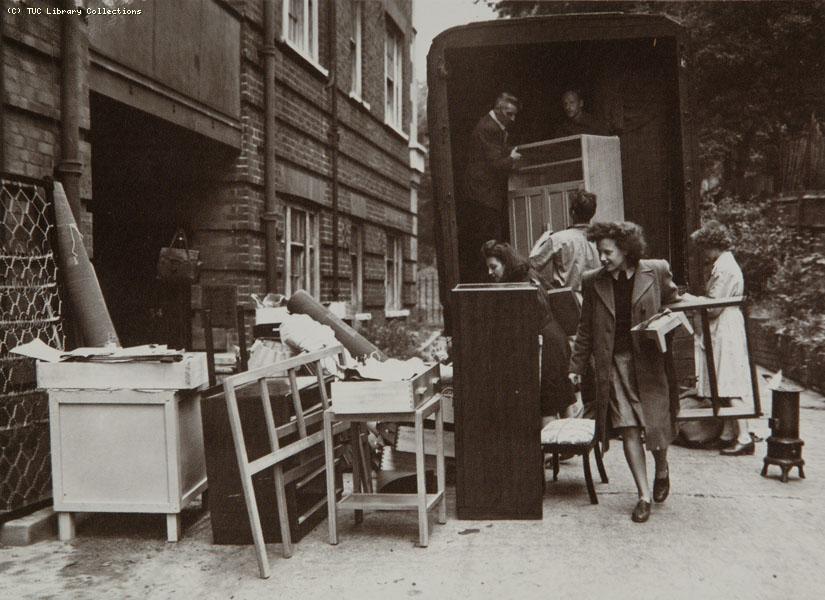
http://www.unionhistory.info/web/objects/common/webmedia.php?irn=534&size=275x200 FURNITURE TOO!
Squatters at Duchess of Bedford House, Campden Hill, Kensington, 1946.
(Photo TUC collection)

THE Con Dem government is bringing in a new law to make sqautting illegal. At present it is unlawful activity, but only a civil offence. Under the law being promoted by Home Secretary Kenneth Clark the police will not only be able to evict squatters from residential property but to treat them as criminals, who could face prison sentences.

As the Torygraph reported on March 18 last year:
"A senior Whitehall source told The Daily Telegraph Mr Clarke has made changing the law a priority because he is sick of seeing cases of law-abiding people fighting to regain possession of their properties. The source said: “Ken has had enough of seeing hard working home owners battle to squatters out. He is determined to use the full force of the law to save people from the nightmare of having to fight to get their houses back.

“The days of 'squatters’ rights' will be over.”

For a party called "Conservative" the Tories are good at taking away our age-old rights, with the help of their coalition partners who are "Liberal Democrats".

The media has obligingly provided stories of families returning from holiday to find a bunch of strangers occupying their home, and outrages like these:
" In 2009 squatters moved into David Blunkett's former grace and favour mansion in central London while others took over a £33 million house close to Nigella Lawson's home in Eaton Square, central London".

http://www.telegraph.co.uk/news/uknews/law-and-order/8388795/Squatting-to-be-made-illegal-vows-Clarke.html

This doesn't leave much space to raise a fuss about families who are losing their homes to be repossessed, or those who will face hardship and possibly homelessness because the government is putting a ceiling on housing benefits but would not dream of pegging rents. Their 'ceiling' could take away your roof. In London the number of people having to claim housing benefit is going up, as more people face wage cuts or lose their jobs, while landlords keep upping rents. Homelessness is also expected to increase.

So the politicians who like to preach "self-help" are taking a precautionary measure criminalising people who help themselves to empty property. The reference to it being "residential" does not specify that anyone is already living there. Those are cases for newspaper stories. But £3 million properties can remain empty for years. Then there are those more modest properties which local authorities board up, as Tory Westminster did, because they want to reserve them for sale.

In the 1970s there were entire streets left empty by "planning blight", having been taken over for redevelopment which was then postponed because funds ran out. In two cases I know local, often elderly, residents petitioned the council not to evict those nice young people squatting across the street because without them the places would be dark and derelict, prey to less desirable characters and rats. Sympathy and safety concerns went hand in hand, and the councils listened. But things have changed.

Yet squatting is traditional, or else you would not have "squatters' rights". Sometimes it has been a popular movement. After the Second World War, Britain had its pre-war legacy of overcrowded slums compounded by the problem of thousands of people who had been bombed out of their homes. Service personnel returning home determined that things must change found their families lodging with relatives or friends. Meanwhile, though promised house building was slow to get moving, the government still had lots of properties on its hands, from army camps with nissen huts to luxury blocks that had been requisitioned for officers.

One such place was Abbey Lodge, in St.John's Wood, near Lords cricket ground. Before it could be returned to private owners it was being refurbished and redecorated, under the auspices of the Ministry of Works. One evening as the workers were leaving, one man hid himself in a cupboard and waited till the rest had gone. Then he slipped out and opened the front doors, and up rolled the furniture vans and lorries, with people from Kilburn and other districts who needed homes. Abbey Lodge was squatted, or occupied!

The authorities responded by besieging the place with police to prevent food being brought in, and Labour's Housing Minister Nye Bevan wanted electricity and water supplies cut off, though the medical profession warned of the health risk if water was stopped.

Thousands of people rallied outside to challenge the police, blocking the main road for hours. I've begun with Abbey Lodge because I first heard about this in the 1960s from a Willesden trade unionist who had been one of that crowd outside. But Abbey Lodge was one of several places taken over like this.

For ex-marine Arthur Hill, living with his wife and baby in one room in his gran's house, where Mum and Dad also lived, was getting too much. So were rebuffs from the council housing department when he inquired about getting rehoused. He'd heard about people moving into disused forces camps, but "had enough of Nissen huts". Then "early one Sunday morning Ginger phoned to say that a large group were preparing to squat in a block of luxury flats in Kensington, that I dropped everything and went.

"This was it, the BIG ONE! The first ever mass squatting. We hit the headlines! Not that we ever had time to read them, but Monday 9th September 1946 The Times ran a headline:

‘1500 SQUATTERS OCCUPY LUXURY FLATS
— AUDACIOUS OPERATION IN WEST END’

The Duchess of Bedford House in Campden Hill was invaded, there must have been at least 200 of us, and we went straight in. Somebody had opened everything for us, and it was just like staking a claim, - and we did!"

http://www.bbc.co.uk/history/ww2peopleswar/stories/01/a2053801.shtml

I used to think of organise squatting as an urban thing, but the countryside had its housing problems too, and still has, from tied cottages and poor facilities to cottages priced out of the reach of working people because they are wanted for weekending commuters and gentrified.

At the end of the Second World War, there were different kind of invaders, people who had been moved around because of the war, either those in the armed forces, or workers whose factories or offices had moved out, or evacuees displaced from the city because of the blitz.

The war had shaken up people's ways of thinking too. Hadn't Londoners needing shelter from the bombing taken over the Underground stations at night? And if you had been in the forces, particularly in the kind of outfit where you are not only organised, but expected to use your initiative, and take places over when needed, might it not ocur to you to do the same in a concerted way in civvy street?

Chalfont St.Giles is a pleasant little place, known for Milton's cottage (the poet and Cromwell secretary had been advised to get out of London for his health) and the nearby Chiltern Open Air Museum, old pubs around the village green, and overlooked by pastoral land and some quite expensive desirable homes. Not the sort of place you'd expect to figure in class war history. But it does.

This episode even made Time magazine:

"Britain's Labour Government, long under fire for failing to straighten out the housing shortage, last week had a revolt on its hands. The leader was a lean ex-Commando-man, John Mann, of Chalfont St. Giles, Buckinghamshire. Mann had been sharing a small, unsanitary cottage with his wife, his five-year-old son, and ten strangers. At the local pub one night, Mann heard a Polish captain say that a deserted army camp at nearby Vache Park was being readied for Polish soldiers of General Anders' army in exile. Mann decided to get there first.

"At dawn, he and a handful of homeless veterans bloodlessly routed three Polish guards and seized Vache Park. Next day, 120 families had moved into the spacious army huts. After a flurry of resistance, local authorities capitulated.

"From Vache Park, the squatters' revolt swept over Britain. Near by, at Beech Farms, Chesham Bois, Polish soldiers raced squatters to grab empty huts, staked their claims by installing beds. When they returned with the rest of their belongings, the beds were on the lawn, the squatters in the huts. At Prestwick, Scotland, R.A.F. men were called out of movies and dance halls to guard their quarters. At Chandler's Hill Camp, Iver, Buckinghamshire, soldiers sent vain S.O.S. calls to the police when the squatters moved in, wound up amicably sharing the camp with them. At Hamilton, Lanarkshire, 19 squatters each paid a £1 fine for trespassing, then marched from court right back to their commandeered camp. Into the anti-aircraft establishments at London's Cricklewood Park, a veteran named Arthur Bunce led 15 families. Said his major: "Jolly good luck to you, Bunce. I would do the same thing if I were in your shoes."

" Most of Britain felt like the major. But the Labor Government squirmed. A reporter asked the Ministry of Works how it stood on the squatters' revolt. 'Oh,' said a spokesman, 'we stand well back. But they must be going crazy over at the Ministry of Health, and they say at least 20 generals expired at the War Office.' Timidly the Cabinet recommended that all squatters who were occupying camps essential for military or civilian training should move at once. Instead, veterans even began moving into empty private homes.

"This strange new mood the BBC called 'orderly lawlessness.' The squatters were not just people who had grown tired of waiting for new houses. Many were people who had never had houses before. Said Squatter Violet Bree at Vache Park: 'Is it not wonderful? So much space! We used to live in one room with my mother-in-law—I was terrified of her. They say it will be ten years before we get a house, but I do not mind if we can stay here. There is another room behind there (they are going to knock a door through) with a telephone. I never had a telephone before.'"

http://www.chalfontstgiles.org.uk/squatters.htm

Then as now there were Labour Party members and trade unionists involved in militant activity, such as squatting, but the Labour leadership then in government took a dim view, even the left-wing Tribune, loyal to Bevan, denouncing the squatters as anarchists no better than thieves. The Communist Party was actively involved in organising and supporting squatters, and made recruits. But eventually it backed down, supporting a compromise under which London squatters moved out of places like Duchess of Bedford House to accept alternative accomodation, only to find themselves in an old Victorian workhouse.

Still, the squatting movement of 1946 may have lent some urgency to government housing policy, one part being the production of pre-fabricated housing, the famous prefabs, some estates replacing those former army camps.

There's an article on "The Squatters of 1946", looking particularly at the movement in Buckinghamshire, in issue 25 of Socialist History, and the author Paul Burnham is speaking tonight at a meeting of the Socialist History Society, 7pm, at the Bishopsgate Institute, opposite Liverpool Street station.
http://www.socialisthistorysociety.co.uk/news.htm

Meanwhile for a bit of contemporary atmosphere around another of the London squats:
http://www.britishpathe.com/video/home-front-squatters

The man being arrested outside the Ivanhoe Hotel in Bloomsbury in this film was probably Johnny Morten, a Communist Party member, who had taken part in a deputation to Holborn Town Hall for the squatters in the hotel.

As the Evening News reported:

"When the deputation re- turned to the hotel he shouted up to a squatter leaning out of a first floor window.

Police told him to move on, but he continued to shout. He was then escorted by the
police to Tottenham Court-road police station, followed by a crowd, some of whom shouted 'Is this what we won the war for.'"


http://www.purplepoets.com/morten.html

Labels: History, housing, law, London

posted by Unknown @ 5:29 AM   0 comments

Tuesday, April 03, 2012

Seeking justice in Birmingham, Meeting it in Nottingham

[shrewsbury09ricky.jpg]
THE CASE THAT WILL NOT GO AWAY. Rally in Shrewsbury. On his feet speaking Ricky Tomlinson, to his right under other banner former fellow picket Terry Renshaw.

THE union battles of the 1970s have not gone away. They were in the background of two cases that came up today. In Birmingham, actor and former building worker Ricky Tomlinson and his fellow campaigners for justice for the Shrewsbury pickets applied to the Criminal Cases Review Commission (CCRC) to have their 1973 convictions overturned, on the basis that the case against them was contrived between the big building companies and the then Tory government.

It was after the 12-week national building strike in 1972, indeed five months after it, that police raided a number of homes in the area of North Wales and Chester, and took away two dozen men who had been active in the strike. Eventually, after a trial at Shrewsbury, they were variously convicted of conspiracy, unlawful assembly and causing an affray.

The charges related to a day when pickets had gone to Shrewsbury and Telford new town to encourage men still working there to come out and join the strike. In his book "The Key to My Cell", the late Des Warren recounts how at one site a boss challenged him to a fight, which he declined, and at another he was threatened with a shotgun by the boss's son -who later turned up as a prosecution witness against him.

At no time that day were any of the pickets arrested or charged with any offence. In fact, Ricky Tomlinson says that not knowing their way around, they were escorted by the police, and when they were leaving at the end of the day an officer thanked them for the way they had conducted themselves.

This gap between the events of the day and the move to arrest them months afterwards lends weight to their suspicion that a political decision took place behind the scenes. It was not just the links between the Tories and big building companies that were involved. The authorities had been humiliated by the miners' victory in closing Saltley coke depot with the help of Birmingham trade unionists in February 1972, and shaken by the way workers in London forced them to free the Pentonville Five shop stewards jailed later that year. Going for the less well-organised building workers was one way the government could remind us who is boss, and get its revenge.

All this is surmise. But just what the pickets were up against may be indicated by the fact that since Ricky Tomlinson began campaigning he has been refused access to some relevant official documents, on grounds supposedly of "national security".

Six of the pickets were jailed. Ricky Tomlinson and Des Warren received the longest sentences and became known as the Shrewsbury Two. Jailed for two years for conspiracy to intimidate, Ricky has since become a successful actor, starring in many films and on television in Brookside and The Royle Family.

Des Warren, charged with conspiracy, told the court "The only conspiracy was between the government, the employers and the police. " Jailed for three years, he came out of prison with ruined health, and did not work again. He died of Parkinson's disease, believed to have been induced by tranquilisers administered in jail, in 2004.

"We were innocent then and we're innocent now," said Tomlinson. "I promised Dessie that I would continue the fight to clear the names of all convicted pickets."

The application to the CCRC by the solicitors, Bindmans, is based on four years of work by researcher Eileen Turnbull. It will claim that the Conservative government interfered with the judicial process by encouraging the prosecutions to deter effective picketing, then a standard process in industrial disputes. Turnbull said that she used the National Archives at Kew to uncover details of the decision-making process in the prosecution.

"There is a lot of material and we are very optimistic that we will finally be able to overturn what we believe is a miscarriage of justice," she said. The legal submission claims that the trials were an "abuse of process" and the convictions should be quashed by the court of appeal. The CCRC has the power to refer such cases to the court of appeal.

Although the Shrewsbury convictions came under the Tories, the case does not show Labour in a good light. Trade unionists had been led to believe the incoming Labour government in 1974 would put things right, but then Labour Home Secretary Roy Jenkins - whose own father was imprisoned after the 1926 general strike - refused to interfere, and as Ricky Tomlinson says "We served more time under Labour than under the Tories".

Nevertheless, one Labour MP was in Birmingham today to support the pickets case. That was John McDonnell, MP for Hayes and Harlington, who campaigned unsuccessfully during the last Labour government for some restoration of rights taken away by Tory anti-union laws.

Meanwhile in Nottingham...

A VERY different case came to a conclusion.

The same newspapers which once pilloried Des Warren and his comrades as "wreckers" had nothing but praise for those men who led a breakaway from the National Union of Mineworkers to oppose Arthur Scargill and the 1984-5 miners' strike. These were the heroes, decent honest men who supposedly had nothing but the good of the country and welfare of their fellow miners at heart.

Neil Greatrex, 60, who led the breakaway Union of Democratic Miners after the strike was convicted today for stealing nearly £150,000 from his own union's charity. Greatrex was found guilty of 14 separate thefts from a care home for miners.

He denied charges of making fraudulent claims of work done on the building, near Skegness, to pay for a new kitchen and garden improvements at his own home, telling Nottingham crown court the payments had been in lieu of salary as the UDM's former president, according to established custom and practice.

The UDM was formed by Nottinghamshire colliers who chose to work during the year-long strike. Its general secretary, Mick Stevens, 60, was cleared of similar charges after telling the court he had signed cheques under the impression that the money was going to the care home. Both men were trustees of the Nottinghamshire Miners Home and carried out their financial dealings through a subsidiary company, Phoenix nursing and residential homes.

Greatrex funnelled £148,628 to two building companies and a joiner for work that staff at the home in Chapel St Leonards told the court had never been done. The two-week trial was told by prosecutor Martin Hurst that the scheme was "a sophisticated attempt to steal from a charity" to pay for items ranging from a granite worktop to a pool for ornamental koi carp. Trustees of the charity were expressly forbidden to take any benefit from it.

Greatrex and Stevens were criticised by Labour MPs in 2004 after it emerged they were receiving salary packages worth £150,000 while leading a union with only 1,431 members.

The verdict was welcomed by John Mann, the Labour MP for Bassetlaw, who worked with the Serious Fraud Office on the case. He called for a renewed police investigation into UDM involvement with solicitors struck off for grossly expensive but inadequate handling of miners' injury compensation cases.

He said: "The whole thing has been a disgrace from start to finish and now we have the predictable demise of the union leader at the heart of the scandal. I am calling on the police to open up their investigation into whether others have benefited from the UDM fraud.

"The UDM should also pay back monies taken from the compensation of sick and elderly miners, reopen the care home as a miners' convalescent home and invite in the fraud squad to investigate every aspect of its finances over the last 10 years."

While I hope the police do their job, investigate further, and bring charges if necessary, I am reminded that my then trade union, the right-wing led EEPTU, reportedly lent a hand in the formation of the UDM, as I'm sure did the state itself one way or another. The EEPTU then joined the enginers, till both were swallowed up by Unite, but there should be enough there for someone in the movement to investigate.

http://www.guardian.co.uk/business/2012/mar/20/udm-union-charity-court

http://www.gainsboroughstandard.co.uk/news/local-news/udm-men-stole-nearly-150k-from-miners-charity-trial-told-1-4365408

http://www.guardian.co.uk/uk/2012/apr/03/neil-greatrex-guilty-miners-union-theft/print

http://www.bbc.co.uk/news/uk-england-nottinghamshire-17602275

Labels: building, law, trade unions

posted by Unknown @ 6:42 PM   0 comments

Saturday, January 21, 2012

Bosses get off -for now. But workers get ready for another round by celebrating ground they have gained.


FUNNY, does not look like the face of defeat! Raising a glass with supporters yesterday, Dave Smith (centre) says fight will go on. Next stop Strasbourg?
(photo by Frances McGinlay)

LONDON building worker Dave Smith was celebrating with friends and supporters yesterday afternoon, even while the tribunal which had heard his case against major building and civil engineering contractor Carillion was still deliberating in chambers.

Dave, a qualified engineer who was denied employment for years under the blacklist, had little illusion about the likely outcome. He and his dedicated lawyers had presented evidence showing how information about him - some of it false - was secretly circulated among building firms to effectively punish him and his family for his legitimate union activity and concerns about safety, by making sure he could not get work.

Carillion was unable to deny what it did. The company won, because it argued, and the tribunal evidently accepted, that it could not have infringed Dave Smith's rights, because he was - like a large proportion of Britain's workforce today - employed via an agency, and had no rights.

That is apparently the state of affairs under British law as it stands. It might not be the case under higher, international laws on human rights to which Britain is supposed to adhere.

As Dave Smith remarked on Facebook, "it's not a battle, it's a war". He is considering going to the human rights court in Strasbourg, and meanwhile a bigger case involving 100 workers is looming in Britain. Dave's parting shot, for now, in the Blacklist Support Group, on Facebook:
"Let's put it like this: I bet Carillion didn't have a celebration party".

Here is a press release from the Blacklist Support Group:

Agency workers have no legal protection against blacklisting by multi-national firms according to a shock decision in the Central London Employment Tribunal today. The court found that Dave Smith (an engineer) had been blacklisted by the respondents Carillion (JM) Limited and Schal International Limited (a wholly owned subsidiary of Carillion) because he raised concerns about asbestos on building sites and because of his trade union activities.

The firms actually admitted that their managers had supplied the malicious information to Mr. Smith's blacklist file in a signed statement to the court.

David Renton (pro-bono barrister for Mr.Smith) argued that the blacklist was a major breach of the Human Rights Act and therefore the law should be interpreted in such a way as to protect all "workers" including agency workers. However the court found that because Mr. Smith was employed through an employment agency, UK employment law does not protect him (or millions of other agency workers), so on that point alone the multi-national constrcution firms won on this legal technicality.

Mr. Smith said outside the court:

"The blacklisting conspiracy is a deliberate breach of human rights by big business. Human Rights are supposed to apply to everyone but Carillion and their subsidiaries have got away with systematic abuse of power simply because I was an agency worker. If the British justice system does not protect workers rights, then we will be taking our case direct to the European Court of Human Rights in Strasbourg"

A secret blacklist file collated by the Consulting Association was presented as evidence and contained Mr. Smith's photograph, address, National Insurance number, work history, car registration, union credentials, information about his family and pages of information about times when Mr. Smith had raised concerns about poor toilet facilities or asbestos on building sites. This information was secretly supplied to the blacklist by managers from major building companies. The blacklist file was covertly shared amongst the 44 largest construction firms in the UK and resulted in periods of unemployment.

Despite the result, the evidence that came out in court about including invoices and hundreds of blacklist files is almost certain to become a key element in a larger "class action" style claim being brought to the High Court by 100 blacklisted workers in the next few months with representation by Hugh Tomlinson QC (the barrister representing celebrity clients in the News of the World phone hacking cases).

There is more to this case still. The evidence which has come up shows that spies attended union meetings and gathered information about people outside work.

Dave Clancy said in the hearing under oath:

"There is information on the Consulting Association files that I believe could only be supplied by the police or the security services"
He also told the court that the Consulting Association held information on elected politicians, journalists, lawyers and academics.


Dave Clancy is the Head of the Investigations Team at the Information Commissioners Office, the man who led the raid on the Consulting Association premises and discovered the blacklist. He is an ex-police officer.

Labour MP John McDonnell said after hearing these revelations:
“I am calling upon the Government to launch a public inquiry into the full extent and impact on people’s lives of blacklisting. These revelations are truly shocking and warrant a detailed and open, public investigation."

Mr. Smith was represented by: David Renton (barrister) and Declan Owens (solicitor) on a pro-bono basis via the Free Representation Unit


More reports:
http://www.socialistworker.co.uk/art.php?id=27291

http://blogs.mirror.co.uk/investigations/2011/08/ten-years-of-pain-for-blacklis.html

http://www.guardian.co.uk/money/2012/jan/17/multinational-admits-engineer-blacklisted-uion

report on earlier hearing:
http://www.hazards.org/blacklistblog/2011/09/01/judge-backs-worker-against-blacklisting-carillion/

Labels: building, law, snoops and blacklists, trade unions

posted by Unknown @ 7:33 PM   0 comments

Thursday, January 19, 2012

Blacklist case could break new ground

WORKERS fighting the employers' blacklisting of those who stand up for their rights will know by the end of Friday afternoon whether or not they have won a historic case against a major construction company.

Carillion plc boasts of employing around 50,000 people, and having annual revenue of around £5bn, with operations across Britain and in Europe, Canada, the Middle East, North Africa and Caribbean.

Dave Smith is a skilled engineer who found himself blacklisted and unable to get work for which he was qualified, after he had raised concerns about asbestos and poor toilet facilities when he was a safety representative for the building trade union UCATT.

Dave was fired from a Schal site after presenting a petition from 150 workers complaining about “pigsty” toilets. One manager filmed Dave as workers protested against his dismissal from the Schal job in 1999. Schal and Mowlem are both part of Carillion now.

This week the Holborn employment tribunal has been hearing from Dave and his legal representatives, about how he and his family were affected by the blacklist, and from Carillon defending its part. When I managed to look in on Wednesday the room was packed, with a number of workers having come to support Dave Smith and follow the case. Dave's lawyer David Renton was attempting to elicit from Carrillion management an acknowledgement of responsibility for agency staff employed on their sites.

Two years ago the Information Commissioners Office(ICO) which is concerned with data protection ordered a raid on the Midlands offices of the Consulting Association(CA), a business established by a former officer of the notorious right-wing Economic League, whose anti-union, witch-hunting and intelligence gathering activities went back to 1919.


What they uncovered was a collection of confidential files on workers, to which companies could provide information, and which could then be circulated to those who subscribed, ennabling them to maintain a blacklist. This is particularly effective in the construction industry, where workers have to apply for work as it arises, but can find that a black mark against their name for whatever reason can affect them from way back. (By contrast, workers affected in later life by health problems such as caused by exposure to asbestos may have difficulty tracing past employers such as sub-contractors who are no longer in business, in order to pursue compensation claims).

In July 2009, Ian Kerr, the private investigator who ran the CA, was fined £5,000 under the Data Protection Act. But in the previous five years firms which subscribed had paid £500,000 to the CA for its services.

Evidence disclosed by the ICO investigation showed that senior managers from Carillion and two subsidiary companies, John Mowlem and Schal, gave information to the illegal CA operation which could be used in the blacklist.This information was circulated among the 44 largest contractors in the UK building industry. They used it to deny people like Dave work in the industry. An estimated 3,200 workers were effected by the blacklist, and doubtless many still are.

Dave Smith was the first person allowed to view the entire CA blacklist, without restrictions. He found that his own file, including information on his wife and friends, was 36 pages long. Dave is accusing Carillion of victimisation, and says he and his family were made to suffer as a result of his perfectly legitimate activity as a trade union representative concerned over health and safety. For over ten years he could not get work in construction or earn a decent wage.

As Dave says, “I was a qualified engineer during one of the longest building booms this country has ever known. My children were on milk tokens.”

In his closing submission today, David Renton said:. "This case is about companies telling lies about a worker. Lies that caused that worker detriment. Even now the companies are still not prepared to fully come clean about what they have done"

Besides being able to cite over a hundred files that show the extent of the blacklisting of which his was one case, Dave Smith could be breaking new ground for workers' rights under law.
He argues that the blacklist breached Article 8 (right to privacy) and Article 11 (right to association) of the European Convention of Human Rights.

Under current UK law, only direct “employees” are entitled to legal protection at work. But the possible human rights breaches call for the Employment Tribunal to interpret legislation in such a way to cover all workers. A victory for Dave would set a precedent.establishing rights for for Britain’s 1.6 million agency workers, who are currently deprived of employment law rights.i
"If we win - we're told it will be a landmark decision for agency workers and blacklisting
If we lose - we're off to the European Court of Human Rights, " Dave promised yesterday.

There is more to this case still. The evidence which has come up shows that spies attended meetings and gathered information about people outside work.

Another Dave, Dave
Clancy said in the hearing under oath:

"There is information on the Consulting Asociation files that I believe could only be supplied by the police or the security services"

He also told the court that the Consulting Association held files on elected politicians, journalists, lawyers and academics.


Dave Clancy is the Investigations Manager at the Information Commissioners Office, the man who led the raid on the Consulting Association and discovered the blacklist. He is an ex-police officer.

Labour MP John McDonnell said after hearing these revelations: “I am calling upon the Government to launch a public inquiry into the full extent and impact on people’s lives of blacklisting. These revelations are truly shocking and warrant a detailed and open, public investigation."

With thanks to Simon Basketter (Socialist Worker ) and John Millington(Morning Star) for their coverage of case.

http://www.socialistworker.co.uk/art.php?id=27223
http://www.morningstaronline.co.uk/news/content/view/full/114294

Labels: building, law, snoops and blacklists, trade unions

posted by Unknown @ 9:33 PM   0 comments

Thursday, January 12, 2012

High Street Robbery

SOME stories illustrate what the government is doing to young people. First there's Cait Reilly. This 22-year old studied geology at university, but found she could not get a job in her field. So while she had to sign on and claim unemployment benefit, Cait volunteered to help in a museum.

It seemed like a sound move. It might not bring any more money. but besides giving her some interesting activity it would be relevent experience to put in her CV when applying for a suitable job.

But the authorities had other ideas. At the suggestion of her Jobcentre Plus adviser Cait attended a retail jobs ‘open day’, which she was told would lead to a period of training and a job interview.

Miss Reilly and other candidates were sent to an employment skills training workshop for a week, aimed at improving attributes such as communication skills, followed by the five-hour-a-day stint at Poundland near Miss Reilly’s home in King’s Heath, Birmingham, in November.

She and five other claimants spent their time on the placement sweeping up and stacking and cleaning shelves, before they had to attend a final week of training under the ‘sector-based work academy’ scheme (SBWA). The promised job interview never materialised.

As she said: ‘I was actually doing something that was helping me work towards a job and was taken away from that to do something of no value to me. It was very frustrating.’

Under the scheme that is supposed to "encourage" the unemployed off benefits, claimants are being required to take part in an Employment, Skills and Enterprise Scheme in order to receive their Jobseekers Allowance (or dole as we old timers used to call it). The Department of Work and Pensions says that candidates who ‘express an interest’ in doing unpaid placements will lose their JSA if they pull out after the first ‘cooling off’ week on the scheme. But Cait Reilly says she was not informed about any cooling off period.

She said she felt she had to do it because ‘without my Jobseeker’s Allowance, I would literally have nothing’. She believes the placement allowed Poundland to use her as ‘free labour’ in the run-up to Christmas. She has now returned to her voluntary role at the city’s Pen Room Museum of writing and pen trade memorabilia, still looking for paid employment.

Cait is now pursuing legal action against the government. Her solicitor, Jim Duffy, said the practice contravenes article 4 (2) of the Human Rights Act, which states: ‘No one shall be required to perform forced or compulsory labour. ...This Government has created – without Parliamentary authority – a complex array of schemes that allow Jobcentres to force people into futile, unpaid labour for weeks or months at a time".

Read more: http://www.dailymail.co.uk/news/article-2085142/Unemployed-graduate-sues-ministers-forced-stack-shelves-Poundland.html#ixzz1jCAInzrG

Talking about this case soon brings people relating similar experiences. One friend's son is doing a plumbing course at college but has been sent to fill shelves in Tesco. A well-known chain laid off all paid staff in the run-up to Christmas and relied on those working for their dole. God bless us all, said Tiny Tim.

Poundland says it had a ‘positive experience’ of the work placement programme which was ‘designed to provide on-the-job training for those looking to retail as a career opportunity’. Poundland's press website says the chain, which was recently acquired by Warburg Pincus, a leading global private equity firm, aims to continue its impressive growth with plans to open a further 50 new stores in 2010/11, creating an additional 2000 jobs.

"Highlights for the year ending 28 March 2010: Operating profit of £21.5 million - up 81.5 per cent (2008/9 £11.8million)• Turnover £509.8 million (net of VAT) - up 28.7% (2008/9 £396.2 million)• c2,000 new jobs created". It does not say how many were paid. It also boasts that £180,000 was raised for Macmillan Cancer Relief. So perhaps young people like Cait Railly should put down their shelf-filling stints on their CV as "working for charity".

http://www.poundland.co.uk/press-centre/2010-press-centre/full-year-results/

Meanwhile to see how the problem is people on the dole not wanting to go after jobs, we go over to Llandudno, north Wales, where DFS the furniture store is due to open a new branch on February 18. So far the company has received 1,385 applications for the 16 jobs that it advertised.

Latest figures from the Office for National Statistics show that 9.1 per cent of Wales’ workforce were unemployed in the period of August to October 2011 - up from 8.4 per cent between May and July last year.

Read more: http://www.dailymail.co.uk/news/article-2085142/Unemployed-graduate-sues-ministers-forced-stack-shelves-Poundland.html#ixzz1jCAzVOfy


In these troubled times it is not just "ordinary" folk who are getting in trouble. Take TV chef Anthony Worral Thompson. As a friend on Facebook comments, "Millionnaire AWT, a Tory party fundraiser, was caught five times stealing food and wine from Tesco’s worth around £100. He got off with a warning. Nicolas Robinson, a 23-year-old student, was arrested for stealing water worth £3.50 from Lidl during the London Riots. He was given a 6 month prison sentence."

http://uk.news.yahoo.com/anthony-worral-thompson-arrested-for-shoplifting-cheese-and-wine.html
http://politicalscrapbook.net/2012/01/anthony-worrall-thompson-ybf/

Others have chipped in to cite the person who was jailed for receiving a tee shirt that had been nicked,and the juvenile sent down for stealing a plastic dustbin. Some even recalled AWT denouncing the rioters last Summer.

Now come on, fellows, let's be fair. Anthony Worral Thompson could presumably have afforded to pay for the wine and cheese he stole from the store in Henley on Thames, but had his mind on other things. Whereas the people who were sent to jail could not prove their families did not need what they stole, and anyway, the government had told the magistrates what kind of sentences it expected them to pass after the riots. And there were no riots in Henley on Thames, were there?

Seems AWT is still down to speak in schools and colleges for the Tory Young Britain Foundation (unlike those trade unionists I know who have prepared talks to give in schools explaining about trade unions, but find they can't get invited). So he will be able to explain why shoplifting like his is different.
http://politicalscrapbook.net/2012/01/anthony-worrall-thompson-ybf/

If this seems like a recipe for discontent, even disorder, let us note that the government is being asked to consider other means, besides punitive sentences, for teaching the 'oiks' their place.

Plans to open military-run academies in deprived areas were condemned as "national service for the poor" today.

Right-wing think tank Respublica urged the government to open a pilot programme of military academies in underprivileged areas to "tackle poor discipline and educational failure" in the wake of last summer's riots.http://www.blogger.com/img/blank.gif

It claimed the academies "would open up new opportunities for those lacking hope and aspiration. They would change the cultural and moral outlook of those currently engulfed by hopelessness and cynicism."

http://www.morningstaronline.co.uk/index.php/news/content/view/full/114063

Yeah right. Stand up straight there and speak when you're spoken to! Get in line there!
Not that I suppose they will be giving out any proper military training and hardware to practice with in those deprived areas? That would be dangerous.

Labels: law, students, trade unions, unemployment, youth

posted by Unknown @ 2:38 AM   1 comments

Friday, October 14, 2011

CPS says "Sorry". But does the government give a FACK?

The Crown Prosecution Service (CPS) has apologised to the family of Mark Wright for failings in the way it investigated and took action over his death.

Mark, the 37-year old father of two children, had gone to work for a firm called Deeside Metal near Chester, which disposed of scrap metal and waste. He was not happy with safety and conditions there, but soldiered on with his family to keep.

One day in March 2005 a lorry delievered a load of what the driver said were empty aerosols. The firm did not check, but told Mark to put them in a crusher. In fact, the cans contained inflammable materials, and there was an explosion in which Mark was engulfd in flame and inhaled burning gas.

The CPS initially ruled that neither Deeside Metal, aerosol manufacturer Jeyes nor his boss Robert Roberts should face manslaughter charges.

I remember Mark Wright's mother, at a Workers Memorial Day rally in London, describing how the family had heard about his horrible death. Rather than investigate the circumstances the police were more concerned with warning his parents against "harassment" of the employers when they took flowers to the site.

It took four years cmpaigning by the Wright family before the CPS decided Mr Roberts should face manslaughter charges, and a court ruled that the length of the delay meant any subsequent trial would be an "abuse of process."

Jeyes, Deeside Metals and Mr Roberts were convicted of breaching health and safety laws in December 2010.

Mr Wright's mother Dorothy Wright said the apology "brings to a close our battle for justice. I would hope that in future workplace killing will be considered as the serious crime that it truly is."

Labour MP Katy Clark welcomed the apology, but said it was "long overdue" and would have not have been made but for tireless campaigning by Ms Wright and Families Against Corporate Killing (Fack), the campaign group of which Ms Wright is a founder member.

She added: "It is clear there could have been a criminal prosecution for manslaughter. The failures in how Mark's case was handled meant that this did not happen. Now that these failures have been acknowledged it is essential that measures are put in place to stop them from ever reoccurring."

Meanwhile the Con Dem government is proceding with measures to run down the Health and Safety Executive inspectorate, and reduce the "burden" of safety regulation on companies. The September issue of Hazards magazine says minister Chris Grayling had met ten different industry bodies this year to discuss his plans. "But he couldn't find any time in his diary for FACK..."


http://www.morningstaronline.co.uk/news/content/view/full/110706

http://randompottins.blogspot.com/2011/03/your-safety-your-life-their-burden.html

http://www.independent.co.uk/opinion/commentators/johann-hari/johann-hari-thanks-to-cameron-more-men-like-this-will-die-2275035.html

http://www.hazardscampaign.org.uk/fack/about/index.htm

Labels: law, safety

posted by Unknown @ 2:21 PM   0 comments

Wednesday, June 16, 2010

Will new inquest bring justice for Jeremiah?

THE long-sought second inquest on the death of student Jeremiah Duggan is to open next Tuesday at Barnet coroners' court, in north London. Jerry was killed in Wiesbaden, Germany, where he had gone to attend what he thought was a peace conference to oppose the war on Iraq.

His body was found by the autobahn just outside town, on March 27, 2003. German police accepted that he had run out into the motorway and been struck by two vehicles.

But a London inquest in 2004 rejected a suicide verdict, after hearing from the Metropolitan Police that the organisers of the Wiesbaden conference, the Schiller Institute, were a front for the political cult led by the American, Lyndon LaRouche. Hours before his death Jeremiah Duggan had 'phoned his mother saying he was in "big trouble" and wanted to be rescued. The coroner ruled that the student had been in a "state of terror" when he died.

However it was left to the Duggan family and friends to campaign for a full and fearless investigation into Jerry's death. The evidence they gathered with the help of professional experts pointed to a very different picture than that accepted by the German authorities, even as to whether Jerry was killed by the two vehicles, or elsewhere, and his body brought to where it was found.

The LaRouchites meanwhile have claimed variously that the British student was on drugs, or some kind of spy, and that the allegations of suspicious death were part of a high-level conspiracy against them involving British and US government figures, and the Tavistock clinic in London.

At a hearing in the High Court in London last month the Duggan family won their case for a new inquest. Before it can be held the process of gathering the facts and making the enquiries takes place and only then does the Coroner hold a full Inquest and give a verdict. The official opening of the Inquest will start the process and be presided over by the North London Coroner Mr Andrew Walker.

After the official opening relevant matters can be discussed in preparation for the initiation of a full fact finding enquiry into the cause and circumstances whereby Jeremiah met his death. It is not a criminal trial nor will any guilty party be blamed. But Lyndon LaRouche, who from the start opposed any full investigation, has written to the Coroner to become an "interested party."

In April 2010 Judge Elias and Mr Justice Aikenhead were presented with legal witness documents which provided new information about how Jeremiah was in the offices of the LaRouche Executive Intelligence Review prior to his dead body being found on the road and that Jeremiah was seen as the enemy and a spy and hunted down . This information together with other reports led the two Judges in the Royal Court of Justice to state that “in the interest of Justice” a fresh Inquest should be held.

In Germany, where the Wiesbaden prosecutor had ruled that no one else but Jeremiah Duggan himself had been responsible for his death, a spokesman for his office stressed again in March last year that there was no evidence linking the LaRouche movement to the young man's death. In February 2010 the Federal Constitutional Court of Germany rejected the Duggan family's request for judicial review of the decision not to reopen the inquiry.

The Duggan family and supporters say they welcome the start of a process of Justice and hope it will "set a precedent of how human life is to be valued whether at home or abroad, but also show how we are with Germany and France members of one European Community and committed therefore to assist one another in examining fully and fearlessly how Jeremiah met his death".

Official opening 9am on Tuesday 22ndJune 2010 ( one hour duration)

BARNET NORTH LONDON CORONERS COURT29 Wood Street High Barnet EN5 4BE
Tel:020 8447 7680.Nearest tube Northern Line High Barnet.


For more information :www.justiceforjeremiah.comor emailjusticeforjeremiah@googlemail.com

Labels: Duggan, law

posted by Unknown @ 8:01 AM   4 comments

Friday, June 11, 2010

'As one door closes, another one opens...'


THE National Shop Stewards Network(NSSN) will be holding its annual conference on June 26,
and it is likely British Airways cabin crew will be speaking about their ongoing dispute, even if they have to hide their faces or appear in disguise to avoid yet more victimisation by BA boss Willie Walsh.

The employer has banned people from posting messages on Facebook or talking to local papers, taken disciplinary action against 50 workers, and sacked their branch secretary for taking time on union business,
before reaching for another High Court injunction on May 15.

"It's a free country", as we used to say.

Railway workers too have had their experience of court injunctions derailing their union's legally balloted strike actions. The National Shop Stewards Network was formed on an initiative from their union, RMT, arising from discussion at a conference it called on the crisis in working class political representation.

So the NSSN conference, which attracts workplace representatives, trades union council and branch delegates and workers from across industry and public services, is bound not only to hear reports from ongoing struggles but to consider the political and legal dimensions. We now face a Tory government committed to cuts and privatisation, to making working people and the poor pay for the rich capitalists' crisis, and armed with the Tory anti-union laws which New Labour so dutifully maintained for them while in office.

We have seen unions conducting ballots in accord with the law, only for the results to be challenged and even overturned on trivial, contentious, even fabricated reasons. John Hendy QC who has acted for the unions says he has been told by a senior judge that there is no right to strike in this country. (See also:
http://ilj.oxfordjournals.org/cgi/pdf_extract/39/1/82)

We heard the other day that Labour MP John McDonnell, who fought for a trade union freedom bill under the last Labour government, had withdrawn from the Labour leadership contest. Now, thanks to RMT trade unionist Janine Booth, writing in the Stroppyblog, is the good news:

As one door closes another one open: John McDonnell tops the poll in the Private Members' Bill Ballot.

John McDonnell MP has been drawn first in the Private Members' Bill Ballot today and has opted for a Bill to tackle abuse of trade union ballots by employers.

John McDonnell said:

"It's a funny old world, as one door closes another one opens. Coming top in this poll will enable me to tackle an abuse of the current employment laws by employers that I have tried to reform for the last 4 years."

"As we have seen in the current BA Cabin Crew dispute and many other recent disputes, employers have been able to exploit a loophole in the existing law by using minor technical errors in a trade union ballot for industrial action to frustrate the democratic decisions of trade unionists who wish to take action.

This resort to the courts by some ruthless employers is bringing current employment law into disrepute and undermining industrial relations in this country. The courts are being dragged into disputes and used as weapons in the hands of bullying employers. Even where there have been overwhelming majorities in ballots in favour of strike action, minor technicalities which would have no material effect on the outcome of the ballot, are being exploited to negate the democratic decision of the trade unionists involved.

This cannot be right and in the interests of good industrial relations needs to be addressed."


Note-to Editors-

Over the past four years John has made several attempts to tackle this issue by introducing amendments to the then Government's employment legislation and promoting in Parliament the TUC backed Trade Union Freedom Bill.


I know some NSSN activists, including my good friend Dave Chapple, who is NSSN chair, have felt I attached too much importance to the Labour Party contest. They argue that Labour is past saving, and that anyway trades unionists must rely on their own strength rather than putting any faith in parliament. I can't say they are entirely wrong. Certainly that so few Labour MPs were even prepared to nominate a socialist says something about the parliamentary Labour Party.

Yet Labour was originally formed to defend trade union rights, as a result of the experience of the RMT's forerunners, the Amalgamated Society of Railway Servants, confronting the Taff Vale judgement which said trade unions could not be indemnified against legal action for the results of striking. And until we have built an alternative, we might look at Labour today, and apply the saying that it is
"Better to light one small candle than to forever curse the dark".

So long as John McDonnell or any other MP does hold up that light, I am sure that everyone coming to the National Shop Stewards Network conference, whatever their views on the Labour Party, will agree on welcoming this news.


National Shop Stewards Network Conference, 11 am Saturday June 26, 2010,
South Camden Community School, London NW1

http://www.shopstewards.net/

Labels: Labour Party, law, trade unions

posted by Unknown @ 11:19 AM   0 comments

Thursday, May 13, 2010

The Law isn't always an ass!

I'M sorry I missed a good day in the High Court today and I imagine, a good drink with friends afterwards. Mr.Justice Eady struck out the libel case being brought by Tower Hamlets Tory activist Johanna Kaschke against journalist and blogger David Osler.

He did so on grounds of "abuse of process".

I'm not well up on law, and won't attempt an interpretation of this. I did attend court the other week when the lawyer acting for Dave Osler made application for the case to be struck. Judge Eady suggested to Ms.Kaschke that since the differences between anything she had said and anything Mr.Osler had allegedly said about her were slight, and as he had been prepared to withdraw anything that was wrong, it seemed pointless to go to the expense of a jury trial.

Kaschke replied at some length, saying she had already devoted time and expense to bringing the case, that her business had suffered, and so on. She did not accept the judge's suggestion that this was good reason to stop now. Later, she seemed to question whether Dave Osler had referred accurately to an article from Der Spiegel which had appeared, then disappeared, from her own blog site. Claiming her link with fundraising for Rote Hilfe, which assisted members of the Baader-Meinhof group, had only come about through her musical interests, she went on to refer to details of a police raid and court case in Germany, which, as the judge pointed out happened thirty years ago.

It sounded interesting but I could not understand its relevance to the present case. Nor I suspect could Mr.Justice Eady, though he listened with patience, as I suppose is his job.

Anyway, you read the full details of his decision at:
http://www.bailii.org/ew/cases/EWHC/QB/2010/1075.html

Johanna Kaschke is needless to say, not a happy woman, as she makes clear amid her rejoicing at the advent of David Cameron's Tory-Liberal Democrat government, though she finds comfort in Judge Eady not having issued an order forbidding her from pursuing further cases:
"A gagging order would make it clear to the world, that if my name was added to the banned souls in the British legal system that there is no fair justice in this country. the Left are already allowed to run havoc with people’s reputation and get away with whatever they like; is it any wonder that Karl Marx chose London as his second home when the Germans had thrown him out".

The odd thing is, well one of the odd things about this case, that three years ago when Dave Osler was supposed to have libelled Johanna Kaschke, he had no reason to think she was not one of those Lefties whom she now complains are running around, protected by British justice. (Karl Marx, incidentally, was the bringer of a successful libel suit, not the subject of one).

It all started when then comrade Kaschke had obtained but one vote, having offered herself to be shortlisted as a Labour parliamentary candidate (With Bethnal Green and Limehouse both now having returned Labour MPs, just think what we have missed!) Upset by rejection, she joined George Galloway's Respect, and then a Communist Party, before moving on to.. the Tory party! All in one year.

But meanwhile, having offended her, Dave Osler offered her the right of reply, as he said was the custom within the Left and the labour movement. In court the other week, Johanna Kaschke cited this to argue that he had not really offered her the right of reply, as she was not a socialist.

Indeed, not only has Kaschke included speeches by Margaret Thatcher about socialism on her blog,
http://johannakaschke.blogspot.com/
but she has taken exception, both in court and her blog, to the accusation that she ever had connections with left-wing extremists.
"..., there is no evidence whatsoever in the extensive paperwork I provided that I was ever accused of links to left-wing extremists by the German authorities. I have got a letter from the German Attorney General to proof that point. I do not know why Eady J chose to ignore that evidence".
(note that emphasis, it is in the original)
http://jkaschke.wordpress.com/2010/05/13/kaschke-v-osler-2010-ewhc-1075-qb/


That might be misinterpreted, but I will leave it to Ms.Kaschke to keep on digging. She has some more cases pending.

Last time I blogged about Johanna Kaschke I was impressed by the number of committees for which she managed to find time, but also by her wide-ranging knowledge of subjects including the Knights Templar, and significant numbers. I'm surprised she did not notice that yesterday was the 13th.

As it is, suggesting that blogger Dave is some kind of media Goliath, she has commented ruefully: " I think it is amazing how well Mr Osler’s publicity machinery is organised to give interviews after the hearing and put it on YouTube straightaway, for that extra bit of publicity".

Yeah. Amazing what some people can do with a laptop and/or a
mobile.

I wonder, though, without any of this litigation, how many people would have noticed, let alone remembered what Dave Osler said in a blog, three years ago about an obscure East End character, and a long spent German court case? Far from silencing him, the case has amplified the issue through a large number of other blogs and into the news media. Maybe this will give some others reaching for their libel writs pause for thought.

See:
http://www.davidosler.com/
Jack of Kent: What the Osler Decision Means

Labels: Friends and Fellow Bloggers, Kaschke, law, London

posted by Unknown @ 5:45 PM   6 comments

Tuesday, April 13, 2010

Making War, Using Law

HOW far is British law, as well as police action, being twisted into a means to punish and intimidate anyone who opposes Israeli aggression and solidarises with the Palestinians? We heard Israeli Zionists fuming and raging about the possibility that some of their generals and politicians could be arrested if they set foot here, and charged with war crimes. That arose from a citizens' initiative led, in the first place, by an Israeli born lawyer. First time it was going to be tried the Israeli general was tipped off by someone in the Metropolitan Police, and stayed on his El Al plane at Heathrow. Since then British ministers have done nothing but apologise to the Israelis, and promise to remove the offending legislation.

It's another matter when maintaining 'order' in Britain. Those responsible for the law are far less considerate, or even neutral.

Last year, on my way home from a demonstration in Trafalgar Square over the onslaught on Gaza, I was overtaken by a crowd of angry kids for whom listening to speeches was obviously not enough. They turned left into Shaftesbury Avenue, heading west towards the embassy. Police cars came haring up, disgorging officers who had been taken by surprise and I guessed would be mad at this.

Later when we did have an official march heading for the embassy - or supposed to go past it - most of us probably realised on clocking the police in Kensington High Street as well in front of Palace Green, many in riot gear, that discretion being the better part of valour, it might be a good idea to furl our banners as soon as decently possible, and make off down side streets, before they trapped us.

Unfortunately many of those whose feelings had rightly been aroused by the agony of Gaza were new to the game we call demos, and the ways of the police, and I doubt they would have listened to words of caution. But that's no excuse for the way they have been treated, not just by police, but by the courts one year later.

Some 78 people have been charged with public order offences. In February and March almost two dozen young men, mostly Muslim, appeared at Isleworth Crown Court, and were sentenced to between eight months and two and a half years imprisonment. That rather puts my two quid fine for defacing the War Office during the Cuban missile crisis into the shade. (A crowd of us had turned from the well-defended US embassy in Grosvenor Square and swept through the West End and down to Whitehall before the police moved in. Myself and a mate spent a night at Rochester Row police station. But they were pretty gentle in those days).

Angered by the Gaza slaughter, frustrated and provoked, by police "kettling" tactics, some of these youth appear to have done little more heinous than throwing a plastic bottle towards the embassy. None so far as I know have killed anybody. Compare this with a case I remember a decade ago when, not far from that Isleworth court, a group of young men who kicked a Chinese student to death and were charged with manslaughter received sentences of three years and less. Mind you, none of them had Moslem names.

Yahia Tebani, a teenager, took part with tens of thousands on the Gaza demonstrations, and at one of these he was among people "kettled" by a police cordon, and only let out slowly, having to give their names and addresses to police and be filmed before they could go. Sarah Irving, on the Electronic Intifada website, describes what happened next:

At 5 am one April morning, police forced their way into the Tebani family's home. Yahia's father Badi Tebani and his family were ordered to lie on the floor. "His four sons were all handcuffed. Three police officers knelt on the back of Hamza, 23. He was sleeping in shorts, but they refused to let him put on any clothes, even though they'd opened the windows, letting in the cold. Computers, mobile phones and clothes were all taken and the family car was broken into. Badi and Hamza described how police played games on the boys' iPhones and made themselves coffee in the kitchen.
....

The entire family was shocked when they discovered that it was Yahia the police were after. "He is a student at university, he has never has been in prison or in trouble with the police," says Badi Tebani. "He's always had a good character, good behaviour."

Yahia was later charged with violent disorder, an offence which carries a jail term of up to five years. He says that during the demonstration he took a chair from a nearby Starbucks to sit on, but police alleged that the cafe was trashed and the furniture used as weapons. Yahia was advised that if he pleaded guilty to the charge he would get community service, so he followed his lawyer's advice. He didn't know that most of the protesters who did the same were being sent straight to jail, so he was shocked when a friend was handed a two-year sentence. Yahia is now serving a one-year prison term.
(See article in full,
UK's discriminatory criminalization of dissent
Sarah Irving, The Electronic Intifada, 13 April 2010
http://electronicintifada.net/v2/article11199.shtml

Parents like Badi Tebani cannot see why their youngsters are being treated as such criminals, considering the atrocious crimes they were moved to protest against. But the courts don't seem to consider public feeling over the war, nor police behaviour at the time. Police are using CCTV evidence but don't allow access to parts which might show them in a bad light. That defendants are young people, without previous records, who acted from understandable, human motives, does not seem to count. Judge Denniss at Isleworth Crown Court in West London, has made it clear that he is imposing "deterrent" sentences. "A 15-year-old boy was given a non-custodial sentence which involves a curfew and an electronic tag, while a Palestinian who only days earlier had seen images in the newspapers of dead relatives in Gaza was given a two-year jail term" (Irving, ibid).

The number of arrests alone, not to mention the custodial sentences, is way out of proportion to what happened on other large demonstrations, and certainly contrasts with the response so far to English Defence League rampages, even when as in Dudley they threw things at police.

MPs Jeremy Corbyn and George Galloway have tabled a motion in parliament, and the Stop The War Coalition, has collected more than 1,500 signatures on a petition against the sentences. Police conduct attracted 55 complaints to the Metropolitan Police and the Independent Police Complaints Commission. A number of these were dropped because the ID numbers on officers' uniforms had been covered up.

Meanwhile, a case in Scotland has gone differently, for now Five Palestine solidarity campaigners who protested during an Edinburgh Festival concert given by the Jerusalem Quartet in 2008 had been charged with “racially aggravated conduct”. On Friday they learned that all charges were being thrown out.

The protesters, members of the Scottish Palestine Solidarity Campaign (SPSC), (which is separate from the main Palestine Solidarity Campaign), had been concerned about the Israeli siege on Gaza, and also saw their action as part of the boycott campaign against Israel. They argued that the Quartet is regularly sponsored by the Israeli government, and entertains Israeli troops, so is a legitimate target for protest.

I have my doubts about the value, or justice, of a cultural boycott, and the tactic of upsetting concert goers. Disrupting cultural events - in that case visiting Soviet artists - was a method used by the right-wing Zionist youth, Betar, and the Kahanites, and everyone knows they are fascist thugs . On the other hand, I can understand the feeling that while people are being starved or killed, the bourgeoisie should not be allowed to pretend everything is normal; and the calculation that quiet, peaceful protest is all very well, but does not receive any publicity.

Anyway, whatever you think of the concert protests - (there has been another one recently when the Jerusalem Quartet played the Wigmore Hall in London) - it is a bit much when people seeking to protest against racism are charged, not with causing a disturbance, or some such offence, but with racialism. The protest took place on August 29, 2008, and the Scottish protesters were originally charged with "breach of the peace", but it was after a quite big breach of the peace, the war on Gaza, that the Procurator Fiscal changed the charge to “racially aggravated conduct”.

To make this stick, the campaigners had been accused of making “comments about Jews, Israelis, and the State of Israel”. But a BBC audio recording of the event revealed that there had been no reference made to “Jews”. Comments included “They are Israeli Army musicians”, “End the Siege of Gaza”, “Genocide in Gaza”, and “Boycott Israel”.

Sheriff James Scott ruled that “the comments were clearly directed at the State of Israel, the Israeli Army, and Israeli Army musicians”, and not targeted at “citizens of Israel” per se. “The procurator fiscal’s attempts to squeeze malice and ill will out of the agreed facts were rather strained”, he said.

The Sheriff expressed concern that to continue with the prosecution would have implications for freedom of expression generally:
“if persons on a public march designed to protest against and publicise alleged crimes committed by a state and its army are afraid to name that state for fear of being charged with racially aggravated behaviour, it would render worthless their Article 10(1) rights. Presumably their placards would have to read, ‘Genocide in an unspecified state in the Middle East’; ‘Boycott an unspecified state in the Middle East’ etc.
“Having concluded that continuation of the present prosecution is not necessary or proportionate, and therefore incompetent, it seems to me that the complaint must be dismissed.”

So far so good. Thank whatever you believe in for Scottish law.

But Mr Fraser, the Procurator Fiscal Depute, said he would be appealing the ruling.

The prosecution seem awfully keen to get a result in this case, regardless of expense, for what after all was but a minor incident. Maybe there's a shortage of crime in Scotland these days, so they are having to scratch around for matters to keep the courts busy? But we thought "Try, try and try again!" was only Robert the Bruce's motto.

Or could it be the concert case was meant to set a precedent for dealing with boycotts, even introducing the lie that "anti-Zionism is antisemitism" into law?

Not that I am suggesting the police and judiciary are being influenced by political considerations. ... but that seems fairly obvious. What we need to clarify is just what those considerations are, and where they re coming from.

Labels: anti-war, law, Palestine, police

posted by Unknown @ 4:23 PM   0 comments

About Me

Name: Unknown

View my complete profile

Links

  • Google News
  • Historical Passages
  • Workers International
  • Jewish Socialists' Group
  • Independent Jewish Voices
  • JSG Resolutions 2008 and 2010
  • Gush Shalom
  • Kibbush
  • Max Blumenthal
  • Tikkun Olam
  • Jews sans frontieres
  • Mike Marqusee
  • Namibian Forum
  • Iraq Solidarity Campaign
  • Totally Hussein al Alak
  • Houzan Mahmoud
  • Dave Rovics
  • Think Before You Laugh
  • Jezza's Blog
  • Random Blowe
  • Mark Metcalfe's blog
  • A Very Public Sociologist
  • It's Grimmer up North
  • Unknown Conscience
  • Tali Janner-Klausner
  • Don Milligan
  • Sue Katz Consenting Adult
  • Anna Chen
  • Madam Miaow
  • Harpy Marx
  • Dolphinarium
  • Stroppyblog
  • Liberal Conspiracy
  • Unrepentant Communist
  • Sue Blackwell>
  • Communist Student>
  • Defend the Right to Protest
  • Desert Peace
  • Asa Winstanley
  • Palestine Pal
  • Renegade Eye
  • Just to the Left
  • Bill Hunter's site
  • Dave's Part(David Osler)
  • Jon Rogers
  • Martin Wicks
  • Marcus Mancunius
  • Lipstick Socialist
  • Greater Surbiton
  • Tuzla Daily Photo
  • Music Weaver(Brian's blog)
  • Dave Renton
  • John McDonnell MP
  • Jacob's Cracker
  • Mick Hall
  • Jim Jepps
  • John Lea
  • JohnTyrrel>
  • Respect UK blogspot
  • Marxist Internet Archive
  • Bartholomew on Religion
  • Theocracy Watch(USA)
  • Eyewitness in Manchester

Previous Posts

  • Property Versus People
  • Labour's new McCarthyism is already beyond a joke
  • Remember Deir Yassin - and Forget Paul Eisen!
  • Blood Money promised, then postponed.
  • The 'Mail' finds a link - or does it?
  • Limited Company, or Insiders Out
  • Could Spin Turn Flip to Flop?
  • Not all Angels, but Not Just Victims Either.
  • Don't let Netanyahu finish Iran nuke deal. Instead...
  • Nasty business in Bromley

Archives

  • October 2005
  • November 2005
  • December 2005
  • January 2006
  • February 2006
  • March 2006
  • April 2006
  • May 2006
  • June 2006
  • July 2006
  • August 2006
  • September 2006
  • October 2006
  • November 2006
  • December 2006
  • January 2007
  • February 2007
  • March 2007
  • April 2007
  • May 2007
  • June 2007
  • July 2007
  • August 2007
  • September 2007
  • October 2007
  • November 2007
  • December 2007
  • January 2008
  • February 2008
  • March 2008
  • April 2008
  • May 2008
  • June 2008
  • July 2008
  • August 2008
  • September 2008
  • October 2008
  • November 2008
  • December 2008
  • January 2009
  • February 2009
  • March 2009
  • April 2009
  • May 2009
  • June 2009
  • July 2009
  • August 2009
  • September 2009
  • October 2009
  • November 2009
  • December 2009
  • January 2010
  • February 2010
  • March 2010
  • April 2010
  • May 2010
  • June 2010
  • July 2010
  • August 2010
  • September 2010
  • October 2010
  • November 2010
  • December 2010
  • January 2011
  • February 2011
  • March 2011
  • April 2011
  • May 2011
  • June 2011
  • July 2011
  • August 2011
  • September 2011
  • October 2011
  • November 2011
  • December 2011
  • January 2012
  • February 2012
  • March 2012
  • April 2012
  • May 2012
  • June 2012
  • July 2012
  • August 2012
  • September 2012
  • October 2012
  • November 2012
  • December 2012
  • January 2013
  • February 2013
  • March 2013
  • April 2013
  • May 2013
  • June 2013
  • July 2013
  • August 2013
  • September 2013
  • October 2013
  • November 2013
  • December 2013
  • January 2014
  • February 2014
  • March 2014
  • April 2014
  • May 2014
  • June 2014
  • July 2014
  • August 2014
  • September 2014
  • October 2014
  • November 2014
  • December 2014
  • January 2015
  • February 2015
  • March 2015
  • April 2015
  • May 2015
  • June 2015
  • July 2015
  • August 2015
Locations of visitors to this page

Powered by Blogger