Thursday, October 16, 2014

For Kobani, Kurdish freedom, and International Solidarity
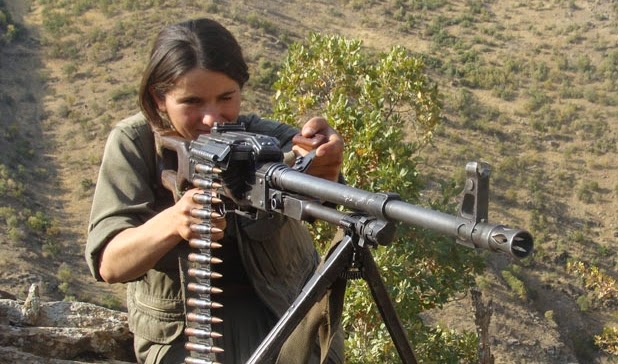

PKK FIGHTER. Women as well as men have will to fight, but not always the weapons. And as they face ISIS, Turkish NATO forces attack their back. 

The militant Popular Front for the Liberation of Palestine (PFLP) has expressed its solidarity with the Kurdish resistance in Kobani struggling to defend themselves and their community from the reactionary Islamicist armed group, ISIS, which it says was ennabled to enter the Middle East region by the support it received from imperialist powers and their lackeys.

Khaled Barakat of the PFLP called on “All Palestinian and Arab revolutionary forces to unify their efforts to support the struggle of the Kurdish resistance in Kobane against ISIS and their imperialist supporters.”

"People in Syria, Iraq and everywhere in the region have been under attack by imperialism – an attack that comes not only through air strikes and occupation, but through the support of reactionary regional powers, through the promotion of sectarianism, and through reactionary armed groups carrying out a program of sectarian chaos. They have sought to replace the central conflict in the region: that of the people with Zionism and imperialism, with sectarianism and the imposition of massive, reactionary violence against minority groups who are an integral part of the region, while these same reactionary armed groups leave the Zionist state and imperialist forces untouched."
http://pflp.ps/english/2014/10/13/pflp-calls-for-unified-revolutionary-front-of-solidarity-with-the-struggle-of-the-people-of-kobane-against-isis/

For once I agree with the PFLP, and I'm inclined to accept their support for the Kurds as genuine. Some years ago at a conference in Vienna, attended by many high-powered Arab and pro-Palestinian delegations, I arose somewhat nervously during a session on nuclear and chemical weapons, to point out that the latter had already been used in the Middle East. "Yes, against the Kurds!"  exclaimed someone from the large PFLP delegation (which included famous 'plane hijacker Leila Khaled), to murmurs of assent. So I knew I was not alone, and need not feel hesitant about the point I was making.

Having armed Saddam Hussein's Iraqi regime with all they could, Western powers were reluctant to admit that he had gassed Kurds at Halabja, until years later when they wanted excuses to invade Iraq and it suited them to remember.  Then one of the places the US managed to bomb too was Halabja.

The situation in Syria and northern Iraq now is complex, but it's good to see the PFLP for one not turning away, nor letting their justified suspicion of imperialist aims and motives serve as an excuse for not taking sides, and ignoring the basic right of the Kurdish people and others to fight to survive, and expect solidarity. 

 Here is a letter which Labour MP Diane Abbott received from one of her north London constituents:


 Dear Diane,

I am a British Kurd living the UK. Kurds in West Kurdistan ‘Rojava’ are being attacked by the barbaric gang ISIS or ‘Islamic State’. Right now in Rojava town Kobani, ISIS has nearly entered the city. There have been heavy clashes and Kurds are not stepping down as they have no choice but to fight for their livelihood. It is a matter of hours that a mass murder by this gang is waiting to happen. It is very important that Kobani town is helped by the International military coalition.

Dear Diane, as an elected member parliament in the United Kingdom of Great Britain and my elected representative, I ask you to act now on the name of humanity. Kurds are the only secular, society who respect international laws and uphold the universal human right values. Humanity is under attacks not just Kobani. I beg you as a fellow human being and I know that you can change this. Please ask our PM, Mr Cameron to instruct our military forces to assist Kobani. Please tell Turks not to help ISIS. Yours truly, etc.
Many Kurds from Turkey live in Diane Abbott's Hackney North and Stoke Newington constituency, and many of them support the Kurdistan Workers Party, PKK, whose fighters have gone to the aid of Yezidi refugees and are supporting those fellow Kurds fighting in Rogava, and resisting ISIS siege of Kobani.


Yet the Turkish government, with which the PKK had been negotiating, after ceasing its armed struggle in Turkey, has launched its own raids against Kurds in Rogava, used its forces to prevent Kurdish fighters crossing into Syria, and bombed Kurdish targets in Turkey. Turkey is a NATO member. So is it not helping ISIS?
http://online.wsj.com/articles/turkish-warplanes-bomb-kurdish-pkk-in-turkey-1413296160?tesla=y

The British and other NATO governments still list the PKK as a "terrorist" organisation, if only to please Turkey. Diane Abbott herself has in the past asked whether the then Labour government intended to arrest hundreds of her otherwise law-abiding constituents for their political sympathies. The Home Secretary said that was ridiculous. But now I have seen quote attributed to Diane Abbott to the effect that arming the PKK would be no different to arming and supporting ISIS. I have not been able to verify whether the MP said anything as foolish. But I can easily answer the assertion.

One, if anyone wants to know the difference between ISIS and the PKK or any of the Kurdish parties, just check which direction the refugees have been moving. The second difference is that from what we have seen of the conflict so far, someone has already been arming and training ISIS - with mainly American equipment. Directing some weapons and aid to the poorly-equipped Kurdish fighters woul only be making up some of the difference.

While what is left of the once massively supported Stop the War Coalition has, true to form, staged demonstrations against Western intervention without saying a word in support of the Kurds, Yazidis, Christians or secular, progressive Iraqis, the national executive of the National Union of Students found itself called upon to debate a motion on the issue. According to Daniel Lemberger Cooper, who sits on the NUS NEC:

The “Iraqi solidarity” motion had been worked on with Roza Salih, a Strathclyde university student of Kurdish descent (she submitted an almost identical motion to the Scottish equivalent of the executive, the Scottish Executive Council, which I will post later, which, incidentally, did pass! One must ask Scottish executive members why vote for a motion in Scotland, but not in England?!).

"The motion was opposed by Malia Bouattia, the NUS Black Students’ Officer, for astonishing and bewildering reasons. Bouattia argued that the motion was “Islamophobic” and “pro USA intervention” ...Apparently another NEC member, Aaron Kiely, tweeted during the debate to say how marvellous Bouattia's speech was. " The motion then fell as large numbers of NEC members either abstained or voted against (including the bulk of the political Left on NEC). I think this says a lot about the current state of the student movement."
http://anticuts.com/2014/10/07/report-of-nus-nec-success-on-national-demonstration-disgrace-on-iraqkurdistan/

Not being well up on the internal politics of the NUS, but wary that Daniel might be giving a slanted account of the arguments, I looked at the actual resolution:

Iraqi/Kurdish solidarity

Proposed: Daniel Cooper.  Seconded: Shreya Paudel, Clifford Fleming

NUS NEC notes

1. The ongoing humanitarian crisis and sectarian polarisation in Iraq
- which has resulted in thousands of Yazidi Kurds being massacred.

NUS NEC believes

1. That the people of Iraq have suffered for years under the sectarian
and brutally repressive dictatorship of Saddam Hussein, the US/UK
invasion and occupation, the current sectarian regime linked to both
the US and Iran, and now the barbaric repression of the “Islamic
State” organisation.

2. That rape and other forms of sexual violence are being used as
weapons against women in IS-occupied areas, while minorities are being
ethnically cleansed.

NUS NEC resolves

1. To work with the International Students' Campaign to support Iraqi,
Syrian and other international students in the UK affected by this
situation.

2. To campaign in solidarity with the Iraqi people and in particular
support the hard-pressed student, workers' and women's organisations
against all the competing nationalist and religious-right forces.


3. To support Iraqis trying to bridge the Sunni-Shia divide to fight
for equality and democracy, including defence of the rights of the
Christian and Yazidi-Kurd minorities.

4. To condemn the IS and support the Kurdish forces fighting against
it, while expressing no confidence or trust in the US military
intervention.

5. Encourage students to boycott anyone found to be funding the IS or
supplying them with goods, training, travel or soldiers.

6. To make contact with Iraqi and Kurdish organisations, in Iraq and
in the UK, in order to build solidarity and to support refugees.

7. To issue a statement on the above basis.

I can see nothing "Islamophobic" or "pro-imperialist" in this, nor does it owe anything to a "Western narrative",  as the opponents claimed. If anyone felt it did not go far enough in denouncing US or British motives I am sure a simple amendment would have sufficed, rather than Britain's student union turning its back on the Kurds and effectively siding with ISIS. Perhaps some NUS NEC members fancy themselves more principled and doughty fighters against imperialism than the PFLP, but hopefully more students will have something to say about this.

Although some more important left-wing movements in other countries are supporting the Kurdish struggle, it seems reluctance to do so is not confined to the British Left. Among the dishonourable episodes of the Stop the War Coalition here was when a group of Iranian comrades set out from Birmingham to march to London and take part in an anti-war rally, only to be told they could not have five minutes to speak from the platform because, being ...er, refugees, they did not support the Islamicist regime in Iran.

So I was not entirely surprised to hear that in Australia, a group called Socialist Alternative, with roots not dissimilar to some of the Stop the War Coalition leadership, was opposed to opening anti-war platforms to speakers representing immigrants from Kurdistan.

If we want to build principled working class internationalism we have a lot of wok to do.

Labels: , , , ,

Monday, June 16, 2014

Remembering Kevin Gately

IT was forty years ago, on June 15, 1974, that Warwick University student Kevin Gately was killed in the 'battle' of Red Lion Square.  He was a few days short of his 21st. birthday. No one has ever been found responsible for the killing.

That day the fascists of the National Front were marching to a meeting in Conway Hall, traditionally a venue for left-wing and progressive meetings. Just how the hall's owners, the humanist South Place Ethical Society, had been persuaded to let their premises to a bunch of racists, I don't know.
 

A crowd assembled to demonstrate against the National Front. Among the organisations taking part in this protest were Liberation (the former Movement for Colonial Freedom), the Communist Party, the International Socialists (who later became the Socialist Workers' Party), and the International Marxist Group (IMG), then a growing influence among students.

Kevin Gately, a second year maths student, was not a member of any of these organisations. But he was opposed to racism and fascism, and was persuaded to go on this, his first, demonstration, particularly when he heard his girl friend was going.


Besides the fascists and their left-wing opponents, another element was out in force that day, and probably better prepared, and equipped, to determine the outcome.  This was of course, the Metropolitan Police, including the elite Special Patrol Group, formed to deal with "serious public disorder".


.At some point there was disagreement among the organisers as to whether to chance a serious confrontation with the police. This was not Cable Street in 1936, when a working class population aware of what fascism was doing in Europe, and sick of Mosley's Blackshirts' activities in the east End, turned out to say "they shall not pass".  The students might adopt the same slogan, but did they really know what they were getting into?

By the end of the afternoon the debate might have seemed irrelevant. Groups of demonstrators were not only attacked by police, but found their retreat blocked by more police. A section of the anti-fascist demonstrators apparently led by the IMG had managed to get into Red Lion Square, hoping to deny the National Front access to Conway Hall, but were subjected to repeated charges by police. The Warwick students, some of whom were IMG members, were caught up in this. Among them, standing out by his height (6 foot) and red hair, could be seen Kevin Gately.  

Photos show Kevin moving through the crowd, apparently trying to get away from the crush of bodies at the front being shoved back and forth against the police cordon. Later, the Warwick students
got away from the square and were returning to their bus when they noticed they were without Kevin. The clashes in Red Lion Square had only lasted a quarter of an hour, but after them a St.John ambulance crew found the Warwick student lying on the ground.

A student who went to University College Hospital was shown Kevin Gately's body and asked to identify him. A pathologist later confirmed that Kevin had died from a blood hemorrhage as a result of a blow to the head.  Some say his height above the crowd, and red hair, made him a target for police batons.  The Warwick student on his first demonstration was the first person in over half a century to be killed on a demonstration in Britain.

Five years later, on April 23, 1979, it was the turn of New Zealand born teacher Blair Peach, killed by a blow to the head in Southall. Eye witnesses said he had been attacked by members of the Special Patrol Group. Thirty years later, after much campaigning, the Metropolitan Police issued a report acknowledging its men had killed Blair Peach.


A painting in honour of Kevin Gately hangs in the student's union at Warwick. But though there was a demonstration over his death in the immediate aftermath, neither he nor the circumstances of his death have received much attention over the years.

An item in the current issue of the anti-fascist magazine Searchlight, part of an editorial by Gerry Gable, says "Like we still remember Blair Peach, so should we recall the unresolved death of young Kevin".

"Some claim it was from a lethal akido blow, a martial arts technique favoured by many riot squad officers", observes Gable, going on to regret that "Nobody appears to have pursued the idea that the blow may have been struck by one of the agents provocateur who were seen seen assaulting people on what was supposed to be their own side and pushing people under the hooves of the police horses."

Maybe the idea has not been pursued because these suggestions have not been aired before, or perhaps because applying Occam's Razor, if a simpler explanation appears to hand, namely that Kevin was killed by a blow from an unidentified police officer, there is no need to chase after more complicated explanations. These might be put out by a police source keen to confuse and divert any investigation of their direct role. It would not be the only time they used such tactics.

On the other hand, if Gerry Gable or anyone else has evidence that provocateurs were at work in or around Red Lion Square that day, this should be looked at, not as any kind of excuse for the police, but on the contrary, to fully expose the methods used by the state and what the game was.

Gerry mentions the inquiry conducted by Lord Scarman, which "failed to establish the circumstances of Kevin Gately's death".  But this was not the focus of Scarman's inquiry, which was to "review the events and actions which led to disorder in Red Lion Square, London, on 15 June, and to consider whether any lessons may be learned for the better maintenance of public order when demonstrations take place".  

The IMG held its own internal inquiry into the events in which its members had been involved that day. The late Bob Pennington and Gery Lawless took part in the proceedings, and IMG members who had been at Red Lion Square gave evidence. I don't know whether any of this was published, or whether any of the IMG's successor organisations (Socialist Resistance,Socialist Action, etc) have had anything to say on the matter.
 
Sadly, the anniversary of Kevin Gately's death seems to have passed without much in the way of commemoration, or comment.

For additional reading:
http://hatfulofhistory.wordpress.com/2013/06/15/red-lion-square-and-the-death-of-kevin-gately/

Labels: , , ,

Saturday, November 24, 2012

Can we revive Plebs tradition?

COULD sacked Tory Chief Whip Andrew Mitchell yet be credited with contributing to a renewal of interest in independent working class and socialist education in Britain?

It was Mitchell's outburst after a woman police officer told him to use a side gate leaving Downing Street which eventually deprived him of his post. According to the police he called them "fucking plebs", and told them they should know their place.

The quaint put-down "plebs", from the term Plebeians, used for the lower orders in Ancient Rome, provided inspiration for numerous placards on the October 20 demonstration called by the TUC against government austerity policies, bringing a smile to the face of police as the marchers assembled. Working people and pensioners were proud to identify themselves as "Plebs" against Old Etonian David Cameron's government of "Toffs",.another old expression enjoying a revival.

Class is back. Of course it never went away, despite all the nonsense from some politicians and intellectuals, and Cameron's insistence that we "are all in this together" and must pay for the bankers' crisis put the lid on it. With thanks to Mr.Mitchell, we are all learning our place, and his.

Proudly donning the label "Plebs" bestowed upon us is not new, and this too is having a revival.  When I was a lad and first started nipping into my local library's reading room to peruse such periodicals as "Tribune", "Labour's Northern Voice" and the "Socialist Standard", perhaps the most curious was a little magazine called "Plebs", published by the National Council of Labour Colleges from Tillicoultry, Clackmannanshire, in Scotland. I believe it survived until 1964.

It was back in 1908 that Noah Ablett, a miner from the Rhondda Valley in South Wales, returned from Ruskin College, Oxford, where he had been leading unofficial classes discussing Marxist political economy, and began promoting Marxist education through branches of the Independent Labour Party. In November 1908, a group of students and former students from Ruskin formed the Plebs :League, and started publishing its magazine.

The editorial in its first issue was (probably) written by George Sims, a carpenter from Bermondsey who had been secretary of the Bermondsey and Rotherhithe Trades Council, and had been expelled from the supposedly "Marxist" Social Democratic Federation that year for supporting industrial unionism. This indicates the way the founders of the Plebs League were more inclined to the militant combination of Marxism and working class self-organisation associated with Daniel De Leon's Socialist Labour Party, which had also inspired the Industrial Workers of the World(IWW) in the United States, and the Irish socialist James Connolly.

Indeed the word "Plebs" was adoped from De Leon's "Two Pages from Roman History".
In the first issue of the magazine Sims concluded by saying the aim must be "industrial democracy". while Ablett, writing about Ruskin, said that if working class educatio was to prepare people for social emancipation then "its control must be in the nads of the workers".  Ablett was to become better known for his authorship of the 1912 pamphlet "The Miners' Next Step".       

In 1909 there was student unrest at Ruskin, and the students went on strike in support of the Principal, Dennis Hird, who had supported them, when he was dismissed. This led to the formation of a Central Labour College, which worked with the Plebs League. Dennis Hird became its first principal. By 1910 the Plebs League had spread its activities to Lancashire and to Scotland, where its educators included the famous John Maclean.    

 The Central Labour College received trade union backing, though not from all. Having moved to London it lasted until 1929, when the depression, and no doubt the political divisions in the labour movement took their toll. But the National Council of Labour Colleges, as the Plebs League had become, carried on as a network of workers' education classes. By 1964, when it was wound up, higher education appeared to be radically changing and becoming more open, while the trade unions had moved far from the heady days of 1912 or 1926. The old division with Ruskin had been replaced by co-operation. Mr. Wilson was announcing the "White Heat of the Technological Revolution". New battles were coming, but even the Thatcher years did not stop TUC talk of "social partnership", and union education nowadays is a far cry fom the Plebs League.

It was on the 100th anniversary of the Ruskin strike that Post-16 Educator published a paper by Colin Waugh, "'Plebs' the Lost Legacy of Independent Working-Class Education", looking in detail at how the movement evolved. But more recent developments at Ruskin, with the revelation that archives were being dumped to ease the college's move to new premises on the outskirts of Oxford, have sparked new student unrest and interest in independent wotking class education.
This fits into the broader concerns of academics and trade unionists over what the Con Dem cuts and reactionary policies are doing to society and culture. London Metropolitan University, which had already begun closing many courses when its future was endangered this year by the trumped up attack on overseas students, happens to house the TUC's archive.

Meanwhile there is a revival of rank and file militancy with a new generation coming into struggle under very different conditions from the boom years' narrow wages struggles or sixties' student militancy. Development is slow and uneven, and many workers are hesitating before the srriousness of what confronts them. But class is back, and so is Marxism. People will want to know much more than their "place" in society. We want to change society.
I can see local trades union councils, which are increasingly called on to join with and involve unemployed committees and students, being interested in a new educational and cultural initiative. Where we still have premises and clubs that would be an asset. Unions like my own which are turning to community branches could also be part of it. 
Various left-wing groups which at present run their own study classes and annual events like 'Marxism' will presumably not object to the broader labour movement taking some responsibility, and will be able to contribute personnel, contacts and experience to this work.

I have not even considered the very diffferent technological environment to a century, and how much can be done "on line".

But it is early days yet.; Things are just sprouting up in a few places. All the same I will be interested to see what comes from a conference being held at Northern College in Sheffield this weekend.


Ruskin archives row:  http://www.historyworkshop.org.uk/whose-archive-whose-history-destruction-of-archives-at-ruskin-college-oxford/

De Leon on class struggle in ancient Rome:
http://www.marxists.org/archive/deleon/pdf/1902/two_pages.pdf

About Noah Ablett
http://ourhistory-hayes.blogspot.co.uk/2012/03/noah-ablett-miners-next-step-1912-lost.html 

Interesting article from year before NCLC was wound up into TUC education.
     http://www.marxists.org/history/etol/newspape/isj/1963/no012/bidwell.htm    

http://www.post16educator.org.uk/

Labels: , ,

Tuesday, January 24, 2012

Destroying homes and, like thieves in the night, bulldozing peace chances


NIGHT OPERATION . Israeli troops ready for action...

Their target a family's home.

Jeff Halper, secretary of the Israeli Committee Against House Demolitions, sent this message out to friends last night:
"Its 11 at night here on a cold, rainy night in Palestine. I just got a phone call from Salim Shawamreh, a Palestinian comrade, that Israeli army bulldozers have arrived at his home and have begun demolishing it and the home of his neighbor as well. Salim's home, which has been demolished already four times because the Israeli authorities refuse to grant Palestinian building permits, is one of 26,000 homes that Israel has demolished in the Occupied Territories since 1967. I'm rushing out there, but it will probably be destroyed before I get there. There isn't much to do -- you feel so powerless in these circumstances -- but at least you now know. I'll stay in touch with you. The American-European supported Occupation goes on..... "

For some reason Jeff's message was delayed in getting through. As was the media in covering what was going on. Western media usually is. And it was dark. But the bulldozers lost no time in getting to work.


By the morning, Jeff reports, eight homes had been reduced to rubble, and about 80 people were homeless. Like Arabiyeh sitting on her furniture out in the cold.


It was only the fifth time the home had been demolished.

"As its name suggests, Beit Arabiya is a home belonging to Arabiya Shawamreh, her husband Salim and their seven children, a Palestinian family whose home has been demolished four times by the Israeli authorities and rebuilt each time by ICAHD's Palestinian, Israeli and international peace activists, before being demolished again last night.

"At around 11p.m. Monday, a bulldozer accompanied by a contingent of heavily armed Israeli soldiers appeared on the Anata hills, to promptly demolish Beit Arabiya, along with residential and agricultural structures in the nearby Arab al-Jahalin Bedouin compound. 3 family homes were demolished along with numerous animal pans, and 20 people including young children were displaced, left exposed to the harsh desert environment. While standing in solidarity with Palestinians, ICAHD staff and activists were repeatedly threatened by Israeli soldieries. ICAHD Co-Director Itay Epshtain was beaten and sustained minor injuries.


"Beit Arabiya was issued a demolition order by Israeli authorities back in 1994, following their failure to grant a building permit. It has since been demolished four times, to be rebuilt by ICAHD activists. Following a reissue of the demolition order last Thursday, came last night's fifth demolition. ICAHD Director, Dr. Jeff Halper, standing astride the ruins, vowed to support Salim and Arabiya in rebuilding their home. "We shall rebuild, we must rebuild forthwith, as an act of political defiance of the occupation and protracted oppression of Palestinians" said Halper."

http://www.icahd.org/?p=8107

Reports by European Union officers and heads of missions in Jerusalem and Ramallah have criticised house demolitions and said the Israeli government is forcibly driving Palestinians from areas under Israeli control. in other words, "ethnic cleansing".

Warning that this would endanger chances of a "two state solution" the EU's latest report promises support to the Palestinians trying to keep their ground in the West Bank.

http://www.icahd.org/?p=8028

http://www.haaretz.com/news/diplomacy-defense/eu-report-israel-policy-in-west-bank-endangers-two-state-solution-1.406945

Whether this good intention will become real support remains to be seen. Interestingly, the British government, though it has abstained on Palestine's UNESCO membership, recently tried to arrange a meeting between Palestinian President Mahmoud Abbas and UK Jewish leaders during his visit to London. It was rebuffed by the Board of Deputies, the main Jewish community body, on instructions from the Israeli government. Some members of the Board who only heard about this after the opportunity had been rejected may be asking what is the use of a "representative" body that takes orders from Netanyahu.

The head of the Jewish National Fund in Britain rejected calls from Jewish peace groups that it should stop funding development schemes in the Negev that involve evictions of Bedouin.

One group of people who don't seem to let small matters like the demolition of family homes or he arrest of Palestinian students for boycotting a lecture by Israeli president Peres bother them are the leading lights of the Labour Party students in Britain. No reality tours with the ICAHD for them, nor volunteering spells with the International Solidarity Movement. They enjoyed an all expenses paid trip to Israel and its illegal settlements in the West Bank, covered by the pro-Zionist Union of Jewish Students (UJS), itself subsidised, which as they admit "set the agenda".

Apparently the highlights included a meeting with Tony Blair, and Israeli officers, but all their rigorous "fact-finding" left students like Ruth Brewer from Liverpool Uni with time to tweet home about cocktails in Tel Aviv and what fine fellows the Israelis were.

Palestinian students have complained, but it's us who on past performance are likely to meet these bright young things in future making their careers as Labour candidates or even union officers. Still, things are changing and their prospects might not be the same now.

http://electronicintifada.net/content/uk-labour-party-student-officials-face-backlash-over-free-tour-israel-settlements/10819

More information about ICAHD and its support group in the UK.

http://www.icahd.org/

http://uk.icahd.org/icahdukdev/eng/

Labels: , ,