Thursday, October 16, 2014

For Kobani, Kurdish freedom, and International Solidarity
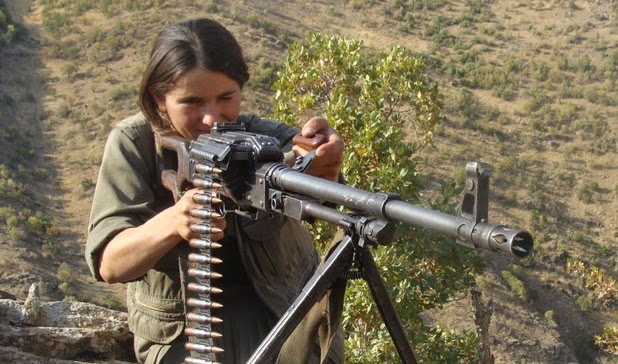

PKK FIGHTER. Women as well as men have will to fight, but not always the weapons. And as they face ISIS, Turkish NATO forces attack their back. 

The militant Popular Front for the Liberation of Palestine (PFLP) has expressed its solidarity with the Kurdish resistance in Kobani struggling to defend themselves and their community from the reactionary Islamicist armed group, ISIS, which it says was ennabled to enter the Middle East region by the support it received from imperialist powers and their lackeys.

Khaled Barakat of the PFLP called on “All Palestinian and Arab revolutionary forces to unify their efforts to support the struggle of the Kurdish resistance in Kobane against ISIS and their imperialist supporters.”

"People in Syria, Iraq and everywhere in the region have been under attack by imperialism – an attack that comes not only through air strikes and occupation, but through the support of reactionary regional powers, through the promotion of sectarianism, and through reactionary armed groups carrying out a program of sectarian chaos. They have sought to replace the central conflict in the region: that of the people with Zionism and imperialism, with sectarianism and the imposition of massive, reactionary violence against minority groups who are an integral part of the region, while these same reactionary armed groups leave the Zionist state and imperialist forces untouched."
http://pflp.ps/english/2014/10/13/pflp-calls-for-unified-revolutionary-front-of-solidarity-with-the-struggle-of-the-people-of-kobane-against-isis/

For once I agree with the PFLP, and I'm inclined to accept their support for the Kurds as genuine. Some years ago at a conference in Vienna, attended by many high-powered Arab and pro-Palestinian delegations, I arose somewhat nervously during a session on nuclear and chemical weapons, to point out that the latter had already been used in the Middle East. "Yes, against the Kurds!"  exclaimed someone from the large PFLP delegation (which included famous 'plane hijacker Leila Khaled), to murmurs of assent. So I knew I was not alone, and need not feel hesitant about the point I was making.

Having armed Saddam Hussein's Iraqi regime with all they could, Western powers were reluctant to admit that he had gassed Kurds at Halabja, until years later when they wanted excuses to invade Iraq and it suited them to remember.  Then one of the places the US managed to bomb too was Halabja.

The situation in Syria and northern Iraq now is complex, but it's good to see the PFLP for one not turning away, nor letting their justified suspicion of imperialist aims and motives serve as an excuse for not taking sides, and ignoring the basic right of the Kurdish people and others to fight to survive, and expect solidarity. 

 Here is a letter which Labour MP Diane Abbott received from one of her north London constituents:


 Dear Diane,

I am a British Kurd living the UK. Kurds in West Kurdistan ‘Rojava’ are being attacked by the barbaric gang ISIS or ‘Islamic State’. Right now in Rojava town Kobani, ISIS has nearly entered the city. There have been heavy clashes and Kurds are not stepping down as they have no choice but to fight for their livelihood. It is a matter of hours that a mass murder by this gang is waiting to happen. It is very important that Kobani town is helped by the International military coalition.

Dear Diane, as an elected member parliament in the United Kingdom of Great Britain and my elected representative, I ask you to act now on the name of humanity. Kurds are the only secular, society who respect international laws and uphold the universal human right values. Humanity is under attacks not just Kobani. I beg you as a fellow human being and I know that you can change this. Please ask our PM, Mr Cameron to instruct our military forces to assist Kobani. Please tell Turks not to help ISIS. Yours truly, etc.
Many Kurds from Turkey live in Diane Abbott's Hackney North and Stoke Newington constituency, and many of them support the Kurdistan Workers Party, PKK, whose fighters have gone to the aid of Yezidi refugees and are supporting those fellow Kurds fighting in Rogava, and resisting ISIS siege of Kobani.


Yet the Turkish government, with which the PKK had been negotiating, after ceasing its armed struggle in Turkey, has launched its own raids against Kurds in Rogava, used its forces to prevent Kurdish fighters crossing into Syria, and bombed Kurdish targets in Turkey. Turkey is a NATO member. So is it not helping ISIS?
http://online.wsj.com/articles/turkish-warplanes-bomb-kurdish-pkk-in-turkey-1413296160?tesla=y

The British and other NATO governments still list the PKK as a "terrorist" organisation, if only to please Turkey. Diane Abbott herself has in the past asked whether the then Labour government intended to arrest hundreds of her otherwise law-abiding constituents for their political sympathies. The Home Secretary said that was ridiculous. But now I have seen quote attributed to Diane Abbott to the effect that arming the PKK would be no different to arming and supporting ISIS. I have not been able to verify whether the MP said anything as foolish. But I can easily answer the assertion.

One, if anyone wants to know the difference between ISIS and the PKK or any of the Kurdish parties, just check which direction the refugees have been moving. The second difference is that from what we have seen of the conflict so far, someone has already been arming and training ISIS - with mainly American equipment. Directing some weapons and aid to the poorly-equipped Kurdish fighters woul only be making up some of the difference.

While what is left of the once massively supported Stop the War Coalition has, true to form, staged demonstrations against Western intervention without saying a word in support of the Kurds, Yazidis, Christians or secular, progressive Iraqis, the national executive of the National Union of Students found itself called upon to debate a motion on the issue. According to Daniel Lemberger Cooper, who sits on the NUS NEC:

The “Iraqi solidarity” motion had been worked on with Roza Salih, a Strathclyde university student of Kurdish descent (she submitted an almost identical motion to the Scottish equivalent of the executive, the Scottish Executive Council, which I will post later, which, incidentally, did pass! One must ask Scottish executive members why vote for a motion in Scotland, but not in England?!).

"The motion was opposed by Malia Bouattia, the NUS Black Students’ Officer, for astonishing and bewildering reasons. Bouattia argued that the motion was “Islamophobic” and “pro USA intervention” ...Apparently another NEC member, Aaron Kiely, tweeted during the debate to say how marvellous Bouattia's speech was. " The motion then fell as large numbers of NEC members either abstained or voted against (including the bulk of the political Left on NEC). I think this says a lot about the current state of the student movement."
http://anticuts.com/2014/10/07/report-of-nus-nec-success-on-national-demonstration-disgrace-on-iraqkurdistan/

Not being well up on the internal politics of the NUS, but wary that Daniel might be giving a slanted account of the arguments, I looked at the actual resolution:

Iraqi/Kurdish solidarity

Proposed: Daniel Cooper.  Seconded: Shreya Paudel, Clifford Fleming

NUS NEC notes

1. The ongoing humanitarian crisis and sectarian polarisation in Iraq
- which has resulted in thousands of Yazidi Kurds being massacred.

NUS NEC believes

1. That the people of Iraq have suffered for years under the sectarian
and brutally repressive dictatorship of Saddam Hussein, the US/UK
invasion and occupation, the current sectarian regime linked to both
the US and Iran, and now the barbaric repression of the “Islamic
State” organisation.

2. That rape and other forms of sexual violence are being used as
weapons against women in IS-occupied areas, while minorities are being
ethnically cleansed.

NUS NEC resolves

1. To work with the International Students' Campaign to support Iraqi,
Syrian and other international students in the UK affected by this
situation.

2. To campaign in solidarity with the Iraqi people and in particular
support the hard-pressed student, workers' and women's organisations
against all the competing nationalist and religious-right forces.


3. To support Iraqis trying to bridge the Sunni-Shia divide to fight
for equality and democracy, including defence of the rights of the
Christian and Yazidi-Kurd minorities.

4. To condemn the IS and support the Kurdish forces fighting against
it, while expressing no confidence or trust in the US military
intervention.

5. Encourage students to boycott anyone found to be funding the IS or
supplying them with goods, training, travel or soldiers.

6. To make contact with Iraqi and Kurdish organisations, in Iraq and
in the UK, in order to build solidarity and to support refugees.

7. To issue a statement on the above basis.

I can see nothing "Islamophobic" or "pro-imperialist" in this, nor does it owe anything to a "Western narrative",  as the opponents claimed. If anyone felt it did not go far enough in denouncing US or British motives I am sure a simple amendment would have sufficed, rather than Britain's student union turning its back on the Kurds and effectively siding with ISIS. Perhaps some NUS NEC members fancy themselves more principled and doughty fighters against imperialism than the PFLP, but hopefully more students will have something to say about this.

Although some more important left-wing movements in other countries are supporting the Kurdish struggle, it seems reluctance to do so is not confined to the British Left. Among the dishonourable episodes of the Stop the War Coalition here was when a group of Iranian comrades set out from Birmingham to march to London and take part in an anti-war rally, only to be told they could not have five minutes to speak from the platform because, being ...er, refugees, they did not support the Islamicist regime in Iran.

So I was not entirely surprised to hear that in Australia, a group called Socialist Alternative, with roots not dissimilar to some of the Stop the War Coalition leadership, was opposed to opening anti-war platforms to speakers representing immigrants from Kurdistan.

If we want to build principled working class internationalism we have a lot of wok to do.

Labels: , , , ,

Sunday, January 13, 2013

Did "Deep State" order Kurdish women's murder?

WERE three Kurdish women murdered in Paris victims of a rogue Turkish state organisation out to sabotage peace talks with the Kurds and possibly bring down the Turkish government itself?

Sakine Cansiz, 55, a founder member of the Kurdistan Workers party (PKK) living in Europe;  Fidan Dogan, 28, president of a Kurdish lobby group, based in Strasbourg; and Leyla Soylemez, a young Kurdish activist, living in Germany, were killed on Wednesday, . None of the three women lived full time in Paris, but were visiting a Kurdish information centre near the Gare du Nord when they were killed.

It was reported yesterday that each of them had been shot several times in the head, which suggests a professional killer. They had their outdoor coats on, indicating they had either just entered the building or were about to leave. This also counters suggestions that they must have opened the door to their killer or that the assassin had to know the door entry code to gain access. It is possible they had been followed and/or that the killer was waiting for them to leave.

It has echoes of the murder in 1976 of Egyptian communist Henri Curiel at his home in Paris. Curiel, who was under secret state surveillance at the time, was about to step from the lift on his way out when gunmen who had entered the foyer. No one was ever caught for this murder.


The three Kurdish women were murdered on the same day that the Turkish press reported the government had reached an outline agreement with the imprisoned PKK leader, Abdullah Ocalan,  to end the 30 years old conflict with Kurdish guerrillas in the south east of the country, which has cost an estimated 40,000 lives.

Kurdish leaders have rejected suggestions from either French or Turkish sources that the killing was the result of an  “internal split” among Kurdish militants. They blame the “deep state”, as both they and Turkish leaders have called it, a network of Turkish officials and senior army officers who distrust the elected government and are opposed to any concessions to minorities or form of Kurdish autonomy.

Turkish prime minister Recep Tayyip Erdogan has himself referred to this "deep state" before, and whether it would allow him to govern. But Erdogan has been casting around this past week, claiming the murder in Paris must be part of a struggle among Kurds, and making diversionary accusations. 

Complaining that France's President Francois Hollande had spoken with Sakine Cansiz, Erdogan said that Cansiz, one of the foundrts of the PKK, had been placed in custody in Germany in 2007, but was released soon after."We notified French Interpol just two months ago," Erdogan said. "France didn't do anything about it. The French head of state must explain why he was seeing these terrorists,"

But reports in the Turkish press say Cansiz was in favour of the PKK ending its armed struggle, and had been involved in negotiations in Oslo between the Turkish state and the PKK. She reportedly met with members of the Turkish National Intelligence Organization (MİT) in recent months.

According to the conservative daily Yeni Safak it was Sakine Cansaz's job to communicate to factions in European countries once she received information from Abdullah Ocalan.

The French police were initially reported investigating the possibility that the attack was a robbery or a dispute about money. There are reportedly a number of investigations into political fundraising from Kurds in France. But the women's handbags had not been touched.Police found a neatly packed suitcase in offices of the Kurdish Information Centre, which is on the first floor of a residential building in the Rue Lafayette..

After it was revealed that the women had been shot several times in the head, and that the gunman had used a silencer,  the view was strengthened that this was a professional killing.  French Interior Minister Manuel Valls said the slayings were "without doubt an execution."

Those who suspect this was the work of conspirators within the Turkish state remembered the murder of  newspaper editor Hrant Dink on 19 January 2007 outside the office of his journal Agos. Dink was an ethnic Armenian, and had campaigned for recognition of the 1915 masacre of Armenians in Turkey. A juvenile killer Ogün Samast was arrested, but many people refused to believe he acted alone, or without encouragement. A video clip was released showing him posing with two police officers. A suspect accused of helping Samast was linked to right-wing nationalists, and had been a staff member of the Gendarmerie intelligence service, JITEM.


Some 20,000 people marched through Istanbul last year on the fifth anniversary of Hrant Dink's murder, both to honour the murdered journalist  and demand that the authorities conduct a full investigation into those behind the murder.

Hundreds of Kurds have been demonstrating outside Turkish embassies in Paris and London over the murder of the three Kurdish women. Joining demonstrators in London on Friday, I ventured to one of the organisers that it was difficult to know exactly who might be behind this killing. "It is difficult," he agreed. "But we know the Turkish prime minister himself was talking recently about the 'deep state', and whether they would let him govern. We think it is the 'Turkish Gladio'" (a reference to the right-wing secret armies established in NATO countries during Cold War years).  France is a funny country...We know there were also Turkish threats against the Armenians there". 


DHA Photo   SAKINE CANSAZ

http://www.spiegel.de/international/world/paris-murders-jeopardize-turkish-kurdish-peace-process-a-877025.html

http://www.newyorker.com/reporting/2012/03/12/120312fa_fact_filkins


http://www.spiegel.de/international/europe/threat-of-sanctions-erdogan-slams-racist-france-over-genocide-bill-a-811118.html
http://www.hurriyetdailynews.com/new-owners-of-turkish-deep-state.aspx?pageID=238&nid=37921 

http://www.bbc.co.uk/news/world-europe-16632890


Labels: , , ,

Monday, December 19, 2011

Raising consciousness and solidarity

https://blogger.googleusercontent.com/img/b/R29vZ2xl/AVvXsEjiyhGV_7kL1h9Wstce47Rm54Jsvhnv7iqEFV-ymQF7SfLdvWjYoFcybKgmWf1EDFuzsAnvD1rqd3jraI8U5djrhB87E_qqNAo0mxaFmia8piGXejAhym0EsEeeu1v_1z6LnNsEEg/s1600/barmayday2011.jpg
BAHRAINIS at London May Day rally.
Now Manchester is centre of solidarity
.

WITH scenes of police brutality in Egypt, the continuing death toll in Syria, and Israeli forces attacking the funeral procession of someone they had killed earlier, we can see why some people have said despondently that the euphoria of the "Arab Spring" has been succeeded by a Middle Eastern Winter.

But if we are looking for rays of light, one is that the people are plainly not giving up, nor going away, not even when the surely desperate forces of "order" have to drag women by their hair from Tahrir Square.

Another is that there is a movement of support and solidarity sprouting, more aware and conscious than anything we saw in the anti-war movement, maybe because it is centred on people with first-hand knowledge of the struggles because they and their families are directly involved. Refugees and exiles, from being merely people we ought to help, can help us know the score, the better to understand and fight the policies and regimes our governments are supporting.

Here's a report about Bahrain, and the arrest, physical violence and ill-treatment practiced against human rights defender Zainab AlKhawaj:

" We are deeply concerned about her safety after seeing the violence that she was subject to during arrest. Zainab Al-Khawaja is a 28-years-old member of Bahrain Centre for Human Rights, famous human rights blogger as @angryarabia and a mother of 2-years-old girl from Bahrain.

"On 15 December 2011, Zainab was arrested by Bahraini security forces from a roundabout on Budaiya highway, west of capital city Manama where she was taking part in a peaceful-sit-in-protest. The security forces responded with firing tear gas and stun grenades to disperse the protest, while Zainab continued the sit-in before the police moved in to rough her up. She was arrested, handcuffed, assaulted and punched in her back by the police officer as she was forcibly dragged off into custody. She, as well as another woman Masooma Al-Sayed were then taken to the police station.

"Zainab is a mother of a two-year-old child, whose husband Wafi Al-Majed is in prison along with her father, Bahrain’s most prominent political activist and human rights defender, Abdulhadi Al-Khawaja who was imprisoned for life in June by special military court. Zainab faces grave danger and is at risk of being tortured, as the regime has systematically attacked human rights defenders, health workers and professionals who are speaking up against the repression and human rights abuses.

"We condemn ill-treatment of Zainab Al-Khawaja in public in the strongest possible terms, and arbitrary detention and demand the authorities to release her and Masooma Al-Sayed immediately and unconditionally. We ask all concerned people to take immediate and urgent action in support of Zainab Al-Khawaja and Masooma Al-Sayed. Zainab Al-Khawaja and Masooma AlSayed are to be detained for seven days.

"According to their lawyer:
Masooma Alsayed was kicked in her leg and is now limping, was not seen by doctor
Zainab when arrested had something sprayed in her eyes and was unable to see for approx an hour. Zainab in police station was beaten on head, arms and legs, as she was unable to see
Zainab recognized the voice of the policewoman who beat her, but the prosecutor refused to write it down. When her lawyer attempted to show the prosecutor video of the arrest, he refused to see it. A policewoman came in with bandaged arm claiming Masooma and Zainab hit her.

Zainab refused to sign statement unless policewoman's name was taken who hit her. The prosecutor got angry and made everyone leave the room, awaiting decision.

The moment Zainab was arrested http://www.youtube.com/watch?v=i3Zdk98x9TM

http://www.rapar.org.uk/bahrain-solidarity-campaign.html


This information from Bahrain was relayed to us via Manchester, where there is a Bahraini people's solidarity campaign that has demonstrated with support from health workers and other local trades unionists and students against a Bahraini business conference, and in support of Bahraini doctors and nurses who were brutally attacked by the regime there.

At the weekend there was a conference in Manchester about the struggle for freedom and equality in Bahrain, addressed by among others, Tony Lloyd MP who is chair of the Parliamentary Labour Party. (Just for the record we note that Manchester Central MP Lloyd did vote against the Blair government on Iraq, and on the renewal of Trident.) This conference "In support of the Bahraini revolution" was made possible with the help of the refugee rights and political asylum research group RAPAR which says it will work with rather than merely for its clients, and has been assisting Bahraini students whose funds were stopped by their government.

As a Mancunian "exile" who grew up proud of Peterloo and the Chartists, and the area's historic lnks with colonial and Irish freedom and anti-Apartheid struggles , I award full marks to those who are maintaining the tradition in today's world! And best wishes to the Bahraini freedom struggle!


http://www.rapar.org.uk/bahrain-solidarity-campaign.html

http://menasolidaritynetwork.com/2011/10/15/bahrain-manchester-protest-highlights-medics-plight/

http://www.socialistworker.co.uk/art.php?id=26378

And Iraq - Kurdistan

Meanwhile, and to set aside the mutual back-slapping between allies that has accompanied the US withdrawal from Iraq, here's a friend on Facebook posting pictures of an event that happened in London recently:

"On the occasion of International Human Rights Day our group Freedom Umbrella: Action for Kurdistan organised a seminar in UK parliament on the violation of human rights in Kurdistan. The seminar was hosted by Labour MP John McDonnell the speakers included Asos Hardi from Awene Newspaper in Kurdistan, Bashdar Ali Journliat and brother of journalist Sardasht Osman who was assassinated last year for criticizing the Kurdish authorities, Houzan Mahmoud from Organisaiton of Women’s freedom in Iraq and Mufid Abdullah journalist also editor of Kurdistan Tribune website. The seminar was chaired by Gona Saeed from Freedom Umbrella".

To which an Iraqi woman solidarity activist has commented:
"Great work Houzan, to have this meeting in parliament at this crucial time when the US/UK are congratulating themselves on what they have done to Iraq! The Kurdish region is often referred to by lobbies like 'Labour Friends of Iraq' as a shining example of people who benefited from the invasion and are living in democracy! Corruption, nepotism and lack of accountability are the main ills in Iraq today!"

To which Houzan Mahmoud replies:
"Th
ank you dear friend, well the so called Labour Friends of Iraq are standing with dictators not with the workers of Kurdistan. We know what is going on that's why we are hosting such meetings to make these issues known. best wishes".

To which I concur.

Labels: , , , ,

Tuesday, February 22, 2011

Don't forget Kurdistan, or Iraq

THERE were two demonstrations in London yesterday. Libyans aghast at the reported killings of demonstrators in their homeland gathered outside their embassy.

But also thousands of Kurdish people marched to condemn the killing of protesters in Iraq-Kurdistan "and in solidarity with peoples protest movement against militia rule, corruption, poverty, lack of social justice and freedoms", writes Houzan Mahmoud "We started form 8Am in front of the office of the so called Kurdish Regional Government and marched through the streets of Edgware Road, all the way to Parliament. This was the biggest protest in Europe against these atrocities commited by Barzani militias.. People chanted slogans such as Barzani is terrorist, Militias out out, Barzani, and Talabani out out, long live freedom and equality, and down with Barzani and many more. Also photos of Barzani and Talabani were burnt down by protestors".

The Kurdish region of northern Iraq has been billed as a democracy since the fall of Saddam Hussein's regime, and the British government and others have forcibly repatriated Kurdish refugees. But the region remains under the control of the two rival Kurdish nationalist parties which fought Iraqi rule, and their two leading families, the Barzani-led Kurdish Democratic Party(KDP) and Jalal Talabani's Patriotic Union of Kurdistan. Jalal Talabani is also president of post-invasion Iraq.

It was reported from Sulaimaniya at the weekend that demonstrators had thronged the streets on Saturday to demand justice over a deadly shooting at a protest earlier that week. In Baghdad, hundreds of orphans and widows rallied to call on the government to take care of them.

The demonstrators in Sulaimaniya demanded that those responsible for a shooting two days earlier that killed two people and injured nearly 50 be held responsible. The crowds shouted: "Down, down, with Massoud Barzani!" referring to the president of the three provinces that make up the autonomous Kurdish region.

On Thursday, hundreds of protesters had demonstrated in front of the offices of Barzani's Kurdistan Democratic Party in Sulaimaniyah,. They pelted the building with stones, and Kurdish guards on top of the building opened fire. The KDP claimed its guards were forced to defend themselves from the crowd; Barzani has appealed for calm and vowed to investigate.

The demonstrators were angry with the tight grip with which the two main ruling parties in the Kurdish north dominate the region and its economy. They say it is impossible for people not affiliated with either one to find a decent job or start a business.

Saturday's rally was largely peaceful, but at one point security forces fired shots overhead to disperse the crowd; an official at the hospital said 12 people were treated after being hit by stones, indicating some scuffling had gone on. The official did not want to be identified because he was not authorized to speak to the media. Earlier at the city's university, about a 1,000 students also rallied to demand Barzani apologize.

In Baghdad, MPs loyal to Barzani got in a shouting match with a representative from Goran, a new opposition party in the Kurdish region. As the Goran member was describing how the protesters were not armed and carrying out a peaceful protest, a Kurdish MP shouted: "This not true!"

About 1,500 people rallied in Baghdad in a demonstration organized by non-governmental organizations looking to highlight the plight of some of Iraq's most vulnerable citizens. Hundreds of thousands of women who lost their husbands in wars over the decades or children who have lost parents are particularly vulnerable.

One of those in attendance was 9-year-old Ahmed Nasir, who lost his father in 2006 in a roadside bombing in western Baghdad. "We have seven children at home," he said. "My mother takes care of us by sewing clothes, and we have no salary."

In a statement, the organizations behind the demonstration said they want the government to give each orphan a monthly stipend.

Media Attacked
An Iraqi television channel that carried live footage of protests in Kurdistan was attacked early on Sunday, its owner said.
"At 2:00 am (2300 GMT Thursday) in Sulaimaniyah, a group of masked men carrying weapons entered the building of our television channel," said Tuana Othman, owner of the Nalia station.

"They wounded the guard with a gunshot before firing their weapons onto our equipment and then fleeing."
Othman said that while the channel was not fully up and running, it had aired live images of protests on Thursday in Sulaimaniyah, the second-biggest city in Iraqi Kurdistan, to carry out testing.

It is also reported that immediately after the protests, looters targeted seven offices of the Kurdish opposition Goran party, despite the bloc's denials that it was involved in the protests at the KDP offices
http://www.google.com/hostednews/afp/article/ALeqM5gMn2Adj93I_MaUteKzPueh6i0e1A?docId=CNG.5ff705d1bb699953d27412f47c096871.791

In NEW YORK, Human Rights Watch has said Iraqi authorities should open an independent and transparent investigation into the reported shooting of several protesters in demonstrations on February 16 and 17 They should recognise the right to free assembly and use only the minimum necessary force when violence occurs at protests, Human Rights Watch said.

On February 16 Iraqi police in Kut, southeast of Baghdad, opened fire on angry demonstrators outside the governorate of Wasit province, killing three and wounding more than 50, according to various news reports and a protest organizer.

"Iraqi forces and their commanders have a lot of explaining to do to justify the use of live ammunition on demonstrators," said Sarah Leah Whitson, Middle East director at Human Rights Watch. "Similar behavior by security forces in this tense time in the region has only ignited more powerful and angry popular reactions."

Iraqi oil workers have also been engaged in strikes and demonstrations in the south of the country. They are complaining of poor pay and conditions, and also threatening not to allow foreign companies to enter the Rumaillah oilfield.
http://www.facebook.com/home.php?sk=group_182807648418537#%21/video/video.php?v=111978952211156&oid=179025415465838&comments

The London demonstration called on the Kurdish Regional Government to release people arrested on Thursday in Sulaimaniyah and bring to justice thoseresponsible for opening fire on demonstrators.

Dashty Jamal of Freedom Umbrella , a coalition of British-based Kurdish organisations and supporters involved in yesterday's demonstration, said: "The British and US government want to present the KRG as a success to legitimise their wars, but here is the reality. There is rising unemployment, the government has no respect for women's rights or workers' rights. People are angry," he said.

"Protests have since spread across Iraqi Kurdistan as people call for increased freedom and civil liberties, jobs and an end to political corruption," he said. "The ruling parties have responded to this by increasing the presence of armed militia in cities and shooting on more demonstrators and arresting activists."

Refering to KDP rule since 1991, Mr Jamal added: "People in Kurdistan are fed up with 20 years of military dictatorship."

http://www.morningstaronline.co.uk/index.php/news/content/view/full/101398

The Stop the War Coalition, which mobilised huge demonstrations against the US-British invasion of Iraq, has called for support for a demonstrations today and Friday, but over Libya and Bahrain:

> 1) TODAY 3-6PM: PROTEST AT DOWNING STREET
> SOLIDARITY WITH LIBYA
>
> 2) FRIDAY 3.30PM: MARCH FROM BAHRANI EMBASSY TO LIBYAN EMBASSY & DOWNING
> ST
> UNITED WE STAND, SOLIDARITY WITH THE ARAB PEOPLE
>
> ************

There is also an Iraqi demonstration on Friday, against the Iraqi government and the suppression of demonstrators in Iraq. The call says:

"Support our Iraqi brothers and sisters who will be demonstrating on
25/11/2011 in Baghdad and let us demonstrate against the horrific crimes
against our people in London.

The "War on Terror" has stripped us off our basic rights, stolen our freedom
and robbed our lives. Let us unite in the face of this farce democracy of a religious dictatorship
and occupation and protest for our rights!

Join us for the sake of humanity and demand basic rights, freedom and true democracy!

The US strongly supported the protests in Egypt and Tunisia yet they have not condemned the attacks on the Iraqi protesters- Resist the occupation!"

Labels: , ,

Sunday, January 09, 2011

Remembering a Murdered Editor

HRANT DINK, murdered four years ago in Istanbul. His enemies remain at large.
But his viewpoint continues to inspire.


THE lawyer for a Turkish editor gunned down in front of his newspaper four years ago says those who planned the murder may never be caught.

A teenage gunman and his accomplice are facing trial for the killing of Hrant Dink, who edited a Turkish-Armenian bilingual newspaper. But a stir was caused by the publication of a photograph of the accused youth with smiling policemen in front of a Turkish flag.

Interviewed by the daily Al Hurriyet, lawyer Cetin, who says she was with Hrant Dink when he was found guilty of insulting "Turkishness", under Article 301 of the Turkish Penal Code, says that although he had defied death threats before, he was seriously worried a few days before his death that he was going to be targeted by assassins.

Cetin says those on trial were anti-social types from poor families. "The teenage gunman does not even know why he murdered Dink". But they saw themselves as heroes and believed they would be released after a minimum time in jail.

The lawyer is convinced a right-wing organisation called Ergenekon had planned the killing. A cache of hand grenades found in a retired army NCO's house in June 2007 were linked with Ergenekon. The organisation's hand had been seen in several bombings and assassinations, and plans for a coup in 2009. But some police bureaus had worked to conceal evidence.

"The Ergenekon gang is a deep organisation and as long as the true leaders remain free, the real instigators of Din's muder will never be captured."
(Hurriyet Daily News, January 9, 2011)

Though the killers succeeded in silencing an important voice for truth about the Armenian tragedy and a new understanding between Turks, Armenians and Kurdish people, they have failed to close Hrant Dink's vision or the inspiration it gave. Thousands marched in his honour after his death, and the anniversary is going to be marked by several events.

Information from Wikipedia:

Hrant Dink was born in Malatya on September 15, 1954, the eldest of three sons to Sarkis Dink (known as Haşim Kalfa), a tailor from Sivas_Province, and Gülvart Dink, from Sivas. His father's gambling debts led to the family's move to İstanbul in 1960. A year after their move, Dink's parents separated, leaving the seven-year old Dink and his brothers without a place to live. Dink's grandfather enrolled the boys at the Gedikpaşa Armenian Orphanage. The orphanage children spent their summers at the Tuzla Armenian Children's Camp, on the Marmara beachfront in a suburb of İstanbul, building and improving the summer camp during their stay. It was at the camp that Hrant met his future wife as a child and later married her . The government-led closing of the Camp in 1984 was one of the factors that raised Dink's awareness of the Armenian issue in Turkey, and led to his politicisation.

At Istanbul University, Hrant became a sympathizer of TİKKO, the armed faction of the Turkish Communist Party- Marxist-Leninist. His friend Armanek Bakırcıyan, who changed his name to Orhan Bakır, later rose in TİKKO to membership of the central committee, took part in armed struggle in Eastern Turkey and was killed during fighting in 1978.

Hrant's wife Rakel Yağbasan, whom he first met when she came to the Tuzla Armenian Children's Camp, was born in 1959, one of 13 children of Siyament Yağbasan, head of the Varto clan and Delal Yağbasan who died when Rakel was a child.

In 1915, the Varto clan had received orders to relocate along with the rest of the Armenian population in the region, but they were attacked during the journey. Five families from the clan escaped to nearby Mount Cudi and settled there, remaining without any contact to the outside world for 25 years. Eventually they re-established contact and largely assimilated into the nearby Kurdish population, speaking Kurdish exclusively, although they retained knowledge of their Armenian origin and Christian beliefs.

Staying at the Tuzla Camp during summers and at the Gedikpaşa Orphanage during winters, Rakel learned Turkish and Armenian, and finished primary school. Because she was registered as a Turk, not as an Armenian, she was not allowed to enroll at Armenian community schools and her father did not give permission for her to attend a Turkish school past 5th grade. Not able to obtain further formal schooling, Rakel was privately tutored by instructors at the Gedikpaşa Orphanage. At first her father opposed the marriage, but the young couple insisted

Having graduated from the university, Hrant Dink completed his military service, but whether for his Armenian background or his political record he was denied promotion, something which confirmed him in his activism. Back in Istanbul he and his brothers established a bookstore which became popular with students and expanded into a publishing business. After the 1980 military coup, when restrictions were placed on travel, one of Hrant's brothers was arrested for using false papers, and he himself was questioned about alleged links with Asala, a secret Armenian armed group.

Hrant Dink was one of the founders of Agos weekly, the only newspaper in Turkey published in Armenian and Turkish, and served as the editor-in-chief from its founding in 1996 until his death in 2007. Agos was born out of a meeting called by Patriarch Karekin II when Turkish media started linking Armenians of Turkey with the illegal Kurdistan Workers' Party (PKK) A picture of PKK leader Abdullah Öcalan and an Assyrian priest appeared in a Turkish daily, with the caption "Here's proof of the Armenian-PKK cooperation".

The view at the meeting was that the Armenians in Turkey needed to communicate with the society at large. The group held a widely covered press conference, followed by monthly press events and eventually formed Agos. Dink had not been a professional journalist until founding Agos., though he had contributed occasional articles and book reviews to local Armenian language newspapers and corrections and letters to the editor to the national dailies.[21] He soon became well known for his editorials in Agos and also wrote columns in the national dailies Zaman and BirGün.[28]

Up to the founding of Agos, the Armenian community had two main newspapers, Marmara and Jamanak, both published only in Armenian. By publishing in Turkish as well as Armenian, Hrant Dink opened up the channels of communication to the society at large for the Armenian community. After Agos started its publication, the participation of Armenians in the political-cultural life in Turkey increased greatly, and public awareness in Turkey of the issues of the Armenians started to increase.[26] Always willing to speak on the issues faced by Armenians, Hrant Dink emerged as a leader in his community and became a well-known public figure in Turkey.

Under Hrant Dink's editorship, Agos concentrated on five major topics: Speaking against any unfair treatment of the Armenian community in Turkey, covering human rights violations and problems of democratization in Turkey, carrying news of developments in the Republic of Armenia, with special emphasis on the Turkey-Armenia relations, publishing articles and serials on the Armenian cultural heritage and its contributions to the Ottoman Empire and Turkey, criticizing malfunctions and non-transparency in the Armenian community institutions.

As a leftist activist, Hrant Dink often spoke and wrote about the problems of democratization in Turkey, defending other authors such as Nobel laureate Orhan Pamuk and novelist Perihan Mağden who came under criticism and prosecution for their opinions. In a speech Hrant Dink delivered on May 19, 2006, at a seminar jointly organized in Antalya by the Turkish Journalists´ Association and the Konrad Adenauer Foundation, he said:

"I think the fundamental problems in Turkey exist for the majority as well . Therefore, ..., I will speak for the majority, including myself in it and dwell on where, we, as Turkey, are headed."
Dink hoped his questioning would pave the way for peace between the two peoples:
"If I write about the [Armenian] genocide it angers the Turkish generals. I want to write and ask how we can change this historical conflict into peace. They don’t know how to solve the Armenian problem."
Active in various democratic platforms and civil society organizations, Hrant Dink emphasized the need for democratization in Turkey and focused on the issues of free speech, minority rights, civic rights and issues pertaining to the Armenian community in Turkey. He was a very important peace activist. In his public speeches, which were often intensely emotional, he never refrained from using the word genocide when talking about the Armenian Genocide, a term fiercely rejected by Turkey. At the same time, he was strongly critical of the strategy of the Armenian diaspora of pressuring Western governments into official recognition of the Genocide label.

Dink featured prominently in the 2006 genocide documentary film Screamers in which he explains:

"There are Turks who don't admit that their ancestors committed genocide. If you look at it though, they seem to be nice people… So why don't they admit it? Because they think that genocide is a bad thing which they would never want to commit, and because they can't believe their ancestors would do such a thing either."

Indicating that a show of empathy would have nothing to do with accepting or refusing the genocide, Dink called for dialogue:

Turkish-Armenian relations should be taken out of a 1915 meters-deep well."[26]

Dink was prosecuted three times for denigrating Turkishness under Article 301.

The first charge under the previous version of Article 301, then called Article 159, stemmed from a speech he delivered at a panel hosted by human rights NGO Mazlum-Der in Şanlıurfa on 14 February 2002.[39] Speaking at the "Global Security, Terror and Human Rights, Multiculturalism, Minorities and Human Rights" panel, Dink and another speaker, lawyer Şehmus Ülek, faced charges for denigrating Turkishness and the Republic.[40] In the speech, Dink had stated:

"Since my childhood, I have been singing the national anthem along with you. Recently, there is a section where I cannot sing any longer and remain silent. You sing it, I join you later. It is: Smile at my heroic race... Where is the heroism of this race? We are trying to form the concept of citizenship on national unity and a heroic race. For example, if it were Smile at my hard-working people..., I would sing it louder than all of you, but it is not. Of the oath I am Turkish, honest and hard-working, I like the 'honest and hard-working' part and I shout it loudly. The I am Turkish part, I try to understand as I am from Turkey."[41]
"Of course I'm saying it's a genocide, because its consequences show it to be true and label it so. We see that people who had lived on this soil for 4,000 years were exterminated by these events."

ARMENIAN INSTITUTE

A SONG FOR HRANT

Saturday, 15 January 2011 at 7:30

Nevart Gulbenkian Hall, Iverna Gardens, W8 6TP

(Tube: High Street Kensington)

An informal event bringing together communities of neighbouring cultures.Please bring your favourite song, dish to pass, and friends.

Join Armenian–Turkish–Kurdish musicians in a New Year’s evening of singing and music–making to remember Hrant Dink (d. 19 January 2007). A short excerpt from “Heart of Two Nations”, prize–winning documentary by Nouritza Matossian will be screened.

Donation of £5 welcome to cover costs. Please confirm your attendance by email.

info@armenianinstitute.org.uk.

Labels: , ,

Monday, December 13, 2010

Looking back at the 'first Holocaust'

ARMENIANS being marched off under armed guard.

ARMENIAN poster in their quarter of Jerusalem's Old City commemorates massacres of May 1915


"Who, after all, speaks today of the annihilation of the Armenians?". So Adolf Hitler is said to have assured his generals of impunity when he urged utter ruthless, as they prepared to invade Poland.

I was talking about Armenia yesterday evening, to a teacher friend worried about the way "the Holocaust" is taught as an exclusive event, and how it is used and abused in propaganda. As a matter of fact, 'holocaust' a Greek word for sacrifice by fire, was first used by Winston Churchill during the First World War to describe events in the Ottoman empire, during which a million Armenians died, some burned, some drowned, more driven into the desert.

Massacres were nothing new, and without getting into arguments as to whether the deaths in the Atlantic slave trade or Irish famine count, we can say that neither Armenians nor Jews were the first victims of modern genocide.That honour belongs to the Herero and Namaqa poples of what is now called Namibia. In 1904 they rose up against the growing German colonisation of their country, where they faced loss of their land and cattle, and being forced into reservations, or bondage to the settlers.

Before ordering his troops into battle against the Herero, the German commander General Trotha wrote: "I believe that the nation as such should be annihilated, or, if this was not possible by tactical measures, have to be expelled from the country...This will be possible if the water-holes from Grootfontein to Gobabis are occupied. The constant movement of our troops will enable us to find the small groups of nation who have moved backwards and destroy them gradually.".

Unarmed men, women and children were shot and bayoneted, Up to 100, 000 Herero and 10,000 Nama were killed. Many were also herded into concentration camps, where without adequate food, they were worked to death, and some were used in medical experiments. Skulls were sent to German universities, displayed in scientific lectures on the superiority of the white race.

After the First World War, German South West Africa was attached to South Africa, but after it gained independence as Namibia, Herero filed a lawsuit demanding reparations from Germany and the Deutsche Bank, which had financed colonisation. On August 16, 2004, at the 100th anniversary of the start of the genocide, Germany's Minister of Economic Development Heidemarie Wieczorek-Zeul, officially apologized, :
“ We Germans accept our historical and moral responsibility and the guilt incurred by Germans at that time."

Responsibility for the death of over a million Armenians remains in contention, almost a century after. Turkish governments have argued that their predecessors were confronting Armenian revolt, supported by the Russians, and they had no genocidal aim.

Three years ago when a memorial to the Armenians was unveiled in Cardiff's Garden of Peace, hundreds of Turks were bussed up to protest. The memorial was vandalised on the eve of Holocaust memorial day the following year. Journalist Hrant Dink was murdered outside his newspaper's Istanbul office in 2007, the victim of a right-wing hate campaign because he wrote about the Armenian massacres. The European Court of Human Rights ruled in September this year that the Turkish authorities had failed to protect his rights or his life. Orhan Pamuk, Turkey's first Nobel prizewinner for literature, has had to leave his country to avoid a similar fate.

What other governments have to say about the Armenians is influenced by modern day relations with Turkey and strategic considerations. Many Armenian refugees settled in Iran, Lebanon, Cyprus (whence some have been made refugees a second time) and Palestine, as well as Western countries. Armenians in Israel have demonstrated demanding official recognition that what happened to their people was genocide, and today I read that academics from the Bar Ilan and America's Georgetown University have signed a letter to the Israeli government to this effect, also urging it to support the Kurds. Neither of these are progressive institutions, and whatever the Israeli government's temptations to hypocrisy, it may prefer to keep Turkey an ally for now. But since the Mavi Marmara incident the US Congress foreign affairs committee has changed its tune, officially recognising for the first time that what happened to the Armenians was genocide.

What's stranger to understand is why present day Turkish people and governments should feel responsible for the actions of a long past regime, (that of the 'three pashas' Enver, Talat and Cemal, each of whom paid for the crimes one way or another), and for policy aims that were not entirely Turkish. It is ironic that German parliamentarians are among those who have urged Turkey to acknowledge its responsibilities.

On August 3, 1914 Enver Pasha signed the secret treaty allying Turkey with Germany, and the following day Rear-Admiral Wilhelm Souchon was ordered to head with two battleships to Turkey. There the German crews donned the fez before proceeding to attack Russian ports. Souchon was made commander in chief of the Turkish Navy.

Imperial Germany had entirely material aims in this war, extending across Europe and the Balkans and along the Baghdad Railway, to coveted Mesopotamia and its wealth, and threaten British India. But the Kaiser had proclaimed himself "protector of Islam", and Germany's agent Max Freiherr von Oppenheim, urged that the secular Turkish government request the Sultan, as head of the Caliphate, to declare jihad.

Blaming Armenian resistance for setbacks, on February 25, 1915, Enver ordered that all Armenians serving in the Ottoman forces should be disarmed and sent to labour battalions. Special units, recruited from convicts, were formed for action against the Armeninians. On April 24, Interior minister Mehmed Talat declared that the Armenians had rebelled against his government, and ordered mass arrests in the cities. Elsewhere, Armenians were forced on long marches, without food or water, into the Syrian desert.

Satisfied that "the deportation of the Armenians has been decided", General Fritz Bronsart von Schellendorf , at army GHQ., was undertanding. "...the Armenian is just like a Jew, a parasite outside the confines of his homeand, sucking of the marrow of the peoples of the host country". Even when officers reported there were no signs of an uprising. Bronsart still insisted on the "military necessity" of deporting Armenian civilians.
In Germany, military censorship made sure even Reichstag members let alone the general public were kept in the dark about what was being done.

I've written an article on the Armenian massacres in the current issue of Jewish Socialist magazine. It was a chapter on "The First Holocaust" in Robert Fisk's monumental work The Great War for Civilisation which drew my attention to Vahakan N.Dadrian's book German Responsibility in the Armenian Genocide, which I was able to read in the British Library.

While Dadrian's carefully researched work has come under attack from various scholars of whatever loyalty, some much lesser and more scurrilous publications are available on the internet. One of these, also on sale in Yerevan, apparently, (Searchlight, December 2010) is snappily entitled Zionism from Theodor Herzl to Lord Rothschild and the Armenian Response , by Harytium Sarkissian,and purports to show that from the 18th century on there was a Jewish-British and Jewish-Turkish conspiracy against the Armenians. The presence of covert Jews in Enver Pasha's Committee of Union and Progress is presumably the clincher.

I am not sure how this squares with Herzl's failure to obtain backing from the Kaiser or the Sultan, after which the Zionists threw in their lot with the British, from whom Weizman negotiated the Balfour Declaration sent to Lord Rothschild, but I guess I am not patient enough, you have to really believe in such conspiracy theory. Von Schellendorf and co. blamed "the Jew Morgenthau" (US ambassador) for "interfering", and Jewish movelist Franz Werfel for propagandising on the side of the Armenains.

By way of an alternative brand of idiocy, there's an American Zionist pamphlet available on the net which uses the quote from Hitler with which I started to "prove" that responsibility for the Nazi Holocaust lay with Haj Amin el Husseini, the Mufti of Jerusalem, who had served as an officer in the Turkish Army and thus got the holocaust idea. Why the Nazis, whose antisemitism was born in Germany and clad in 19th century racial theory, should need an upstart junior ally from an inferior "race" to inspire them, is not clear. The mufti had been 20 when he was commissioned as an artillery officer at Smirna, and within a year he switched like the Zionists had done the British side. (Moshe Sharett, a future prime minister of Israel also served in the Turkish army). With 12,000 German soldiers having served in Turkey, including top generals and prominent officials of the Nazi regime, Hitler and his officers hardly needed telling about what had been done to the Armenians. Not to mention the Hereros.

Still, I suppose if the right-wing Zionists can blame the Mufti, and Islam in general, they can figure Hitler a mere innocent who was misled, and that would excuse some of their new alliances!

The important thing to establish and teach is not just the truth of mass atrocities, nor the nationality of those responsible, but the kind of policies that lead to such atrocities. Only when we end them can we say NEVER AGAIN -TO ANYONE.

* Massacring the Truth, by Charlie Pottins, is in Jewish Socialist no.67, Winter 2010-2011
£2, from Jewish Socialist, BM3725, London WC1N 3XX. Also from good bookshops.

Labels: , , , ,

Friday, July 16, 2010

Bringing Christ the warmonger to Kurdistan, courtesy of US taxpayer

AS though people in Iraq did not have enough trouble getting over the effects of war, and coping with sectarian and ethnic strife, a bunch of aggressive Evangelicals from Tennessee have landed in Kurdistan, with a view to establishing the superiority of their version of Christianity, and waging "Spiritual Warfare" against Islam.

Wealthy as some American Christian outfits are, with their own TV stations and publishing houses, these new crusaders from Servant Group International and related bodies are not depending on the dimes and dollars of their flocks back home, nor on individual wealthy donors. Notwithstanding America's famous separation of Church and State, they are being subsidised by the generous taxpayer, Uncle Sam.

Describing the Classical School of the Medes, built on a hillside outside Sulaymaniyah, reporter Michael Reynolds says it is one of three new private schools in the region that teach a "Christian worldview," established by the evangelicals from Tennessee.

"Since the US occupation took hold, American evangelicals have established not only schools, but printing presses, radio stations, women's centers, bookstores, medical and dental clinics, and churches in northern Iraq, all with the blessings and assistance of the Kurdistan government. Many of these efforts were funded in part by US taxpayer dollars, channeled through Department of Defense construction contracts and State Department grants".

How American Right-Wing Christians Are Waging 'Spiritual Warfare' in Northern Iraq
By Michael Reynolds, AlterNet
http://www.alternet.org/story/147513/

Reynolds says that in September 2003, just four months after the US led invasion and occupation of Iraq, 350 evangelical pastors and church leaders assembled in Kirkuk, where they were welcomed by Massoud Barzani, president of the Kurdistan Regional Government. At that gathering, George Grant, a leader of Servant Group International, the evangelical organization in Nashville that set up the new Christian schools, declared: "Jesus Christ is Lord over all things; He is Lord over every Mullah, every Ayatollah, every Imam, and every Mahdi pretender; He is Lord over the whole of the earth, even Iraq!"

Documents from CENTCOM, the US Central Command for the Middle East, show that between 2005 and 2007,the US Defence Department's contracting organisation paid a Kurdish company at least $465,639 for the construction of Grant's School of the Medes. Two years earlier, tens of thousands of dollars from a State Department-funded program called Healthcare Partnerships in Northern Iraq went into various Servant Group evangelical and humanitarian projects.

In return for the Kurdish Regional Government's support, Doug Layton, a Servant Group founder, served as its liaison in Washington during the Bush years. He ran Kurdish public relations efforts and recruited evangelical businessmen to invest in the region.

For helping the Barzani Kurds gain favour with the Bush administration and its right-wing Christian base, the Evangelicals were rewarded, by being permitted and even assisted to set up their schools and churches in Barzani's Kurdish fiefdom. This is in striking contrast with the intolerance shown political dissenters in the region, and with the attacks on traditional Christian communities in 'liberated' Iraq. Some American observers, like Mike Amitey, a Middle East senior policy analyst at the Open Society Policy Center, are worried the invasion of the evangelicals could cause trouble. "Given the rise of the Islamic parties in Kurdistan and Assyrian Christian resentment of American evangelical exceptionalism and proselytizing, they're playing with fire."

The US military, then still adhering to a policy that favoured Saddam Hussein against Iran, were reluctant to admit the Iraqi leader's responsibility for the chemical weapon attack on Halabja in 1988. But the war on the Kurds led to thousands fleeing as refugees, and many reached Nashville, Tennessee. In 1992, a cadre of Nashville evangelicals from Servant Group International, including large numbers of Kurdish believers, made their way back to Kurdistan, carrying Kurdish-language bibles, money, medical equipment and a plan to establish their "Father's Kingdom" between the Turkish border and Iran. Since arriving in northern Iraq some twenty years ago, Servant Group has widened its global presence, establishing offices, ministries and schools in Turkey, Central Asia, Indonesia, Germany, and Norway.

According to Reynolds, since the US-led invasion, "they have burrowed deep inside the Kurdistan Regional Government, the ruling coalition of Barzani's Kurdish Democratic Party (KDP) and Jalal Talabani's Patriotic Union of Kurdistan (PUK). With help from Layton at the Kurdistan Development Corporation and aided by connections with Republican lobbyists and Congressmen in Washington, they have brokered international business concessions and oil drilling contracts and funneled USAID and DOD money into their missions, setting up their chain of Christian schools. In turn, the KRG has backed Servant Group's ministries and schools with grants of land, buildings and other favors.

Servant Group and its partners are distinguished by their military model of evangelism (what they call "spiritual warfare"); their covert action tactics such as "tent making" or "Kingdom Business" (they enter a country to establish seemingly secular businesses as a cover for evangelism); their intelligence gathering, which they call "spiritual mapping" (where teams of evangelicals conduct full-spectrum "field research'" that includes demographic, historical and geographic data from the neighborhood level to entire countries); an ingrained animosity to Islam; and their dominionist "Kingdom Now" worldview (a fusion of neo-Calvinist authoritarianism and "New Apostolic" Pentecostalism, a millenarian sect of the Assemblies of God whose best known adherent is Sarah Palin)".

Douglas Layton coauthored a book, Our Father's Kingdom: The Church and the Nation, in 2000, in which he explicitly lays out his mission: "If communists and Muslims can take nations -- so can our God!"

That book's co-author, George Otis, Jr., heads a global evangelical intelligence agency, The Sentinel Group, that deploys "field cells" with laptops to gather demographic data in countries the movement has targeted for conversion -- currently, Uganda, as well as several countries in Central America and the Middle East, including Iraq. The data is forwarded to Sentinel's computer banks as part of its "spiritual mapping" project.

In June 2002, as the Bush administration began prepping for the US invasion of Iraq, Congress green-lighted $3.1 million for a State Department-funded program called Healthcare Partnerships in Northern Iraq, ostensibly an effort to improve healthcare in the Kurdish region, but primarily viewed by Middle East policy experts in the United States and local NGO observers as a way to bring the KDP and PUK together under a unified governing body. Douglas Layton was hired as field operations director for this project.

Two-thirds of the Partnership money was swallowed up by Meridian International, a "Non-Governmental Organisation" whose board, at the time, included the wife of then-Senate Majority Leader Bill Frist, and its subcontractors, according to an analysis by one of the program's participants. That left about $1 million for Layton to direct into Kurdish health programs. According to published reports by Servant Group and sources in northern Iraq who were involved with the program, Layton funneled much of it into Servant Group operations such as its mobile dental service, health clinics, and into the pockets of Kurdish officials with whom he was currying favor. Layton also rented an office in the Kurdish Regional Government's Ministry of Health for $1,000 a month-another kickback to KRG officialdom-where he wrote speeches for Health Minister Dr. Jamal Abdul Hamid Abbas. According to two NGO sources who were then in Kurdistan, Layton also handed out cash and equipment from Healthcare Partners to Abbas' cronies.

Under Layton's guidance, the Partnership set up Internet connections at local clinics and medical schools, then required the organizations to pay $1,000 a month to continue the service -- money they did not have.

A field director for an international NGO involved in health programs in Kurdistan from 2002 to 2004 was not much impressed with Layton or with the Partnership. "HCP was full of shit," said the field director, who, due to his ongoing work in the politically volatile region, asked not to be named. "Our NGO conducted a series of nursing trainings in all three major hospitals, and we heard of no activity in this area by the HCP.

"You look at the HCP final report and one thing that jumps out is the fuzzy math. They say they gave twenty-six grants averaging about $13,000. That comes out to about $338,000, not nearly the $1 million they say went into the grants programs. As far as reports on grant activities go, this is one of the shoddiest pieces of garbage I have ever seen."

George Grant is the author of The Blood of the Moon, a book first published in 1991 and reprinted in 2001. In his book, Grant calls for conquering the Islamic world by military might in order to bring about Muslim conversion, an obvious prerequisite for achieving his uncompromising theocratic worldview. In his 1987 Dominionist polemic, The Changing of the Guard, Grant wrote:
"Christian politics has as its primary intent the conquest of the land -- of men, families, institutions, bureaucracies, courts, and governments for the Kingdom of Christ. It is to reinstitute the authority of God's Word as supreme over all judgments, over all legislation, over all declarations, constitutions, and confederations."

In an April 2004 lecture at fellow Dominionist R.C. Sproul's Highlands Study Center in Virginia, Grant said, "We're to make disciples who will obey everything that He commanded, not just in the hazy zone of piety, but in the totality of life.... It is the spiritual, emotional, and cultural mandate to win all things in the name of Jesus."

Mark Potok, director of the Intelligence Project at the Southern Poverty Law Center, which keeps a watch on racist and far-Right movements, says Grant and his schools "are deeply influenced by white supremacist ideas." He points, in particular, to Grant's close association with Douglas Wilson, who founded both the Association of Classical and Christian Schools (of which Grant is a longstanding member) and New Saint Andrews College in Moscow, Idaho, which provides teachers to the Classical Schools in Kurdistan.

Wilson also co-authored a book, Southern Slavery: As It Was, a neo-Confederate fantasy disguised as history. The book argues that Southern slavery was sanctioned by the Bible and that slaves enjoyed a wonderful life due to the patriarchal benevolence of their evangelical masters. "Slavery produced in the South a genuine affection between the races that we believe we can say has never existed in any nation before the [Civil] War or since," it reads. "There has never been a multi-racial society which has existed with such mutual intimacy and harmony in the history of the world." According to Potok, Grant and Wilson are in the leadership of a movement within Christian Reconstructionism called "Celtic Sunrise" that is deeply influenced by white supremacist ideas.


Amitay says the Kurdish leaders are not concerned about the evangelicals' long-term agenda. "Everyone knows it's a game. The Kurds just want to cash in. The KRG isn't concerned about what evangelicals say over here. English reports in the US aren't going to be read over there." He beleives the KRG "will draw the line" if the evangelicals pursue aggressive conversion efforts. "A priority for the KRG is a decent relationship with Tehran," he says. "And there is a rising pro-Islamic movement responding to the economic disparities between wealthy Kurds and the majority of working poor. There is resentment out there that the Islamists can tap into."

American experts admit Iraq is fragmented along religious and ethnic lines, and there is contention over cities like Kirkuk and the oil-rich region around. They fear that the evangelicals helped by their own government and the Kurdish authorities could make things a good deal worse. It seems the Kurdish leaders have in a small way acted like the Israeli government, which has welcomed evangelicals like Pastor Jack Hagee bringing gifts of money, knowing that he said Hitler was sent by God, and that he preaches war in the Middle East, and Armageddon. Playing with fire is an all too common temptation.

Rebaz Mahmoud contributed reporting from Kurdistan. Michael Reynolds is a former correspondent for the Reuters Miami/Caribbean bureau and a senior analyst with the Southern Poverty Law Center Intelligence Project.
View their story online at: http://www.alternet.org/story/147513/

Thanks to Tahrir Swift for drawing my attention to this story,
http://solidarityiraq.blogspot.com/

Labels: , , ,

Wednesday, May 12, 2010

Protests over hangings in Iran

PROTESTS are continuing over the executions in Iran of five political prisoners, including a leading Kurdish teacher and trade unionist, Farzad Kamangar, one of whose letters from prison we include below.

Students in Manchester intend holding a vigil for the Iranian hangman's victims tomorrow, at the Students Union at 1pm. There have been protests in Tehran called by the victim's families, and left-wing Iranians protested at their country's embassy in London.

Teachers' union organisations internationally have condemned the hangings, and the general secretary of Britain's Trade Union Congress(TUC), Brendan Barber, wrote this letter to the Iranian ambassador:

The HE Mr Rasoul Movahedian

Ambassador

Embassy of the Islamic Republic of Iran

16 Prince's Gate

London SW7 1PT

Dear Ambassador
The execution of Farzad Kamangar, teacher and trade unionist

I am writing to you on behalf of the Trades Union Congress (TUC), the national centre for British trade unions, with 58 affiliated unions and 6.3 million members, to protest at the execution on Sunday of teacher and trade unionist Farzad Kamangar.

The TUC has been informed that Farzad Kamangar, together with four other prisoners, was executed on Sunday 9 May. He was sentenced after a court process which did not meet international or Iranian standards for a fair trial.

The TUC is opposed to the death penalty and unequivocally condemns the execution. It also denounces the inhumane treatment of Farzad Kamangar's family, who were not even informed before the execution took place. On Mother's Day, his mother was not even allowed to say goodbye to him.

The TUC has consistently denounced the persistent repression of trade unionists and all Iranians who do not share the views of the government. The brutal execution of Farzad Kamangar confirms the repressive nature of the Iranian regime, and your government's complete lack of respect for international obligations or human rights.

The TUC will support the International Trade Union Confederation (ITUC), to which we are affiliated, in its complaint to the ILO Committee on Freedom of Association about this gross violation of the principles of the ILO.

The TUC will call on its affiliates to denounce this inhumane act, and show solidarity with our Iranian brothers and sisters. In that respect, we continue to express concern about the other teachers and trade unionists languishing in Iran's jails, such as bus workers leaders Mansour Osanloo and Ebrahim Madadi.

I cannot emphasise enough the damage that this execution has done to the reputation of Iran and your government.

I urge you to let your government know how abhorrent British people feel this execution to have been, and urge your government to halt any further escalation of trade union repression and human rights abuses against trade union members.

Yours sincerely

BRENDAN BARBER


General Secretary

The Iranian authorities had variously accused the prisoners of being "enemies of god" and terrorist offences, but both the trials and executions were conducted in secret, and Farzad Kamangar's family were not even informed that he was being put to death.

Karmangar was not only a trades unionist, but an educator and writer, speaking out for the poor and oppressed in Iran. His letters from death row are likely to be published and become classics of political literature, one day taught in Iranian schools. Here is one from last month, concerned about the rights of the Kurds and other peoples in Iran:


We Are People Too: A Letter by Farzad Kamangar, Imprisoned Teacher Sentenced to Execution

April 16, 2010


Farzad Kamangar was executed on May 9, 2010, along with four other prisoners.


A Letter by Farzad Kamangar, Imprisoned Teacher Sentenced to Execution

“We Are People Too”
The purpose of this letter is not to pinpoint the problems of the Kurds and deny the inequalities that exist among the Baluchis, Turks, Persians, and Arabs. By adopting a sympathetic comradely toward others, one can regard themselves as a religious or ethnic minority, and thereby recognize the pains of others. We are people too.

The Kurdish story is the story of the woman who gets nothing from her matrimony but insults and beatings. When her husband was asked, “You don’t really pay for her expenses nor do you show any love to her, so why do you beat and belittle her every day?” He replied, “If I don’t do this, how will anyone know I’m her husband?”

Now for our story. In Iran’s mainstream political discourse, the words Kurds and Kurdistan unfortunately imply separatism and have anti-revolutionary and anti-security (regional) connotations. It is as though the words Kurds and Kurdistan are uninvited guests and have no affinity with Iran.

The province of Kurdistan has become a breeding ground for certain adversities. The Kurdish people are deprived of many basic economical, social, and cultural rights. Historical underdevelopment in the province has resulted in poverty, unemployment, and disillusionment of the Kurdish people.

Although patriotic and kind Kurds have persistently opted for a peaceful life in Iran and have not asked for anything but their basic rights, the response to their legal demands has been an increase in political and civil imprisonment, exile, and execution. This is a result of existing negative perceptions and common prejudices against the Kurdish people.

The presence of ethnic and racial minorities in Iran and the rest of the world is not a new phenomenon. Ethnic, racial, and cultural plurality in a society can act as a double-edged sword. Under the conditions where a [minority] region is developed and fair and equal social relationships exist, co-habitation of various ethnicities is not only problematic, but it is also culturally enriching for that society. It increases the society’s tolerance and reduces cultural dogmas and narrow-mindedness. Today in the era of globalization, where many societies feel threatened by the shadow of cultural monotony, multiculturalism is a gift that needs to be protected and cherished.

At the same time, under conditions where the leaders of a society do not pay attention to the needs and legitimate rights of minorities, extended [negative] consequences will be inevitable. Perhaps one of the basic rights every Iranian feels entitled to, whether Kurdish or not, is the right to citizenship. This is a right that stands against seclusion and exclusion; two sentiments formed from the influence of tangible realities in daily life: from poverty to the dimming light in a famished child’s eyes; from the embarrassed father with empty pockets to the empty family dinner table; to the pale cheeks and impoverished look of a mother.

Seclusion is formed from the centralist approach and segregates the problems and the needs of the Kurdish people (the marginal population) from those living in the central regions [of the country].

There is no doubt that sentiments of exclusion, seclusion, and self-alienation are not limited to ethnic minorities when issues of underdevelopment and mismanagement are prevalent in society [as a whole]. These feelings affect, more or less, all members of society. However, due to structural inequalities, they have much deeper implications for minorities.

The sentiment of seclusion for all groups results in tension and unrest; especially in the presence of cultural poverty which is a consequence of economic poverty. Why not, even for once, instead of a security approach, we approach the basic problems of the people? This way we can solve the problems once and for all. However, there are other issues.

Is there no civil solution to fight the phenomenon of smuggling goods than to shoot or kill? If a person’s basic financial needs are met, would a young person risk his or her life to smuggle a box of tea or a few rolls of fabric across the border? Along the same double-standard policy, the security-centred approach implemented against Kurdish political and civil prisoners is severe.

[Translator's note: One of the only sources of income for the Kurdish population living near the Iraqi border is smuggling goods into Iran and selling them. The security and military forces shoot, injure and kill many of these impoverished individuals every year].

Even inside prisons, and in regards to punishment, do the Kurds have to still bear the label of ethnic minority and experience dark sentiments of seclusion and exclusion? Is there really a difference between a Kurdish and non-Kurdish prisoner that the former should be deprived of many legal rights such as access to a lawyer, temporary release, reduction in sentence, pardon, or freedom? Why despite recent leniency toward political prisoners of Tehran and some other major cities (I.e. their release, which is a source of great joy and I wish it continues), harsh and strict treatment of Kurdish prisoners persist. Instead of attempts to solve the issues, general policies continue to revolve around suppression and execution.

Unfortunately, some use the geographical location of the province of Kurdistan as a pretext to justify the security-oriented approach. The regime continues with pressures and crackdowns on political and civil prisoners. They also proceed with the occasional execution of prisoners who are essentially hostages or scapegoats rather than prisoners serving a sentence for a crime.

How long will this security-oriented view which has caused adversity and divergence amongst the Kurdish youth continue?

The victimized Kurdish population has chosen the most reasonable method to solve their problems: a non-violent life. Doesn’t the security-oriented approach toward the Kurds and Kurdistan imply that the Kurdish people are separated from Iran and Iranians, and thus have to be treated as non-Iranian citizens? I really wish this does not remain the case, or it can result in violence; a consequence that no sane mind wants to accept.

I hope the [discriminatory] treatment of Kurdish prisoners will end. By extending the same treatment to all prisoners, a necessary step (even if the step is small) will be taken to reduce the problems in this region. I wish the story of the Kurds will not be similar to the story of the woman whose only share of matrimony is the daily abuse she receives from her husband…

Farzad Kamangar

Evin Prison, April 10, 2010

Labels: , ,

Wednesday, November 11, 2009

State Murder in Iran

[Picture1.png]

The Iranian authorities have reportedly executed a Kurdish militant whom they charged with being an "enemy of God". Ehsan Fattahian, 27, was hanged yesterday in the western city of Sanandaj, according to Ali Akbar Gharoussi, head of the judiciary in Kurdistan province.

Ehsan Fattahian's executioners ignored pleas from international human rights organisations, and petitions signed by many thousands of people, appealing against the death sentence.

Ehsan had admitted membership of the banned Kurdish movement Komeleh, which has a long history of fighting for Kurdish rights and self-determination. He denied involvement in killings, and said he was tortured for three months. His initial 10-year jail sentence was changed to death by a higher court.

Ezzatollah Fattahian, the defendant's father, told Human Rights Watch that prison officials had prevented the family from visiting his son in prison for the past three months.

http://www.mideastyouth.com/2009/11/11/ehsan-fattahian-was-hanged-this-morning-in-iran/

Amnesty International, which appealed on Tuesday for Ehsan Fattahian's life to be spared, has warned that two other Iranian Kurdish men are at risk of execution, and at leastleast 10 other men and one woman are believed to be on death row in connection with membership of and activities in support of proscribed Kurdish organizations.


Oppositionists say the Iranian regime is using incidents like last month's explosion in Baluchistan, in which 41 people including senior Revolutionary Guard officers were killed, to come down hard on minorities. A Baluchi group called Jundullah claimed responsibility for the attack. The regime accused US, British and Israeli intelligence agencies of supporting separatists.

"The Iranian regime is trying to intimidate ethnic minorities from joining the Green Wave," Komeleh leader Abdullah Mohtadi told al-Arabiyya TV, referring to the movement led by Mir Hossein Mousavi, who claims to have beaten Ahmadinejad in the elections. "One of the methods to deter people is stricter sentencing in ethnic provinces such as Kurdistan, Baluchestan and Ahwaz."

The Komaleh, and Kurdish aspirations, go back much further than the present Iranian regime and its troubles at home or abroad. Like neighbouring Iraq and Turkey, Iran has a chunk of Kurdish lands, with around four million Kurdish people. Sanandaj, the capital of Iran- Kurdistan province, is in an area where Kurdish guerrillas have clashed with Iranian security forces. In September there were a number of attacks, often targetting religious leaders and judges. No group claimed responsibility. The authorities variously blamed a Kurdish Independent Life Party and "hard-line Sunni fundamentalists" linked with outside powers. But Komaleh is a secular organisation, which some even see as Marxist.

Amnesty International condemned the September killings, but opposed the use of the death penalty against political prisoners. Amnesty lists Iran as the world's second most prolific executioner in 2008 after China, and says it put to death at least 346 people last year.

Ehsan Fattahian was detained on 20 July 2008 and said in a letter smuggled from prison that he was regularly beaten in detention. Branch 1 of the Revolutionary Court in Sanandaj sentenced him to ten years imprisonment, to be served in exile, after a trial in which he was denied access to a lawyer. Both Ehsan and the prosecutor appealed this verdict, and in January this year the Appeal Court overturned the first sentence. Instead he was sentenced to death for "emnity to God". He said the new sentence was passed because he refused to confess, or to renounce his beliefs.

Here are the concluding paragraphs of Ehsan Fattahian's letter from the condemned cell:


"... shortly before my sentence was changed to the death sentence, I was taken from Sanandaj prison to the Intelligence Ministry’s detention center, where I was asked to make a false confession on camera, show remorse for the actions I had not committed and reject my beliefs. I did not give in to their illegitimate demands, so I was told that my prison sentence would be changed to the death sentence. They were fast to keep their promise and prove to me how courts always concede to the demands of intelligence and non-judicial authorities. How can one criticize the courts then?

All judges take an oath to remain impartial at all times and in all cases, to rule according to the law and nothing but the law. How many of the judges of this country can say that they have not broken their oath and have remained fair and impartial? In my opinion the number is countable with the fingers on my hand. When the entire justice system in Iran orders arrests, trials, imprisonments and death sentences with the simple hand gesture of an uneducated interrogator, what is to be expected from a few minor judges in a province that has always been discriminated against? Yes, in my view, it is the foundation of the house which is in ruins.

Last time I met in prison with the prosecutor who had issued the initial indictment, he admitted that the ruling was illegal. Yet, for the second time, it has been ruled that my execution should be carried out. It goes without saying that the insistence to carry out the execution at any cost is a result of pressures exercised by political and intelligence groups outside the Judiciary. People who are part of these groups look at the question of life and death of a prisoner only based on their own political and financial interests. They cannot see anything but their own illegitimate objectives, even when it is the question of a person’s right to life - the most basic of all human rights. How pointless is it to expect them to respect international treaties when they don’t even respect their own laws?

Last word: if the rulers and oppressors think that, with my death, the Kurdish question will go away, they are wrong. My death and the deaths of thousands of others like me will not cure the pain; they will only add to the flames of this fire. There is no doubt that every death is the beginning of a new life.

Ehsan Fattahian,

Sanandaj Central Prison

http://shooresh1917.blogspot.com/2009/11/ehsan-fattahian-was-executed-by-islamic.html

*************************


I hope that Ehsan Fattahian's death
does breath new life into the struggle against the Iranian regime, and that his brave stand will both inspire the young and remind us all that Kurds too are a people, with rights and aspirations, however inconvenient these may be, whether for Middle Eastern regimes or great power diplomacy.

I hope it will also increase the determination - expressed here by Hands Off the People of Iran (HOPI) - to separate our opposition to the Ayatollah's regime firmly from those who want to wage war on Iran and its peoples; and, at the same time, to separate the anti-war movement from those who are willing to be stooges of the Islamicist regime and accomplices of the hangman.

As someone who sympathises instinctively with anyone deemed "an enemy of God", I am certainly not religious. But I think the Old Testament suggests certain ideas about justice. So let us promise that wherever the working people and oppressed of this world take power from reactionary regimes like that in Iran, we will give our enemies a fair trial before we do whatever they deserve doing to them.

Labels: ,