Saturday, September 17, 2011

Once Again, the Price of Coal

POLICE and the Health and Safety Executive (HSE) are to investigate the disaster at the Gliesion colliery in the Swansea Valley. Four men were killed - Charles Breslin, 62, David Powell, 50, Philip Hill, 45, and Garry Jenkins, 30. They were trapped deep undergound as water flooded the shaft where they were working, on Thursday morning.

Three others, including David Powell's son Daniel, managed to get out and raise the alarm. But the mission to rescue the trapped miners ended up as recovery of their bodies. Specialist mine inspectors were at the pit yesterday to work with police.

Mining is a dangerous industry throughout the world, and Thatcher's reduction of Britain's coal industry to a bare remnant of its past has not ended the dangers, even if it has reduced the scale of disasters. Wales has a poud mining tradition, but has also had more than its share of tragedy, which these four men now join.

Melvyn Bragg, in his BBC series on film recently had an episode called Black Diamonds, recalling the 1934 Gresford Disaster, when 266 men died in an underground explosion and fire. Because the workers had only completed three quarters of their shift when it happened the company docked their last wages by the appropriate amount.
http://www.bbc.co.uk/programmes/p00jv72t

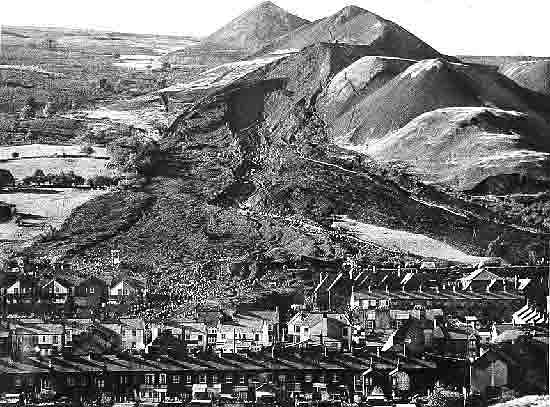
It has not only been the miners themselves who perished, nor was state ownership enough to ensure safety came first. In 1966 a coal waste tip and tons of slurry slipped down the mountain side at Aberfan, destroying homes, engulfing the village school and killing 144 people, including 116 children and five of their teachers. "Buried alive by the NCB!" cried a man at the inquest, referring to the National Coal Board. The official inquiry verdict spoke of "men charged with tasks for which they were totally unfitted, of failure to heed clear warnings, and of total lack of direction from above".

What is left of the mining industry since the Thatcher years, a scattered mixture of size and ownership, has been having a little boom as world demand for coal for power raises prices despite the low-carbon talk. The privately-owned Gleision colliery had been in and out of mothballs and different hands, over the years, but was recently producing about 250 tonnes a week of anthracite, a "smokeless" hard and relatively clean coal burned in local boilers.

The National Union of Mineworkers (NUM) is worried that these privately-controlled facilities, which barely employ more than a dozen workers at any one time, operate largely "under the radar" of mine inspectors – if only because they are usually situated on remote hillsides.

Chris Kitchen, general secretary of the NUM, said: "We have grave concerns about safety standards in these kinds of mines. We fear that safety is often set at minimum standards so that costs can be kept down. They are not generally unionised or easily visited by inspectors."

Large mines, such as the five remaining deep underground mines which employ hundreds of workers, tend to operate under safety standards established when the industry was nationalised, up to 1995. But the big collieries such as Kellingley in Yorkshire will typically have teams of dedicated fire and safety officers, surveyors and ventilation staff whose job it is to alert the owner and workforce to any problems, says Kitchen. "You are not going to have that kind of thing in a small drift mine that employs nine people."

http://www.guardian.co.uk/uk/2011/sep/16/welsh-mine-miners-died-num-concerns?intcmp=239

The rush of water into the shaft at Gleision is thought to have come when the roof over the miners' heads gave way. releasing a deluge from an old flooded mine-working above. The roof could have been literally undermined by blasting and removing coal, or held up by undersized props, or it may have deteriorated over time. A spokeswoman for the HSE said the inspectorate's records showed no enforcement notices on the colliery, which was due an inspection later this year.

But an inquiry will focus on what information the management of the colliery had about existing and disused mine workings in the vicinity. The Lofthouse disaster in West Yorkshire in 1973 when seven miners were trapped led to a code of practice to try to ensure no further cases of a dangerous inrush of water.

The law requires managers to employ a surveyor whose job it is to provide maps of nearby workings so miners can work a safe distance from them. The HSE has specific regulations making it the duty of the mine owner and manager to obtain all available information about nearby workings from the Coal Authority, where mine abandonment plans are filed, and to ensure that water inrushes do not happen.

The regulations state that mining should not be carried out within 45 metres in any direction, of a layer of rock containing water, or any disused workings that are not linked to mines. Nor are miners supposed to work in tunnels within 37 metres of any disused mine workings. The major mines in the country would have detailed archives and mine plans that would ensure that modern shafts and workings steer clear of previously-worked areas. Records of old mines are not always reliable or adequate. Private mining companies early in the last century did not always file them.

Nevertheless, mining companies today are supposed to take care, and if they are entering areas of old workings. to inform the HSE. The NUM will want to know whether Gleision;s owners did everything they could to observe the regulations and code of practice. The investigation into the tragedy at Gleision could take months to complete as the mine safety inspectors piece together what happened.

We have yet to see any suggestion that the government might take this tragedy seriously enough to reconsider plans to cut down on the HSE. But just for now perhaps the press will suspend its treatment of Health and Safety as a joke, and we might stop hearing old chestnuts about children playing conkers being required to wear goggles.

Though I would not count on it.


Mid-Term Merriment about Mesothelioma

A support group for asbestosis sufferers has condemned the behaviour of two Tory MPs during a committee debate on legal aid. The group, which attended a hearing of the public bill committee this week to hear a debate on the Legal Aid, Sentencing and Prosecution of Offenders Bill, said that Conservative MPs Ben Wallace and Ben Gummer had behaved like "rowdy public schoolboys" and displayed "contempt" for working people.

The Asbestos Victims Support Groups Forum said it was shocked at the behaviour of the two MPs when Kate Green MP was speaking about the effect of the Bill on asbestos victims dying from mesothelioma, citing the suffering of her own constituents.

Under the proposed legislation those who have suffered work-related illness or injury and seek compensation would be responsible for success fees which are to be capped at 25 per cent of damages. Campaigners argue that, without the alternative of legal aid, claimants are returned to a worse position than prior to 2000 when legal aid for such cases was scrapped.

The Asbestos Victims Support Groups Forum said its research suggests that many mesothelioma sufferers, defeated by illness, will never make a claim because of the additional stress and the financial risk they will face.

Jim Sheridan MP, chairman of the public bill committee, was apparently forced to rebuke Mr Wallace and Mr Gummer for disrupting the proceedings.

From 'Tory 'schoolboys' disrupt asbestosis committee hearing'- Paddy McGuffin, Morning Star, September 16

http://www.morningstaronline.co.uk/news/content/view/full/109618

Labels: , , ,

Sunday, July 11, 2010

"The fightback starts here" - David Hopper at Durham

http://upload.wikimedia.org/wikipedia/en/thumb/5/5c/061_Chopwell1.jpg/300px-061_Chopwell1.jpgYESTERDAY was the 126th Durham Miners Gala, or the "Big Meeting" as it is locally known, a great reassertion of working-class tradition, showing that, in spite of everything that has been done to them, the spirit of the mining communities defiantly lives on.

The uniquely traditional aspects will have been there, of course, from the blessing of union banners in the cathedral to the beer and the bands and, doubtless, the dancing in the street. The banners have always been a colourful eclectic reflection of influences, from the religious, and the "Socialism through Evolution" to the Chopwell banner depicting Marx, Lenin and Keir Hardy.

I was stuck in London dutifully attending a somewhat smaller meeting yesterday. But I am pleased to hear that members of my union were out with their flags among the thousands marching besides the miners and others in Durham. And the days when Durham miners' leader Sam Watson, a Labour Party chairman (1949) tipped for ministerial office , could make the Gala a celebration of contentment, and platform for Labour leaders, are well gone.

Besides miners' leaders, this year's platform line-up included Ken Livingstone, left-wing Labour MP Jeremy Corbyn, PSC assistant general secretary Chris Baugh, whose members are gearing up to fight the cuts, and Nour Alabassi, women’s representative of the Jafra Palestine Refugee Centre in Damascus. Sam Watson was a leading Labour Friend of Israel, where he was a regular visitor, and has a room named after him in the Knesset building.

The tone for the gala this year was set by Durham Miners' Association general secretary David Hopper, in a programme statement (also published in Friday's Morning Star:

"A new Con-Dem coalition has been elected, and the people of north-east England have no illusions whatsoever about what they face in the next few years.They are prepared for the inevitable onslaught on the social wage and the forthcoming attacks on the sick and infirm, who happen to be on state benefits.

Our people have learned the lessons of the past. That is why not one of the parliamentary seats in the counties of Durham and Tyne and Wear fell to the Tories or Lib Dems, and why there were Labour gains all over our region in the May local authority elections.

The first Durham Miners' Gala was held in the city 140 years ago. Alexander McDonald, the leader of the first National Miners Association, delivered a thundering speech to the crowds.

"If nothing will move our rulers - if the cry of our widows and orphans will not move them - then I say all the miners in Durham, Northumberland, Yorkshire, Staffordshire and in Wales and Scotland should lay down their tools," he said.

He was speaking after Parliament failed to pass the Mines Inspection Bill. His call was greeted with cheers and cries of "We will, we will!"

Today people take to the streets for the 126th gala. We need once again to inspire the working class into action to defend our social advances, and to turn back the expected attacks on British workers' living standards.

During its 13 years in power the new Labour government missed many opportunities to redress the balance between rich and poor, and in the end failed miserably.

The whole deceitful programme of the war in Iraq and the unwinnable conflict in Afghanistan proved that most Labour MPs were just voting fodder for Blair.

Who would have thought that Labour would advocate such senseless conflicts and cause so much misery and bloodshed to thousands of our troops - let alone to the hundreds of thousands of Iraqi and Afghan people?

Then came the spectacle of Gordon Brown's coronation - a disaster from start to finish. He bailed out a corrupt banking system and under his stewardship new Labour lurched from crisis to chaos at every turn. It was a miracle we did not get obliterated in the general election.

For former miners the new Labour government's refusal to introduce a compensation scheme for knee problems, similar to that for vibration white finger, was a huge blow. We now have to take such claims to court in an attempt to gain justice. Such cases are costly and often time-consuming. Many of our members are elderly, and may never see any compensation.

A number of candidates are now contending for the Labour Party leadership. Nearly all are new Labour to the core, Blair or Brown men who helped to prop up policies that widened the gap between rich and poor.

We need a leader who can embrace the whole party, one who can be an inspiration to the people of this country, because there are many battles that lie ahead if we are to eradicate poverty in our society, and retain free health care and education for all.

Whoever wins must not be allowed the same autocratic power that Blair had to use the party as their own, ignoring the wishes and opinions of the membership.

Today's event takes place as the coalition government plans swingeing cuts in state benefits. Because of our past industrial heritage massive numbers of people in our region receive incapacity benefit and employment support allowances. In many cases these people served a lifetime in mining, shipbuilding and ship repair, in the steelworks and in wider manufacturing. We must protect them.

Just as at the first gala 140 years ago, the fight has to carry on. Circumstances have changed, but the battle between labour and capital still remains. The bankers were bailed out with billions of pounds, but the workers have to struggle to advance their cause.

We have been shown a good example by our sisters and brothers in Greece, Spain and other parts of Europe. They have mobilised and taken to the streets to defend their living standards. Perhaps we can learn a lesson from them.

I believe this year's gala will once again show the collective will and determination of our people. We expect a bumper turnout of bands, banners and people to show that the spirit of our communities has not been extinguished.

The fightback starts here."

http://www.morningstaronline.co.uk/index.php/news/content/view/full/92596

Labels: ,

Thursday, July 08, 2010

Memory in Manchester, to Monument in Durham, the Big Meeting, and back.


I met Murder on the way -

He had a face like Castlereagh.

(The Masque of Anarchy, by Percy Bysse Shelley)

http://www.fact-archive.com/encyclopedia/upload/d/d9/Lord_Castlereagh.jpg

From a contemporary cartoonist's view of the action at St.Peter's Fields, Manchester, on August 16, 1819, to "the man on the hoss" in the centre of Durham.

Along the way meeting Viscount Castlereagh, as characterised by Shelley.


We're taking another ramble through history. Starting in the centre of Manchester. Here on August 16, 1819, a big crowd assembled at St.Peter's Fields, to demand reforms. They came from Leigh, and West Houghton, from Bolton and Bury, Wigan and Whitefield, Oldham and Rochdale, Salford, Stockport and Stalybridge. And of course, Manchester.
The crowd was put at 60,000, men, women, and children, who had marched all the way. The weather was good, and many came in their Sunday best.

As these working folk gathered for a peaceful rally, to call for political representation and economic improvement in their lot, there were assembled against them 600 Hussars, and the Royal Horse artillery, and making up in enthusiasm for what they might lack in military experience, the Cheshire Yeomanry, and Manchester and Salford Yeomanry, variously described as "younger members of the Tory party in arms",[25] and as "hot-headed young men, who had volunteered into that service from their intense hatred of Radicalism".[26].

Shortly after the meeting began, local magistrates called on the military authorities to arrest the main speaker, Henry Hunt and several others on the hustings with him. Then, claiming that the people were attacking the Yeomanry, they ordered the Hussars to disperse the crowd. Cavalry charged into the crowd with drawn sabres, and although it was claimed that they only used the flat of their swords, they succeeded in killing eighteen people and injuring some 600, including 100 women.

Reporters were arrested, but one escaped, and got the news to London. The authorities raided Richard Carlile's premises and confiscated papers, but as word spread, pamphlets and cartoons appeared of the military "heroes" in action, and a name was coined for the bloody events on St.Peter's Field, referring ironically to the battle of Waterloo four years before - Peterloo.

Lord Sidmouth, the Home Secretary, congratulated the authorities in Manchester for the way they had dealt with the Radicals - several of whom were jailed. Parliament passed Six Acts - banning "seditious" meetings, treating agitation for radical reform as "treasonable", taxing newspapers and pamphlets, and banning anyone from taking unauthorised military training. The Peterloo crowd had been peaceful and unarmed, but the government plainly felt it could not rely on people remaining that way.

Among the loyal members of this government, approving of this use of force, was Lord Castlereagh, son and heir to Lord Londonderry, and leader of parliament. He had earned his spurs suppressing the United Irishmen in 1798, and after 1815 as Foreign Secretary he helped the great powers of Europe set up the Congress system to secure their grip on the continent. This association with reaction at home and abroad may explain Shelley's characterisation. Castlereagh succeeded to his father's title Lord Londonderry in 1821, but took ill and became convinced people were plotting against him. He cut his throat with a sharpened letter opener on August 12, 1822.

Charles William Vane Stewart, the third Marquis of Londonderry, aka "Fighting Charlie", was born in Dublin in 1778, educated at Eton, and a major by the age of 17. He served under the Duke of Wellington, in Belgium, Holland, Portugal and Spain, earning the nicknames “the Bold Sabreur”. After the war with Napoleon he was made ambassador in Vienna, helping his half-brother Castlereagh at the Congress which redrew the map of Europe, though according to Adam Zamoyski in his book "Rites of Peace: The Fall of Napoleon and the Congress of Vienna", he distinguished himself in the recreational rather than diplomatic side of Congress, being often drunk, frequenting prostitutes, and touching up young women in public. On one occasion the Viennese constabulary had to rescue him after he started a fight with a coachman in the middle of the street.

This behaviour might not have hampered his military career so much as poor eyesight and hearing, but he showed smart tactics in 1819 when he left the army to marry Frances Anne Vane-Tempest, a 19-year-old heiress who made £60,000 a year exporting coal from her County Durham estates – roughly £50m a year in today’s money.

This was not the first time a Stewart had married into money, mind. Alexander Stewart, father of the 1st Marquess of Londonderry, Robert Stewart, had married Mary Cowan, sister of Robert Cowan, a good Presbyterian and Alderrman of Derry city. He had been nearly 20 years in the East India Company, serving as Governor of Bombay (modern Mumbai) from 1729-35, when it exported raw cotton and imported cloth, and though he failed in an attempt to crush Kanhoji Angre's Marathi rebel "pirates", he did succeed in amassing a personal fortune as governor. Cowan died two years after he retired, and his fortune passed via his sister, and a little help from the lawyers, into the hands of the Stewart family. With his wealth from India, the Marquess expanded his landed estates in Ulster, and developed the flax trade.

Lord Charles Stewart had never been to Durham before, but he soon got involved with the coal industry. Coal was hauled by horses along a wooden wagonway to staithes, dropped into keels and rowed down the Wear to Sunderland, where it was transferred into bigger ships. Stewart reckoned that if he could cut out the keelmen and avoid the harbour fees, his wife would earn an extra £10,000 a year. So, for £63,000 in 1821, he bought the Seaham Hall estate from the Milbanke family and started building his own harbour.

The miners knew Stewart's reputation and that he was half-brother to Castlereagh. On August 12, 1822, he inherited the title 3rd Marquis of Londonderry, and he showed himself if anything worse than his half-brother. He refused to allow pit inspections, he objected to the school leaving age being raised from 12 because he employed cheap boys, and he opened his harbour at Seaham in 1831 and said he’d be happy “to see grass grow in the streets of Sunderland”.

In those days, and until 1872, miners worked under a Bond, setting their pay and conditions for a year, and forbidding anyone to go looking for other work. A man called Thomas Hepburn had managed to organise the miners of Northumberland and Durham into a union, though their terms were drastically reduced by hard times. In March 1830 the union called a huge meeting at Black Fell and another on the Town Moor where 20,000 pitmen turned out. Later there were conflicts with the soldiers and the owners but Londonderry had severe financial problems and he was the first owner to cave in. On 13th August 1831, fired up by their victory, the pitmen’s union held a big meeting on Boldon Fell. Pitmen marched to this meeting in their thousands behind bands and banners. Perhaps this was the start of the Durham Big meeting. The first business of the meeting was to elect Thomas Hepburn as a full-time official of the union and by this time the union included Blacksmiths, Joiners, Deputies and Overmen.

The miners strike of 1832 also began in April, to coincide with the Bond, and within a few days all of the collieries in Northumberland and Durham were again at a standstill. This time however the coalowners had an effective strategy - they brought in blacklegs from all over the country, and evicted strikers and their families from their homes. Thousands of people were thus driven into the fields, while their villages were filled with police and soldiers.

The coalowners' terror broke the strike, and for a time the bosses could pick and choose whom they took back on, till as demand for coal picked up miners could regain employment. Not so their leaders. Thomas Hepburn was reduced to selling tea around the villages, and mining folk were intimidated by the owners, led by Lord Londonderry, from daring to buy from him. Driven by starvation to beg at Felling Colliery for work, he was forced to renounce the union before he was taken back on. It would be more than a decade before trade unionism raised its head again.

In 1844, the miners struck again, and it lasted for four months. Besides evictions of "ringleaders", and importation of workers from Ireland and Wales, many of whom were not told they were strikebreaking till they they found themselves stuck in the area with seemingly no option to but to work, Lord Londonderry also issued his famous 'Seaham Letter' , warning traders there not to give credit to striking miners, saying they would be 'marked men' if they did, and threatening to ruin the town if he could not get his way.

The onset of the Great Famine in Ireland showed the Marquess, one of the ten richest men in Britain, an opportunity to show his generosity as an absentee landlord. People were starving on his estates. The Londonderrys donated £30 to famine relief. But they did find £150,000 for refurbishment at Mount Stewart, their magnificent stately home.

The 3rd Marquess died in 1854 at his home in Park Lane, London. Today there is an ongoing controversy in Durham over whether to move his statue, though not I think that far. Some say it is an obstruction to developing the market place, others that it is an important asset like the Cathedral and castle. There is even some controversy whether he was hero or villain, though not many miners would say the former.

In modern times, the seventh Marquess of Londonderry eclipsed his colourful ancestors by gaining a reputation as Appeaser of Nazi Germany. He was a leading figure in the pro-Nazi Anglo-German Fellowship. Hitler's ambassador Joachim Von Ribbentrop was entertained at Mount Stewart, in 1936, thereby acquiring the soubriquet "the Londonderry Herr".

Britain's mining industry has been destroyed by Thatcherism, but tomorrow the mining communities of Durham and Northumberland and their proud spirit will come alive again in the Durham miners' gala, the 'Big Meeting'. I think it is probably right that "Fighting Charlie", the third Marquess of Londonderry should continue to look down from his pedestal on the bands, the banners, the pubs and pie shops, the young people who I've seen link arms to dance in the street. the working folk that he could not beat. I hope that for generations to come parents will continue to point up at the statue, and teach history to their children, just as mine told me in St.Peter's Square, Manchester, about the massacre called Peterloo.

I remember also the mural depicting the massacre, in Manchester's Free Trade Hall, where I'd gone to meetings and concerts as a teenager with my pals, and which was perhaps nearer the spot. Today it is a hotel, but still remembers its past. Which is more than can be said, it seems, for the organisers of this year's Trade Union Congress (TUC) in Manchester. At a time when we are facing huge attacks on our jobs and public services from this government, and further attacks on our rights, they have invited Tory Prime Minister David Cameron to the conference.

They should know that Manchester still has ghosts, and the workers' movement still has spirit.
RMT leader Bob Crow was applauded last week in Shrewsbury when he promised to lead a walk out if Cameron came. South West Region of the TUC has called for the invitation to be cancelled, and I am sure others will do the same. We are proud of our past, aware of our present, determined to fight for our future. Whoever in the movement would prefer to lick Cameron's ass deserves no place with us.

Labels: , ,

Monday, August 20, 2007

Miners martyrs of China's "miracle"

ANGUISHED relatives of trapped Chinese miners toppled a security fence and fought with police on Sunday, as it appeared that a rescue operation was being called off, and hope for the 172 men underground faded.

Flash floods caused by torrential rains had breached a levee and poured into an old shaft, engulfing the mine in the city of Xintai in Shandong Province on Friday. It was the latest of a number of tragedies that have befallen miners in China. China has been the world's biggest coal producer in recent years, and coal provides two-thirds of the electricity powering China's much-famed economic growth. But China's mining industry has one of the poorest safety records in the world.

A crowd of 200 people, angry at the lack of information, toppled an iron fence and broke into the compound of the Zhangzhuang mine, clashing with security officers. Some people threw stones at administration windows and fought police. But later officials insisted that the rescue operation was continuing, though the head of the Work Safety administration, Li Yizhong, said rescue teams had to proceed with caution because of the dangers of further flooding and gas leaks in the pit.

CCTV state television reported that high speed drills had been brought to the site to cut through the rock to accelerate the pumping operation, while Xinhua said 11 pumps had been installed by more than 6,700 rescue workers.
http://asia.news.yahoo.com/070819/afp/070819155854asiapacificnews.html

http://www.cnn.com/2007/WORLD/asiapcf/08/18/china.miners.ap/index.html?eref=rss_topstories

China's coal mines are some of the most dangerous in the world and fatal accidents happen almost every day. More than 4,700 workers died last year, according to official figures, but independent labour groups say the real toll is nearer 20,000 annually, because many accidents are covered up.

China's leaders have sought to speed up coal output to meet growing energy needs and avoid power cuts which hit many provinces a few years ago. But while the government promised to improve safety, the price has been high.
After 166 workers died in the Chenjiashan explosion in November, 2004 the State Council ordered an inquiry and newspaper editorials called for a more humane and balanced view of economic progress. An editorial in China Daily said the authorities should pursue "more serious actions for safety despite an energy shortage".

The Chenjiashan mine had reportedly failed a safety test days before the explosion, and had frequent fires. Relatives of the dead blamed managers' pursuit of a 400,000 yuan bonus for beating output targets.

In 2005 a gas explosion at the Shinjawan mine in north-east China killed 214 miners.

China has two kinds of mines: big, state-run mines, which are generally thought to be safer, and smaller private mines where the majority of deaths occur. "They're technically illegal, but they also have certificates. They pay money and get a licence," says film-director Li Yang, who spent 18 months making a film, Blind Shaft, set in small, private mines.

During filming, he lived in half a dozen mines and spent 50 hours underground. He counts himself "lucky" to have been asleep in the pithead dormitories when a roof collapse killed two miners. The response was matter-of-fact. "They cleared up the debris, cleared the shaft, treated it no differently from a traffic accident."

Miners had helmets and lamps, but most wore soft rubber boots. He never saw steel toe-caps. Ear mufflers? He laughs at the question. "They had no training."
Miners worked 10 hours a day, seven days a week, earning roughly 1000 yuan ($120; £62) a month. Pay was linked to how much coal they cut. Gas is the biggest killer, but miners often carried on working "even when it's close to the warning level", says Li Yang.
http://news.bbc.co.uk/1/hi/business/4060185.stm

Increased demand for coal has kept the private mines running profitably alongside the sped up state ones. Miners lives have been sacrificed to "growth", but then, not theirs alone. China's record of factory fires, in which the victims are often women workers, recalls some of the worst history of unregulated capitalism.

Capitalists from abroad, as well as home-bred, find the state bureaucracy a helpful partner in exploitation. Earlier this year almost 500 slave workers, including children, were freed from brick kilns in Henan and Shanxi provinces, north China, where they had been put to work, with the connivance of local Communist Party officials. This was an extreme case, and the authorities intervened. But the way Chinese embassy officials reacted to a strike by ill-treated Chinese building workers in Israel, ordering them back to work, underlined the irony of thinking the People's Republic a "workers' state"; and the terrible fate of Chinese migrant workers drowned in Morecambe bay in England while picking winkles, exposed the desperation that had driven them to pay for the privilege of working abroad.

Only the day before the Xintai disaster, it was reported that striking miners at the Tanjiashan Coal Mine in Hubei Province had suddenly been surrounded by more than 200 part-time security guards hired by management to break the strike. According to a report by Radio Free Asia, the security guards set about the workers and in the ensuing clash at least one worker and one security guard died. The conflict lasted about two hours. Workers vented their anger by attacking company offices and two nearby police vehicles they believed had been used to transport management's hired security guards to the mine. The dispute arose over allegations that management were diverting money allocated by central government for redundancy payments.
http://www.china-labour.org.hk/public/contents/news?revision%5fid=48962&item%5fid=48961

The Chinese government says it wants to make the mines safer by bringing them all under central control. But what is really needed is the right of working people in China to organise freely so they can assert some control over their conditions and working lives, as well as their environment, and press political leaders for the laws they need, and for these to be enforced. Workers' rights and democracy are not a luxury extra for socialism. They are a matter of life and death.

Labels: , , , ,

Sunday, August 19, 2007

Miners and rescue heroes buried in mine owners' scramble for profit

THE search for six coal miners trapped underground at the Crandall Canyon Mine in Utah was halted on Friday after two rescue workers and a federal mine inspector were killed by crumbling tunnel walls. Six more rescuers were injured.

After eleven days of efforts to get through to the six men, trapped 1,800 feet below ground, it was time to tell their families and friends that they might never be found. “People here are just sick in the stomach about all of this,” said Joanne Carpenter, whose son was good friends with the son of Dale Black, a killed rescuer. Joanne had been with other local people, waiting for news.

Dale Black was a cousin of one of the trapped miners, Kerry Aldred.

About 130 people had been involved in the rescue. When some requested to reassigned from inside the mine because it was too dangerous, other volunteers offered to help. Hopes had been raised in the town by news that sounds could be heard from inside the mine, but then at 6.55pm on Thursday an entire rib, or wall, of the mine collapsed on the rescuers.

Cecil E. Roberts, president of the United Mine Workers of America, issued a statement saying the deaths at the Utah mine were “needless and preventable.”
A union spokesman, Phil Smith, said that the plan to mine the mountain should not have been approved by the federal government, and that the rescue effort “should not have moved forward because the mountain was in the process of collapsing and was clearly dangerous.”

The director of the Mine Safety and Health Administration, Richard E. Stickler, said that the strongest available support structure had been put in place to protect the rescuers, including fencing and steel buttresses, but that “obviously it was not adequate.”

The governor of Utah has promised to conduct an “unprecedented and comprehensive” investigation of the disaster and rescue work and to seek to improve mine conditions in Utah and throughout the country.

The mountain has been experiencing seismic jolts since the start of the assignment. Seismic specialists at the University of Utah in Salt Lake City have recorded 22 readings of earth movement at the site since the original magnitude 3.9 shock.

"These events seem to be related to ongoing settling of the rock mass following the main event," Lee Siegel, a spokesman for the University of Utah seismographic station, told the Associated Press. "I don't think I'm going too far to say that this mountain is collapsing in slow motion."

Mine owner Robert E. Murray had promised the trapped miners would be brought out within a few days. "We’re going to get them,” he said after the mine collapse, “There is nothing on my mind right now except getting those miners out". Murray, whose Murray Energy Corp., based in Cleveland, Ohio, part-owns and manages the mine, claimed the original mine collapse was caused by an earthquake and that dangerous mining procedures were not to blame. But seismologists said that what their instruments had recorded as an initial quake was the mine collapse.

Murray has been an outspoken opponent of mine safety legislation as well as environnmental laws. After last year's Sago mine disaster in which 12 men were trapped and killed in West Virginia, he opposed legislation by lawmakers there and in his home state of Ohio that would require miners to wear emergency tracking devices. Murray called the proposed legislation "extremely misguided" and accused politicians of "playing politics with my employees' safety. "

Before the mine collapse, the mine owner was well known as a staunch detractor of global warming. "The science of global warming is suspect," Murray told the Senate Committee on Environment and Public Works in June.
"Climate change or the so-called global warming issue is a human one," he said. "Reducing carbon emissions will impact our poorest families worst. All you are doing with this Draconian legislation is destroying American families' standard of living, their ability to have jobs, and export jobs to China."

This boss who is so concerned about protecting jobs is not so keen on protecting miners, whether by law or unions. He made his earthquake claim to deny reports that the mine accident was a result of a dangerous procedure called "retreat mining", in which pillars of coal are left holding up the roof while the coal around them is removed, before the pillars themselves are excavated. "Retreat mining had nothing to do with the disaster," Murray said, . … There are eight solid pillars where the men are right now. … I'm not going to respond to retreat mining anymore. It was invented by people with motives to damage the coal industry."

"The UMWA is trying to organize the mine," Murray said by way of explanation.

Workers at the Crandall Canyon mine do not belong to a union.
The UMWA said it represented workers at six mines owned by Murray, but now only represents one. "He is a difficult guy to deal with on a rational basis," Phil Smith, the union's spokesman, told reporters. According to the Department of Labor's Mine Safety and Health Administration, the mine had a record of 300 safety violations, of which 118 resulted in injury. There had only been one death at the mine in the last 12 years.

For more on this disaster from a union angle see:
http://blog.aflcio.org/?s=mine+safety&cat=-11&submit.x=0&submit.y=0&submit=submit


Here's another union response:
Former Mine Workers Head Calls for More Worker Safety Attention After Utah Disaster
By Pat Kinney, Waterloo-Cedar Falls Courier, Iowa

Aug. 16--WATERLOO -- Richard Trumka, AFL-CIO national secretary-treasurer and former president of the United Mine Workers of America, called the federal mining safety regulatory agency a cadaver Wednesday and accused President Bush's administration of inattentiveness to all worker safety issues in the wake of a Utah mine collapse.

Trumka, UMWA president from 1982 to 1995, when he was elected to his current post with the AFL-CIO, made his comments following a keynote address to the Iowa Federation of Labor AFL-CIO state convention in Waterloo Wednesday.

"You know, honestly, MSHA, the Mine Safety and Health Administration, has become basically a cadaver under George Bush," said Trumka, who mined alongside his father in Pennsylvania before becoming a labor leader. "It's not about enforcing the laws or making them better, how they can get by. MSHA inspectors are good quality people, but they don't get the support from the leadership in MSHA. They put people in who have no identity with miners."

"We were strengthening the laws under (President Bill) Clinton, getting some regulations passed" Trumka said, but those initiatives died or fell by the wayside when Bush took office.

Of the Aug. 6 Huntington, Utah mine collapse, where the search continues for six trapped miners, Trumka said, "Here's one thing: It wasn't an act of God. It was an act of man. One of two things are inevitably true. Either they weren't following the laws or the laws weren't strong enough to protect them. In either case, there's got to be changes made to protect workers.

"Now here's the real travesty," Trumka continued. "Workers in this country die in ones and twos every day. Miners die in ones and twos every day. And no one pays any attention. Thousands and thousands of workers are injured and crippled every day and no one pays attention. It's only when there's a mass major disaster that it gets the attention. Each day is a tragedy when you lose a worker or cripple a worker or rob a worker of his or her health.
"This administration is not enforcing the mining laws in this country as they should. I think it applies to every area of workers' safety," Trumka said. "I think it applies to OSHA (the federal Occupational Safety and Health Administration) as well as MSHA."
http://www.wcfcourier.com/articles/2007/08/16/business/local/5ecbfdcd1d7a1de886257339004a7bb7.txt

A report from West Virginia public radio says mine owner Roberts' methods have attracted attention before in that neck of the woods, along with his boasts that with his influence he could fend off any interference from safety inspectors:

In 2001, a belt foreman named Tom Ciszewski had his arm ripped off by a conveyor belt at Ohio Valley Coal’s Powhatan No. 6 mine in Belmont County, Ohio. He bled to death.Later, a belt repairman testified that Robert Murray pressured miners not to shut down the belt, "unless there’s a man it," and that he would fire them on the spot. A judge ruled the company was not negligent. But problems at the mine continued. Eventually, MSHA ordered the mine to shut down after repeated violations. Murray had enough. He was upset at MSHA’s action, and met with Tim Thompson, then the head of MSHA’s District 3 office that covers a portion of Ohio and northern West Virginia. Back in 2003, Jeff Young of West Virginia Public Broadcasting obtained the notes from the meeting: Jeff Young 2003 report: Those notes show Murray repeatedly threatening to have MSHA employees fired. ‘I will have your jobs. They are gone. The clock is ticking," Murray said at various points. And he stressed his political influence with the agency, saying, "I talked to Laresky (former MSHA director) personally," and again, quoting, "Mitch McConnell calls me one of the five finest men in America, and last I checked he was sleeping with your boss.’ Sen. McConnell of KY is married to Labor Secretary Elaine Chao, who oversees MSHA.
http://www.wvpubcast.org/radio/newsroom/Murray0808.pdf

See also: Utah Mine Owner Used Repub Political Clout To Get Rid Of MHSA
http://www.dailykos.com/storyonly/2007/8/15/93935/8068

http://www.wvablue.com/showDiary.do?diaryId=892

It seems this Roberts has been a big donor to the Republican Party, and expects to get his money's worth. Here in Britain, though all three main parties have been competing to find ways of soliciting big money from business, he'd most surely find a home-from-home with the Tories, now David Cameron's bike riding greenery has given way to John Redwood once more raising the banner of deregulated capitalist "free-for-all" (but not free trade unionism of course).

Labels: , , ,

Tuesday, October 24, 2006

"Buried alive by the NCB"


Forty years after disaster at Aberfan

At 9.15 am on Friday, October 21, 1966 a waste tip slid down a mountainside into the mining village of Aberfan, near Merthyr Tydfil in South Wales. Down below it was foggy in the valley, and people heard the rumble before they could see what was happening. The black avalanche destroyed a farm cottage in its path, killing all the occupants. It continued down to Pantglas Junior School, where the children had just returned to their classes after singing All Things Bright and Beautiful at their assembly.

Gaynor Minett, an eight-year-old at the school, remembered four years later:
"It was a tremendous rumbling sound and all the school went dead. You could hear a pin drop. Everyone just froze in their seats. I just managed to get up and I reached the end of my desk when the sound got louder and nearer, until I could see the black out of the window. I can't remember any more but I woke up to find that a horrible nightmare had just begun in front of my eyes."

Men working above the tip had tried to run and give warning. They had no phone, apparently because the cables had previously been stolen. In any case even a 'phone warning would not have ennabled anyone to move in time, it all happened so quickly. The slide engulfed the school and about 20 houses in the village before coming to rest. Altogether 144 people died in the Aberfan disaster: 116 of them were school children. About half of the children at Pantglas Junior School, and five of their teachers, were killed.

"Buried alive by the NCB!" was one father's bitter verdict, shouted aloud at the inquest. Though volunteers had rushed to help local people and rescue teams at the disaster scene, Lord Robens of Walsingham, the former Labour MP Alf Robens, chairman of the National Coal Board (NCB) had carried on with his scheduled business, going to accept an appointment as chancellor of the University of Surrey. He would try and hide the causes of the slide and claim that nothing could have been done to prevent it. He never apologised.

A Tribunal of Inquiry found that the National Coal Board had been responsible for the disaster, "due to ignorance, ineptitude and a failure of communication".
The Aberfan disaster was not some unpredictable freak of nature. It could have been foreseen. Aberfan lies below Merthyr Mountain, on the bank of the River Taff, near the Merthyr Vale colliery. Like other mountain areas in Britain it has a high rainfall. Where mining subsidence has accentuated cracks in the sandstone of the mountain, the water penetrates down until it reaches layers of coal or clay, when it bubbles back to the surface as springs and streams down the slopes. One such stream was buried under Tip 7.

As far back as 1927 a Professor Knox delivered a paper to the South Wales Institute of Engineers in Cardiff, warning that if water accumulated in tips it would cause landslides. Collieries which failed to pay for drainage to remove the water would end up paying compensation for the results. Among those who studied this paper was a man who would later be Production Director of the NCB's South Western Division, covering Merthyr Vale, near Aberfan.

Before nationalisation, in 1947, the mines in this area were owned by the Powell Duffryn company. It was at one of their collieries, the Albion, five miles from Aberfan, that on December 5, 1939, some 180,000 tons of wste from a tip slid down the hillside, into the road, the canal and the River Taff. Powell Duffryn commissioned a consultant engineer to investigate, and he produced a study called "The Sliding of Colliery Rubbish Tips".

In November 1944 a large part of the conical Tip No.4 at Merthyr Vale slipped down the hillside. The tip had partly lay on loose material left from an earlier slide. Earlier that year company officials had assured the local council that there was no immediate danger from the tip, and said they were starting to have drainage trenches dug. When the November slip happened the colliery agent blamed the rain, and told the council it could have been worse but for the drainage channels. In fact the No4 tip had buried 400 foot of a stream.

By the time of the Aberfan disaster the waste was being tipped on Tip.No7, and there was a new danger. Mechanised mining methods brought a new kind of waste, fine dust left when the smallest amounts of coal were extracted. These tailings could not be piled high as more solid material, and their inclusion considerably lowered the "angle of repose" at which a pile would settle significantly. In rain they could turn to a wet slurry, sliding down into watercourses, then drying to form a solid blockage behind which more water accumulated until it flooded.

Already in 1959 and 1960 the council, backed by the Merthyr Vale Labour Party, had raised concern over flooding and the dangers of tip slides. In 1963 part of the foot of Tip No.7 was washed away by a spring, leaving a steep face over 70ft. high. A consulative committee, attended by miners' representatives and others on November 26, 1963, heard fears of further slides. The colliery manager visited the tip, and decided tipping of tailings must stop. There had already been a decision in the South Western Division that such waste should be poured into disused shafts. But the tipping continued.

On March 29, 1965, at Tymawr, a tailings lagoon held behind rubbish at the base of a tip burst its banks and flowed over railway tracks and the main road for hundreds of yards, wrecking cars in the car park and threatening to flow into the mine shafts. It cost the NCB £20,000 but somehow the incident never made into records at the Board's headquarters. Nor had the 1963 slides of waste at Tip 7 over by Aberfan.

Yet local people did express fears about what could happen if waste contnued to be tipped on the hillside behind their school. The Merthyr Express reported on January 11 1964 that a local councillor warned a planning meeting "if the tip moved it could threaten the whole school".

Perhaps other voices were getting more attention. On 7 July 1965, the colliery manager and senior engineers from the area NCB visited the Aberfan tips with the managing director of a fuel company that was interested in reclaiming coal from the waste tips. Apparently they saw no evidence of anything wrong or any instability.

And so on Friday, 21 October 1966, at 9.15 am, after smaller movements, the big slide began. Down the hillside came 140,000 tons of waste. At the bottom part it appeared as liquid, like a cold black lava tide. Smashing through two mains water pipes its flow increased, crossing a railway embankment to engulf more homes.

The tribunal found that the disaster could and should have been prevented. The main cause was a build-up of water in the pile and, when a small slip occurred, the disturbance caused the saturated, fine material of the tip to liquefy and it flowed down the mountain. In 1958, the tip had been sited on a known stream (as shown on earlier Ordnance Survey maps, and it had previously suffered several minor slips. Its instability was known, both to colliery management and to tip workers but very little was done about it. The Merthyr Tydfil Borough Council and National Union of Mineworkers were cleared of any wrongdoing. No NCB employee was sacked, demoted, or even disciplined. The NCB was ordered to pay compensation, though much of this was made up by government, and compensation to local families was later reduced because they had received sums from an appeal fund.

Labour's nationalisation of industries like coal in 1947 did not remove them from capitalism. On the contrary, they were expected to show a profit after paying out interest on loans made to compensate the former coal owners, who had risked miners' safety and pocketed subsidies, and continued recieving payments even when their former mines were closed as "uneconomic". State owned industries were modernised at public expense to serve the private sector, while neither their workers nor the public gained any control over bureaucratic management.

Bosses and bureaucrats anywhere, management members, aim to increase profit, keep down costs, empty their in-trays, look the other way when necessary, endear themselves to their superiors, raise their status and earnings, and make sure anything that goes wrong will be blamed on someone else, preferably lower down in the workforce, or on unpredictable factors beyond their control. Anyone, manager or worker, who sees their responsibility to the wider comunity, the environment and humanity is asking for trouble with their careers, and woe betide the worker who speaks out of turn let alone expects a say in things.

Since Aberfan we have seen several major disasters, not least in the Thatcher era of "deregulation" - the Kings Cross fire(1987), the sinking of the aptly- named Herald of Free Enterprise off Zeebrugge(1987) and the Marchioness pleasure boat in the Thames, and major rail crashes, not to mention the continuing toll on workers' lives in the construction industry. Nor can we forget that this year was the twentieth anniversary of the Chernobyl disaster. State ownership with bureaucratic rule and control of information does not equal socialism. But we know that if global capital continues its way, under whatever political labels, the planet itself is threatened.

At the Labour Party conference in Manchester last month the party leadership was defeated on issues of public housing, privatisation in the Health Service, and the watering-down of the government's long awaited Corporate Manslaughter and Homicide Bill. Transport and General Workers' general secretary Tony Woodley said the bill only allowed companies to be fined, and would give guilty directors a "get out of jail free" card.

We will see whether this government takes more notice of union or Labour party members, or continues listening to the City and big employers. The tide of opinion in this country has swung against big business and privatisation, but on this as on the peace and war issues, the public mood still needs to find political expression. Socialists should be getting far more support, but whether in the Labour Party or out of, we have to ask how we realise this potential.

As we remember the victims of Aberfan, the children slaughtered when their lives had hardly begun, let us recognise the human cost of continuing to subordinate everything to profit, and the need to gain not just public ownership but democratic control by society over our industries and environment. It is a life and death question.

ACKNOWLEDGEMENTS

Much of the information about the history leading up to the disaster is from Victor Bignell's study on the Aberfan Disaster in Catastrophic Failures, published 1977 by the Open University.

I was spurred to write something on this by a TV news item on the village marking the anniversary, but also by fellow-blogger Mark Elf covering it in his blog Jews Without Frontiers. He also provides a reference to other resources at
http://www.nuff.ox.ac.uk/politics/aberfan/home2.htm

Labels: , , ,

Wednesday, September 13, 2006

British company mines trouble in Bangladesh

BANGLADESHIS in east London have been losing jobs as textile work is transferred to Bangladesh. Meanwhile garment workers there are fighting for their rights and owed wages, while an even angrier explosion is continuing over a British-owned company's opencast mining plans.

I've come across the report below on a libertarian communist news and discussion site. (see http://libcom.org/news/bangladesh-unrest-bhulpari-mining-garment-industry-310806 for full report and pic).

News from Bangladesh
Submitted by Ret Marut

Unrest continues across Bangladesh, with widespread strikes and the mass revolt against an attempt by a British company to begin destructive open cast mining in Phulbari.
.
In the capital, Dhaka, the unrest continues. In the garment industry there are ongoing clashes almost daily; regular walkouts by workers protesting conditions, strikers marching to other factories calling out fellow workers, workplace occupations, employers' lockouts, bosses' property regularly attacked. Workers also often block main roads and clash with police and army. Much of this is fuelled by disputes over unpaid back pay and also the failure by the bosses' federation to implement most of the concessions agreed after the major revolt of May/June, continuing on a lesser scale to the present

"At least 50 people were injured as police clashed with several thousand garment workers blockading the city's Airport Road yesterday demanding a pay rise and end to 'inhuman treatment'.
The demonstrations by the workers of four garment units of NASA Group went on for three and a half hours at Khilkhet intersection,
forcing hundreds of vehicles to be stranded on either direction along the busy thoroughfare during the morning rush hour.
Vehicular movements came to a standstill on the road stretching from Mohakhali to Khilkhet while on the other side, thousands of commuters from Uttara and beyond were stuck in a miles-long
tailback from 8:30am till 12 noon.
As the police clubbed the demonstrators to clear the road, a clash broke out between them and the garment workers. At least
10 teargas shells were fired to disperse the agitators who retaliated by throwing stones at the policemen.
The garment workers also damaged around 20 vehicles during the demonstration that escalated into a pitched battle leaving
50 of them injured." (Daily Star, 15/Aug/06)
There have also been struggles elsewhere; strikes in the river transport and sugar and jute mill sectors. Teachers have been on strike over employment conditions and for a living wage. Rumours circulate around the country; of recent workers' uprisings involving thousands in different areas, but all news has been censored.

In Phulbari, 217 miles (350 kilometres) north of the capital, Dhaka, there has been major resistance in the last few days to an opencast mining project that would forcibly resettle up to 100,000 people (though the mining company claims only 40, ooo). This would include thousands of indigenous people, mainly Santal. At least five people were killed and about 50 injured as police and Bangladesh Rifles (BDR) opened fire on demonstrators advancing towards the office of the British-owned Asia Energy Corporation (Bangladesh) Pvt Ltd in Dinajpur.

"Thousands of demonstrators, mainly farmers and indigenous people including women armed with bows and arrows and sticks, joined the protest apprehending massive eviction and loss of farmland that might be caused by the implementation of the Phulbari Coalmine Project."(New Age)

A 14-party oppositon coalition are conducting negotiations with the government in an attempt to control the movement, but the mass activity that has seized the town appears to have a strong autonomous element to it. Rail and road links with the rest of the country are blocked. On Monday the troops withdrew, as did Asia Energy staff, and the town fell into the hands of thousands of protesters who ransacked the company offices

"Boiling with anger after Saturday’s police firing which left 5 people dead and scores injured, the locals carried out arson attacks on at least six houses and business establishments belonging to ‘dalals’ (collaborators) of the British company, torching and ransacking whatever they found there. The police in riot gear looked on in silence as over 30,000 farmers, indigenous people and petty traders staged demonstrations all day on Monday..." (New Age)


A general strike and regular street demonstrations in the town continue.
The property of those who have collaborated with the mining interests has been extensively targetted;


"People from different neighbourhoods of Phulbari and surrounding villages started pouring into the town since early in the morning. They cut off the upazila town from the rest of the country by felling tress, electric poles, putting up barricade on a bridge and burning spent tyres and wood. A 15,000-strong mob first attacked an oil mill owned by Hamidpur union parishad chairman [i.e. chair of a local administrative council], Anwar Ali, at about 11:00 am, threw everything out on the street and set them on fire. One and a half hours later they attacked the house-cum-office of one Bulbul Chowdhury, burning three motorbikes, two refrigerators, 15 bicycles and other valuables. An information centre of Asian Energy and some other shops in the town were also damaged and set ablaze till 3:00pm. The angry mob turned down the request of deputy commissioner of Dinajpur, Tahsinur Rahman, thana nirbahi officer and police officials to show restraint.‘We would beat them to death if they are captured,’ one of the demonstrators yelled. ‘These people are helping (Asia Energy) to realise their ill-motive,’ the youth said. Meanwhile, people accused by the locals of helping Asian Energy to go ahead with their plan have fled the town."(New Age)

London-based Asia Energy have agreed a contract with the government to mine the 570 million tons of coal in the area over a 30 year period. 70% of Bangladesh remains without electricity yet the company website says the projected 15 million tons of coal mined per year will be "mostly ... export coal." . They claim on their website to be "Making natural resources work for the people of Bangladesh"; clearly the locals do not see the trashing of their environment or eviction from their lands in such a rosy light and have
shown admirable resistance . Offers of compensation, including cash and colour TVs, have been rejected. The indigenous peoples are at a particular disadvantage in this respect, as their relationship to the land means they have no title deeds to prove any private 'ownership'.
The company's latest website statement also claims, in an attempt to reassure investors; "Asia Energy PLC said today preparations for its Phulbari Coal Project in Northwest Bangladesh would continue in the aftermath of last weekend’s violent protests. "We are continuing to work positively with the Government of Bangladesh to make this project a success," said Asia Energy Chief Executive Steve Bywater. "The Government has assured us that it remains committed to the project." (http://www.asia-energy.com/index.php).

This is a major project, with investment of £700 million ($1.1billion). But the class struggle is proving a tough obstacle. With the present level of resistance, one would expect either an eventual compromise solution negotiated by the politicians claiming to represent the movement (who are using the issue to damage their political rivals but would undoubtedly also grab such foreign investment if they held power) - or a bloody repression. But with the present mood in Bangladesh, the authorities appear to have realised the danger of such a move and, for the moment, have ordered restraint from the security forces.
On Tuesday there was a nationwide strike in solidarity with the Phulbari resistance. Yesterday (Weds) there was rioting in Dhaka, as hundreds of students clashed with cops. One cop died from a heart attack after receiving a head wound from a thrown brick. These protests are reported to have been organised by the main opposition party, the Awami League, who are attempting to use popular protests to destabilise the government to further their own political ambitions. How cynical this is becomes obvious when one bears in mind that it was the Awami League that granted the Phulbari mining licence when it was last in government. It is sometimes hard to measure from this distance the exact meaning of strikes and other events in Bangladesh; some strikes are called by opposition parties simply as a means to damage their political rivals in power, with little motive to advance workers' conditions. But the sheer scale and explosive spontaneity of recent events such as the garment workers' and Phulbari revolts suggest a strong autonomous current of class struggle emerging among workers earning some of the lowest wages in the world.

Labels: , ,

Sunday, September 10, 2006

The price of coal in India...

While looking up other matters about India, I found the item below in the Tribune, Chandigarh.
http://www.tribuneindia.com/
I have decided to put it in my blog as a reminder that besides political and religious extremism and terrorism, ordinary everyday capitalism also kills. Guess the death of 50 miners, though bigger than the toll from the horrific Malegaon bombing, is nothing to India's infamous Bhopal disaster.
So that is why it has not made the British media.

50 miners feared dead

Blast triggers gas leak, fire in Dhanbad

Dhanbad, September 7 At least 43 of the 50 miners trapped in a coalmine here have died due to inhalation of carbon monoxide following an explosion underground and the authorities virtually ruled out the survival of the remaining.

“Rescue teams have located 43 bodies from the Bhatdih mines of which 34 have been brought to the upper level,” the Dhanbad Deputy Commissioner Bela Rajesh said, adding efforts were on to trace the remaining bodies.

Fearing the worst, Coal Minister Shibu Soren, who visited the accident site, announced a compensation of Rs 3 lakh to the families of the deceased workers and a job to their kin.

Bharat Coking Coal (BCCL) Chairman and Managing Director Partha S. Bhattacharya had earlier said “the possibility of the survival of the miners is bleak.

Twenty rescue teams from BCCL and other Coal India subsidiaries, Eastern Coalfields and Central Coalfields, were engaged in rescue operations and were drilling holes to let in fresh air into the mine which collapsed yesterday trapping the miners at Bhartdih mine. Four of them managed to come out.

Soren said rescue teams were close to the site of accident at the gassy mine under Nagda colliery of BCCL.

“The miners were working at a depth of 460 metres (1,510 feet) when the explosion and the gas leak reduced the oxygen level to almost zero,” Bhattacharya said.

Although rescue operations were launched overnight, officials said they had given up on finding any survivors as rescue teams had only been able to get past level six or seven of the 18-level mine. The 50 miners were believed to be trapped in the last level.

Thousands of locals, including families of the 50 men, crowded outside the mines and shouted slogans criticizing the state government.
Rescuers said a fire in the mine, triggered by the blast, had made their task tougher. “We can’t breathe at all,” one rescuer said. “And there are no maps of these mines, so finding our way through is also difficult.” — PTI, Reuters


...and China

India and China are supposed to be competing Asian "miracles", destined to new economic superpowers. So we might as well note this from the London Independent:

China's coal catastrophe
China produces more coal than anywhere else in the world, fuelling the country's economic boom. But it comes
at a terrible price: the mines are the world's deadliest, and their
environmental impact is catastrophic. Safer - and cleaner - technology exists.
But is there the political will to make it happen?
Report by Clifford Coonan
Published: 29 July 2006

The trucks rattling away from the collieries in China's Shanxi province are on a tight schedule. There are lumps of coal lying on the grass verges beside the roads. Pollution from the coking plants chokes the air while in some places the whole landscape looks like it's been coated with fine coal dust.
Datong is one of these places.
The city is one of the three most polluted in China ...

and then there is opencast mining in Bangladesh, by a British-owned company, concern over which has prompted a general strike; but I'll get back to that.

It will shortly be the 72nd anniversary of Britain's worst mining disaster, which occurred at 2am on Saturday morning, September 22, 1934 in the Gresford colliery, near Wrexham, north-east Wales, which had perhaps the deepest shaft in the country, the Dennis section. Heavy unemployment had forced the miners to risk dangerous conditions for low pay.

The Gresford Disaster

You've heard of the Gresford Disaster,
The terrible price that was paid;
Two hundred and sixty five colliers were lost,
And three men of the rescue brigade.

It occurred in the month of September
At three in the morning that pit,
Was racked by a violent explosion
In the Dennis where the gas lay so thick.

The gas in the Dennis deep section
Was heaped there like snow in a drift,
And many a man had to leave the coal-face,
Before he had worked out his shift.

A fortnight before the explosion,
To the shotfirer Tomlinson cried,
"If you fire that shot we'll be all blown to hell!"
Now no one can say that he lied.

The fireman's reports they are missing
The record of forty-two days;
The colliery manager had them destroyed
To cover his criminal ways.

Down there in the dark they are lying.
They died for nine shillings a day;
They have worked out their shift and now they must lie
In the darkness until Judgement day.

The Lord Mayor of London's collecting
To help out the children and wives;
The owners have sent some white lilies
To pay for the poor colliers' lives.

Farewell our dear wives and our children
Farewell all our comrades as well,
Don't send your sons down the dark dreary pit,
They'll be doomed like the sinners in hell.

Labels: , ,