Friday, January 31, 2014

"Britain First" - Whatever Next?


BRITAIN FIRST's Jim Dowson stirs the crowd in Belfast.
Daily Record, January 9, 2013 


WITH Tommy Robinson, aka Stephen Yaxley Lennon, having defected from the English Defence League (EDL) for greener pastures, and Nick Griffin of the British National Party (BNP) declaring himself bankrupt, who is likely to elbow their way to the front and take up the flag for Britain's Far Right crusade?

Can they outdo the United Kingdom Independence Party (UKIP) and its increasingly oddball looking characters, to harness that combination of popular disillusion with parliamentary politics, and backward prejudice against Johnny Foreigner, that has brought remunerative seats in the European parliament? 

Britain First, set up as a campaign group before deciding to call itself a political party in September 2012, is led by former members of the BNP, like Paul Golding, Andy McBride, and Jim Dowson, who was the BNP's top man in Scotland and leading fundraiser before he fell out with Griffin and quit, leaving his former pals potless. A report in the Scottish Daily Record in 2009 linked Dowson with hard-line Loyalists and criminal activities.

It said Dowson, expelled from his Orange Lodge after accusing fellow members of not being extreme enough, called himself a "dyed in the wool Protestant". But this did not stop him meeting members of the right-wing Catholic Youth Defence group in the south of Ireland, trying to emulate their anti-abortion protests. Plainly when it comes to ecumenism the far Right can set an example to us all!

Last year Searchlight reported that "Dowson is currently busy in Belfast helping to stir up loyalists to protest against the democratic decision by Belfast council to fly the Union Flag at Belfast City Hall only on 20 days a year,...Golding has also visited Belfast for the protests."  

It also reported that Britain First held a meeting in Dartford, Kent, on January 13, 2013, with the EDL and others, at which according to the BF website, they discussed "the disintegrating situation in the street protest movement and were unanimous in their resolve to salvage the situation and start again."

One year later the Britain Firsters decided to come to Cricklewood, in north west London, and wave their flags. Whether they were able to salvage anything from this adventure was not clear, as experts tell me even their flags were upside down.

The ostensible occasion for this was the news that the Muslim Brotherhood, only recently forming Egypt's first elected government, but now being repressed, had opened a small office in a flat over a shop in Cricklewood Broadway. To confront this peril to the populace and civilisation as we know it, the BF brought out just over a couple of dozen flag-waving patriots on Saturday, January 18.

Having heard they were coming, Brent Trades Union Council and local Unite Against Fascism(UAF) supporters managed at a few days' notice to mobilise a larger counter-demonstration.. I was not able to go myself, so here is an account by fellow-blogger Martin Francis:  

Around 27 members of Britain First were confronted by three times as many local activists and residents when they turned up in Cricklewood Broadway today. Ostensibly they were demonstrating against the Muslim Brotherhood office above a shop but their agenda was really anti-Muslim, anti-Mosque and anti- immigrant, using the MB office as a pretext.

In fact they had no placards or leaflets to explain to the local community why they were there. Brent people were present, not to demonstrate in favour of the Muslim Brotherhood, but to say that they did not want Britain First to come into the area and disrupt and divide their diverse local community.


Brent and Harrow Unite Against Fascism gave out a leaflet to passers by, many of whom joined them,  explaining the origin of Britain First in evangelical Protestantism and anti-abortion campaigns, and its associations with Loyalist paramilitaries. The BNP had found them too extreme and their leader James Dowson is on bail for violence.

Local campaigners and residents told Britain First they were not wanted in Cricklewood and a 9 year old boy used his megaphone to passionately tell them that his best friend was a Muslim.

The numbers of Britain First supporters gradually reduced during the afternoon and eventually the dozen or so remaining were escorted by police to Cricklewood Broadway accompanied by cries of derision from local residents and the chant of 'Brent united will never be defeated'.

LESS IMPRESSIVE in Cricklewood.  A local mother comments "These are the imbecilic excuses for grown men that offered out my nine year old son for a fight when he pointed out that his best friend is a Muslim. I am sure they are very proud of themselves".
  photo from Martin Francis blog "Wembley Matters"   


Meanwhile ....Galloping Galloway Enters Fray

CRICKLEWOOD lies partly in the Hampstead and Kilburn parliamentary constituency which straddles the Watling Street border of the boroughs of Camden and Brent. Sitting Labour MP Glenda Jackson is about to vacate the seat at the next election, and as the candidates hoping to replace her line up, a surprising outsider - in every sense -has made an intervention.

Respect MP George Galloway first entered parliament as Labour MP for Glasgow Hillhead, went on to win Bethnal Green for Respect, and now sits as MP for Bradford West, though several councillors there fell out with him and Respect after hearing he might decide to stand for Mayor of London. Since then he has been campaigning for a "No" vote in the Scottish independence referendum, but this week he turned his attention to Hampstead and Kilburn,

Here's the Kilburn Times: 
 Denouncing Lib Dem candidate Maajid Nawaz as “rancid” and Labour hopeful Tulip Siddiq as a “New Labour apologist”, the outspoken MP for Bradford West revealed yesterday his party would be inviting applications from those interested in standing for his left-leaning party.

It comes not long after Mr Nawaz, a former Islamist who now runs a leading anti-extremist organisation, caused outrage among some sectors of the Muslim community after publishing online a cartoon depicting the Prophet Muhammad.

Mr Galloway MP was among those condemning him, saying: “No Muslim will ever vote for the Liberal Democrats anywhere ever unless they ditch the provocateur Maajid Nawaz.”

He later added: “Respect will take the Hampstead and Kilburn fight right to rancid Maajid Nawaz and the New Labour apologist for Awami League.”
The latter was a reference to Labour candidate Cllr Siddiq’s family ties with Bangladesh’s current ruling political party the Bangladesh Awami League.
The prospects of a Galloway-backed campaign could make the Hampstead and Kilburn 2015 election battle one of the most animated in the country, with the constituency already known as the most marginal seat in the country.

The last election saw the constituency’s current Labour MP, Glenda Jackson, win with a majority of just 42.
http://www.kilburntimes.co.uk/news/george_galloway

So all Galloway needs now is a candidate, and though I'd hazard a guess that Respect would fare little better than Britain First in the Hampstead and Kilburn constituency, it could make enough of a dent in the Labour vote as to let the Tory in.

I can accept there may be more to Nawaz than a cartoon he tweeted. He is a founder of the Quilliam Foundation which opposes "extremism" and facilitated Tommy Robinson's announcement that he was leaving the EDL. All the same, is this such a burning issue in Hampstead and Kilburn as to bring George Glloway's intervention?

As for the Awami League, in Bangladesh, it is  certainly no worse than some of the regimes which George Galloway has defended, and it has the merit of having prosecuted the enemies of Bangladeshi freedom who committed war crimes in the service of the Pakistan military against their own people.  

But that brings us to the Jamaat e Islami party which took that stand, and which has a well-established presence in George Galloway's old Bethnal Green constituency, where it has been said to influence local politics as well as doing successful fundraising. Surely Galloway is not trying to help them extend their reach into Camden?

If so, Britain First are not the only intruders attempting to divide communities.

Labels: , ,

Wednesday, November 27, 2013

Resisting the Rise of Modi


WHILE Modi's friends in West like his dedication to business, BJP posters in Mumbai show the other side.

COMMUNIST PARTY of India (Marxist) General Secretary General Secretary Prakash Karat has warned that inter-communal violence in different parts of India is a part of an orchestrated campaign to create communal polarisation to help the right-wing Bharatiya Janata Party(BJP) and its prime ministerial candidate Narendra Modi in the coming elections.

Opening his party's conference at Palakkad,  in Kerala, southern India, Karat criticised the policies of both the ruling UPA and BJP as having nothing to offer people beyond rising prices and unemployment, and said that only the CPI (M) and Left democratic parties could bring a change by rallying the secular forces and creating alternative policies.
 http://ibnlive.in.com/news/bjp-orchestrating-riots-to-make-narendra-modi-pm-cpm-leader-karat/436435-37-64.html

In selecting Narendra Modi as its choice for Prime Minister, the BJP has picked the man who most people know at Chief Minister of Gujarat, western India, where 2,000 people, mostly Muslims, were killed in 2002 in supposed "riots" that were more like organised pogroms. Police were ordered not to interfere with the violence, and though Modi and his supporters have denied responsibility, he is on record comparing the deaths to running over a "puppy" in your car.

There was a reminder of the link between the BJP and communal violence this year, in another state, Uttar Pradesh.  As an All India News report tells us:
 Three men accused of inciting deadly riots in Uttar Pradesh were treated as guests of honour today at election rallies in the western part of the state, where nearly 60 people were killed in communal violence in Muzaffarnagar three months ago.

BJP legislators Sangeet Som and Suresh Rana were garlanded by the party's state leaders at Narendra Modi's rally in Agra. Both men spent over a month in jail for instigating that Hindu-Muslim violence.

They were removed from the stage before Mr Modi arrived, an attempt by the party to allow its main man some distance from the controversial legislators.
http://www.hindustantimes.com/india-news/bjp-honours-mlas-accused-in-muzaffarnagar-riots/article1-1154033.aspx

Referring to the hardline Hindu supremacist RSS movement from which Modi came, CPI(M) leader
Karat told his party members "The BJP and RSS have decided to promote hardcore communal agenda by projecting Modi as prime ministerial candidate,"

He said that the UPA government is associated with high price rise, unemployment and massive corruption while the BJP is trying to project itself as the change in the next Lok Sabha elections but in effect the policies of both are same.

Karat said, "Narendra Modi is projected as BJP's prime ministerial candidate. He is one political leader who has the support of the all the big corporate and business house. The BJP and RSS have decided to promote hardcore communal agenda by projecting Modi as prime ministerial candidate."

He added that the credibility of the Congress is fast eroding among the people and only the CPI (M) or other Left democratic forces have the credibility and the confidence of the people.

While inciting inter-communal hatreds to divert discontents in India, the BJP is still looking to business interests there and in the West for backing. A petition from Modi supporters is trying to get the United States to lift its visa ban on the man from Gujarat, while Time magazine is considering featuring him as its "Person of  the Year". Some have unkindly recalled that in 1938 Time's  Man of the Year was one Adolf Hitler.
http://indiatoday.intoday.in/story/dont-read-too-much-into-modi-for-time-person-of-the-year/1/326640.html.  

Still, Modi has also been praised for his economic policies by none other than Goldman, Sachs.

In Britain, David Cameron says he is willing to meet Narendra Modi as a potential prime minister of India. But the running for Modi fan club member number one has been made by Labour MP Barry Gardiner(Brent North), who wanted to bring Modi over to address parliament this year.

This led to an angry demonstration outside Brent Civic Centre when Gardiner held his surgery there this Autumn, and at the weekend the annual conference of the left-wing Labour Representation Committee adopted the following resolution: 

This conference of the Labour Representation Committee condemns attempts to bring the right-wing Indian politician Narendra Modi to Britain, and urges the Labour Party and the Labour Friends of India to dissociate themselves from the Labour MP Barry Gardiner (Brent North) who has invited Modi to address parliament.

Modi, the Chief Minister of Gujarat, is held responsible for the organised pogroms in that state in 2002, when as many as 2,000 people, mainly Muslims, were killed. A veteran'of the RSS movement inspired by Hitler, the BJP leader is campaigning as a 'Hindu nationalist' to become India's next prime minister. Already his supporters have been linked with communal violence in other parts of India, and attacks on socialists.

Yet because of his encouragement of Western investment in Gujarat, Modi hopes to be rehabilitated by Western governments. He recently had meetings with the British High Commissioner in Ahmedabad, promising advantages for British companies. Modi's past visits to Britain were used to raise funds here and his prestige back home. A visit now would fit his election campaign.

It is regrettable, to say the least, that his invitation came from a Labour MP, and it can only discredit the Labour Party. Narendra Modi is opposed by socialists in India, notably trade unionists in the state of Gujarat. His visit to this country is opposed by British Asians of all backgrounds, and by several Labour MPs. The LRC must add its voice to the opposition.


 Workers movement and Left in India should get our support.

Labels:

Friday, September 06, 2013

Storm grows over Modi invite

   
JUST IN CASE there was any doubt. As Gujarat economic glitter fades, Modi's posters in Mumbai  prepare voters by proclaiming what he really stands for. 
The storm of opposition is growing against the invitation to Britain of right-wing Indian politician Narendra Modi. There's to be a protest on Monday outside the surgery of Labour MP Barry Gardiner, who has invited Modi to speak in the Commons on "The Future of India".

Modi is chief minister of the Indian state of Gujarat, where as many as 2,000 people may have been killed in 2002 in pogroms against the Muslim minority. His bid for premiership of India at the head of the BJP, a party combining right-wing businessmen with fascist thugs and Hindu fanatics, is worrying moderate Hindus, religious minorities and people dedicated to India's traditional claim to secular democracy.
 
There are fears Modi's trips abroad to meet supporters and Western politicians will be used not only to raise campaign funds but to shine up his "respectable" image, suggesting foreign governments are prepared to forget the massacres in Gujarat and let investments come rolling in. But opposition is growing. At Westminster, Labour MP Mike Wood MP has been joined by Respect's George Galloway in an Early Day Motion against Modi's visit to the UK. Reminding MPs and the government of the 2002 slaughter that led to a ban on Modi entering the UK, the motion calls for the ban to be reinstated. (see full text below).

Wood, the MP for Batley and Spen, has also written to fellow Labour MP Barry Gardiner (Brent North) to complain that Labour Friends of India, which Gardiner chairs, were not consulted about the invitation to Modi.

Brent Trades Union Council has also written to Gardiner, and is backing a protest against the Modi visit.

Among British Asians of all backgrounds who oppose a Modi visit is Turner prize-winning artist Anish Kapoor who was quoted in the London Evening Standard, on Monday, September 2,  calling  on the Government to block (Modi) from speaking in parliament..."I join fellow citizens who abhor discrimination and intolerance...I call on David Cameron and Ed Miliband to provide ethical leadership and urge those responsible for the invitation to rescind it immediately"'

Those in the West singing Modi's praises like to focus on his success on fetching foreign investment and the supposed prosperity and technology it brings, but recent reports from Gujarat concerning corruption and child poverty indicate how little any of that wealth has trickled down. Politically, Narendra Modi and his campaign managers seem to be turning away from mere economics to the theme for which his wing, at least, of the BJP is notorious.
  MUMBAI: Narendra Modi declaring "I am a Hindu Nationalist" has suddenly become one of the most ubiquitous ad campaigns in Mumbai, hogging space in prominent and highly prized outdoor locations across the city and stoking speculation that the Gujarat CM's upcoming election campaign may emphasise so-called 'Hindu' themes.
The multi-lingual advertising drive features images of Modi, who is expected to be BJP's contender for the post of prime minister in the next parliamentary elections, alongside various statements he made during a recent, highly publicised interview with Reuters.The campaign is the brainchild of Ashish Shelar, the head of BJP's Mumbai unit. Local BJP leaders told ET there is no wider game plan behind the campaign. The advertising, they claim, is simply an attempt to reflect on a debate that is playing out in the media. Conveniently, it also helps the party get noticed at a time the state assembly is in session.

BJP leaders in Delhi claim the Mumbai hoardings are not meant to be a precursor to a nationwide campaign. Shrikant Sharma, in charge of BJP's national media cell, says the state unit is attempting to highlight Modi's 'talking points'. "If state units feel they must acknowledge some of his talking points, they will do so," he says.

Senior party general secretary Mukhtar Abbas Naqvi adds that while supporters and state leaders are free to post hoardings and posters, the catchline mentioned is not part of any authorised campaign. "The theme of the campaign is still good governance, and we are designing our campaign to reflect that," he says.

Not everyone accepts this explanation. To many who have seen the hoardings, they signal the start of BJP's poll campaign for the 2014 elections. The line itself is evocative of the 'Garv se kaho hum Hindu hain' (Say you are a Hindu with pride) slogan coined during the Ramjanmabhoomi-Babri Masjid movement of the early 1990s. Party leaders admit there is likely to be merchandise with slogans like 'Do you want your country Modi-fied?' on T-shirts, caps and key chains, all coloured in a saffron hue. In Karnataka, some of this merchandise is already up for sale.
According to KV Sridhar, chief creative officer at Leo Burnett, the agency that created the 'Aam aadmi ko kya mila' campaign that is credited with having brought the UPA to power in 2004, "Narendra Modi is making a transition from being seen as a growth agent to being considered primarily a Hindu nationalist. The three statements he has made - about puppies (in reference to the Gujarat riots of 2002), being a Hindu nationalist and that Congress is wearing the burqa of secularism - are not coincidental. He's appealing to the masses, and that is the only mass appeal platform the party has."
"We tell our brands if you can't correct your weakness, play on your strength. BJP's weakness is secularism and its strength Hindutva. They have chosen the one plank Congress cannot attack them on. India may have changed a lot, but it is still a predominantly Hindu country," believes Sridhar. 
http://articles.economictimes.indiatimes.com/2013-07-18/news/40657377_1_hindu-nationalist-poll-campaign-narendra-modi
Modi's return to his party fundamentalists and Hindutva has alarmed the more moderate members of the BJP such as those in Goa where there is a Christian electorate.
But as Modi pauses his visit to sort out his party, he has continued to enjoy support from Barry Gardiner who in interviews rounded angrily on the BNP leader's Indian critics.
http://www.firstpost.com/politics/nidhi-razdan-vs-barry-gardiner-a-spectacle-of-shamelessness-1038279.html
http://www.live-news-india.in/ndtv-reporter-scolded-by-british-mp-barry-gardiner-over-narendra-modi-issue/ 
  In 2001, when Barry Gardiner proudly presented a cheque for earthquake relief in Gujarat he could be forgiven for not knowing those accepting this were officials of Hindu supremacist outfits who, according to critics, made sure the funds passed on through sectarian channels. Besides this was the year before the Gujarat pogroms which left little space for innocence.  
 The Brent North MP has continued to defend Modi against opponents, and stressed the importance of British investments in Gujarat.
This is not just a matter of Gardiner's views or relationship to Gujarati Hindu voters in his constituency, who might well resent their political allegiance being assumed from their religion or ethnicity. There has been an orchestrated pro-Modi campaign at work organised by professional lobbyists.
If Barry Gardiner cannot bring himself to break from such company, the Labour Party in Brent must be prepared to divest itself of Barry Gardiner. 
;;;;;;;;;;;;;;;;;;;;;;;;;;;;;;;;;;;;;;;;;;;;;;;;;;;;;;;;;;;;;;;;;;;;;;;;;;;;;;;;;;;;;;;;;;;;;;;;;;;;;;;;;;;;;;;;;;;;;;;;;;;;;;;;;;;;
EDM on Modi visit submitted by Mike Wood MP: 
That this House calls on the Secretary of State for the Home Department to reinstitute the ban on Gujarat's Chief Minister, Narendra Modi, from entering the UK, given his role in the communal violence in 2002 that claimed the lives of hundreds if not thousands of Muslims, including British nationals; expresses its concern that the ban was lifted for economic and diplomatic reasons, ignoring the role Mr Modi and his administration played in the violence that warranted the ban that stood for more than 10 years; notes that Mr Modi was previously denied a visa on grounds that he was 'responsible for or directly carried out... particularly severe violations of religious freedom'; and calls on Mr Speaker and the House authorities to ban Mr Modi from entering the Palace of Westminster. 
;;;;;;;;;;;;;;;;;;;;;;;;;;;;;;;;;;;;;;;;;;;;;;;;;;;;;;;;;;;;;;;;;;;;;;;;;;;;;;;;;;;;;;;;;;;;;;;;;;;;;;;;;;;;;;;;;;;;;;;;;;;
LOBBY calling on Barry Gardiner MP to cancel his invitation to Narendra Modi:
Monday, September 9, Brent Civic Centre, Engineers Way, Wembley HA9,nearest tube Wembley Park,
11.0am to 13.00
 

Labels: , , ,

Thursday, August 22, 2013

No Invitation to the 'Butcher of Gujarat'!


AYES (FAR) RIGHT?  Narendra Modi could use Commons visit to boost his campaign to become prime minister of India. 

RIGHT-wing Indian politician Narendra Modi, whom many people hold responsible for riots in which 2,000 people were killed, has been invited to Britain, and a Labour MP has made the invitation.

Modi, Chief Minister of the Indian state of Gujarat, is expected to run for prime minister of India next year on behalf of the right-wing Bharatiya Janata Party(BJP), and opponents fear a British visit will be used to boost his prestige and the party's fundraising.  A Modi campaign would favour big business while spelling hostility to India's minorities and neighbouring countries.

 Modi first became Chief Minister in the western state of Gujarat in 2001, and within a year an attack by Muslims on a train carrying Hindu pilgrims from a controversial site became the pretext for riots which many describe as government-organised pogroms, prepared beforehand. Muslim homes and shops were attacked, and as many as 2,000 people, including children, may have been killed.

Women and young girls were subjected to some of the worst violence. Some 250 were gang raped and killed, their bodies being thrown on bonfires. Some children were burned alive.
 
The gangs appear to have had lists of addresses to target, and police had instructions not to interfere with the attacks. A leaked report from the British High Commission in India said the violence 'had all the hallmarks of ethnic cleansing' and that 'far from being spontaneous' it was 'planned, possibly months in advance, carried out by an extremist Hindu organisation with the support of the state govemment.'

The High Commission gave as his opinion that "reconciliation between Hindus and Muslims is impossible while the chief minister [Narendra Modi] remains in power'.

A Special Investigation Team appointed by India's Supreme Court cleared Modi of complicity last year, but Muslims reacted with anger and disbelief, and human rights organisations say evidence was suppressed. Modi is a lifelong member of the Rashtriya Swayamsevak Sangh (RSS),which drew much of its inspiration from European fascism, describes himself as a "Hindu nationalist", and remains unrelenting in his hate-mongering.

In 2005 the United States decided to refuse Modi a visa because of his record, and in 2009 an invitation to him to address a prestigious business conference in London was cancelled. But this time, with the US, EU and British business seeking advantages, the invitation to Modi comes from Labour Friends of India chairman Barry Gardiner, MP for Brent North. He has been joined by the Conservative Friends of India in inviting Modi to address MPs in the Commons on "The Future of Modern India".


“The invitation is a culmination of several years of engagement between senior representatives of the Labour Party and Narendra Modi,” the MP for Brent North said.
http://www.thenews.com.pk/Todays-News-2-196030-UK-asked-not-to-allow-Modi-visit

If that is true then a lot of people, and not least Labour Party members and supporters, might want to know more about it.

Meantime the focus is on Barry Gardiner. The Brent North MP has a large number of Hindus among other people in his constituency, and some may be supporters of the BJP.  His Tory predecessor in the seat Rhodes Boyson once chaired a meeting with Menachem Begin. But it is not a precedent to be followed, let alone exceeded (Begin was already Israeli PM and the guest of the British government by then). Cultivating good relations with communities is one thing, assisting right-wing parties and leaders to exploit them as base, and build bridges to government, is another.


Several people and organisations, including Brent Trades Union Council, are writing to Barry Gardiner expressing concern over the Modi connection, and an online petition against the visit has gathered more than 7.000 signatures. The South Asia Solidarity Group is inviting people to join a protest at the MPs surgery on September 9.

Join the protest, No Invitation to the Butcher of Gujarat!
MONDAY September 9, 11.30am to 1pm, at Brent Civic Centre, Engineers Way. Wembley, HA9 OFJ (nearest tube Wembley Park).

See also:

http://www.thehindu.com/news/international/world/opinion-divided-on-invitation-to-modi/article5019214.ece  

http://gujaratgenocide.org/

http://www.firstpost.com/politics/nidhi-razdan-vs-barry-gardiner-a-spectacle-of-shamelessness-1038279.html

http://indiatoday.intoday.in/story/online-petition-urges-uk-govt-to-stop-narendra-modi-britain-visit/1/299793.html

https://www.change.org/petitions/david-cameron-and-ed-miliband-stop-the-visit-of-mass-murderer-narendra-modi-to-the-uk

Labels: , ,

Monday, November 26, 2012

Triangle Fire Again


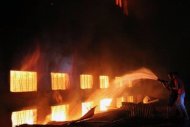
Firefighters try to extinguish a fire in a garment factory north of Dhaka on November 24. Tuba Group, the parent company of the Tazreen Fashion factory, said on its website that the factory opened in 2009 and employed 1,630 workers making polo shirts, T-shirts and jackets


IN a  tragedy reminiscent of that which occurred in New York over 100 years ago, at least 110 people have been killed by a fire which swept a garment factory in Bangladesh. Witnesses saw desperate workers leaping to their death from upper floor windows as they tried to escape the flames.

Firefighters battled for several hours to contain the blaze, which broke out on the ground floor of the nine-storey Tazreen Fashion plant 30 kilometres (20 miles) north of the capital Dhaka late on Saturday.
The factory made clothes for international brands including the European chain C&A and the Hong Kong-based Li & Fung company.


"I smelt smoke and ran downstairs and found that the place was already full with black fumes," Rabiul Islam told AFP as he surveyed the gutted ruins of the building where many of his colleagues had died.

"With another worker, I broke open an exhaust fan in the second floor and jumped to the roof of a shed next to the factory," he said. "I broke my hand but survived somehow."

Bangladesh is a global centre for clothes manufacturing due to its cheap labour, with many popular brands using huge factories to produce items for export to Western markets. But work conditions are often basic and safety standards low.

Dhaka district commissioner Yusuf Harun told AFP the death toll was 110, including several workers who died while jumping from windows or the roof. About 100 people were injured.
"We laid the bodies out in the grounds of a nearby school and have now started handing them over to relatives," Harun said.

"The factory had three exits but since the fire was on the ground floor, workers could not come downstairs," he said, adding that most victims were women.

Kalpona Akter, director of the Bangladesh Centre for Workers Solidarity, said the blaze was the worst that the nation's garment industry had ever suffered.

The owner of the factory, Delwar Hossain, told AFP the cause of the fire was not yet known but he denied his premises were unsafe.
"It is a huge loss for my staff and my factory. This is the first time we have ever had a fire at one of my seven factories," he said,

A Li & Fung spokeswoman told AFP: "We are very distressed and saddened by the deaths of workers and wish to express our deepest condolences to the families of the victims."

The company is "matching the Bangladesh Garment Manufacturers and Exporters Association's financial assistance by pledging 100,000 Bangladeshi taka ($1,200) to each family of every victim," the spokeswoman added.

Thorsten Rolfes, C&A spokesman in Berlin, said the company had commissioned the factory to make 220,000 sweaters to be delivered to Brazil. "The victims and their families are in our thoughts and prayers," he said.

Tuba Group, the parent company of Tazreen Fashion, said on its website that the factory opened in 2009 and employed 1,630 workers making polo shirts, T-shirts and jackets. It also said its factories make clothes for Walmart, Carrefour and IKEA, and added that the Tazreen plant had 60 smoke detectors and more than 200 fire extinguishers.

Relatives of the workers made phone calls to those inside the factory as it burned, local residents told AFP, and one witness said firefighters were helpless as the blaze took hold.
"I came to the factory premises and found workers crying for help," Mohammad Ratan said. "I saw many jumping from windows."

A police investigation was under way and no cause had been identified, but fires as a result of short-circuits and shoddy electrical wiring are common in South Asian factories. A blaze in a Pakistan garment factory in September killed 289 workers and injured 110 more. Two of the owners are facing murder charges. According to the Clean Clothes Campaign, a Amsterdam-based textile rights group, at least 500 Bangladeshi garment workers have died since 2006 in factory fires.

"These brands have known for years that many of the factories they choose to work with are death traps," said spokeswoman Ineke Zeldenrust. "Their failure to take action amounts to criminal negligence."

Bangladesh has emerged as the world's second-largest clothes exporter with overseas garment sales topping $19 billion last year, or 80 percent of national exports.
The sector is the mainstay of the poverty-stricken country's economy, employing 40 percent of its industrial workforce.

http://uk.news.yahoo.com/bangladesh-factory-fire-death-toll-soars-121-fire-043734708.html

It was on March 25, 1911, that a fire swept through the Triangle Shirtwaist factory in New York, killing 146 workers, mainly young Jewish and Italian immigrant women. This tragedy led to a massive movement to improve conditions and safety in the garment industry, with trade unions pressing legislators. But 101 years later the clothing trade remains the scene of huge profits and sweatshop exploitation internationally, with cheap labour hidden behind expensive designer labels, and blazes like that in Bangladesh.
 
In March this year hearing via War on Want that Amirul Haque Amin, president of the National Garment Workers Federation Union in Bangladesh, was coming to Britain to speak about the gap between sweatshop toilers and Olympic glitter, the Jewish Socialists' Group invited him and his colleagues to speak at a meeting at which we also commemorated the Triangle Sjirstwaist fire. The Bangladeshi brothers and sisters also spoke to trade unionists at a meeting in Congress House.They see the link with Western high street stores as giving an opportunity for friends here to put pressure on companies to see conditions are improved in Bangldesh.  But the tragic blaze this weekend highlights how urgent this is, and how much needs to be done,

History on the Triangle fire:

http://en.wikipedia.org/wiki/Triangle_Shirtwaist_Factory_fire 

http://www.ilr.cornell.edu/trianglefire/ 

Organisations working for solidarity with workers like those in Bangladesh:

http://www.labourbehindthelabel.org/ 

http://www.nosweat.org.uk/ 

http://www.waronwant.org/campaigns/love-fashion-hate-sweatshops

Labels: , ,

Wednesday, October 17, 2012

West's two faces on Bangladesh war criminals

 FOR the right-wing Daily Mail it must have seemed just what the doctor ordered.

'NHS boss faces death penalty over charges of torture and 18 murders in Bangladesh'


One of Britain's most important Muslim leaders – who has a senior role in the NHS – is to be charged with 18 murders by a war crimes tribunal in his native Bangladesh, investigators have told The Mail on Sunday.
Coming amid the growing outcry over Jimmy Saville's visits to hospitals, the Mail story appeared timely, and to hit two targets at once - Muslims and the NHS.

Unlike a lot of the chaff on these topics that appears in the tabloid presss, the story by Abul Taher, published on October 13, was serious and factual, even if the headline's reference to Chowdhury Mueen-Uddin's status as an "NHS boss" might have been a bit misleading.

Mueen-Uddin won't have been in a position to decide anything about your treatment or operation, recruitment and remuneration of staff, or whether your local A&E closes. Not even about hospital car parking. He is described as director of Muslim Spiritual Care Provision in the NHS and chairman of the Multi-Faith Group for Healthcare Chaplaincy.

But as the Mail says, he "is accused of abducting, torturing and killing 18 journalists, academics and doctors during the bloody war of independence in Bangladesh in 1971"

If you read on to the end of the story you would find:
A Department of Health spokesman said: 'Mr Mueen-Uddin is not employed by either the Department of Health or the NHS.

'He was head of Muslim spiritual care in the NHS, and chair of the Multi-Faith Group for Healthcare Chaplaincy, an independent organisation which provides advice to the Department of Health about multi-faith healthcare chaplaincy on behalf of all Faith Groups.
.Nevertheless, Chowdhury Mueen-Uddin's background, the allegations against him, and how far he got in this country, deserve to be examined.  

During the Bangladesh war, forced when the Pakistan rulers refused to accept election results, thousands of people were killed, not only by the Palistan army, but by irregulars sponsored and armed by Islamicist parties opposed to Bangladesh seceding. The biggest of these was Jamaat e-Islami, which has wings in both Pakistan and Bangladesh, and has supported mujaheddin in Kashmir. One of the armed groups supported by its student wing in Bangladesh was the Al Badr brigade. 

Bangladesh's war crimes investigators say that Chowdhury Mueen-Uddin, while working as a journalist for a newspaper called the Daily Purbadesh in the capital Dhaka, was also said to be a secret member of  the Al-Badr Brigade, which abducted and killed opponents. Mueen-Uddin fled Bangladesh shortly after independence, going via India, Nepal and then Pakistan, from where he caught a flight to London in the early Seventies.


Sanaul Huq, the Inspector-General of Bangladesh's national police force, who is co-ordinating the ICT investigation, said his investigators believe that Mr Mueen-Uddin killed dozens of people during the independence war, but they can link him only to 18 murders with evidence and eyewitness testimonies.

The ICT said  Mueen-Uddin and his associates allegedly subjected their victims to horrendous torture before killing them and dumping their bodies in sports grounds which earned the nickname 'killing fields'.


Mr Huq told The Mail on Sunday: 'They abducted an eye doctor, and then gouged his eyes out before killing him and dumping his body.'They abducted a cardiologist and cut out his heart before killing him and dumping his body.'They kidnapped a woman journalist, and cut her breasts off before killing her. Her decomposing body was later found with her breasts cut off.

'These victims were chosen because they were leading figures in the independence movement. Mueen-Uddin was a leading figure when it comes to killing activists. This is why we want to try him in court.'As soon as charges are made – which I can guarantee will happen in days – we will request the British Government to hand him back to Bangladesh, and we will ask Interpol for his arrest. We will use all means, diplomatic and legal, to bring him back. If we fail, we will try him in absentia.'

Bangladeshi socialists in London alleged years ago that war criminals fleeing justice in Bangladesh were being admitted to Britain, with the apparent connivanmce of the British authorities, and  finding a niche for themselves in such fields as religious education. The East London Mosque was singled out for mention.Mueeen-Uddin is vice chairman of the East London Mosque and has worked with Dawatul-Islam, an educational and youth organisation seen as pro-Jamaat e-Islam.

Despite its record, Jamaat e-Islami has been able to function as a legal political party in Bangladesh, as well as raising funds in London, It was in government for a time in coalition with the Bangladesh National Party, between 2000-2008. During this time it received praise from the US assistant secretary of state for South and Central Asian Affairs Richard Boucher, who considered Jamaat-e-Islami as a democratic party and didn’t find any evidence of Jamaat being involved in bombing or connected to bombing.’ -The Bangladesh Observer report (5 August 2006.   This did not prevent Jamat e-Islami leading anti-US protests during the recent row over a "blasphemous" film. 

The return of the Awami League to government in 2008 set in motion the long-delayed invesyigation and pursuit of the war criminals, and yet Jamaat e Islami continues to present itself as the innocent victim of a political witch-hunt, and continues to enjoy sympathetic backing, free or paid for, from some quarters in the West.

In Open Democracy,Gita Sahgal has been looking at the Bangladeshi party's background and its backing. ( Bangladesh: the forgotten template of 20th century war
"A recent article by Elliot Wilson in the Huffington Post asked whether British aid was being used to fund a crackdown on human rights in Bangladesh. The article did not discuss where the £250 million given by the British government is spent or whether that spending is effective. Wilson argues that the Awami League government of Sheikh Hasina has undertaken ‘the most sustained assault on freedom of speech in the 41 years since independence’. A major reason for his claim is the arrest of Mir Quasem Ali, whom he describes as a leading member of the Islamist political party Jamaat-e-Islami, head of a major charity and a media magnate, arguing that he has been arrested solely for his public criticism of a Tribunal established to try crimes committed during the Bangladesh war of liberation in 1971.

Gita says many Bangladeshis living at home and abroad are concerned about the human rights situation in their country. But althouh human rights advocates and independent observers agree that many of the tribunal processes are flawed, they don't accept that the International Crimes Tribunal (ICT) was established solelyfor Prime Minister Sheikh Hasina, to get rid of her political opposition. 
 Indeed the tribunal has helped raise human rights issues by addressing impunity for mass crimes. And many people see a reckoning with the past as a necessary reassurance over their future.

 
"Human rights concerns in Bangladesh are far wider than the Wilson suggests. For instance, the government has been reluctant to accept new refugees fleeing violence in Burma. Unfortunately for Wilson’s argument that this is the worst attack on freedom of speech in Bangladesh’s history – the opposition is also implicated in targeted attacks on minorities when they came to power in a BNP and Jamaat e Islami coalition.

"Fear of their rise to power again has lead religious minorities to campaign hard for Bangladesh to return to its secular founding principles. At meetings in the East London tabernacle and at the House of Commons a number of organisations representing religious minorities such as Ahmadiyyas, and the Bangladesh Hindu Buddhist Christian Unity Council, described pogroms against them as soon as the BNP came to power in a previous election. Syed Anas Pasha, representing Bangladeshi journalists, described how journalists reporting on these attacks were themselves attacked.

"For those whose lives are threatened by fundamentalists, 1971 is not simply a bad memory but a current threat; one which has largely disappeared from public memory abroad."

Gita Sahgal says that Bangladesh 1971 is the "forgotten template" for conflicts that define the late 20th century, from former Yugoslavia, through Rwanda during the 1990s, and on a smaller scale in Gujarat, India in 2002. "The Bangladesh story tells us what happens when a military crackdown is supported by militias composed of religious fundamentalists with their own agenda".

The Jamaat e Islami was already known as a violent political party of the far right in Pakistan, bent on attacking minorities and creating an Islamic state. Indeed, their founder Maulana Maududi, who had opposed the creation of Pakistan as a Muslim homeland, is regarded as the first modern theorist of an Islamic state. On March 25th 1971, the Pakistan army launched a huge military crackdown in Dhaka – including an assault on Dhaka University in which many staff and students were rounded up and killed. Hindu halls of residence were particularly targeted.
The most notorious event that al Badr are said to have instigated, is known as the ‘killing of the intellectuals’. In the days before the surrender of the Pakistani army, dozens of professors, journalists, doctors and others were picked up, taken to torture centres, and killed.
 Wilson fails to mention that Mir Quasem Ali is under investigation by the tribunal, not for what he said about it, but for what he is alleged to have done during 1971. According to the Bangladesh press, the charges against the Jamaat leader include that he was the Chittagong unit commander of Al-Badr, described as ‘a vigilante outfit mobilised by Jamaat's erstwhile student wing Islami Chhatra Sangha’, and was third in the outfit's command structure. The investigation relates to atrocities alleged to have been committed by al Badr.
It is not surprising that Wilson, who calls himself an investigative journalist, doesn’t mention any of this. A recent book on 1971 by Sarmila Bose, Dead Reckoning: memories of the 1971 Bangladesh War, which has been comprehensively rebutted by Naeem Mohaiemen, manages to claim to interview all sides, to give a balanced account of what happened. As I showed in my analysis of the book, the author failed to interview any members of the Jamaat e Islami, or address allegations of their role in the conflict.  The story has simply vanished from her work.

David Bergman, himself a critic of the Tribunal, has investigated the Jamaat e Islami’s extensive lobbying efforts in the USA, and raised questions about whether the lobbying firm hired by Mir Quasem Ali in New York acted legally under the Foreign Agent Registration Act of 1938.

This Act requires that any lobbying firm acting on behalf of a foreign political party must register itself with the Department of Justice. The firm in question has signed contracts with Mr Ali (whose contract was terminated) and his brother worth $310,000 to work on exactly the same issues – ‘the Bangladesh War Crimes Tribunal and political opposition matters.’ Later they were reported to have dropped the work on opposition matters.

Given the extensive well funded lobbying effort by lawyers and lobbyists hired by the Jamaat e Islami or individuals connected to them, we might ask whether the Huffington Post article is part of this extensive lobbying effort, or driven by a genuine concern for fair trial and free speech. Both human rights and development efforts have been driven forward in Bangladesh by the efforts of  activists committed to secular values and gender equality. Without these efforts, the Awami League would not have made a commitment to hold trials in the first place, nor be able to show such a good record on development".
Much as imperialist Western governments and their media may affect distaste for religious reactionaries such as Jama'at e Islaimi, they also have to consider whether the diversions and divisions they create are not preferable to some of the things that go with commitment to secular values and economy. That's a consideration which applies in both Tower Hamlets and Bangladesh.

http://www.dailymail.co.uk/news/article-2217367/NHS-boss-faces-death-penalty-charges-torture-18-murders.html?ito=feeds-newsxml 

http://www.guardian.co.uk/commentisfree/2009/oct/07/bangladesh-war-crimes 

http://www.opendemocracy.net/5050/gita-sahgal/bangladesh-forgotten-template-of-20th-century-war-0

Labels: , ,

Wednesday, October 10, 2012

The 14-year old who frightened the Taliban


 MALALA on left-wing platform. Opposing Islamic reaction and imperialism.

TALABAN operating in Pakistan's Swat valley have been credited with a new victim today - a 14 year old schoolgirl who was targetted because she stood up for the rights of women and children, and especially for girl's education. 

A gunman walked up to a bus taking children home from school and shot 14-year old Malala Yousufzai in the head and neck. Two other girls were wounded, but it was clearly Malala who was the target.
The teenager was airlifted by helicopter to a military hospital in Peshawar, and there were reports she might be sent abroad for treatment. Several schools in the area stopped for the day in protest at the attack and in sympathy with Malala.

Malala, whose father is a headmaster, began writing a blog when she was just 11 under the pseudonym Gul Makai for the BBC. She opposed the Taliban and championed the need for girls education, which the Islamic extremist movement opposes.

"This was a new chapter of obscenity, and we have to finish this chapter," said Taliban spokesman Ahsanullah Ahsan by telephone.

Prime Minister Raja Pervaiz Ashraf condemned the attack and called her a daughter of Pakistan. State Department spokeswoman Victoria Nuland called the shooting "barbaric" and "cowardly."
Leila Zerrougui, the U.N. special representative for children in armed conflict, condemned the attack "in the harshest terms."

 ''Education is a fundamental right for all children," she said in a statement. The Taliban "must respect the right to education of all children, including girls, to go to school and live in peace."

Malala was nominated last year for the International Children's Peace Prize, which is organized by the Dutch organization KidsRights to highlight the work of children around the world.

But the 14-year old heroine, who knew that her outspoken views would make her a threat and a target for the Taliban, was not just a campaigner for "Western culture", as the media report. She was a supporter of a left-wing movement linked with the International Marxist Tendency, which means she opposes both Islamicist reaction and imperialist control.

Al Qaida and Taliban fighters began spreading from their base in Afghanistan into the Swat valley of Pakistan about five years ago.By 2008 they controlled much of it and began meting out rules and their own brand of justice. During about two years of its rule, the Taliban forced men to grow beards, restricted women from going to the bazaar, whipped women they considered immoral and beheaded opponents.

Taliban militants in the region also destroyed around 200 schools. Most were girls' institutions, though some prominent boys' schools were struck as well. The private school owned and operated by Malala's father was temporarily closed under the Taliban.

At one point, the Taliban said they were halting female education, a move that echoed their militant brethren in neighboring Afghanistan who during their rule barred girls from attending school.
While the Pakistani military managed to flush out the insurgents during the military operation, the Taliban's top leadership escaped. 

Link to International Marxist tendency comment:
http://www.marxist.com/imt-sympathiser-shot-in-swat.htm

Labels: , , , ,

Saturday, September 29, 2012

Reclaiming a Hero, Regaining a History

BHAGAT SINGH, hero of freedom struggle,
 celebrated in Pakistan, and by
people in India.


 SHAHEED BHAGAT SINGH did not have a long life. Born on September 26, 1907, he was hanged by the British rulers of India on March 23, 1931, so did not live to see his 24th birthday. But in those short years he had made a name as a fighter for freedom, and one who cared for the people -all the people. That's why his birth was celebrated yesterday by a gathering in Pakistan, which a party from India, including Singh's nephew, wanted to attend, but ran into that old standby of obstructive regimes, visa problems.
    
Shaheed Bhagat Singh was born in  Banga village, Jaranwala Tehsil in the Lyallpur district of the Punjab Province of British India, now part of Pakistan. His family had come from another village, Narli in erstwhile Lahore district, now part of Tarn Taran district in India.  His grandfather, Arjun Singh, was a follower of Swami Dayananda Saraswati's Hindu reformist movement, Arya Samaj, his father, and uncles Ajit Singh and Swaran Singh, were members of the Ghadar Party, led by Kartar Singh Sarabha and Har Dayal. Ajit Singh was forced to flee to Persia due to pending court cases against him, while Swaran Singh died at home in 1910 following his release from Borstal Jail in Lahore,

In 1919,  at the age of 12, Bhagat Singh visited the site of the Amritsar massacre, where thousands of men, women and children gathered at a public meeting in the Jallianwala Bagh gardens found themselves trapped when Brigadier General Reginald Dyer ordered troops to fire into the crowd. They kept firing for ten minutes until ammunition was almost exhausted., getting through 1,650 rounds of ammunition.  People trying to flee through the garden's narrow exits faced British armoured cars with machine guns fitted. Official Government of India figures said 379 people were  killed and 1,100 wounded, the Indian National Congress estimated more than 1,500 casualties and 1,000 dead. It was April 13, 1919, one day in that imperial history we're exhorted to be proud of.

Bhagat Singh took part in Mahatma Gandhi's Non-Cooperation Movement the following year, and at 14 he welcomed protestors against another massacre when they came to his village, but he became disillusioned with Gandhi's philiosophy of non-violence.  In 1922, he joined the Young Revolutionary Movement.

In 1923, Singh joined the National College in Lahore, where he did well academically, becoming fluent in several languages, but also took part in nationalist youth politics. He also joined the Hindustan Republican Association, and persuaded it to change its name to Hindustan Socialist Republican Association (HSRA).

In 1927 Singh was arrested, accused of being involved in a bombing in Lahore, but later released with a heavy fine. He wrote for and edited Punjabi and Urdu newspapers published from Amritsar, and in September 1928 when the Kirti Kisan Party ("Workers and Peasants Party") organised an all-India meeting in Delhi, Singh emerged as its secretary.


That same year the Superintendent of police in Lahore ordered a baton charge on peaceful demontrators protesting the British government's Simon Commission. Lala Lajput Rai who had organised the demonstration was injured and died not long afterwards. Superintendent Scott had personally asssaulted Rai, and Singh blamed him and vowed revenge. By mistake, Singh and his comrades shot the wrong man, an Assistant Superintendent Saunders.

Singh and the others went on the run,and might have remained free, but in 1929 he and Batukeshwar Dutt comrade were caught after bombing the Legislative Assembly. on April 8.  It was more of a spectacular protest against repressive legislation than a terrorist act. They threw two bombs from the public gallery, shouted slogans, and scattered leaflets. Few people were injured and nobody killed, but Singh and Dutt were charged with conspiracy to murder and went to prison.

Then on April 15, 1929, the 'Lahore bomb factory' was discovered by the police, and many members of HSRA arrested. Some turned informants, helping the police to connect Singh with the murder of Saunders..While in prison he led a hunger strike for political status.After one of the prisoners died, and the continuing hunger strike won international attention -lasting 116 days - the authorities moved to bring the Saunders murder case forward.

While in prison Singh kept a diary in which he noted sayings by various people, notably Marx and Engels, and he also wrote a pamphlet, "Why I am an atheist". 


Bhagat Singh, Rajguru and Sukhdev were sentenced to death in what had become known as the Lahore conspiracy case, and ordered to be hanged on 24 March 1931. But the hanging was carried out after dark on the evening before. 

There were strikes and protests, and Bhagat Singh became a hero to the people and inspiration to the youth. India did in the end gain independendence, but it was partitioned, with tremendous bloodshed, and 25 million people caused to flee because they lived wrong side of the partition lines. The problems of the people remained unsolved. We can safely say that this is not the freedom for which Bhagat Singh and his comrades fought and died. But they have not been forgotten. Those who have tried this week to reclaim their heroism are regaining the path of history.
  • Birthday memorial: ‘Bhagat Singh was a hero of working people’

    By Ali Usman
    Published: September 29, 2012
    daily Express Tribune


    LAHORE:
    Bhagat Singh’s proper description is as a revolutionary and anti-imperialist, Farooq Tariq, a member of the Labour Party Pakistan, said on Friday.
    Tariq was speaking to a gathering of some 100 people in connection with the 105th birth anniversary celebrations of
    Bhagat Singh at Diyal Singh Mansion. The celebrations had been organised by Bhagat Singh Memorial Society Pakistan and included a documentary screening, speeches on his life and ideology, and cutting of a cake at Shadman Chowk, the place where Bhagat Singh was hanged on March 23, 1930.
    Tariq said some people in India spoke of him as a nationalist or Sikh leader but his struggle was against those who usurp the rights of the peasants and workers. Tariq announced that they would collect donations and build a Bhagat Singh Museum at his ancestral village.
    Tariq said it was sad that a group of 32 guests from India including writers, intellectuals, social activists and Singh’s nephew did not get visas in time for the birthday celebrations. “They applied for the visa a month ago. Intelligence agencies personnel from kept asking us about them. We provided them their profiles but to no avail,” Tariq said. “It is sad since it was mostly people who oppose fanatics in India and the occupation of Jammu and Kashmir by India,” Tariq added.
    Iqbal Virk, who has possession of Singh’s house and lives in Banga village Jaranwala, ancestral village of Bhagat Singh, was invited as special guest.
    Virk said the primary school where legendary Bhagat Singh received his early education was in a dilapidated condition and his class room has just three walls standing.
    He said the ground where Bhagat Singh used to play as child has turned into a sewage pond but the people of the village still took pride in Singh’s role for independence.
    Playwright Shahid Nadeem said, “The story of Bhagat Singh still continues. Nawab Ahmad Khan, the magistrate who signed the death warrant of Bhagat Singh, was from Kasur. The family expelled Bulleh Shah from Kasur. Nawab Ahmad Khan was killed at the place where Bhagat Singh was hanged. Zulfikar Ali Bhutto, the then prime minister, was awarded a death sentence in the same case.”
    Farooq Qaiser, the author of several Punjabi books, said it was wrong to present Bhagat Singh as a “peace commodity.” He said he could not be compared to the Taliban either. “The Taliban took up arms to kill innocent people. Singh did not kill a single innocent person. He threw crackers in the assembly to make the deaf hear,” he said.
    Performers from Ajoka Theatre sang folks songs about Singh’s ideology and life between the speeches.
    Later, a cake cutting ceremony was arranged at Shadman Chowk. Those gathered to mark his birthday called it Bhagat Singh Chowk.
    A message from Indian guests who could not attend the event was read before the audience who termed the celebrations “historic…since Lahore had been the scene of Singh’s struggle.”
    Published in The Express Tribune, September 29th, 2012.


Labels: ,

Sunday, September 23, 2012

Another Pakistan, that we should hear more from


AFTER affair of "charred Koran", less media attention, or concern,  for 300 burned people? (Photo Fareed Khan, Associated Press)  Trade unionists protest demanding adequate safety laws and protection.
http://www.ecouterre.com/garment-factory-fire-in-pakistan-kills-300-trapped-behind-locked-doors/

IT is not often that we see good news from Pakistan, but that might have something to do with our corporate news media as much as with the politics of that unhappy country. We got the predictable and well-choreographed angry response to well-publicised anti-Muslim provocation across several countries this week, and though the Pakistan government declared Friday a day of "love for Mohammad", love was not the most obvious theme of several days of unrest in which 20 people died and at least 195 were injured.


It is reported that a Pakistani government minister offered $100,000 on Saturday to anyone who kills the maker of an online video which insults Islam. "I announce today that this blasphemer, this sinner who has spoken nonsense about the holy Prophet, anyone who murders him, I will reward him with $100,000," Railways Minister Ghulam Ahmad Bilour told a news conference, to applause.
"I invite the Taliban brothers and the al Qaeda brothers to join me in this blessed mission."

A spokesman for Pakistan's prime minister said the government disassociated itself from the minister's statement. As always the regime treads a careful path between encouraging religious fanaticism and appeasing the US master.

"You can kill our people with Drones but don't you dare upset us with films", was how one might cynically have interpreted the minister's priorities and message  I was also incluned to wonder how the minister's zeal for punishment might deal with the cleric who charred a Koran to frame a Christian child with learning difficulty, or those brave warriors who recently dragged two dozen people off a 'bus and slaughtered them because they were Shi'ites.

To which a friend added: "Not to mention the factory owners who murdered hundreds of their own workers in fires. I think if Muhamed were alive today that might anger him a lot more than the film."

He was referring to the fire in a Karachi clothing factory earlier this month, in which 289 people were killed, and the one in a Lahore shoe factory which killed another 25.

Reports indicate that workers could not escape the fires because the factory buildings lacked basic fire safety standards and emergency exits. The fire at Ali Enterprises, the garment factory located in Hub river road, Sindh Industrial Trading Estate (SITE) in Karachi killed more than 289 workers. Many of them died of suffocation as they were trapped in the basement. A large number of workers suffered grievous injuries as they jumped from the building to safety.

It is reported that the factory was illegally established and identifying the dead is extremely difficult as the workers were not registered with government authorities nor received written contracts.

To be fair, the Pakistani authorities have charged a factory owner with murder. This followed  demonstrations by Pakistani workers expressing their sorrow and anger, and demanding more adequate safety laws and protection. The unions also demanded proper compensation for the families of the victims as well as that the owners be charged with murder.
http://www.labourstartcampaigns.net/show_campaign.cgi?c=1570 
http://www.bikyamasr.com/77386/pakistani-factory-fire-highlights-lack-of-workplace-safety-measures/

According to central bank data, the textiles industry contributed 7.4 percent to Pakistan's GDP in 2011 and employed 38 percent of the manufacturing sector workforce. It accounted for 55.6 percent of total exports.
Noman Ahmed, from the NED University of Engineering and Technology in Karachi, said few industries and businesses implement the law on safety and fire exits, finding it easy to avoid because of lack of effective monitoring.

The clothing factory fire has echoes of the notorious Triamgle Shirtwaist factory fire in New York in 1911 in which workers were trapped, or died leaping from upper windows too escape the blaze. While unions and reformers campaigned for improvements in safety, many of the garments on sale nowadays in the United States, Britain and other rich countries are produced in poor countries like Pakistan, Cambodia and Bangladesh. Pakistani factory owners say they are under pressure to keep down costs to compete for export orders.

It has come out that the Ali Enterprise factory produced clothing for the KiK store chain in Germany. It has also been revealed that only last moth the Karachi factory was given a clean bill for safety by inspectors working on behalf of Social Accountability International, a New York-based monitoring group largely financed by big companies so they can say their contractors meet approved standards.

http://www.nytimes.com/2012/09/20/world/asia/pakistan-factory-passed-inspection-before-fire.html?pagewanted=all&_moc.semityn.www


We may well ask whether it is accidental that reactionary groups and governments welcome any religious pretext or provocation they can use to whip up a diversion from more material issues. We might also ask whether it is a surprise that our TV news and papers focus on such rows, even when there are much bigger strikes and movements over social issues, as happened recently in Egypt, which might remind us how much we have in common rather than what is supposed to set us apart.

Even the terrible news from Pakistan, particularly about that factory inspection, might have got people thinking about where our clothes come from, and about where our protection is going, when David Cameron talks of "killing the health and safety culture" and companies are trusted with "self regulation".

On the other hand, seeing trade unionists in Pakistan marching for their rights and safety reminds us we are all in one fight.

And here is some more good news from Pakistan
 
Dear Friends and Comrades,

Over the past few months, three Left political parties have been holding meetings to discuss the possibility of a merger and creation of a new progressive force in Pakistani politics. Many of us have been striving for left unity for years, even decades.

The challenges that working people an
d progressive political forces face both within this country and in the form of imperialist intrigue cannot be meaningfully confronted without such unity. In the past, efforts to bring the left together have both succeeded and failed, and it is in the spirit of learning from such experiences that this present attempt is being made.

We do not expect to suddenly emerge as a ‘third’ force in Pakistani politics, because we do not enjoy the kind of patronage of state and non-state powers that right-wing parties. Yet we do believe that the people of Pakistan want to see new alternatives emerging and we expect that a merger of existing left groups will be a giant step forward in building such an alternative.

It is true that a majority of the Pakistani population is young, and many of these youth are fed up with the existing political options at their disposal. We believe that a left political party can be the face of this young and struggling population, not on the basis of hollow slogans, but in the form of a workable anti-imperialist, secular, anti-feudal and democratic Socialist programme.

We want to harness the countervailing power of the people of Pakistan to take on and displace all status quo forces.

Baluchistan is burning, Khyber Pakhtunkhwa continues to be caught in the throes of a war between two fundamentalisms (imperialist and religious), and our biggest city Karachi is engulfed in a mini-civil war….the list could go on.

None of our existing political parties acknowledges or tries to address these divisions. We believe that only a mass left party can bring Pakistan’s divided nations together by bringing to the fore the shared interests of working people of all of these nations, and by accepting the rights of nations of self determination including the right of cession. We will struggle to affirm Pakistan’s multinational character, and will try and revive the historic alliances of the left and progressive ethno-nationalists. This is the most urgent task facing all progressives and we believe our new party will be at the forefront of this struggle.

While the merger process to date has included only our three parties, we are circulating this message to clarify that we want all those who share our goals to join us. We believe that the building of a democratic socialist Pakistan is possible only if the means we employ are inclusive from the outset. We invite you all to be part of his historic effort.

It is been agreed that a federal conference consisting of delegates from all three parties will take place on 4th November 2012 in Lahore. An interim body will be elected for the next six months. A congress of the new party will take place in the middle of next year to elect all the bodies and to set the political and organizational priorities.

We would also be happy to invite those who are not part of the party to take part in the first federal conference as observer and decide for themselves, if they want to be part of the new party.

In solidarity,
1- Awami Party Pakistan
2- Labour Party Pakistan
3- Workers Party Pakistan

Please contact for more information and solidarity
Awami Party: (Jamil Umer) 
 alberuni123@hotmail.com
Labour Party: ( Farooq Tariq)
 labour_party@yahoo.com
Workers Party: (Assim Sajad Akhtar)
 amajid@comsats.net.pk

The Labour Party of Pakistan is not like the British Labour Party, but originates in the tradition of Labour's Militant Tendency, now represented by the Socialist Party and the Committee for a Workers' International (CWI).  We might nite though that when Farooq Tariq was in Britain a couple of years ago he spoke with the Scottish Socialist Party, with which the SP has burnt is bridges, and referred to the Scots as a sister party. At any rate the Pakistani Labour Party is clearly more successful than the Socialist Party has been so far in building a broad alliance. 

The Workers Party has a background in Pakistan's version of a Communist Party, having emerged through past splits over whether to look to Moscow or Beijing for guidance, the shock of the Soviet Union's collapse, and the realisation they must find their own way to socialism.

The Awami Party has a history that goes back to the struggle against the British Raj, when the founders of its tradition,in contrast to Jinnah's Muslim League, were prepared to ally with the Congress Party for the freedom of all India. Strongest in the North West Frontier Province and Baluchistan, it at times experienced provincial government and state repression, under both the military and Bhutto. A former secretary was tortured to death as a "Communist".

The Awami Party holds that Pakistan has four nationalities - Pakhtun, Baluchi, Sindhi and Punjabi. This approach to national equality, and secular rather than religious identity, could be a factor in he new party becoming a force for workers unity and genuine democracy.       

Labels: , ,

Friday, September 21, 2012

Faraway Places, Familiar Story

 CONRAD HILTON-RANGALI ISLAND, MALDIVES 
A long way from Tottenham Court Road. Or is it?

"A million miles from the nine-to-five, nestled in an azure ocean, lies a secret... maybe nature's best kept secret. An island of tranquility and harmony, where mankind and Mother Nature entwine in an exceedingly passionate dance of color and life and where every visitor is as special and totally different because of the wondrous creatures that grace this paradise.

The only place on earth where there are thousand ways to try to do nothing, and each day may be a dream return true..."

That's the alluring blurb for Conrad Hilton's Rangali island resort in the Maldives, faraway in the Indian Ocean and clearly far away as life could be from the cares and bustle of London's Tottenham Court Road.

Or is it?

I've mentioned Tottenham Court Rd in London because this week trade unionists have been picketing there after earler going to Westbourne Park, in a dispute over what they say is victimisation of union members on the Crossrail project.

But before we come to that, let's hear from the International Union of Food and Catering Workers (IUF) about what's happening across the world in the Maldives:

Guests at the Hilton Conrad Rangali Islands Resort in Maldives pay 1,000 dollars a night to stay in luxury villas located on two private islands, where they can choose from "seven world class restaurants including the world's first all-glass undersea restaurant serving contemporary cuisine". "For the ultimate dining experience" guests can order a private beach dinner with their own chef and waiter. But conditions are less than luxurious for the workers who serve them.

 Last year, some 350 workers held a peaceful work stoppage to highlight their longstanding demand for a clear reckoning of the service charge which makes up a crucial l part of their pay. Since 2009, the IUF-affiliated Tourism Employees Association of Maldives, TEAM, had attempted unsuccessfully to raise the issue with management.
 When management gave assurances that they were prepared to discuss the issue, the workers returned to work. Twenty-nine workers were then terminated. Union supporters were at the top of the list, which included employees with 10 or more years of service. The ostensible reason for the dismissals was a projected slowdown in business in the second and third quarters of 2011. In fact, tourist arrivals into Maldives grew significantly in this period. The real motivation for the dismissals was to bust the union's activist base

Twenty-two workers challenged their dismissals at the Employment Tribunal. In February, the Tribunal ruled that the mass firings were unfair, and ordered management to reinstate the workers within 10 days with full back pay.

The workers are still waiting. Management refused to comply with the court decision, and then appealed it. In August, the IUF wrote Hilton Worldwide Resorts management, urging it to reinstate the 22 workers in compliance with the court order and to enter into negotiations with TEAM. Hilton has not responded. Workers face a long wait at the appeals process, which is only now getting underway.
The workers have been more than patient.
  Management responded by terminating union supporters - and refuses to comply with a court order ordering the resort to reinstate them.

http://cms.iuf.org/?q=node/1924 

If you go to this IUF site there's a place where you can  click to send a message calling on Hilton management to reinstate these 22 workers who stood up for their rights and recognize their union! 

Incidentally, that bit about the company ignoring a court order to reinstate sacked workers will sound all too familiar to British trade unionists who have gone to arbitration or employment tribunals and won their case against victimisation only to find the employer simply ignores it.  

Anyway, here from the Blacklist Support Group on Facebook is the report of what's happening on Crossrail:

 SACKED FOR JOINING A UNION

28 workers including a UNITE steward and safety rep have been dismissed from the Crossrail project because they are members of a trade union. The unionised workers employed by E.I.S. Electrical were searched and removed from site last Friday at the instruction of Bam Ferrovial Kier (BFK), the consortium of contractors building Crossrail.

 Crossrail is going to be one of the largest infrastructure jobs in the whole of Western Europe – if it is unionised, the workforce will earn good wages and the job will be safe. This is a deliberate attempt by BFK to intimidate workers and keep the union off the project, so they can keep wages down and force through rushed production targets.
Whatever nonsense BFK come up with to justify the dismissals, everyone knows there are 3-4 years work left on the project for these sparks alone. But as soon as the union appeared on the job, the steward was banned from the tunnel and forced to sit in the site offices at Westbourne Park for weeks on end. The Safety Rep was suspended and left to sit at home for the past 13 weeks. Eventually BFK threw EIS off the job just to get rid of the union. The Managing Director of E.I.S. has given the union a witness statement and states that the only reason the workers and the reps have been removed from the job is because of the union presence.

This is a dispute about safety and money. Even the EIS electrical engineer was sacked after he took a photograph of unsafe high voltage electrical cables. BFK are making money by playing with our lives.

BFK want to save money on Crossrail We want to save lives on Crossrail

BAM and Kier (part of the BFK consortium) are proven blacklisters of trade union members. They were part of the Consulting Association blacklisting conspiracy exposed in 2009. There is documentary evidence that their senior managers and Directors have illegally victimised union members. We know exactly what they’ve been up to – We’re not going to stand for it on Crossrail. The sparks won their fight against BESNA pay cuts – The rank and file will win the fight for Crossrail. ·

 SUPPORT THE VICTIMISED CROSSRAIL SPARKS · END THE BLACKLIST

Here's a video from the frontline:
http://www.youtube.com/watch?v=Qp_j9OIaawU 

And an update posted by Dave Smiith, a well-known figure in the fight against the blacklist: 

Video of Day 3 Crossrail dispute - action spreads from Paddington to
Tottenham Court Road construction sites. Supermodels were delayed from
attending London Fashion Week catwalk shows


*http://www.youtube.com/watch?v=Qp_j9OIaawU*

So even in the heart of London the class struggle interfaces with the glamour world! 


Labels: , , , ,