Thursday, July 04, 2013

Success in Basra, So-so in London
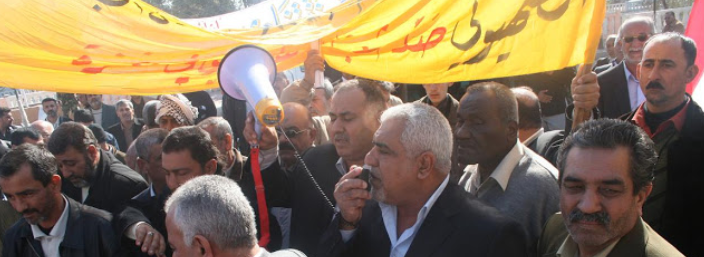

HASSAN JUMA'A (with mike).  Case falls, after EIGHT attempts! Oil workers' leader thanks international solidarity campaign. 

REMISS of me not to update this blog on a couple of issues we have been following.

FIRST, from IRAQ, we got this news on Monday:

 CHARGES AGAINST HASSAN JUMAA HAVE BEEN DROPPED TODAY!
Today the company lawyer and the prosecutor have repeated the accusation against Hassan but in the same time confirmed that there is no damages caused by Hassan’s activities. The prosecutor have asked to close the case and drop the charges. Hassan’s lawyer didn’t need to present his defense and he didn’t expect that the prosecutor will demand dropping the charges. .... Hopefully this will deter future malicious and repressive prosecutions.

Hassan Juma'a Awad, the leader of the Iraqi Federation of Oil Unions, had been facing charges that he organised strikes and campaigned against oil privatisation, in other words did what a union leader ought to be doing, but as Iraq since "liberation" has retained legislation from Saddam Hussein's regime where unions are concerned, he was facing a possible prison sentence. Here is a report from an international union centre:

"The Basra court hearings, originally tabled for 20 March, 7 April, 15 April, 2 May, 19 May, 3 June, and 17 June were all postponed when the Ministry of Oil, the Southern Oil Company (SOC) and its legal representatives consistently failed to provide any evidence in support of their claims that Hassan Juma’a was guilty of undermining the Iraqi economy by organizing illegal strikes and publicly criticizing the privatization of Iraq’s oil.

"The 1 July hearing took less than 30 minutes to reach the decision to drop the charges after the company lawyer and the prosecutor repeated the accusations against Hassan but at the same time confirmed that there were no damages caused by Hassan's activities. The prosecutor asked to close the case and drop the charges. On this occasion Hassan's lawyer did not even need to present his defense.

"If convicted he would have faced stiff fines and up to three years in prison. This is the first time an Iraqi trade unionist has been charged under penal code 111-1969, an archaic law that the Saddam Hussein regime used to repress state employees".           

http://www.industriall-union.org/union-victory-basra-court-finally-drops-charges-against-hassan-jumaa

A number of international union organisations were supporting Hassan Juma'a against this threat, US Labor Against the War(USLaw) circulated an international petition, and here in London a number of us had pledged to demonstrate outside the Iraqi embassy if the oilworkers' leader was sentenced.

Hassan Juma’a issued this statement on behalf of the Iraq Federation of Oil Unions (IFOU):
 “In such a happy occasion we would like to thank unions, federations, organizations and individuals who have contributed to the International Campaign to drop the charges and signed the letter addressed to Mr. Prime Minister of Iraq. Around 41 international federations and unions, 44 national federations and unions, 68 non-governmental organization contributed to the campaign. We specially thank the following organizations which tributed to the coordination of the international campaign: Initiative of Solidarity with the Iraqi Civil Society (ICSSI), the (USLAW), International Solidarity Center (SC) and IndustriALL.

 This verdict is a victory of the union freedoms in Iraq and the entire world. It is the best evidence that labour international solidarity is capable of achieving rights.
 
 To the Iraqi government and the ministry of oil: IFOU and its president were never against or source of harm to the Iraqi economy. We were the ones who protected oil and work facilities during difficult times including the occupation period. However, we will continue to practice our rights guaranteed by the Iraqi constitution including our right on trade union organization, defending workers and oil workers' rights and the national interests. We will continue our struggle and call for the issuance of a labor and trade union law. We are open to cooperate with government and international organizations to achieve this demand.”

And so from Iraqi oilworkers to the staff at London Metropolitan University who have been facing victimisation in what looks very much like a case of the authorities bowing to outside pressure. The most senior of those under threat, Professor Stephen Jefferys, issued this statement on Monday:
  
STEVE JEFFERYS takes a break from troubled academe with his granddaughter

With one bound...


< I am writing to you to thank you for supporting our campaign and signing a petition in February and March of this year protesting at the suspensions by London Metropolitan University of myself (Professor of European Employment Studies), Max Watson (the UNISON trade union branch chairperson) and Jawad Botmeh (a Palestinian who had served 13 years in prison as a result of a major miscarriage of justice) in connection with the Working Lives Research Institute having given Jawad work. You may remember that the suspensions followed immediately after Jawad's being elected by LondonMet staff to represent them as a Governor on the LondonMet Board of Governors.

The result of your efforts was a real success: we were all reinstated by March 13. Jawad resigned as Governor on March 14 and is now back at work.

However, senior management has continued to attempt to make life difficult for Max and me by charging both of us with 'serious misconduct' in connection with Jawad's appointment to a half-time casual job in 2008. This was despite the fact that his 2010 appointment to a permanent post was what triggered his ability to stand as a Governor - and the fact that this appointment went through HR and was raised with Professor Malcolm Gillies, five months after he became VC.

In our hearings and at our appeals both Max and I were found 'guilty': Max for 'not remembering' how Jawad had found out about job and for allegedly 'coaching' him (the only candidate); me - although no rules were broken - for failing to approach an even more senior management to approve such a 'controversial' appointment.

While Max was a junior administrative assistant at the time of Jawad's appointment, and I was responsible for it - a decision that led to no risk or damage to the university, staff or students (unlike a series of other decisions taken by other senior managers, none of whom we were told at my appeal, has ever been taken before the university's disciplinary proceedings) - our punishments are now different.

As from today, July 1, the Final Warning I was issued on April 23rd, has now expired. It is for this reason I am now able to write to you all to explain what has happened.

Unfortunately, Max Watson has got a six months' Final Warning which will now only expire on November 1. This is disgraceful treatment of a worker who did absolutely nothing wrong; and it confirms concerns that the management has all along aimed to victimise him because he is an effective trade unionist. This issue is obviously of particular concern to the UNISON trade union, the UK's largest public sector union, but it it also of concern to all who are concerned with rights at work and social justice.

One final suggestion. The Working Lives Research Institute is about rights at work and social justice. If you are not already on our mailing list, I would like to invite you to go to
http://www.workinglives.org/contact-us/mailing-list/subscribe.cfm
and to sign up. Besides showcasing the research projects we work on, under Courses on the website you will find our flagship Professional Doctorate programme - the DProf (Researching Work). This is a part-time doctoral programme that operates on a 5 a year two-day intensive study basis and leads to a doctoral degree usually based on a thesis probing a professional issue of direct relevance to you. Do contact us if you are interested... a new cohort is starting in October.

Of course, our DProf programme will now be enriched with a critical analysis of our own arbitrary managerial action and of the ethics of human resource management, as well as with examples from our recent research on Forced Labour (for the Joseph Rowntree Foundation), http://www.guardian.co.uk/global-development/2013/jun/05/european-governments-oblivious-forced-labour-conditions

Once again, Thanks for your support. You helped us win reinstatement.
Solidarity remains as important for social justice as ever.

yours in solidarity

Steve Jefferys
(In personal capacity)
Director, Working Lives Research Institute,
Faculty Advanced Institute for Research (Faculty of Social Sciences and Humanities)
London Metropolitan University
www.workinglives.org

Labels: , , , , ,

Thursday, April 18, 2013

Does London Met trouble trail lead to Home Office?


LONDON MET protests won reinstatement. But fight is going on.
 

HAS the government been directly interfering in the running of a university?
 IF it has done, and everything is above board and correct, why has it done so from behind the scenes, and why are the university authorities and media covering up for it?

 London Metropolitan University has been through enough trouble in the last few years to last most institutions a lifetime. In January 2010, it was found guilty of misreporting domestic student numbers and told to return £36.5m of public funding. Courses and staff were cut, though unions and students protested that they were being made to pay for a mess that was not of their making. The governing body resigned en masse and a new vice-chancellor, Malcolm Gillies, was brought in.

Then in August last year, the UK Border Agency accused the London Met of a systemic failure to monitor overseas students. The implication was that students were signing up for expensive degree courses merely so they drop out and take the sort of jobs done by illegal immigrants. Whatever the truth it left many bona fide students who'd paid for their courses in limbo, not even sure they could get back into the country if they had gone home for the Summer vacation, let alone return to their courses. Others feared deportation if they could not find another place to work for finals. Many who had to find another place are still angry.
Banned students still angry
    
On April 9 this year London Met's right to recruit overseas students was provisionally reinstated. But the international scandal has had lasting effects. For the 2012-13 academic year, enrolments were down 43%. And the ban had a "big effect on income", Vice Chanceller Gillies concedes.

In December, Stephen Perkins, dean of the business school, announced that the school would be cutting 40% of staff and three-quarters of its courses "to ensure the university's future sustainability". A report in the Guardian highlights the case of a PhD student whose work was thrown into chaos by staff resignation. "... Ross's main supervisor, whom he describes as a 'fantastic' professor, left the school voluntarily. Ross had no idea what this meant for him – and he couldn't find anyone to answer his questions. 'The university never even contacted me to let me know that my director of studies had left,' he says."

Now Gillies is about to publish a new three-year business plan which will cut a further 150 posts on top of 200 that went last year, and more staff are expected to leave voluntarily.
 London Met "survival strategy"

But London Met's problems have become political, as well as economic.

On March 12-13 three members of staff were re-instated after up to five weeks suspension, which led to a campaign in their support by the trade union Unison and others. Jawad Botmeh, convicted in what many people believe was a frame-up for "conspiracy" to bomb the Israeli embassy in 1994, had been working quietly as a researcher in London Met's Working Lives institute for five years. There were no complaints about his work or conduct, and he appears to have got along well with colleagues. It was after he was elected a staff governor that his suspension followed.

After he was reinstated Jawad stepped down from the board of governors.

According to an email from University secretary Alison Wells: "The Board and the University had become aware that Jawad Botmeh's membership of the Board would impact adversely on the interests and the future sustainability of the institution".

This as good as confirmed my suspicion that somebody was putting pressure on London Met from outside, though it remained to be seen where this was coming from.  

Meanwhile, though back in their jobs, administrator and Unison shop steward Max Watson, and the head of the Working Lives Research Institute, Professor Steve Jefferys, have still been facing disciplinary charges, although it is not clear what they are supposed to have done wrong. What many trade unionists suspect, and beyond the confines of the university, is that not only have people in power disliked London Met's intake of working class students, but they resent the very existence of the Working Lives Institute because it deals with trade union rights and history, and records working people's experience.
 

At a protest meeting on Wednesday, the day Thatcher was being buried, and working people throughout the land were celebrating, Max Watson spoke of victimisation aimed at denying workers representation. Steve Jefferys, a one-time Chrysler factory worker, said that far from acting improperly, his department had introduced proper interviews for casual job applicants, in place of the informal arrangements which enabled people to appoint their mates.

 But what was most headline-grabbing - or should have been - was the announcement by speakers at this meeting that they have seen a confidential document from the Home Office, dated April 9, the same day London Met was given its probationary recruitment rights, expressing satisfaction at its conduct in removing Jawad Botmeh as a staff governor, and warning that its rights will be revoked if he is ever re-elected. 

London Met meeting, April 17 

https://www.youtube.com/watch?feature=player_embedded&v=LzuxsYiGtzQ

   In other words, if you know what is good for you, you will make sure no one is elected to any position of whom we disapprove!
 

And we wonder how long before this way of running things is applied more widely, whether in academic institutions or the rest of the country?  

Labels: , , ,

Wednesday, September 22, 2010

Kelly's War is our war too

GLENN KELLY and above, the people in Bromley defending public services.

TRADE UNIONISTS, community campaigners, and anyone else concerned with maintaining public services in Britain are facing up to a fight with this Con-Dem government and those doing its bidding, and the fight has already begun.

In Barnet, on the northern rim of London, workers and service users joined a lobby at Hendon town hall last week against the Tory council's "Easy-council" plan for shedding services, and tomorrow evening, September 23 the Barnet trades union council is hosting a public meeting to launch a Barnet Alliance to Defend Public Services. Guest speakers include Newsnight economics editor Paul Mason, to put the cuts in context, and help put the Tories in their place.

In neighbouring Brent, the trades union council is backing a Brent Fightback campaign, due to hold its second meeting at the trades and labour hall on Willesden High Road on Wednesday evening, September 29.

Across the other end of London, Unison activist Glenn Kelly took the photo above with his mobile, from outside Bromley town hall, where he had joined council carers and relatives of care users lobbying against the cuts.

COMMUNITY CARE, an online newsletter for the caring professions, carried this report last month:

Council plans to axe in-house care provision
Mithran Samuel
Wednesday 18 August 2010

One hundred home care jobs are at risk in Bromley from cost-cutting council plans to end in-house care provision, a staff representative has warned.

Glenn Kelly, a staff representative at the south-east London council, claimed the authority was implementing plans to transfer all ongoing home care to the independent sector, where services are much cheaper, without consultation with users.

He has started a campaign to save the service, which he claims is backed by most home care staff and public service union Unison, which may take strike action if the plans are not reversed.

There are currently 146 home care staff, most of whom work part-time, serving 250 clients. About 40 jobs will be available in an expanded council reablement service, which will be ring-fenced for existing home care staff, and the council says there may be other opportunities for redeployment, such as in sheltered housing.

However, Kelly said the council had issued a call for voluntary redundancy and planned to make staff who had not been redeployed redundant in January 2011.

Councillors are due to vote on the proposal next month.

Kelly said that instead of tendering out the service and consulting on the changes, the move was being implemented by stealth, with independent care agencies taking on service users after in-house care staff left their posts. "Service users are being told their provider is being changed overnight," he said. "They are siphoning off the work even before the council has voted on whether to keep the in-house service."

He said this was despite 96% of users saying they were satisfied with the service in a recent survey.

http://www.communitycare.co.uk/Articles/2010/08/18/115100/Council-plans-to-axe-in-house-care-provision.htm

Bromley council has confirmed that it expected in-house provision to decline over coming months with "packages moved to other providers". It claimed in-house provision was already in long-term decline, partly because users were taking up direct payments and personal budgets and spending them elsewhere.

That sounds in line with the same Tory policy being pursued by Barnet, whereby old people and others needing care will be given their money (means-tested?) and left to get on with it. It also sounds like another opportunity for enterprising private providers, the Tories' chums, to come in offering their services, at a profit, relieving the council of its cares and the disabled or pensioners of their money, so that we can expect a sequel to those TV series about cowboy builders, this time about rogue "carers". Only this time the witnesses might no longer be around to tell.

At the very least, those people who know community care say cuts are a false economy because they will only speed and increase the number of people needing hospital beds - which are also being cut. That's the thing with implementing cuts. Instead of joining forces to resist, each service provider -local authority, health service, voluntary sector - has to get its books in order by passing the parcel of responsibility to someone else -so after many years of working, and contributing to the community, old people who find themselves in need of care become "packages moved to other providers".

But Bromley's cuts are "fair" - they are hitting young, as well as old. At a time of soaring youth unemployment throughout the country, concern over access to higher education, and fears of more young people being drawn into gangs and being both perpetrators and victims of violent crime, Glenn Kelly had this to report on Facebook the other week:

Just on way back from meeting of 150 workers In the youth and connexions service where management announced 40% job cuts with rumour that half of all youth clubs to be closed. Time for the workers and youth of Bromley to unite and organise.

Quite. So what is Unison, the main union in local government and health services, doing?

At the Trades Union Congress in Manchester, Unison general secretary David Prentiss made a fine speech:

"Today we face our greatest test for a generation. Our economy still on life support. The blight of unemployment scarring lives, wearing down communities.

“A government with no democratic mandate. Mounting an assault on all that our movement has won for our people. Our pay, our pensions, our jobs. Our public services and our welfare state.

“An attack the like of which we have never seen before. The coalition taking a chainsaw to our public services. And they’re hoping no one will notice.

"Hoping no one will notice banks are posting record profits, bankers back to their bonuses. Hoping no one will notice the income, of the top 1 per cent of our society. Now greater than the total pay bill for our NHS, schools, and local government put together.

“Hoping no one will notice the amount we lose every year in tax evasion, and avoidance by big corporations. More than enough to wipe out the deficit at a stroke.

“A society in which some backers of the Tory party, pay less in tax than a cleaner in a hospital.

He went on to pledge:

“Who will champion what is right, not just what is popular? I’ll tell you who. We will. We will speak up for the vulnerable. We will stand shoulder to shoulder with those who work in public services, and those who rely on them. We will work together to raise public awareness. Build opposition. Give practical support to those in our communities fighting to defend their schools, their hospitals, their care homes,

“We will build alliances with NGO’s, with charities, social movements in the UK, our sisters and brothers taking action across Europe. We will build an alliance of public service unions to break the pay freeze. And when the call is there, we will move to co-ordinate industrial action to defend all we hold dear. All that past generations have fought for.

“Congress, we have to rise to the challenge. Show our resolve. Defend our welfare state. Fight for our vision of a fairer society. Build a powerful coalition of our own. Our members expect nothing less from this great movement of ours. To stand up for them. To protect their jobs, their welfare state. To lead the fight. Together united, fierce defenders of our members and the services they deliver".

See Prentis' speech in full:
http://www.unison.org.uk/asppresspack/pressrelease_view.asp?id=1976

That's fighting talk, and welcome it should be too.
But if Unison's leadership has been preparing for a fight it is not against the government.

Earlier this year, six full-time union officials strode into the union's office in Greenwich, south-east London early one morning, accompanied by the council's human resources manager. One of them told Greenwich branch secretary Onay Kassab(Kaz) to "disappear sharpish". Two other branches were hit by the dawn raids. Kaz and three other elected officers -one of them Bromley branch secretary Glenn Kelly, also an elected NEC member - have been barred from holding office.

http://www.stopthewitchhunt.org.uk/

Ostensibly, the moves against these four members began with the absurd row over three wise monkeys in a cartoon on a leaflet, which some people claimed was offensive. The officers long ago apologised for any unintended offence. But many members besides them suspect their real "offence" was to campaign too hard against New Labour policies, and union complaisance, knowing we would still be fighting privatisation and cuts had Gordon Brown been returned again. Glenn Kelly was re-elected to the NEC with an increased majority after the union had begun its moves against him.

If the Unison leadership is serious about fighting the Con Dem cuts, surely it would make sense to drop any bans and moves against these popular and dedicated union members, and bring them on board to help lead the fight?

Instead the four are having to continue to fight for the right to hold the positions to which they were elected by their fellow workers. As Glenn Kelly remarks tersely but sadly on Facebook today (Wednesday):

"Now preparing for day three of court case against union. From fight for workers jobs to now having to fight my own union can't be right".

I don't know Bro.Kelly personally. I am neither a member of his union, Unison, nor of the Socialist Party, to which he belongs. But whatever the court says, I'm pretty sure what the verdict of grass-roots trade union activists and campaigners will be.

***************************************************************************

BARNET meeting to launch Public Services Alliance:
Thursday 23 September, Emerald Suite, North London Business Park, Oakleigh Road South, London N11 1GN
Meeting starts at 7pm, but there will be refreshments available from 6.30pm for people coming from work.
Residents and people working in Barnet welcome. Plenty of time to discuss plans.
Guest speakers include: Paul Mason, Newsnight journalist (personal capacity), Alasdair Smith, Anti Academies Alliance.

Labels: , , ,

Sunday, August 01, 2010

Victory for Yunus, Questions for Unions

AFTER a four year struggle against injustice, a North-East health worker and trade unionist has won the battle to clear his name. For mental health nurse Yunus Bakhsh, the question is whether Northumberland, Tyne and Wear NHS Trust, which had sacked him for alleged bullying, will give him his job back, now that an Employment Tribunal has found the Trust unfairly dismissed him for his trade union activities.

But the question for other union members is why this member with years of work in the health service was abandoned by public service union Unison, so that he was left to fight a long legal campaign against the employer on his own.

There is another question to be asked of both the Northumberland, Tyne and Wear NHS Trust and the union, which insists on being very politically correct in confronting racism. It is, how come characters with far-Right links in the North-East seemed to be well-informed in advance of the accusations and moves against Yunus? An NHS Trust dealing with very vulnerable people and confidentiality on a daily basis must surely be run by people whom we, the public can trust?

Yunus Bakhsh was suspended in 2006, after twenty years service, on the basis of an "anonymous" letter of complaint against him. Senior managers began what they called an "impartial investigation" of allegations that he had bullied or intimidated other staff members. After Yunus became depressed and ill he stopped attending disciplinary hearings. He was sacked in 2008.

In a 400-page report issued last week the employment tribunal found that the Trust had unfairly dismissed Yunus for his trade union activities. It also ruled that the employer had discriminated against him because of his illness.

Referring to Elizabeth Latham, the NHS Trust's head of human resources, the Tribunal says: “The hand of the Human Resources Department which acted unlawfully in suspending the claimant… extends throughout the whole of the process… all the way to the conclusion of the appeal hearing…” It describes her statements as “not credible”. As for her fellow director, Russell Patton, the report says he acted in an “arrogant and hostile fashion” in his dealings with Yunus, and describes his statements as “unreliable and at times incredible”.

One might have expected Unison, which has spent a fortune on advertising telling workers they need the union behind them, to have jumped in to back up Yunus Bakhsh. Instead the officialdom appeared readier to jump on this worker and anyone who supported him.

There was an echo in the beginning of this case of the victimisation of mental health nurse Karen Reissman, in the Manchester area, sacked after 25 years service, for having spoken to the press about her worries concerning the effect of cuts on services. Before he was suspended, Yunus Bakhsh revealed to the press that Nothumberland, Tyne and Wear NHS Trust bosses had awarded themselves big pay increases while cutting the patient food budget.

But Yunus was also hoping to stand for the leadership of a new Unison union branch due to be created after several hospital trusts merged. If he had won he would be heading one of the biggest branches in the country. That might not be a welcome prospect for some people in Unison who have been finding ways to remove other left-wing activists like Yubus (a Socialist Workers Party member) from positions. The employers' action might be their chance.

At any rate, Unison leaders told Yunus he had no chance of winning his case at a tribunal. They refused to fund the challenge or authorise the strike ballot his members were demanding to defend him. They then used essentially the same evidence as the Trust to suspend him from office and mount their own “investigation”.

Yunus was expelled from Unison in 2008, with union leaders knowing that vital paperwork that could clear him of their charges was locked in an office that he was barred from entering. The union held to this position even when it revealed that contributors on far-Right hate sites were confidently anticipating the outcome, and seemed to know more than he did.

Last year when Yunus was invited to speak at the National Shop Stewards Network (NSSN) conference in London, Unison officialdom in the North East tried to forbid union branches from sending delegates or making donations to the conference. Darlington branch secretary Alan Docherty has been suspended for three years for supporting the NSSN.

http://www.socialist.net/unison-gives-alan-docherty-a-3-year-ban.htm

The Employment Tribbunal's judgement notes, “The Tribunal is bound to wonder whether she [Elizabeth Latham] found in Elizabeth Twist [Unison’s former head of health in the northern region] an ally and a shared sense of purpose”.

At this year's Unison conference a delegate from the Midlands was banned from the conference floor and had his credentials removed, for wearing a tee shirt that said "Yunus Bakhsh -working class hero". But nearly 300 people came to a fringe meeting where Yunus spoke, and told them that his tribunal hearing was expected to come up with conclusions on collusion between senior union officials and the employer.

Speaking with him was Caroline Bedale, from Manchester, who had been banned from office in the union for eight years, reduced to five on appeal. Her 'crime' apparently was to continue supporting Karen Reissman's campaign for reinstatement after Unison withdrew legal representation. Also, from London, national executive member Glenn Kelly spoke about the case of four members suspended from office in the notorious "wise monkeys" case, and the "dawn raids" on three union branches by full-time officials.

Interviewed this week by Socialist Worker, Yunus Bakhsh said he could not have survived the last four years without support from fellow-trade unionists. “I want my job back and to be back in my union,” he said.

“Unison should commission an independent inquiry into the way I was forced out of the union, and those responsible should face charges. This Tribunal decision is a massive victory for me. But it is also a victory for everyone who faces discrimination because of a mental health disability, such as depression. It is a victory for every trade unionist who stands up to bullying bosses and refuses to be cowed. And it is a message to those in the leadership of our unions—we expect them to fight to defend activists with all their might, not to witch-hunt them because of their political beliefs.”

As trade unions like Unison are supposedly gearing up to fight the Con-Dem government's cuts and attacks on rights and services, the question of which side union leadership and bureaucracy are really on is a question not just for Unison members but for all trades unionists.

Download the Full judgement [6.1mb PDF]

Victory for Yunus Bakhsh as health trust is bashed,
Socialist Worker, July 31

See also:

http://www.stopthewitchhunt.org.uk/

http://www.supportcarolinebedale.wordpress.com/

(acknowledgements to Labour Left Briefing, July issue, for report on Unison conference fringe).

Labels: ,

Wednesday, March 10, 2010

MP joins outcry over "Dawn Raiders"

LABOUR MP John McDonnell, who is a member of the public service union Unison, has added his voice to the protest over the raids by full-time officials aimed at taking over branch offices and removing elected officers.

The left-wing MPs comments are cited in a press release issued by Unison United Left, the rank and file campaigning group which is supporting Paul Holmes as candidate for general secretary of the union.

Press Release - Dawn raids on UNISON Branches

Unison United Left, the rank and file organisation for members of the UK's largest public sector union today spoke out against the seizure of union branch offices by union staff.

Full time officials from Unison's London Regional Office led teams of staff into branch offices in Bromley and Woolwich in South East London taking control away from locally elected officials.
The Tenant Services authority branch was also placed under regional control.

This action followed the imposition of disciplinary sanctions on four Unison activists, including the Secretaries of the Bromley, Tenant Services and Greenwich branches.

"Evidence in a recent tribunal case shows that the Regional Secretary had wanted these activists suspended two years ago," said a United Left spokesperson, "now the Region is taking control of these branches in a blatant attempt to put in a local leadership who will do as they are told.

" John McDonnell UNISON MP who has consistently spoken up in support of UNISON activists, was outraged at this latest attack and said:

"This is a disgraceful attack on unison members and contrary to union democracy - members should choose their own representatives. It is also an appalling waste of the time and energy of Unison staff and activists at a time when our members face unprecedented job cuts"

Not content with wasting thousands of pounds of UNISON members money witch hunting activists over the last 3 years, UNISON staff are now openly flouting UNISON's own rules

UNISON united left encourages members and activists to voice their opposition to Dave Prentis, General Secretary, and Linda Perks Regional Secretary.

Paul Holmes candidate for UNISON General Secretary said

"This is totally unacceptable. I have raised the issue, as an NEC member for Local Government, as a matter of urgency with the Head of Local Government, Ms H.Wakefield. I can't see how there can be a connection between suspensions relating to incidents over 2 years ago and any need to have raids and to put functioning branches into special measures."

Note to editors.

1. Unison United Left is the rank and file organisation for members of UNISON.

2. Unison United Left believes that UNISON full time officers have breached:
Rule B.2.2 which states that UNISON is a "member-led" Union in which decisions taken by members will be carried out.

Rule B.2.5 which promotes the rights of members to participate in decision-making.

Rule G.3.1 which confirms the rights of members to attend branch meetings

Rule G.4.1.2 which gives members the right to elect the officers of our branches

3. For more information email unisonunitedleft@googlemail.com

4.Paul Holmes is standing for UNISON General secretary more information can be found at www.paulholmeskirklees.blogspot.com

Labels: ,

Tuesday, March 09, 2010

PCS members battle, but Unison battles members

MEMBERS of the Public and Commercial Servants (PCS) Union are taking two days' strike action this week affecting a range of services from ports to job centres, the country's parliaments and the museums and art galleries. This is the opening shots of the conflict to come, whatever the results of coming elections, as both main parties are committed to cutting jobs and services, and government prepares to push through redundancies on the cheap.

The sight of pickets outside job centres is a reminder that when newspapers talk about "cuts in Whitehall" it is the services in your high street that face cuts. The jobs threatened are not Sir Humphreys, but clerks whose take home may be less than some clients, leaving the rest to cope with longer queues, or waits on the phone, and consequent frayed tempers.

One compensation for low paid public service workers over decades was the thought that jobs, pensions and redundancy money were safer. Now the government wants to reduce redundancy payments, and the workers are told their pensions are too high. Anyone would think they caused the crisis. Whereas as the PCS' Mark Serotka points out, the bankers who did are guaranteed their bonuses -under "contractual" agreement the government says, but not intending to honour its contractual obligation to civil servants who are made redundant.

It won't only be national government making cuts, of course. We've already seen one city council, Leeds, provoking a long binmen's strike by its chutzpah in claiming to achieve equal pay for women by lowering the men's wages. A whole number of Tory councils like Barnet and Hammersmith are privatising everything in sight to reduce jobs and workers wages. Hospitals are cutting back service provision wherever they can.
So how is the biggest union in local government and health services, Unison, gearing up for action?

Unison's general secretary Dave Prentiss has said "It's not just about a Labour government warning us that the Tories will cut spending. We know that – it's about Labour convincing us that it will not do the same." He warned last year at the union's conference that there would be no more "blank cheques" for Labour. Prentis is being challenged from the left by not one, but two or maybe three candidates. Paul Holmes, a member of the Labour Representation Committee which supported John McDonnell's battle with the Labour leadership is one, supported by Unison united left, another is Roger Bannister of the Socialist Party, who has stood before, and says the union should break its link with the Labour Party.

Once again, I am reminded of the man on the desert island who, when rescued, explained that the structure he had built on the beach was his synagogue (or chapel, depending on your tradition); whereas that other one further down was "the one I would never go to!"

I'm not a member of Unison, and don't know enough of the background, or which of the left-wing candidates I would vote for. I do know, because it is becoming notorious by now, how Unison' s non-elected full time machinery is operating. If this is a union gearing up for a fight, it is not with the employers or the government, but against its own membership.

It's not true that union officialdom is slow and indecisive. On Saturday, London NEC member Jon Rogers issued the following statement:
Early yesterday morning UNISON officials turned up at the offices of the Bromley, Greenwich and the Tenant Services Authority branches having given no notice. I understand that attempts have been made to seize control of computer hard drives and other resources, including documents on on-going personal cases.

This action follows immediately upon the conclusion of the disciplinary action against the Branch Secretaries of those branches, Glenn Kelly, Onay Kasab and Suzanne Muna, who have now been banned from holding office within UNISON for periods ranging from two years.

There are of course exceptional circumstances in which the Union does need to move in and run branches, the Rule Book deals with these thankfully very rare cases and the National Executive Council has a system of reporting where branches are placed under what is known as "Regional supervision." This procedure now appears to be being applied to these branches.

I also understand that our members in the Hackney branch, where Branch Chair, Brian Debus, has been banned from holding office, have been told that an election for a new Chair will be organised at Regional level. The basis on which this might be done is unclear to me and I am awaiting further information.

Although I and other members of the National Executive Council representing Greater London have been given notice of such action in the past, I had no notice of this action and my requests yesterday for an explanation from the Regional Secretary and the Chair of the NEC Development and Organisation Committee have thus far gone unanswered.

I am therefore unable to confirm that there are good grounds for the interventions in these branches. Indeed all the indications are that the action which is being taken breaches our Rule Book, undermines lay democracy and branch autonomy and threatens to waste scarce UNISON resources at a time when our members in local government, health and higher and further education all face the threat of unprecedented cuts in jobs in Greater London."
http://jonrogers1963.blogspot.com/

Another Unison member describes how six officers turned up at Greenwich:
"When Kaz made the point that the Union acting in this way had deeply upset the office staff he was told "we thought you'd be on your own". ... maybe this is a compliment to Kaz as the Region obviously believes it takes two Senior Officials and 4 "organisers" to replace Kaz.

The Regional Official, Dan Pappiett, had told Kaz on Thursday that he would meet with him next week to do a handover. This was obviously a lie. The officials claim that between Thursday and Friday the situation had changed and that they were instructed by the NEC to take the Branch into administration. No reason was given for the NEC decision, if indeed there was one. Instead, the aim of the raiding party is twofold - Firstly, to send a bullying message but secondly to attempt to uncover evidence to lay further charges, just in case the court cases are successful and also no doubt because the ban was reduced by one year.

On entering the Office, Chris Remington from the Regional Office told Kaz to "disappear sharpish". By midday, the Region had organised the changing of the locks to the office. Most disturbing of all is the obvious collusion with the employer. Two days prior to the raid, Kaz received minutes of a TU Liaison meeting that he had attended. In it, it was minuted that "the Branch would be taken into administration and significant decisions would be taken by the Regional Office ".

This was a coordinated and vicious action by the Union to the extent that when the office administrator arrived and turned on the Union computer, it turned out that it had been disabled for membership use centrally".
http://jimjay.blogspot.com/2010/03/what-is-going-in-unison-london.html
Behind this seizure of control in London branches is the absurd case we have commented on before, in which members were accused of "racialism" and then of "failing to show due care in not anticipating that someone might take offence", for using the traditional "three wise monkeys" image in a cartoon on a leaflet criticising a union steering committee. The accused have made clear there was no intent to offend, and apologised to anyone who was offended, but that was not good enough.

We might contrast this apparent hypersensitivity and determination to pursue the four members with Unison's performance in the North East, where Yunus Bakhsh was both sacked by the employer and expelled by the union, without regard to the fact that accusations against him were coming from racialists, and a far-Right 'Stormfront' website seemed well-informed about moves against Yunus before he heard anything.

Yunus Bakhsh had upset NHS management by contrasting the rises they had awarded themselves with their meanness towards the workers. Union members said he had also strengthened union organisation in the area. One of Yunus Bakhsh's supporters in the union, Darlington local government branch secretary Alan Doherty wrote at the end of last year saying members had not had a proper opportunity to discuss the case. He went on:

"You may not know that at the same time another SWP member Tony Staunton, Branch Secretary of Plymouth LG, who was to stand in an NEC election against Steve Warwick (Labour Link Chairperson) and stood a good chance of winning, was also witch hunted from the union and expelled. This was followed by Socialist Party member, Pat Lawlor, convenor Royal Victoria Hospitals, Belfast, being expelled for sending a message of support to a ’rival’ union on strike.

In the last few months, three branch secretaries and a branch chair, Glenn Kelly, Susan Muna, Onay Kasab and Brian Debus, in the Greater London Region, all members of the Socialist Party, were disqualified from office ranging from 3 to 5 years for criticising the Standing Orders Committee of National Conference, in a leaflet, for ruling out a third of motions from being admitted on to the conference agenda.

However last month, this witch hunt took a new turn. Caroline Bedale, Joint Branch Secretary of Manchester Community Health Branch, was disqualified from office for eight years - yes eight years. Her crime was supporting one of her victimised members, Karen Reissmann, to get her job back. Apparently such an action has brought Unison into disrepute. I consider from what I know of Caroline’s case, the sanctions imposed against her constitute a direct attack on branch autonomy, Unison lay democracy, and individual civil rights. Caroline is not a member of a left wing political party.

Now it is my turn. What is my crime? Despite being given a hearing date commencing on the 7th January, I do not yet know the charges which will be sent to me within 21 days of the hearing date. I suspect these 21 days will include the Christmas holiday period.

I suspect the charges are to do with an incident precipitated by another branch secretary who complained about my conduct. At the time I was a declared candidate in the NEC elections. I spoke to this branch secretary about a motion that his branch was discussing concerning the North East Shop Stewards Network because this motion directly attacked me and another branch secretary. When was it a crime to talk to other branch secretaries in private? Is it not reasonable that I would want to investigate a public criticism against me?

I have no faith in the Union’s disciplinary procedure being fair, as shown by its recent decisions. I know that unless there is genuine objection from lay activists, my days as a Unison activist are numbered.

I believe the real reason they want me out is that I have challenged, through the democratic process, the actions of our ’leadership’ and also that I express my socialist political opinions which often conflict with the interests of the Labour Party. This is despite the hard work I do to support Darlington LG members at work. During my recent NEC election campaign I was told by several senior Unison officials that the union would move heaven and earth to make sure I was not elected to the NEC.

Our union will prove itself to be unhealthy and undemocratic if it has to use the full might of its disciplinary machinery to silence the criticisms of lay activists".

http://www.labournet.net/ukunion/0912/docherty1.html

Tony Staunton's case was classic, and an earlier example of the "dawn raid". That's to say the mid-morning raid. Acting on a complaint that the Plymouth branch secretary might have used union equipment - actually gifted to him by the branch - to produce an unofficial Unison united left leaflet, officials went to his home on a morning when the brother was away in London lobbying against NHS cuts, and seized his lap top, discs, etc.

Though everything he had done was for his members, Staunton was expelled from the union which he had served for more than twenty years.

And sure enough, last month Alan Docherty in Darlington was removed and banned from office for three years.

http://www.labournet.net/ukunion/0611/staunton1.html

http://www.plymouth-tuc.co.uk/Website/Resources/Yunus/yunusfeb09back.pdf

http://www.socialist.net/unison-gives-alan-docherty-a-3-year-ban.htm


Labels: , ,

Sunday, February 28, 2010

Notting Hill but not much trust

STRIKES are breaking out in what would once have seemed the least likely places. For instance, Notting Hill Housing Trust, founded in 1963, "aims to improve the lives of homeless, poorly housed and vulnerable people across London".

It's part of the voluntary sector, esteemed by the public to do good work. If you went to work there when people you knew were getting good money in the banks and property, you could probably tell yourself you'd derive job satisfaction as part of a team relieving some of the misery they caused.

But just because you work for a charity doesn't mean you can afford to be one. People working in the voluntary sector also have to worry about the cost of living and having somewhere to live. Caring for others, they may also have family members to care for. Meanwhile, as the voluntary sector takes on more of the functions that local government is shedding, and bids competitively for the contracts, those in charge seem to be awarding themselves bigger salaries, just like the private sector, while telling those beneath them they have got to do more for less, to compete. Dedication and team spirit start to wear thin.

It happened in Shelter, and now it seems to be happening in the Notting Hill Housing Trust. Last year staff voted overwhelmingly to have a ballot, so they could vote on whether to strike. Ballot papers went out last week, and nearly 57 per cent of the Unison members at Notting Hill Housing Group voted. More than 93 per cent of them voted for strike action. A date for the strike will be set in the next few weeks.

Mary Powell, Unison Housing Associations branch secretary, said: ‘Notting Hill is one of a number of London-based housing associations which has imposed cuts to terms and conditions on its staff, or is threatening to do so. Such cuts come at a time when the need for quality social housing is greater than ever. Staff are expected to deliver a high standard of customer service whist seeing their own conditions of employment eroded. Low morale will only increase staff turnover to the detriment of services.’

‘It is highly unusual for Unison members in London housing associations to take industrial action, however NHHT has left its staff with little choice. The ballot result is clear.’

‘The employer does still, however, have an opportunity to return to the negotiating table so long as they genuinely want to reach an agreement.’

A spokesperson for Notting Hill said it was sorry that ‘some people feel this way’ but that it respected their right to take action. She added that the majority of staff ‘have chosen to sign their contracts and move forward’.

‘We will do our absolute best to make sure that any form of industrial action does not disrupt our services to residents,’ she added. ‘It is essential that we transform our business to improve our customer service and change is an inevitable part of this process.’

The change which Notting Hill had proposed would abolish paid carers’ leave. The union also said the landlord was planning for staff redeployed to a lower-paid job to receive their original salary for six months rather than the current two years and relocation allowances would last for three months rather than a year. Flexitime, where staff have a contractual right to accrue overtime and take it as leave, would be replaced with flexible working, where staff must apply to managers to change their hours.

The association had considered extending working hours from 35 to 37 a week without extra pay but the board ruled out the idea. However it planned to implement the other changes without negotiating with the union, Unison said.

Unison said carers’ leave cost Notting Hill a total of £30,000 in 2008 and its abolition combined with the end of flexitime, would have a disproportionate impact on female staff with caring responsibilities. It said cuts in salary protection and relocation allowances were ‘a cynical attempt to cut employment protection measures in advance of likely restructures and office moves’.


A Notting Hill employee, who wanted to remain anonymous, said: ‘People are willing to make changes if it is necessary but there’s been no negotiation so it is demoralising. The way it has been put forward people feel they are being told they are not working hard enough. It seems the hardest hit are families and carers. Carers’ leave had such a small financial impact on the company that we cannot understand why they would want to get rid of it.’

Notting Hill chair Paul Hodgkinson is also a trustee of Parenting UK, a membership body for organisations which support parents.
http://www.insidehousing.co.uk/story.aspx?storycode=6508387

Tenants and people in the labour movement in west London are concerned at what part voluntary sector charities may play in Tory-run Hammersmith and Fulham council's plans to get rid of some housing estates. A council representative has been abroad meeting property developers to offer them the advantages of "regeneration" in the west London borough.
http://thecowanreport.blogspot.com/2008/07/residents-wary-of-notting-hill-housing.html


As for Notting Hill Housing management's attitude to unions, John Gray, a fairly moderate member of Unison and the Labour Party, wrote to Notting Hill's Chief Executive Officer Kate Davies, who has also been a housing adviser to Blair and the Labour Party, expressing shock at the imposition of conditions, without negotiation with the union. "The refusal to agree to allow trade union representation to your board is even more utterly inexplicable. It makes people wonder what on earth you have got to hide? While the failure to agree to even trying to seek arbitration through ACAS is just utterly appalling and deeply damaging."
http://grayee.blogspot.com/2010/02/dear-kate-letter-to-ceo-notting-hill.html


"Don't I know you?" (or what Katie did)

ONE of my old colleagues from Lambeth trade union council, who went to a meeting about housing, thought one of the speakers seemed strangely familiar from a while back. She was billed as Kate Davies, chief executive of Notting Hill Housing, and before that a Labour Party adviser on housing.

But...

"Didn't you used to be Kate Marshall of the RCP?", he eventually managed to ask. Somehow he had the feeling that this discomforted her.

The Revolutionary Communist Party(RCP), originating in a split from the Socialist Workers' Party, and dubbed at one time "The SWP with hair gel", became a source of wonder on the Left for the ease with which it found ultra-radical sounding arguments to abandon left-wing positions, on issues like trade union political funds or privatisation during the Thatcher years, eventually discovering - ahead of, or at least parallel with Tony Blair - that the class struggle was finished. It's glossy magazine Living Marxism was re-titled LM , and started being sold in posher neighbourhoods, though eventually losing a libel action arising from its skepticism on Bosnian atrocities. The RCP officially dissolved itself, since when leading members seem to have found themselves quite nice jobs in academe and the media.

An ex-RCP comrade who did not get rid of his working class affinities to rise with the leaders remembers that Kate Davies did use to go by the name Kate Marshall, "though her actual name was Barlow, and she married a chap called John Davies, who was in the RCP. ...She became the General Secretary when the group decided to have such a position, but she drifted away from the RCP sometime in the mid-1980s, as far as I know out of politics altogether, as did her other half".

According to Craig Murray, Davies switched partners, to a chap called Nick Johnson, who works for the Commission on Racial Equality. They have a home in Sussex Gardens, and she earns more than him, about £113,000 a year plus benefits, a couple of years ago.
http://www.craigmurray.org.uk/archives/2007/06/new_labour_nome.html

NB - Two readers contacted me to say the Nick Johnson upon whom we gave details is the wrong one. (see comments) Apparently Kate Davies' partner of that name works for Tory Hammersmith and Fulham council, and unusually for a full-time officer, has acted as a spokesman for council policy.

Because some of the other old RCPers still hang together and look after each for speaking engagements, interviews and so forth, there's a school of thought -particularly among Greens whom they have attacked - that the group is still pursuing its own peculiar "marxist" agenda,sans proletariat, but practising deep-level entryism. They also point to various alleged "front organisations" (such as the Institute of Ideas, whence came Mayor Boris Johnson's cultural adviser, Munira Mirza).

I very much doubt it, and I am sure Kate Davies is not part of any such strategy. In fact, contrary to suggestions that Notting Hill Housing Trust was even controlled by the Labour Party, I see that it has been praised by west London's Tory Boy himself, Harry Phibbs, once a wild man of the Federation of Conservative Students and now a Hammersmith and Fulham councillor and pillar of the Tory party's Home and Social Affairs Unit.

In return, Kate Davies has sung the praises of Boris Johnson for his dedication to home ownership, as the basis of housing policy.


http://conservativehome.blogs.com/localgovernment/kate_davies/

http://www.guardian.co.uk/uk/davehillblog/2008/nov/21/boris-johnson-housing

Labels: , , , , ,

Tuesday, June 30, 2009

Discord in Unison

GORDON Brown and David Cameron are sparring over who will cut spending on public services, though both know the billions thrown at the banks will have to be recouped from the public, and there are bound to be job losses. Both are championing privatisation, even though the public is having to subsidise it. Union leaders have seemed oblivious to the widespread working-class disillusionment with Labour, and indeed, with parliament.


So some of my friends were excited recently when Dave Prentis, general secretary of the public service union Unison, said public sector workers support for the Labour Party had collapsed, and members were tired of Labour biting the hand that feeds it. Unison, with members working in local government and health services, is the Labour Party's second-biggest donor.

Addressing delegates at the union's annual conference in Brighton, Prentis warned that union money would not back MPs who voted for privatisation, and suggested that the union’s £1 million campaign fund to support the party at the next general election was also under threat unless it changed direction on policy. He warned there would be no more blank cheques, as Labour in office “had let the billionaires, the bankers and the private profiteers call the shots”.

That's good stuff, though threatening to withhold the union's generous funding is not the same as raising the need for a left-wing alternative, as some young comrades seem mistakenly to imagine. I'm old enough to remember that one of the unions which formed Unison was the old National Association of Local Government Officers (NALGO), which was not affiliated to Labour anyway, and some of its higher paid members in both council and health service management were never your typical Labour voter.

But coming up to date, assuming Dave Prentis' justified warning to Labour signals determination to fight its pro-capitalist, privatising policies, with the union's workplace muscle accompanied by political clout; is Unison geared up for such a fight? Defending jobs and public services requires mobilising the enthusiasm of every union member. And as every union member in hospitals and local services knows, it also needs the solidarity, understanding and support of other working people who are the users of your services.

Last weekend I went to the conference of the National Shop Stewards Network, and listened to speakers from the strike committee at Lindsey Oil Refinery, and the cleaners' fight at London School of Oriental and African Studies. John Maguire, Unite convenor at Visteon in Belfast, spoke, and so did Rob Williams, who has won reinstatement at Linamar in Swansea. Brian Caton, general secretary of the Prison Officers Association, was there, and so was John McInally, vice president of the PCS union whose members mainly work in the civil service. Otherwise it was mainly a rank-and-file gathering, and I was pleased to hear Clara Osagiede again, speaking about the struggle of cleaners on London Underground for decent treatment in a supposedly civilised society. This was a conference of workers from the grass roots, reporting from the front lines.

Aiming to unite workers from different unions and industries, the National Shop Stewards Network adopted a clause at its very beginning pledging that it will not interfere in the internal affairs of any individual trade union. Some people were grumbling about this assurance a while back, saying it stopped them criticising union leaders, but I argued it was so union officialdom would have no excuse to oppose the National Shop Stewards Network by claiming it undermined or usurped the authority of the union.

I was wrong to think that would work. Some union officials evidently need no excuse, specifically those of Unison. This is what they told their branches this year:

Constitutional matters – National Shop Stewards’ Network

Some UNISON branches may have been notified of a national conference taking place on 27 June 2009.

UNISON is not affiliated to the convening organisation - which has interfered repeatedly in internal UNISON matters.

UNISON rules & the Democracy in UNISON guidelines make clear that support should be given to external organisations only if the union is affiliated to the outside organisation or its activities are in line with UNISON aims and objectives.

Therefore, no UNISON funds or resources should be used in promoting the NSSN or facilitating attendance at events convened by the organisation.


On November 1, 2006, a Unison member called Tony Staunton, secretary of the union's City of Plymouth branch and a delegate on Plymouth Trades Union Council, set off to London with a delegation of south-west area trades unionists to take part in a lobby of Parliament over the National Health Service. On the same day, at 11 am, knowing Bro.Staunton would be away, a team of senior officials went to the Unison offices in Plymouth Civic Centre. There they downloaded information on computers, questioned the branch administrator and treasurer, and took away all records and financial documents.

Tony was contacted in London, and told he must hand over his laptop and home computer the next day. He had to explain that these contained personal files and software that was not the union's property, including his children's Windows XP accounts. The equipment had been given to him in lieu of honoraria for doing union work. He was willing to co-operate if the officials wanted to check the computers in his presence.

All this followed a complaint to the General Secretary of Unison, alleging that a 2-sided A4 colour newsletter of the UNISON UNITED Left South West, which contained Tony Staunton's mobile phone number, had apparently been printed using union resources outside of the union’s Rules.

It was like the employers at the worst, if not a police state. As if sending three officials to investigate was not enough, the union also sought legal advice to get its hands on those computers. Who was making wrong use of union funds? In the end, after a six months suspension, Bro. Staunton was found not to have committed most of the things alleged against him. But he was expelled from the union.

Unison activist Tony Staunton expelled after 23 years in the union

http://www.socialistworker.co.uk/art.php?id=12697

Tony Staunton: Expelled from the union for reading a leaflet.
http://bristol.indymedia.org/article/27435

From the South-West to the North-East. Yunus Bakhsh was at the NSSN conference on Saturday.
Yunus, a staff nurse with a 23-year career, was suspended from his job with Northumberland, Tyne and Wear NHS Trust in 2006. A disciplinary hearing was held in his absence, over anonymous allegations of bullying, even though a doctor had certified Yunus was suffering from stress. Then a year ago he was sacked.

Yunus might have expected backing from his union, Unison. He had served on the union's national executive and on its health service group executive. But Unison suspended him too, stopping him from using his union office, and taking away computers and records. Later he was to face charges concerning expenses, phone calls, and misuse of the computer for political purposes. A dossier on him included allegations of threatening phone calls to people who had made complaints, break-ins, and smashed windows. Strangely, nobody had gone to the police over these serious matters.

While he was suspended from work, Yunus Bakhsh had time to think about who might have made the complaints against him. A friend introduced him to Facebook, where he was startled to find that Kerry Cafferty, a colleague who had given evidence against him, had "friends" who were known members of the British National Party and other far-Right groups. Cafferty's husband Peter was Unison chair of health, regional auditor and Labour link officer.

Yunus also discovered the Stormfront website, where he found racists and neo-Nazis discussing him and his activities in Tyne and Wear Anti-Fascist Action and other political causes, as well as Unison. In October 2005 someone calling themself 'Northern Flame' asked for "real and substantiated dirt on this nasty piece of work of immigrant stock". The following year a 'Bob Blatchford' wrote: "Just had it on good authority that Yunus Bakhsh was sacked for BULLYING fellow workers! On January 28 another contributor discssed why the Unison branch had been put in administration. They seemed well-informed on the allegations against Yunus - more so than he was, as he had not been officially informed yet.

In January this year, having previously written to Dave Prentis about Kerry Cafferty, Yunus Bakhsh provided the union with evidence about her membership of racist Facebook groups, and about the far-Right seeming far too well-informed on Unison matters. He was told that Cafferty had resigned from the union, and it has nothing against her husband. Presumably the NHS Trust bosses, whose 35 per cent rises Yunus Bakhsh had had denounced, have nothing against Peter Cafferty either. As chair of the staff side he agreed to ending concessionary Christmas transport for staff.

But Yunus Bakhsh remains sacked from his job and expelled from Unison. And the Nazis of the North-East must still be laughing.

Dave Prentis is supposed to be one of the TUC "awkward squad", and he deserves support if he is challenging New Labour. But there is some awkward business to be sorted out in Unison. And the National Shop Stewards Network may feeel entitled to reconsider its pledge about "non-interference".

National Shop Stewards Network, see:

http://www.shopstewards.net/

Labels: ,