Friday, July 31, 2015

Not all Angels, but Not Just Victims Either.


MATCHGIRLS,1888 strike lit way for new trade unionism.


REBEL councillor Minnie Lansbury on way to arrest and jail, 1921

"ANGEL OF CABLE STREET", Dr. Hannah Billig

CABLE Street, in the East End of London, entered the pages of history on October 4,1936, when police attempting to force a way through for Sir Oswald Mosley's Blackshirt fascists ran into resistance, barricades, and unpleasant objects such as the contents of chamber pots hurled at them from the upper storeys of houses. 

A much larger crowd was waiting at Gardners Corner. Eventually,though heads were bloodied and arrests were made, the police, or the Home Secretary, decided to call it a day. Mosley was told his march was off,and he should pack up and go home. Many an East Ender had stories to tell of what they had been part of that day, and most of the legend they handed on to their young were true.

But if the Battle of Cable Street has rightly been remembered, the "Angel of Cable Street" deserves her place in history too,   Born in Hanbury Street, Spitalfields, in 1901,and growing up around Brick Lane, Hannah Billig, the daughter of refugees from Czarist Russia, qualified as a doctor in 1925, and worked in hospitals before setting up her surgery in a Georgian townhouse at 198 Cable Street in 1935. A blue plaque there commemorates her work. Soon the lady doctor riding around to visit people, on her bike with her big black bag, became a familiar sight. She always seemed to have time for the local kids, whether ill or not. And in those pre-NHS days she would see to the patient first, and worry whether they could pay later, if at all.  Sometimes she would pay for medicines out of her own pocket.

During the Blitz on London, Dr. Billig took care of the sick and injured in the air raid shelters in Wapping.  On March 13, 1941, she was tending to people at Orient Wharf  when an explosion threw her out of the shelter and broke her ankle. After bandaging it herself, she helped to get the others out of the rubble, and cared for them through the night.

For her courage and bravery, Billig was awarded the George Medal. Not content with this service, Hannah joined the Indian Army Medical Corps in 1942 as a Captain and was posted to Calcutta. For her work with injured soldiers and refugees in Assam, she was appointed a Member of the Order of the British Empire (MBE) in 1945. The story goes that she apologised for being unable to collect her decoration at the Palace because she was too busy with her patients.  She carried on in the new NHS until her retirement.
 
Hannah Billig is one of many brave and outstanding women made what they became by their experience in London's East End, but making their own mark on history,and the prospects of future generations.  It was here that Eleanor Marx helped the gas workers organise, and Sylvia Pankhurst turned from women's suffrage to workers' revolution, her follower Minnie Lansbury going on to play a leading part in the Poplar council fight.  Not all the makers of history were particularly famous. We can't give the names of all the Bryant and May "matchgirls" who lit the way for the new trade unionism at the end of the 1880s, or the women who stood their ground united in the Stepney rent strikes of the 1930s, creating in their own way yet another barrier to fascist aims of divide and conquer.

But all deserve to be remembered.

 So when a new museum promising to be ‘the only dedicated resource in the East End to women’s history’ got planning permission to open on Cable Street, that seemed only right, and commendable,something to look forward to.

The original application for the museum said: “The museum will recognise and celebrate the women of the East End who have shaped history, telling the story of how they have been instrumental in changing society. It will analyse the social, political and domestic experience from the Victorian period to the present day.”

The document cited the closure of Whitechapel’s Women’s Library in 2013 to stress that the “Museum of Women’s History”, as it was billed, would be “the only dedicated resource in the East End to women’s history”.

But what has actually opened on Cable Street has turned those apparently virtuous intentions into a sick joke.  Instead of commemorating the matchgirls' strike of 1888, this museum is dedicated to the life of  Jack the Ripper, the serial killer who viciously murdered women across London's East End, from 1888 and 1891.  The founder (a former Head of Diversity at Google) claims "It is not celebrating the crimes of Jack the Ripper but looking at why and how the women got in that situation in the first place”.

This is rubbish. The Ripper's victims may have turned to prostitution in order to live, but they were not to know they would fall victim to a psychopathic murderer who managed to evade detection and whose identity remains a matter of mystery and speculation to this day. Critics of the new museum see it as victim-blaming, as well as treating victimhood as the only role for women, quite the opposite of the kind of history we have cited.

Besides which, it is pretty evident that what was promised in the planning application and what has been delivered are very different things. The new museum, with its sign depicting the supposed Ripper as a black silhouetted figure in Victorian costume on a rose pink background, is turning what may be a legitimate historical and criminological interest into an entertainment for tourists. Besides the implications of treating real-life murders this way, it insults all East Enders, though especially women, by treating the area as a mere backdrop for psychopaths and killers.

A petition is now under way, calling on Tower Hamlets council  to revoke the planning permission for the new museum on Cable street or force it to close down and re-open as the women's history museum we were promised. 


http://www.standard.co.uk/goingout/exhibitions/museum-which-promised-to-celebrate-east-end-women-now-devoted-to-jack-the-ripper-10423690.html

About Hannah Billig:
http://www.eastendtalking.org.uk/ourhistory/dr-hannah-billig

 Sign the petition to Tower Hamlets council:
https://you.38degrees.org.uk/petitions/celebrate-suffragettes-not-serial-killers

 Learn some real East End history on the streets where it happened:
http://www.eastendwalks.com/

And read Dave Rosenberg's book "Rebel Footprints":
http://www.eastendwalks.com/?page_id=613

Labels: , , ,

Sunday, May 17, 2015

Art and Labour in Abu Dhabi


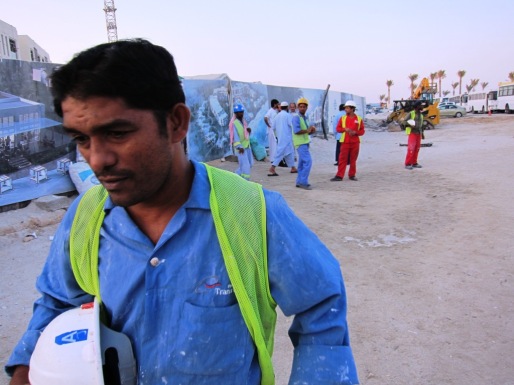
AT the end of April a group of trade unionists and safety campaigners went to the Qatar embassy in London, to hold a protest and deliver a letter about the lives and conditions of migrant workers in Qatar, as part of International Workers Memorial Day. The focus on Qatar is because of booming construction there in preparation for the 2022 FIFA World Cup.

It has been alleged the oil rich kingdom spent billions of pounds lobbying to get the world cup , for which it is building a super-modern air conditioned 40,000-seat stadium and other facilities.  But the workers, mainly from south Asia, and many held under something like debt-bondage, have been working long hours in desert heat, and dying at a rate that suggests 4,000 could have died before the first ball is kicked.  

Qatar is not the only Gulf state where labour conditions at a prestigious world site have aroused international concern. In the United Arab Emirates, the Guggenheim Foundation is building a huge art museum which will be the centre of a cluster of museums on an island off Abu Dhabi. The Louvre, the British Museum, and New York University  are also involved in the project.

The American architect Frank Gehry writes:
“Approaching the design of the museum for Abu Dhabi made it possible to consider options for design of a building that would not be possible in the United States or in Europe. It was clear from the beginning that this had to be a new invention. The landscape, the opportunity, the requirement, to build something that people all over the world would come to and the possible resource to accomplish it opened tracks that were not likely to be considered anywhere else. The site itself, virtually on the water or close to the water on all sides, in a desert landscape with the beautiful sea and the light quality of the place suggested some of the direction.”

But Abu Dhabi offers other features not, thankfully, common in Europe or the United States. At least, no longer, and not yet brought back. As a report for Human Rights Watch in 2009 began:
Foreign construction workers in the UAE are subject to a sponsorship (or "kafala") system that places them in a highly dependent relationship to their employers. In conjunction with prohibitions (de facto or de jure) against unions, collective bargaining and striking, the sponsorship system grants employers an extraordinary degree of control over foreign workers, placing the workers at severe risk of exploitation.
 http://www.hrw.org/en/node/83110/section/5 


The Observer reported at the end of 2013 that the emirate's tourism development and investment company (TDIC), which runs Saadiyat island was "failing to uphold its own employment policies, with workers left destitute, confined to their quarters and sent home for taking strike action. Migrant labourers building New York University's Abu Dhabi campus on the island were found to be suffering even worse mistreatment".

The Observer's investigation found that:

■ Companies were withholding the passports of migrant workers, trapping them in the UAE.

■ Thousands of workers were living in substandard or squalid conditions in apparent breach of the TDIC's pledge to house them all in its model Saadiyat accommodation village.

■ Dozens of workers were deported in 2013 for striking over pay and conditions.

■ Workers decorating the university live in squalid conditions, with 10 men to a room, no free healthcare and some trapped because they have to pay back huge recruitment fees.

■ Louvre workers were having to work for nine months to a year just to pay back their recruitment fees. One worker who went on strike over poor wages was kept in his camp unpaid for three months and then sent back to Pakistan with 19 others.

The European council held a meeting on December 4, 2013, to discuss the growing concern about migrant workers' rights in the UAE and Qatar. The chair of the European parliament's subcommittee on human rights, German MEP Barbara Lochbihler, said migrant workers in the UAE, including those on Saadiyat Island, were exploited "on a daily basis".

She said: "Minimum labour standards are not respected, there are systematic complaints about poor accommodation and sanitation, salaries and medical services are withheld, and both experts and the migrants themselves report excessive police force and situations of forced labour. This is unacceptable."

Sharan Burrow, general secretary of the International Trade Union Confederation, said the organisation was "deeply concerned by the abuses of workers' rights on Saadiyat island".
The findings reflected that labour abuses were a systemic problem in the UAE, with migrant workers suffering "extreme exploitation", including unpaid wages and excessively long working hours, she added.

http://www.theguardian.com/world/2013/dec/22/abu-dhabi-happiness-island-misery

Euro-MPs, trade unionists and campaigners, including many artists, have said the Western cultural institutions engaged in the Saadiyat project must take their share of responsibility for the conditions of the workers. Artists have pledged they will not exhibit until workers rights are respected and conditions have been improved. There have been protests at museums and events in the West.     

https://www.dnainfo.com/new-york/20150501/upper-east-side/demonstrators-take-over-guggenheim-nyu-over-abu-dhabi-labor-conditions

These actions could be having some effect. It seems New York University has been shamed into promising to compensate workers from its Abu Dhabi site.
http://www.theguardian.com/global-development/2015/apr/24/nyu-compensate-thousands-migrant-workers-abu-dhabi-complex-nardello-report

Some artists and campaigners who tried to enter Abu Dhabi to see conditions for themselves have been barred by the authorities. Gulf Labor, a international campaign begun in New York, has sent out this open letter on the subject:

To:
Guggenheim, New York and Abu Dhabi
Louvre, Paris and Abu Dhabi
New York University (NYU), New York and Abu Dhabi
Tourism Development & Investment Company (TDIC), Abu Dhabi
Abu Dhabi Tourism and Culture Authority (TCA), Abu Dhabi
Sharjah Art Foundation (SAF), Sharjah
Art Dubai, Dubai
Salama Bint Hamdan Al Nahyan Foundation, Abu Dhabi.

 This week artists Ashok Sukumaran and Walid Raad were denied entry to the UAE on grounds of “security”. This comes after NYU professor Andrew Ross was similarly barred from flying to Abu Dhabi in March. Given Sukumaran and Raad’s history of vital and sustained engagement with the country and region, invited or celebrated by many of you addressed in this letter, the only possible reason to suddenly have three such integral parts of our art and academic community denied entry, must be their involvement with the Gulf Labor Coalition.

All three are members of this artist-initiated group that has been working since 2010, urging the museums and other institutions being built on Saadiyat to create better conditions for their workers. One of the reasons Gulf Labor has focused directly on the Guggenheim is that as contemporary artists working in and engaging with the region, we have felt particularly implicated, and also felt we could have a say in the development of this museum.

Beyond Saadiyat Island, Gulf Labor has conducted independent research and continues to produce a body of knowledge around migrant labor, not only in the Gulf, but also in the home countries of workers. In July 2015, it will present a report on this research in the context of the Venice Biennial. Gulf Labor’s long history of constructive, and patient engagement with the Guggenheim and TDIC on this issue is documented on our website.

From the summer of 2010, six months before the announcement of a boycott, up to our last proposal in April of 2015, we have have tried to consult with, or address directly, the Guggenheim before making our positions public. Our most recent proposal synthesizes and brings together years of research and engagement with many parties ranging from human rights and labor organizations, to researchers and workers in the region. These remedies have been drawn from the experiences of workers at the Louvre, NYU Abu Dhabi and Saadiyat Island infrastructure sites, and is supported by experts in the field.

We have made this proposal at a pivotal juncture when contractors are meant to be hired and construction of the Guggenheim building is set to begin. Addressed to the Guggenheim and its Abu Dhabi partners we have stipulated:

 (1) setting up a fund to reimburse workers for recruitment fees,
(2) ensuring a living wage,
(3) allowing forms of collective representation.

We provided the Guggenheim a month to engage with what we still believe is a realistic and achievable proposal to improve the condition of workers on the island and to end our call for a boycott. An entire month passed without a response.  Now with these denials of entry, we are faced with a further retrenchment of the possibilities of dialogue and a foreclosing of the exchanges which have contributed to the development of the cultural institutions of this region.

We have always held that the betterment of conditions for workers is not separate from the development of conditions of making and showing art.  These denials are not targeting specific individuals, but potentially setting a dangerous standard of what can or cannot be done within the field of culture itself. And in this way, they implicate all the members of our artistic and cultural communities. Thus, we believe that it is an especially crucial time for institutions with expressed commitments to the region such as your own, to commit to lifting these denials of entry and, at the same time, to explicitly engage with the questions that these denials seem to want to evade – that is, the fair working conditions of the people who construct and maintain your organizations.

The specter of work has always haunted the making of art and the reflections of artists. To deny this engagement is not just a denial of a particular topic or subject matter, it is a denial of the history from which art emerges, which is from an inherent questioning of human activity in this world and the measures by which these activities are valued.

Links to Sukumaran and Raad‘s recent statements.

 May 16, 2015

  http://gulflabor.org/

May Day in New York - bringing it to the Guggenheim.

Labels: , , , ,

Sunday, February 22, 2015

Freedom of Speech, so long as you keep shtum?

"FREEDOM OF SPEECH" has been much talked about lately, in the wake of the 'Charlie Hebdo' killings and with regard to such slightly less serious matters as the enthusiasm with which some groups of students, feminists or whatever want to ban or boycott others, burn their papers, and so forth, in the name of creating "safe spaces". Having regard for my own safety, not to say sanity, I won't go there, but will stick to the relative comfort zone of things I know and can understand.

"Freedom of Speech" is not a new idea, of course, but more like a retro fashion. I can remember it as the first of the Four Freedoms proclaimed by President Franklin D.Roosevelt a year before I was born (and given the middle name Franklin), the other three being freedom of worship, and freedoms from Want, and from Fear. Maybe if freedom is back in fashion we should consider the rest of the package, particularly the last two, which are missing from much of the world, and being increasingly denied a lot of people in this country.

After the war, when the UN was established with such great hopes, Roosevelt's four freedoms were woven into the preamble to the Universal Declaration of Human Rights which reads, "Whereas disregard and contempt for human rights have resulted in barbarous acts which have outraged the conscience of mankind, and the advent of a world in which human beings shall enjoy freedom of speech and belief and freedom from fear and want has been proclaimed the highest aspiration of the common people,...."

I also remember seeing my first live fascists, with placards proclaiming "Let Mosley Speak" and "'Action!' (their paper) "banned from your library. Why?". At that time most town halls were banned to the fascist leader, and if anyone quoted Voltaire, the more recent "barbarous acts" were more uppermost in people's minds, along with the thought that had the War turned out differently, Mosley would most likely have been the only politician to enjoy freedom of speech. As it was, Tory Kensington kept its doors open for Sir Oswald when he wasn't stirring the Teds in the north end of the borough.

 So I was not altogether carried away with the recent fervour over "free speech", nor entirely surprised when a Labour councillor friend in the North East who'd said something about the EDL and Pegida marching in his his city received hate mail saying he was attacking "Free Speech", and going on to accuse him of a string of other offences, as libellous as ridiculous. (Naturally the kind of heroes who send this stuff are always anonymous).

But rather than discuss the ethics of free speech or pontificate about its proper limits, and what the law says or what it ought to say, I would like to look at how much free speech there really is, as illustrated by a few recent instances.

One of the things we ought to be able to freely hear and talk about, because it could affect all our lives, is the treaty being cooked up behind closed doors by European Union(EU) and United States officials, called the Transatlantic Trade and Investment Partnership (TTIP). Ostensibly about removing obstacles to trade, there are fears that it could force countries to remove restrictions on food additives and genetically modified crops, lower safety standards, and drop the minimum wage. Some court cases already being brought by big companies could be the shape of things to come. Philip Morris wants to sue for loss of profits caused by the Australian government's legislation on cigarette packaging, while Germany is facing legal action because it decided to phase out nuclear power.

Under TTIP big companies with their seemingly limitless resources and high powered lawyers could take any  government which got in their way to special, secret courts. The threat of billion dollar fines could deter a future Labour government,say, from renationalising the railways, or reversing the inroads of privatisation in the NHS. What price then your voting in elections, passing conference resolutions, or - if the Met will still allow it - even marching in the street?

No wonder there have been protests in Brussels about TTIP, or that 97 per cent of European citizens said they were against it in an EU poll. Even European commissioners are expressing caution, as are MEPs, and trade unionists both sides of the Atlantic oppose it, though the British government seems content to let it go ahead.      

http://www.theguardian.com/business/2015/feb/19/ttip-brussels-cecilia-malmstrom-eu-trade-us-nhs

The wonder though is how little we hear from politicians or on TV about TTIP, and why it is not being raised in an election year. It seems not even elected members of the European parliament are trusted, and they have to take a vow of silence, forbidding them from telling us what they have seen.
 As Molly Scott Cato, a Green MEP for the South West of England, wrote recently:
'... I have now been granted privileged access to the European parliament restricted reading room to explore documents relating to the Transatlantic Trade and Investment Partnership (TTIP) deal. But before I had the right to see such “top secret” documents, which are restricted from the gaze of most EU citizens, I was required to sign a document of some 14 pages, reminding me that “EU institutions are a valuable target” and of the dangers of espionage. Crucially, I had to agree not to share any of the contents with those I represent.

The delightful parliamentary staff required me to leave even the smallest of my personal items in a locked cupboard, as they informed me how tiny cameras can be these days. Like a scene from a James Bond film, they then took me through the security door into a room with secure cabinets from which the documents were retrieved. I was not at any point left alone.

This week hundreds of protesters against TTIP have descended on the European parliament. They are quite rightly concerned about the threat that this treaty poses to the British government’s ability to conduct its affairs in their interests. On a range of issues, from food safety standards and animal welfare to public services and financial regulation, there are deep concerns that the harmonisation of standards across the Atlantic really means a reduction of standards on both sides.

But how are we to know for certain? All discussions about TTIP have been hypothetical, since the negotiations are taking place in secret. In order to read even brief notes of what has been discussed I have to be reminded of my duties not to undertake espionage for foreign powers. Repeated complaints about secrecy from my fellow Green members have resulted in our being admitted to the restricted reading room but we are still not able to share what we discover there with our constituents or with journalists.'
http://www.theguardian.com/commentisfree/2015/feb/04/secrets-ttip-corporations-not-citizens-transatlantic-trade-deal

Of course, an important part of free expression is the freedom of the press. As people say, if you don't like what you see in a particular paper you can stop buying it. Whereas, if you are wealthy enough you can buy the paper and change its politics.

We all know better than to trust the tabloids for our information, but there's the 'quality' press- papers like the Telegraph.Until recently its chief political correspondent was Peter Oborne, a conservative even if independent.

On February 17, 2015 Oborne resigned from The Daily Telegraph. In a letter posted to the online news website, OpenDemocracy, Oborne criticised his former employer for the relationship between their editorial and commercial arms. Oborne outlined how the paper would suppress negative stories and drop investigations into the HSBC bank, a major source of their advertising revenue, which, in his opinion, compromised their journalistic integrity calling it a "form of fraud on its readers".

He also alleged that the Telegraph’s coverage of stories relating to UK supermarket chain Tesco, shipping company Cunard and the pro-democracy protests in Hong Kong had been influenced by commercial considerations, adding, “There are other very troubling cases, many of them set out in Private Eye, which has been a major source of information for Telegraph journalists wanting to understand what is happening on their paper”.


http://www.theguardian.com/media/2015/feb/18/peter-oborne-telegraph-hsbc-accounts

http://www.theguardian.com/commentisfree/2015/feb/20/peter-oborne-resignation-media-serve-rich-telegraph-hsbc

 It would not be the first time a newspaper has considered its advertising revenue before running a story that might upset a company.  What was newsworthy was that someone like Oborne felt he had to speak out. In other cases journalists newer to the profession have come across what looked like a big story to pursue, but reluctantly had to dump it when they were told it would never get printed, or realised it might break rather than make their career.

I' imagine the Ritz-owning, Channel Island-dwelling Barclay brothers who own the Telegraph might be sympathetic to some of HSBC's tax avoiding customers anyway, aside from the advertising. A much bigger newspaper owner, whose interests' ability to avoid UK taxes did not prevent a mutually understanding relationship with British governments is Rupert Murdoch. The Sun's infamous Hillsborough story was a political matter. And Sun journos who we're told were horrified by what they saw were free to go up the road from Wapping, or keep their heads down and mouths shut, remembering that all that took Prince Rupert's shilling had waved goodbye to conscience along with union rights.

Free Speech at Work?

Are you free to say what you like at work? "Have a nice day?", click, click and/or "would you like fries with that?" may not be the full extent of your repertoire, but it can be pretty well circumscribed. Elsewhere, that nice office where everyone's on first name terms and you can dress down Friday may seem free, but have you noticed how the receptionist looked nervously over her shoulder before she whispered her confidence to you?
How free people feel to speak their mind depends generally on how secure they are and if the place is organised. In some casual jobs people are afraid to talk to the person they are working with, in case what they say is eavesdropped, or reported, and next day they are out of a job.
As for government departments, undermining job security and union organisation is not just about pay and conditions, but one way of intimidating civil servants from speaking out about stuff they know, or telling the public things we should know. Of course it may have the opposite effect.
In the past the Official Secrets Act was used to cover a multitude of sins, and probably still is, but now it is being supplemented with commercial businessspeak.

Members of the Public and Commercial Services(PCS) union at the National Gallery are starting their second strike today in the fight against their work being handed over to a private security firm. But they have an additional issue since management suspended senior union representative Candy Udwin, an art handler, for allegedly “breaching commercial confidentiality,” PCS said, by giving information to a full-time union official, including information about the costs of using profiteers.

http://www.morningstaronline.co.uk/a-bce7-National-Gallery-union-convenor-suspended-on-eve-of-5-day-strike/#.VOlzRy6E3jk

http://artforum.com/news/id=50134

Now hang on. We the public still own the National Gallery, right? In fact the management claims it must get more "commercial" because there are limited public resources available. But the private company coming in is not a charity. It must see a profit in taking over the work. So how come the cost of bringing the privateers in is not something the public, including people who work at the gallery, are supposed to know?

Another aspect of freedom of speech at work is safety. In the construction industry, where many workers were blacklisted after taking up safety issues, and HSE inspections are few and far between, responsible workers will not cut corners, but they may hesitate to raise issues, hoping someone else will, if it means losing your job and having your card marked henceforth.

Electrician Frank Morris lost his job on the Crossrail project after raising concerns about safety, and it took over a year for him to win reinstatement.  Frank was not the last, either. But last week a worker who was sacked in similar circumstances was reinstated within half an hour of workers taking militant action on his behalf.  This may have to do with a demonstration at company headquarters spilling over into London's Oxford Street and stopping rush hour traffic. It is probably also not unconnected with the inquest opening tomorrow at St.Pancras Coroners' court into the death of Rene Tkacic working on Crossrail, and the vigil planned by trade unionists and safety campaigners outside.

Our individual freedom and even lives as workers depends on our ability to join in collective action. 

http://www.morningstaronline.co.uk/a-007b-Crossrail-whistleblower-reinstated-after-sacking#.VOl2xi6E3jk

Crossrail  Vigil at St.Pancras Coroners Court, Camley Street, London N1C 4PP. Assemble 9.15am

Labels: , , , ,

Wednesday, February 18, 2015

Such treatment of staff is a National Disgrace


NATIONAL GALLERY, January 19.  Two thirds of staff told jobs will be privatised.

FINE art can be a profitable business, hoarded as private wealth, or patronised for prestige by big business, but when the care and appreciation of art treasures comes up against the quest for short-term profit, what comes first?

Four years ago the famous art dealers Sotheby, at their New York branch, tried to dispense with professional art handlers and entrust valuable works of art to untrained casual delivery staff. The International Brotherhood of Teamsters (IBT), Professional Art Handlers' Local 14, resisted, even sending a team to London for support, and with other trade unionists I was proud to join the US brothers - and sisters - picketing Sotheby's one evening in Bond Street.  I'm pleased to say that after a ten month lock out, the management signed an agreement with the union and members got their jobs back.


TRANS-ATLANTIC SOLIDARITY on Bond Street.  Guests arriving for white-tied evening do at Sotheby's greeted by union pickets from New York and London.

 Staff at major art galleries have a double responsibility,  looking after the pictures and the public. Both can require sensitive handling.  The staff at London's prestigious National Gallery are used to that.  They are not highly paid, but they might have expected some respect.

 But last year, for a special exhibition of Rembrandt's later works, sponsored by Shell, which opened in October, the Gallery contracted a private security firm to do the work. And by January 18, when the exhibition ended, the workers had been told privatisation was here to stay. Organised in the same Public and Commercial Services (PCS) that covers other civil servants, they are fighting to defend their jobs and the service they provide.  Earlier this month the staff walked out on strike, and they are planning further strike action starting on Sunday.  

"The National Gallery has told 400 of its 600 staff they are to be taken over by a private company. They are responsible for the security of the paintings and the public and look after the millions of visitors.

The National Gallery is the only major museum that does not pay the London Living Wage.

FORTY THOUSAND SAY PRIVATISATION NO WAY

Over 40,000 people have signed our petition and supported our campaign to halt the privatisation.

The Gallery has brought in a private company CIS to “temporarily” take over services in a third of the gallery at the additional cost of hundreds of thousands of pounds of public money.
So privatisation raises public costs, and the private company's profits, not the workers' pay and conditions, nor the standards of service. 

PCS recently received an email from a gentleman complaining that staff in the National Gallery Rembrandt exhibition were rude and aggressive, and that there is no reason why visitors should have to put up with staff shouting at them.
"We don't have to be nice to you" is a phrase he recalled being used by one or the staff.
We explained that the Rembrandt exhibition was staffed by the private security company CIS not by National Gallery staff.
He replied “Clearly these CIS staff are a not up to the job – their hectoring manner is that of prison guards. Please feel free to use this information in support of your campaign. Good Luck!”
We are including here some other bad experiences, mostly taken from the comments on Polly Toynbee’s article in the Guardian. http://gu.com/p/452t7/sbl
Can you help us? Did you have a bad visitor experience at the Rembrandt exhibition? Would you tell us about it in the comments below or send us a personal message?
We are campaigning against the Gallery’s privatisation plans. We don’t like the idea of a private company damaging our reputation and that of the Gallery, and would like to try and establish whether these are just a few isolated incidents, or if they’re more widespread. Thank you!
...Also, we're out on strike 22nd-26th February. Details on how you can support us here:
https://www.facebook.com/events/880876355297820/

Just to show how eager they are to impress the Con Dem government and London's Tory Mayor perhaps, and how uninterested in reaching agreement with their workers, the National Gallery bosses have suspended a senior PCS union representative, Candy Udwin. Candy's 'offence' it seems was  drafting a question for the PCS Negotiation Officer about the cost of CIS.  Supporters have collected over 8500 signatures for a statement condemning this victimisation and calling for her reinstatement.

Appeal for help:
Make a donation to our strike fund – Thanks to those who already donated over £6000!
Most strikers do not even earn the London Living Wage so any donations will help.
Donate to Sort code 086001 Account no 20169002 or cheques to Culture Sector Hardship Fund, c/o PCS North West Region, Jack Jones House,1 Islington, Liverpool L3 8EG.
Write to the Gallery Trustees
Email the chair mark.getty@ng-london.org.uk 

A Commons Early Day Motion, 300, on staffing and security at the National Gallery, has attracted 59 signatures. 
http://www.parliament.uk/edm/2014-15/300
Ask your MP to support the campaign and back Early Day Motion 300.  Email your MP here: http://action.pcs.org.uk/page/speakout/no-privatisation-at-the-national-gallery


Sign and share the no privatisation petition – make it 50,000!
https://you.38degrees.org.uk/petitions/no-privatisation-at-national-gallery

Email noprivatisationatNG@gmail.com  or
www.facebook.com/nonationalgalleryprivatisation %E2%80%99s

On US teamsters' dispute at Sotheby's, see:
http://www.labornotes.org/2012/06/ending-lockout-teamsters-wrap-agreement-sotheby


Labels: , , ,

Sunday, January 18, 2015

Heritage and Security


SO OFTEN THE BACKDROP for protests, like last September's march for the NHS, the National Gallery, one of Britain's biggest tourist attractions, is the centre of a struggle for jobs and a living wage.   


MORE news for flag-waving patriots and those proud of the national heritage. Oh,and concerned - aren't we all? - for our security.

The Public and Commercial Services (PCS) union, which is struggling to continue representing civil servants  and workers in firms doing government work, reports that hundreds of Metropolitan Police civilian staff face being handed to a private company that is sending civil service work overseas.

The union's ability to function is being attacked by government ending the check-off  system for union dues and taking away union representatives' facility time.  Weakening the union is one way of setting civil servants competing to keep their jobs by taking it out on vulnerable members of the public they deal with, rather than trying to cushion the coalition's vicious blows.  It also leaves whistleblowers exposed. 

In the latest privatisation move, around 500 support workers in human resources and finance could become part of an existing contract run by a new company Shared Services Connected Ltd.  The PCS says this decision by London's deputy mayor for policing Stephen Greenhalgh means a contract would either be given to SSCL as early as June or be put out for a full competitive tender.

"Majority owned by French multinational Sopra Steria, SSCL was set up in 2013 to take over similar functions in government departments and has already confirmed some civil service work is now done in India".

Funnily enough, with all the concern which right-wing politicians and media have been showing about our jobs supposedly being taken by immigrants, I've yet to hear any worries expressed about the jobs that are exported to countries with lower wages and conditions, fewer workers' rights and favourable tax arrangements.

Security does not seem a problem either,  with all our files winging their way to exotic parts. Still,with David Cameron so insistent on the state's need to eavesdrop and checkour e-mails, even if the state contracts the work out, maybe those poor sods in Asian call centres who keep ringing to ask me about my consumer lifestyle will be able to get all the information without calling. I assume it is worth something to somebody.

The deal to take away work from the Met's civilian staff is part of a framework agreement, which the PCS says allows SSCL to take over Human Resources and finance services in any part of the public sector.  The final decision is due to be made in April, but the union says the business case is flawed and it wants the work kept in-house.

All of the Met's "non front line services" are being reviewed to see if they could be privatised, including civilian staff who work side by side with officers in criminal justice.
http://www.pcs.org.uk/en/news_and_events/pcs_comment/index.cfm/met-police-staff-face-privatisation

Turning to the nation's  cultural heritage, expect protesters outside the National Gallery on Monday evening, over the use of a private security firm. The row started last Summer when the PCS union heard that the National Gallery's head of security - formerly with that reputable company G4S- had  appointed a private security firm with no prior consultation to guard artworks at an exhibition, Rembrandt: The Late Works.

CIS Security is being paid approximately £500,000 for the task and advertised three-month contracts at £10 per hour to cover the exhibition, running from October 15 to January 18, 2015. According to the advert, guards were expected to answer queries and provide visitors with advice, guidance and information.

There were soon reports that inexperienced and probably unmotivated casual security guards were touching paintings and talking on mobiles when they should be assisting visitors.  But now it appears  CIS is being given more work, moving into the gallery's Sainsbury wing, without having to tender, and without any consultation with the union.

The union said last year it was concerned about the lack of consultation before CIS Security’s appointment. PCS general secretary Mark Serwotka accused the gallery of “using public money to usher in privatisation through the back door”.

Serwotka added: "Private security companies, driven by the need to make profits, have absolutely no place looking after world-famous works of art, and these plans should be scrapped.”

The appointment of CIS Security came after the gallery's announcement that around 400 of its 600 posts would be outsourced later this year, including all visitor, security and ticketing services.

http://www.museumsassociation.org/museums-journal/news/05082014-union-objects-private-firm-rembrandt


It seems the Gallery and their favoured contractors are intent on lowering pay and conditions - even taking away seats from attendants - along with job security.  For this they are prepared to take a risk with standards.  A report in the Daily Mail  -not normally a friend of trade unions - said:


"The National Gallery’s ‘blockbuster’ new Rembrandt exhibition has been hailed a triumph by the critics, but visitors might be advised to keep a close eye on the masterpieces.

Some experienced security guards were replaced earlier this year by agency staff and sources claim the change is proving a disaster.

‘Five of them didn’t bother to turn up for training, while another has been sacked over a foul prank in a toilet,’ claims an insider.

‘When others were given a tour of the gallery, some showed little interest, texting away on their phones.

‘They have been spotted touching paintings and even caught on camera in the Rembrandt exhibition stroking works loaned to the gallery. They have apparently received warnings to stop, but this is really shocking.’

The gallery declines to discuss the claims. ‘We would never comment on matters relating to individual staff members as these are confidential between those involved and the National Gallery,’ a spokeswoman says.

However, she adds: ‘Safety and security are of paramount concern. CIS Security employees are vetted to the same level as existing staff; they will also undertake similar levels of training and assume identical responsibilities.’"

 http://www.dailymail.co.uk/femail/article-2794915/sebastian-shakespeare-hirst-s-ex-art-costly-couture.html#ixzz3P7mcFWZ2

The PCS reported last week :

We are balloting our members at the National Gallery for strikes as part of a campaign against privatisation.
The vote that begins today among hundreds of workers at the world renowned attraction in central London could lead to extended days of industrial action.

We suspended planned strikes over the Christmas break after the gallery used the UK's anti-union laws to challenge them.
We are opposed to plans to privatise almost all staff, including those who look after the paintings and help the gallery's six million annual visitors with enquiries.

Our online petition against the proposal has attracted almost 40,000 signatures.

The National Gallery is the second most popular visitor attraction in the country and we believe the sell-off plan risks damaging its worldwide reputation. Private security company CIS was brought in last autumn to cover the gallery's Rembrandt exhibition.

Now the firm has been handed work in the Sainsbury wing, without any tender or consultation.
Gallery bosses have also reneged on a promise to introduce the London living wage, meaning the institution is the only major museum or gallery in the capital that does not pay it.

There will be a day of action against the privatisation plan on Monday 19 January, including a protest at 6pm outside the gallery in Trafalgar Square.

Sign the online petition

 http://www.pcs.org.uk/en/news_and_events/pcs_comment/index.cfm/national-gallery-staff-ballot-for-strikes

Labels: , , , ,

Saturday, June 15, 2013

Following in young Fred's Footsteps


SOME of the country's most popular museums are endangered by spending cuts. Manchester's Museum of Science and Industry (MOSI) , Bradford's National Media Museum and the National Railway Museum in York could close, according to the Science Museum Group (SMG), which also runs the Science Museum in London. It has announced that a further 10% cut in government funding would leave it with "little choice" but to close one of the museums.

Council leaders in 11 local authorities have written to Chancellor George Osborne  The council leaders said they were "equally concerned" about potential cuts at the National Coal Mining Museum in Wakefield, whose funding is contracted through SMG.

Councils  said visitors to the National Media Museum contributed about £24m a year to the local economy, and the National Railway Museum brought in £40-50m. Visitors to the Museum of Science and Industry provided about £28m to the local economy.

Friends in the North West say they make a point of taking their children to the MOSI for both pleasure and instruction. The museum's hands on gadgets and displays make it an especial favourite with kids. 

That the threatened museums are in the North, where so much of  science and industry was developed, but which has also born so much of the brunt of industrial decline and austerity, has not gone unnoticed. Even the Archbishop of York has said something about it.
Archbishop condemns threat to museums.

As though to rub insult into injury, news of the theat to these valued assets comes with reports that Prime Minister David Cameron favours the building of a £15 million museum dedicated to Margaret Thatcher, whose disdain for industry and the North, and hatred for the workers has been more than reciprocated. At least two popular petitions for the museums are circulating, one of them explicitly saying that money should not be going to the Thatcher museum.
 
 Petition to save the Museum of Science and Industry (MOSI)

Against public money for Thatcher museum

I must confess I have not yet visited the three museums, though I hope to remedy the omission. The MOSI was built long after I left Manchester. It stands on what was once the site of the world's first
railway station, Manchester Liverpool Road, opened on September 15, 1830, for the Liverpool and Manchester Railway. Sadly, this line also saw the scene of the world's first recorded fatal railway accident, when Liverpool MP William Huskisson,  who had travelled for the opening ceremony was knocked down by Stephenson's Rocket at Parkside.

This must have been a great disappointment to the crowd of mill workers and colliers who had come out not only to see the trains but to throw bricks and whatever else was to hand at the carriage carrying the main guest, the Prime Minister, Duke of Wellington. The Iron Duke wisely decided to stay in his carriage and return to Liverpool without setting foot in Manchester. I don't suppose this is the kind of history that Mr.Gove wants taught in the national curriculum. Who knows, it might even give us ideas.

I did go down to Castlefield area with a schoolmate one Saturday in search of an earlier bit of history, the remains of part of the Roman wall of  Mancunium. We found it under the railway arches at the back of a builders' yard near Knott Mill. Knott Mill station, now Deansgate, opened on July 30, 1849, as part of the Manchester to Altringham line. That began from Oxford Road station, which I knew before it was modernised. On another of my urban strolls, after I had become "political", I came to look at the hollow south of the station. There where the River Medlock now runs underground was once the neighbourhood dubbed "Little Ireland", and described in Friedrich Engel's The Condition of the Working Class in England , first published in 1844. 


"....the most horrible spot...lies on the Manchester side, immediately south-west of Oxford Road, and is known as Little Ireland. In a rather deep hole, in a curve of the Medlock and surrounded on all four sides by tall factories and high embankments, covered with buildings, stand two groups of about two hundred cottages, built chiefly back to back, in which live about four thousand human beings, most of them Irish. The cottages are old, dirty, and of the smallest sort, the streets uneven, fallen into ruts and in part without drains or pavement; masses of refuse, offal and sickening filth lie among standing pools in all directions; the atmosphere is poisoned by the effluvia from these, and laden and darkened by the smoke of a dozen tall factory chimneys..."
Chorlton on Medlock and "Little Ireland"


I remember when Salford council decided to name a block of flats after Engels, the local Tories made a fuss, though it was pointed out to them that Fred was a respected local businessman, and we might add that he joined the militia and even rode to hounds.

Anyway I see the ten story block in Eccles has been refurbished, and Engels seems now to be established in local histories.

Young Fred Engels had been sent to Manchester to look after his father's mill and probably to keep him out of trouble. Here he discovered the English -and Irish -working class. Engels and his friend Marx did not have to invent the class struggle, that was already happening. They just had to realise its historical significance. Two years before The Condition of the Working Class in England appeared and six years before the Communist Manifesto, a general strike which began among the Staffordshire colliers had spread across the North West, and Manchester was naturally an important centre.

 August 11, 1842 At 6.30am a crowd of over 10,000, many of whom, it was noted, were women, assembled in Granby Row Fields. The main speaker was Christopher Doyle who urged the strikers not to return to work until their demands had been met. As he was speaking the Mayor Mr Neil and a number of magistrates rode up to the cart and told them that the meeting was illegal and must disperse. The Riot Act was then read and one hundred soldiers appeared, fully armed and with two six pound artillery pieces. The crowd fled but there was no violence or casualties. Companies of soldiers were then stationed in Hunt Street, on Oxford Road near Little Ireland, and also opposite Esdaile’s Buildings.

A meeting took place at the Carpenter Hall attended by mechanics, engineers, millwrights, moulders and smiths which passed resolutions in favour of the People’s Charter which they declared “contains the elements of justice and prosperity and we pledge ourselves never to relinquish our demands until that document becomes a legislative enactment”. They also pledged not to return to work “until the decision of the trades of Manchester be ascertained.”

During the morning thousands of workers marched from Ashton and Stalybridge to Rochdale and brought out most of the mills and factories. A mass meeting passed a resolution declaring that they would not resume work until they had obtained a fair price for a fair day’s labour. They then marched to Heywood and turned out the mills and factories there.

...........

Friday 12 August
There was a meeting of various trades and mill hands at the Fustian Cutters room, 70 Tib Street at 10am which passed two resolutions, one declaring that the strike was for the Charter and the other declaring that the operatives offer themselves as “conservators of the public peace”.
The mechanics met at Carpenters’ Hall at 2pm where they heard reports from delegates from Lancashire and Yorkshire on the situation in their trades and their attitude to the strike. The conference concluded by passing a resolution which stated “that the only remedy for the present alarming distress and widespread destitution is the immediate and unmutilated adoption and carrying into law of the document known as the People’s Charter, that this meeting recommends the people of all trades and callings forthwith cease work until the above document becomes the law of the land.”

Saturday 13 August
The weekly Manchester Guardian, published on Saturday, carried an editorial which practically frothed at the mouth:
“…we have seen the resolutions passed at the meeting of delegates at the Sherwood Inn and the Carpenters’ Hall yesterday. To us, who well knew the real objects of the agitators, these resolutions convey no information. But to parties who have hitherto, either wilfully or ignorantly, shut their eyes to the truth, we recommend a perusal of the resolutions; and especially the second, recommending that the present forced cessation of work shall be continued until what is called “the charter” becomes the law of the land. Disguise it as we may the present movement is rising against the government and the law. Call it by what name we please, IT IS REALLY AN INSURRECTION.” (The Manchester Guardian 13 August 1842)


http://radicalmanchester.wordpress.com/tag/little-ireland/ 


To come back up to date, a film on the Condition of the Working Class is due to get what I think is its first London screening on Thursday evening at Congress House, courtesy of the Southern and Eastern Regions of the TUC (SERTUC). I think there will be refreshments, though I cannot confirm the rumour that Sir Brendan Barber will be standing the drinks.

Here's the info:

SERTUC FILM CLUB - FREE ADMISSION Screening + Director Q&A

A new documentary feature film by Michael Wayne & Deirdre O'Neill
- THE CONDITION OF THE WORKING CLASS
Runtime: 82 mins

Everything changes and yet everything stays the same. 1844: Friedrich Engels writes his book 'The Condition of the Working Class in England', a classic denunciation of the appalling living conditions for working people living at the heart of the industrial revolution in Manchester, England.  In 2012: a group of working class people from Manchester and Salford have the job of devising a theatrical show from scratch based on their own experiences and Engels' book. They have 8 weeks before their first performance. The Condition of the Working Class follows the process from the first rehearsal to first night and situates their struggle to get the show on stage in the context of the daily struggles of working people facing economic crisis and austerity politics.

Review: http://vimeo.com/66049819


Thursday 20 June, 7- 9.30pm


   TUC Congress House, Great Russell Street, London WC1B 3LS
(nearest tube Tottenham Court Road)

FREE ADMISSION    Booking essential

BOOKINGS:             sertucevents@tuc.org.uk or 020 7467 1220

According to Film International, "This is not a film. It is rehearsal for revolution".

 Sounds like the Guardian back in 1842!


Also of interest:
  Digging out Engels club

Labels: , ,

Tuesday, October 30, 2012

I thought they wanted to put trade unionists in the Tower!

FIRST the London Transport Museum (or further back the Fire Service museum if you like) and then the British Museum, Now the Tower of London, scene of so much history, is the centre of a historic dispute. Behind the splendour of the Yeomen warders who greet the tourists and guard the Crown Jewels, the skivvies who keep this medieval fortress and palace clean and presentable are stepping out of the dark and miserable past to demand trade union rights and a living wage.

There will be a demonstration outside the Tower on Saturday, November 3, at 1pm


The .cleaners at the Tower of London, employed by contractor MITIE, say they are currently paid a poverty wage despite the Historic Royal Palaces seeing an admissions income for 2011/12 of £42.8 million. They are asking for the very modest London Living Wage of £8.30 p/hour. Furthermore, they are asking for sufficient numbers of workers to face the excessive and constantly changing workloads, and they are requesting copies of their contracts of employment that actually reflect their actual hours of work and holiday entitlements. The cleaners also lack facilities for changing and washing.

The company has banned the IWGB cleaners' union from the Tower of London and other sites where it has members. 

The union says MITIE is one of the government's favourite contractors, but has a terrible track record regarding the treatment of its workers. It claims some pregnant women working for MITIE were  forced by sadistic managers to carry out tasks that would endanger the life of their unborn babies nearly causing a miscarriage.

Although the Industrial Workers of Great Britain, to give its full name,  is a relative newcomer to the 21st century industrial scene, it claims a name and tradition going back to the early part of the last century when there were efforts to establish a British version of the Industrial Workers of the World (IWW) which was so big in the Western Hemisphere and to some extent Australia.

That first attempt gained success among women workers at the Singer factory on Clydebank. The current edition of the IWGB is claiming some success organising and fighting for low-paid cleaners, often women and/or immigrant workers, in supposedly affluent London. That might be seen as competing with, or reflecting on the adequacy of, activity by bigger trade unions.  But any differences are rightly being put aside when it comes to the basic issues of fighting for a living wage and the right to trade union recognition.

Among those who will be speaking at Saturday's rally are Steve Hedley of the RMT rail union, who has been involved in organising cleaners on the London Underground, and Chris Baugh of the public service union PCS whose members include cleaners at Buckingham Palace. Journalist Owen Jones who is a member of the Labour Representation Committee is also speaking.  

The cleaners at the Tower have also received support from MPs who have signed an Early Day Motion submitted by Labour MP John McDonnell:
That this House notes that the Tower of London has seen the highest number of visitors in over 30 years and that the Historic Royal Palaces have seen an admissions income for 2011/12 of 42.8 million; expresses disappointment that cleaners employed at the Tower of London under contract by MITIE Cleaning Services are paid below the London living wage and that the Historic Royal Palaces have failed to ensure the compliance of its contractor with the Greater London Authority rate of 8.30 per hour, which is designed to provide a minimum acceptable quality of life; further notes the Board of Trustees renewed the contract with MITIE on the proviso that rates of pay and numbers of operatives should not be varied without their approval; further notes that MITIE is an Associate Corporate Member of Historic Royal Palaces; is concerned that the cleaning operatives' conditions of employment do not meet the standards expected, the cleaning operatives do not have sufficient numbers and face excessive and constantly changing workloads, their requests for copies of their contracts of employment have been ignored, as have their request for contracts that will reflect their actual hours of work and holiday entitlements and requests for health and safety training and provision of personal protective equipment have gone unheeded; further notes with concern that cleaners lack facilities for changing and washing and that the efforts of the cleaner union IWGB to raise their members' concerns have been disregarded; and expects the cleaners to be treated with respect, paid fairly and employed in sufficient numbers to meet the demands of the Tower of London.

Industrial Workers of Great Britain:
http://www.iwgb.org.uk/

Early Day Motion 538
http://www.parliament.uk/edm/2012-13/538

Labels: , ,

Monday, October 29, 2012

Battles in the Museums


STAYING on the road despite dangerous obstructions.  LT Museum, Covent Garden. Entrance fee increased, yet management wants to axe jobs and cut pay of lowest paid by around 20 per cent. Projects for schools are being shelved.

MUSEUMS, other than those dedicated to trade union and working class history, might have been thought to provide a quiet refuge from the class struggle, but in today's Britain of attacks on people's living standards, rights and culture, they too are becoming battlegrounds for the resistance.

Cleaners and maintenance staff at the British Museum are on strike this morning to oppose outsourcing which they fear could seriously undermine their pay and conditions. The PCS and Unite unions believe senior managers are already close to confirming contracts which would start from April. The fifty or so workers the unions represent, already low-paid, voted overwhelmingly for strike action.

Meanwhile at the popular London Transport museum in Covent Garden, the Transport Salaried Staff Association(TSSA) which organises staff has raised the alarm about the effect of cuts on members' jobs and the future of the museum.  

The transport museum owes its origins to a decision by the London General Omnibus Company back in 1920 to preserve two Victorian horse buses and a motor bus for posterity. Nowadays the museum has something for everybody, from engines and rolling stock to famous London Underground posters. In 2011 the Museum attracted almost 300,000 visitors, an increase of over 40% in four years. This year over 120,000 schoolchildren were expected to benefit from the Museum’s outreach programme.
The entrance fee has recently risen to £13.50 for an adult ticket.

But Transport for London has cut its grant to the museum by 25 per cent, a total of £3.5 million over four years. the TSSA says Arts Council funding has also dried up, resulting in a number of educational projects and posts being shelved.

In a letter to the Guardian earlier this year, TSSA general secretary Manuel Cortes was joined by TV "Time Team" presenter Tony Robinson and transport expert Christian Wolmar in warning that "Swingeing cuts...have left the museum starved of crucial income", causing outreach work to be shelved, and that recent and possible future increases in the entrance fee were "jeopardising access for poorer Londoners."
http://www.guardian.co.uk/culture/2012/may/02/loss-london-gain-mayors?INTCMP=SRCH

 They noted that seven valued posts had been abolished and now staff feared for jobs. In a more recent leaflet from TSSA the union says museum management is now proposing to cut permanent staff by 30 per cent and cut the salaries of the lowest paid staff by around 20 per cent.

The British Museum celebrated its 250th anniversary in 2003 and as anyone passing through nearby streets can testify is one of the country's most popular tourist attractions, with six million visitors a year, as well as a centre for scholarship.  Today's strike lasted just a few hours, but unions are planning further action next Monday to coincide with a gathering of the museum's members, expected to attract 3,000 guests.

While the TV news and government are crowing that Britain is "out of recession" it does not feel that way to those in work, let alone out of it. The Office for National Statistics has reported that people’s living standards fell sharply since 2008. Meanwhile food and energy costs are rising well above the rate of inflation and train companies recently announced another steep increase in fares.

PCS general secretary Mark Serwotka says: “With the cost of living soaring the last thing these low-paid workers need is a private company taking over and cutting their wages and working conditions to boost profits and line shareholders’ pockets.

“Cleaners and other museum staff work incredibly hard to maintain this prestigious and popular cultural attraction and we know this is appreciated by the millions of visitors the museum attracts every year. Introducing the profit motive is not only unnecessary, it risks undermining these important services to the public.”

Unite regional officer Carolyn Simpson said: “Unite will not stand idly by whilst our members and this vital museum service is sold-off to an external provider. Without our members carrying out the cleaning and servicing of the buildings and exhibits, the British Museum’s standing as a world class heritage site is in danger of becoming second class. We will not allow these jobs be outsourced without a fight.”

http://www.tssa.org.uk/en/whats-new/news/index.cfm/campaigners-demand-action-to-save-london-transport-museum

http://union-news.co.uk/2012/10/best-of-british-museum-workers-on-strike-today/

Labels: , ,

Monday, March 21, 2011

Artists for rights of Workers on the Island of Happiness

http://www.artinfo.com/media/image/73873/Guggenheim_AbuDhabi.jpg

GUGGENHEIM ABU DHABI as it's meant to look. Maybe
Wonders of the Ancient World were built by slaves,
but
can we accept 21st Century versions of slavery?


“Artists should not be asked to exhibit their work in buildings built on the backs of exploited workers. Those working with bricks and mortar deserve the same kind of respect as those working with cameras and brushes.”
-Walid Raad, Lebanese-born New York artist, one of leaders of Guggenheim boycott.

'The British Museum did not respond to our letter expressing in detail our concerns about the exploitation of construction workers in the UAE, which we sent in response to reports that the museum would establish a presence in Abu Dhabi.'
- Human Rights Watch 2009 report on workers in Abu Dhabi

SOME of the world's biggest, most costly and prestigious buildings go up cemented with the blood, sweat and tears of poor, exploited and ill-treated workers, often forced to live in awful conditions. Some people admire these wonders of the modern world, whether or not they can step into the luxury,in these millionaires' playgrounds, without worrying where the wealth they embody comes from, or how it is obtained, and from whom.

But now more than 130 artists, many of them well-known figures in Middle East art, say they will have nothing to do with an $800 million Guggenheim museum being built in Abu Dhabi, capital of the United Arab Emirates, unless the contracts respect workers' rights, and improve conditions.

The new Guggenheim, designed by Frank Gehry, is to be the centerpiece of a development called Saadiyat Island that includes a half-billion-dollar branch of the Louvre Museum designed by Jean Nouvel, a national museum designed by Norman Foster, luxury resorts, golf clubs, marinas and acres of private villas.

The way migrant workers are exploited and ill-treated are far from unique to the Emirates, though they stand out against such opulence, and because of the numbers involved. Some of the worst rip-off starts before the workers leave their own country. Many of the workers in the Emirates are from poor countries like Bangla Desh, attracted by the Gulf's oil wealth, and desperately hoping to work their way out from poverty and debt. It can be a trap in which they end up worse off. They have to pay huge fees upfront to the labour agencies, if they live in remote villages they may have to pay middlemen to even reach the agencies, and have to borrow from family members, sell any land they have, or borrow from money-lenders charging exorbitent interest. When they arrive in Abu Dhabi they can find that the good jobs and attractive wages they were promised by the agencies are a fiction, and so they are trapped, working twelve hours a day in the desert sun, and struggling to pay their debts.

The emirate of Abu Dhabi covers 70 per cent of the UAE land area and controls 94 per cent of the country's oil reserves; the UAE, in turn, has eight per cent of the world's proven crude oil reserves and five per cent of its natural gas. In 2006, the Ministry of Economy placed Abu Dhabi's population at 33 per cent of the UAE total, a figure of up to 1.85 million people in 2007. The ruler of Abu Dhabi, Sheikh Khalifa bin Zayed Al Nahyan, is also the president of the UAE; he succeeded his father, Sheikh Zayed, to both positions in 2004.

The emirates vary in their conditions. Abu Dhabi, for instance, requires construction companies to provide health insurance to all employees, whereas Dubai mandated specialized bodies to protect workers' rights. It is not clear how many foreign workers live in the UAE or in the emirate of Abu Dhabi. The UAE Ministry of Labor states that there were 3.1 million foreign workers in the country in 2007. However, the figure may be higher: as interviews with foreign embassy officials suggests that India, Pakistan and Bangladesh alone account for up to 2.95 million UAE residents. Construction workers also come from Sri Lanka, Nepal, Thailand, and elsewhere, and the large population of foreign domestic workers in the UAE comes from the Philippines, Indonesia, Ethiopia, and other countries.

Extrapolating from official figures, a minimum of roughly 900,000 migrant construction workers live in the UAE, although actual numbers may be higher. By law, construction workers are not allowed to bring their families to the UAE. All residents of labor camps in the UAE are male. The average "cycle" of a foreign construction worker in the UAE is "four to five years," according to a senior advisor to the Ministry of Labor.

The government of Abu Dhabi is developing Saadiyat Island as part of an overall attempt to diversify the economy from oil and gas. The desert kingdom has imported sand to raise the island above sea level. Saadiyat Island is wholly administered by the Abu Dhabi Tourism Authority (ADTA). In 2005, Sheikh Khalifa established the Tourism Development & Investment Company (TDIC), to manage the development of the ADTA's assets. Saadiyat will have hotels, marinas, two golf courses, museums, a university campus, a performing arts centre., and private villas.

Its name in Arabic means "happiness". How happy will it be for the workers?

When Human Rights Watch looked into this a couple of year ago it found:

  • "Foreign construction workers in the UAE are subject to a sponsorship (or kafala) system that places them in a highly dependent relationship to their employers. In conjunction with prohibitions (de facto or de jure) against unions, collective bargaining and striking, the sponsorship system grants employers an extraordinary degree of control over foreign workers, placing the workers at severe risk of exploitation".
  • "A foreign worker's legal ability to enter, live and work in the UAE depends on a single employer. UAE laws make it extremely difficult for workers to escape from this dependency after entering the UAE or beginning employment. If a foreign construction worker in the UAE quits, his employer will request the Ministry of Labor to cancel his labor card; a foreign worker who remains in the UAE more than two months after his labour card is cancelled will be fined. The employer will then take the worker's passport to the Ministry of Interior, which upon being shown the cancelled labor card will cancel the foreign worker's visa, stamp his passport with a six month ban on returning to the UAE, and arrange for his deportation to his home country.
    • "...workers suffer other forms of abuse, such as overcrowded, unsanitary and dangerous housing, which continues to be a severe problem. According to news reports, the economic recession has led to an escalation in overcrowding and other poor treatment of workers at labor camps. The Ministry of Labor's chief inspector said that some companies, to cut costs, have added as much as 40 percent to the population of their labor camps (without increasing space for accommodation), and have cut workers' meals from three a day to one. Some more can be gleaned about workers accomodation from headlines "400 labour camps risk closure for violations," The National, August 29, 2008, http://www.thenational.ae/article/20080828/... "Chickenpox spread like wildfire at labor accommodations," Gulf News, June 6, 2008, http://www.gulfnews.com/Nation/Health/10218831.html, accessed March 16, 2008; Anthony Richardson, Praveen Menon and Greg Aris, "Early morning fire kills 11 men in Dubai," The National, August 26, 2008.

      • Companies require workers to sign new contracts upon arrival in the UAE. These contracts are based on a Ministry of Labor model contract, written in Arabic and English. Most workers interviewed said they did not understand these languages, and that they signed their contracts without receiving any explanation of the contractual terms. No construction workers we interviewed had copies of their UAE work contracts. Workers sign these contracts in a coercive atmosphere. Some workers said companies threatened to deport them if they refused to sign. The driver for a road-building crew on Saadiyat Island said that a labour supply agency had promised him and 30 other men from Andra Pradesh jobs with a basic salary of 700 dirhams ($190) in the UAE; when they arrived and the Al Jaber company told them to sign contracts for a basic salary of 350 dirhams ($95), "We refused to sign anything. But after a month we all signed, because they were going to send us back."

      • Because workers have already paid large fees to manpower agencies, they are not in a position to bargain over these contracts. Many workers interviewed said that their employers instructed them to sign UAE work contracts quickly and under pressure. An Abu Dhabi National Hotels employee said he had to sign his contract immediately after he arrived in the UAE: "they made us sign them on the bus on the way from Dubai airport at four in the morning."

      Illiterate workers are asked for a finger-print. Some workers said they were asked to sign or fingerprint blank sheets of paper, and told the company would fill in the contract later.

      • "In some cases, the degree of control employers exert over migrant workers amounts to forced labor. Several employees of Abu Dhabi National Hotels Compass (ADNH) on Saadiyat Island told Human Rights Watch they wanted to quit their various jobs, but that their employer had threatened to fine them before returning their passports if they quit before completing two years' service".

      In 2006, Human Rights Watch noted that the absence of labor unions and of independent workers' rights NGOs "has produced a situation where the government and the business sector are the sole entities deciding on labor-related issues." This has remained the case today. Workers were afraid to unionize or strike due to threats they would be fired and deported – threats backed up by laws that do not protect the right to organize and that forbid strikes, in violation of international labor laws.

      None of the workers interviewed were members of trade unions. Most workers said they would be fired and deported if they unionized. Some workers said company officers explicitly threatened them if they were to join or form unions. An Al Habtoor employee, who said he had been assigned to work on a Leighton project on Saadiyat (the companies announced a joint venture in 2007), said that when he first arrived in the UAE, "The foreman told us all when we first got here not to try to form any groups because they'd cancel our visas."

      Workers also said that company officials threatened them with deportation if they went on strike. A construction worker from Pakistan, who had been working on Saadiyat Island for five months without a holiday for Al Habtoor, said that "people from the company told us that if we went on strike our visas would be terminated."

      Nevertheless tens of thousands of migrant workers in the UAE have gone on strike to protest low wages or poor treatment; authorities reportedly deported thousands and banned them from returning. In February 2007, a Dubai court sentenced 45 Indian construction workers to six-month jail terms, followed by deportation orders, for violence during a strike. In October, according to news reports, "thousands of construction workers in Dubai's Jebel Ali free-trade zone smashed police cars and blocked traffic. Within weeks, about 40,000 migrants in Dubai had staged strikes to demand pay raises, including for work building Burj Dubai, the world's tallest skyscraper."

      UAE law does not protect the right to form or organize a union, or collective bargaining. The federal labor law is silent on the issue of strikes, but allows employers to dismiss workers without notice who are absent from work "without a valid reason" for seven consecutive or 20 non-consecutive days in one year.

      According to the International Trade Union Confederation, the legislative committee of the UAE Ministry of Justice approved a bill allowing the formation of trade unions in the private sector in October 2004. In May 2006, the minister of labor indicated that the government would enact a law permitting trade union activities by the end of the year. As reported in Building Towers, Cheating Workers, Human Rights Watch asked for but did not receive details of the proposed legislation. There has been no further news on the proposal.

      All workers interviewed by Human Rights Watch said they feared that they would be fired and deported if they used official channels to complain about abuses. One worker, who said that a labor supply agency in Pakistan had tricked him to come to the UAE with false promises of high wages, told Human Rights Watch that he chose not to ask the Pakistani embassy for help because "I'm afraid the next day my name would appear in the company records and I'd be terminated." A mason from India who worked for Al Habtoor on Saadiyat Island said he had still not been paid for his work on a previous job, but that "If we complain the camp boss will tell the head office we're lying and making problems. One year ago when I came back from my leave, one guy got fired for complaining. Now we're afraid."

      The Guggenheim Abu Dhabi will cost £200 million to build, its most expensive museum. Other institutions involved in the Saadiyat Island project include the Louvre, the University of New York, and the British Museum, which is assisting in setting up a new Sheikh Zayyad National Museum. As part of a 10-year contract, the British Museum will lend some of its treasures to the venue and help it set up and curate exhibitions. The museum’s galleries will be based on a number of themes, one promoting “the story of oil”.

      The British Museum may be hoping its undisclosed annual fee could help fund a £135m extension in London as government spending for the arts faces cuts. It's involvement in Abu Dhabi has government backing.

      Human Rights Watch says it met with members of the Guggenheim Foundation in April 2008 and with consultants to the Abu Dhabi Guggenheim project in February 2009. It was told that the Guggenheim had raised Human Rights Watch's reporting on abuses against migrant construction workers to TDIC. But there was nothing in the contract about human rights or labour conditions.

      The previous year it had contacted New York University, who did not respond until; with our concerns in September 2007; NYU did not respond until 2009, when officials finally met Human Rights Watch on April 10. University officials at the meeting stated that they had not sought any specific contractual guarantees of workers' rights protections from the Abu Dhabi Executive Affairs Authority (EAA), their development partner, because construction of the campus had not yet begun; there was a "commitment on both our parts to make sure NYU is a model of best practices in Abu Dhabi"; and "we believe them [the EAA] that labor issues are a top priority for them and that they have room to improve."

      NYU has published a list of eleven "labor values," which state that the NYU project will comply with UAE laws but which are often vague and do not address the fundamental concerns that HRW raised. For example, the first "value" states that, "As a floor, workers providing services to NYU Abu Dhabi will be paid wages and benefits which comply with all applicable UAE laws and regulations and which provide for their essential needs and living standards." There is no minimum wage in the UAE.

      The body responsible for the Louvre was more forthcoming. But the "British Museum, which according to media reports will establish an unspecified presence in Abu Dhabi, had not responded to a letter Human Rights Watch sent on March 9, 2009 as of April 20". Perhaps I'll find out more about that.

      The statement which 135 artists have signed says:

      "We, the undersigned, are writing to demand that the Guggenheim Foundation obtain contractual guarantees that will protect the rights of workers employed in the construction and maintenance of its new branch museum in Abu Dhabi.

      "Human rights violations are currently occurring on Saadiyat Island, the location of the new museum. In two extensive reports on the UAE, Human Rights Watch has documented a cycle of abuse that leaves migrant workers deeply indebted, poorly paid, and unable to defend their rights or even quit their jobs. The UAE authorities responsible for developing the island have failed to tackle the root causes of abuse: unlawful recruiting fees, broken promises of wages, and a sponsorship system that gives employers virtually unlimited power over workers.

      These violations, which threaten to sully the Guggenheim’s reputation, present a serious, moral challenge to those who may be asked to work with the museum. No one should be asked to exhibit or perform in a building that has been constructed and maintained on the backs of exploited employees".

      There is an international petition which so far seems mainly confined to professional artists. But as well as encouraging them in this principled stand for workers rights to be respected, maybe the trade union movement can get involved. And besides the Guggenheim initiative which appears to have been started appropriately in the 'States, we should see whether leverage could be applied on the British Museum connection.

      Guggenheim campaign:
      http://gulflabor.wordpress.com/

      http://www.ipetitions.com/petition/gulflabor/

      http://www.theartnewspaper.com/articles/Artists+boycott+Guggenheim+Abu+Dhabi+project/23383


      Human Rights Watch report:
      http://www.hrw.org/en/node/83110/section/4


      British Museum in the Gulf:
      http://www.artmarketmonitor.com/2011/02/18/british-museum-helps-grow-a-local-institution-on-saadiyat-island/

      http://www.artsjournal.com/culturegrrl/2009/07/british_museumabu_dhabi_connec.html

      http://www.eturbonews.com/10585/british-museum-help-launch-zayed-national-museum-abu-dhabi


Labels: , , , , , ,