Thursday, July 04, 2013

Success in Basra, So-so in London
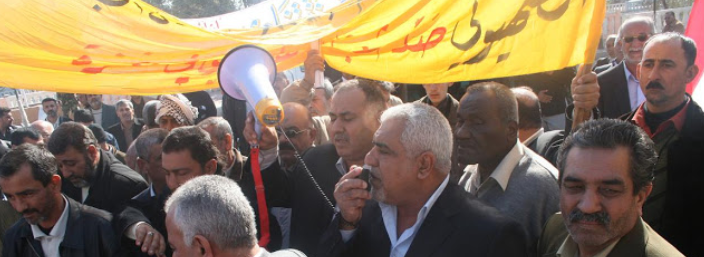

HASSAN JUMA'A (with mike).  Case falls, after EIGHT attempts! Oil workers' leader thanks international solidarity campaign. 

REMISS of me not to update this blog on a couple of issues we have been following.

FIRST, from IRAQ, we got this news on Monday:

 CHARGES AGAINST HASSAN JUMAA HAVE BEEN DROPPED TODAY!
Today the company lawyer and the prosecutor have repeated the accusation against Hassan but in the same time confirmed that there is no damages caused by Hassan’s activities. The prosecutor have asked to close the case and drop the charges. Hassan’s lawyer didn’t need to present his defense and he didn’t expect that the prosecutor will demand dropping the charges. .... Hopefully this will deter future malicious and repressive prosecutions.

Hassan Juma'a Awad, the leader of the Iraqi Federation of Oil Unions, had been facing charges that he organised strikes and campaigned against oil privatisation, in other words did what a union leader ought to be doing, but as Iraq since "liberation" has retained legislation from Saddam Hussein's regime where unions are concerned, he was facing a possible prison sentence. Here is a report from an international union centre:

"The Basra court hearings, originally tabled for 20 March, 7 April, 15 April, 2 May, 19 May, 3 June, and 17 June were all postponed when the Ministry of Oil, the Southern Oil Company (SOC) and its legal representatives consistently failed to provide any evidence in support of their claims that Hassan Juma’a was guilty of undermining the Iraqi economy by organizing illegal strikes and publicly criticizing the privatization of Iraq’s oil.

"The 1 July hearing took less than 30 minutes to reach the decision to drop the charges after the company lawyer and the prosecutor repeated the accusations against Hassan but at the same time confirmed that there were no damages caused by Hassan's activities. The prosecutor asked to close the case and drop the charges. On this occasion Hassan's lawyer did not even need to present his defense.

"If convicted he would have faced stiff fines and up to three years in prison. This is the first time an Iraqi trade unionist has been charged under penal code 111-1969, an archaic law that the Saddam Hussein regime used to repress state employees".           

http://www.industriall-union.org/union-victory-basra-court-finally-drops-charges-against-hassan-jumaa

A number of international union organisations were supporting Hassan Juma'a against this threat, US Labor Against the War(USLaw) circulated an international petition, and here in London a number of us had pledged to demonstrate outside the Iraqi embassy if the oilworkers' leader was sentenced.

Hassan Juma’a issued this statement on behalf of the Iraq Federation of Oil Unions (IFOU):
 “In such a happy occasion we would like to thank unions, federations, organizations and individuals who have contributed to the International Campaign to drop the charges and signed the letter addressed to Mr. Prime Minister of Iraq. Around 41 international federations and unions, 44 national federations and unions, 68 non-governmental organization contributed to the campaign. We specially thank the following organizations which tributed to the coordination of the international campaign: Initiative of Solidarity with the Iraqi Civil Society (ICSSI), the (USLAW), International Solidarity Center (SC) and IndustriALL.

 This verdict is a victory of the union freedoms in Iraq and the entire world. It is the best evidence that labour international solidarity is capable of achieving rights.
 
 To the Iraqi government and the ministry of oil: IFOU and its president were never against or source of harm to the Iraqi economy. We were the ones who protected oil and work facilities during difficult times including the occupation period. However, we will continue to practice our rights guaranteed by the Iraqi constitution including our right on trade union organization, defending workers and oil workers' rights and the national interests. We will continue our struggle and call for the issuance of a labor and trade union law. We are open to cooperate with government and international organizations to achieve this demand.”

And so from Iraqi oilworkers to the staff at London Metropolitan University who have been facing victimisation in what looks very much like a case of the authorities bowing to outside pressure. The most senior of those under threat, Professor Stephen Jefferys, issued this statement on Monday:
  
STEVE JEFFERYS takes a break from troubled academe with his granddaughter

With one bound...


< I am writing to you to thank you for supporting our campaign and signing a petition in February and March of this year protesting at the suspensions by London Metropolitan University of myself (Professor of European Employment Studies), Max Watson (the UNISON trade union branch chairperson) and Jawad Botmeh (a Palestinian who had served 13 years in prison as a result of a major miscarriage of justice) in connection with the Working Lives Research Institute having given Jawad work. You may remember that the suspensions followed immediately after Jawad's being elected by LondonMet staff to represent them as a Governor on the LondonMet Board of Governors.

The result of your efforts was a real success: we were all reinstated by March 13. Jawad resigned as Governor on March 14 and is now back at work.

However, senior management has continued to attempt to make life difficult for Max and me by charging both of us with 'serious misconduct' in connection with Jawad's appointment to a half-time casual job in 2008. This was despite the fact that his 2010 appointment to a permanent post was what triggered his ability to stand as a Governor - and the fact that this appointment went through HR and was raised with Professor Malcolm Gillies, five months after he became VC.

In our hearings and at our appeals both Max and I were found 'guilty': Max for 'not remembering' how Jawad had found out about job and for allegedly 'coaching' him (the only candidate); me - although no rules were broken - for failing to approach an even more senior management to approve such a 'controversial' appointment.

While Max was a junior administrative assistant at the time of Jawad's appointment, and I was responsible for it - a decision that led to no risk or damage to the university, staff or students (unlike a series of other decisions taken by other senior managers, none of whom we were told at my appeal, has ever been taken before the university's disciplinary proceedings) - our punishments are now different.

As from today, July 1, the Final Warning I was issued on April 23rd, has now expired. It is for this reason I am now able to write to you all to explain what has happened.

Unfortunately, Max Watson has got a six months' Final Warning which will now only expire on November 1. This is disgraceful treatment of a worker who did absolutely nothing wrong; and it confirms concerns that the management has all along aimed to victimise him because he is an effective trade unionist. This issue is obviously of particular concern to the UNISON trade union, the UK's largest public sector union, but it it also of concern to all who are concerned with rights at work and social justice.

One final suggestion. The Working Lives Research Institute is about rights at work and social justice. If you are not already on our mailing list, I would like to invite you to go to
http://www.workinglives.org/contact-us/mailing-list/subscribe.cfm
and to sign up. Besides showcasing the research projects we work on, under Courses on the website you will find our flagship Professional Doctorate programme - the DProf (Researching Work). This is a part-time doctoral programme that operates on a 5 a year two-day intensive study basis and leads to a doctoral degree usually based on a thesis probing a professional issue of direct relevance to you. Do contact us if you are interested... a new cohort is starting in October.

Of course, our DProf programme will now be enriched with a critical analysis of our own arbitrary managerial action and of the ethics of human resource management, as well as with examples from our recent research on Forced Labour (for the Joseph Rowntree Foundation), http://www.guardian.co.uk/global-development/2013/jun/05/european-governments-oblivious-forced-labour-conditions

Once again, Thanks for your support. You helped us win reinstatement.
Solidarity remains as important for social justice as ever.

yours in solidarity

Steve Jefferys
(In personal capacity)
Director, Working Lives Research Institute,
Faculty Advanced Institute for Research (Faculty of Social Sciences and Humanities)
London Metropolitan University
www.workinglives.org

Labels: , , , , ,

Friday, June 29, 2007

HM Government doesn't want us to hear voice of Iraqi oilworkers

IRAQI oil workers' leader Hassan Juma'a Awwad is due in London next week. He could expect a warm welcome from British trades unionists and anti-war campaigners, who will be keen to hear how the Iraqi Federation of Oil Unions is maintaining workers' unity amidst the conflict and chaos of occupation, and resisting plans to carve up the Iraqi people's oil between Western oil companies.

Earlier this month the southern oil company workers around Basra came out on strike, only to find themselves surrounded by Iraqi government troops. Arrest warrants were out for Hassan and other union leaders.

Trades unionists in other countries were alerted, and made their protests. My local trades union council promptly e-mailed the Iraqi embassy, and so did larger bodies like the Trades Union Congress and the Italian Federation of Oil and Chemical Workers, as well as US trades unionists.

On Monday, June 11, 2007, Naftana(Our Oil), the UK support group for the Iraqi oil unions, thanked those who had protested, and reported that the Iraqi government had apparently turned about, agreeing to negotiate, and the union was claiming a tactical victory. Naftana relayed this message from Hassan Juma'a:


"Warm greetings,

We would like to inform you of the latest developments in the oil workers strike in the south.Finally the workers have won in demanding their legitimate rights. That is why an enlarged meeting was held with his excellency the Minister of State for the Parliament Affairs lasting five hours resulting in the cessation of all the failings resulting from the conduct of the Iraqi Ministry of Oil and the irresponsible stance of the oil minister. Most of the issues within the remit of the prime minister were dealt with. The meeting was very successful, because the minister represented the prime minister. The activation of the committee formed by the prime minister to deal with the outstanding problems was affirmed. And after deliberations within our union, the two sides agreed to halt the strike and to use dialogue in dealings to resolve the outstanding issues.

On the other hand, all problems were presented to His Eminence Sayyid Sistani, and the Iraqi Ministry of Oil. Therefore, we would like to say to all that the workers will is indestructible . The workers can achieve what they want by the means available to them and their strength. And the oil workers are very strong, because they have a legitimate right. the workers have scored a third victory in demanding their rights.
Long live the Iraqi working class.

Regards, Hassan Juma'a Awwad'

As I said at the beginning, Hassan Juma'a should be in London next week.
He has been invited to speak at the Socialist Workers' Party's annual Marxism event, which usually attracts a large crowd, and he would also be meeting other trades unionists. Yesterday I was in touch with a couple of friends involved in preparing the founding conference on July 14th of a national Shop Stewards Network, which is backed by the Rail, Maritime and Transport workers union RMT and drawing support from a wide range of trades unionists.

When I mentioned that Hassan Juma'a was due in town they readily agreed it would be good if he could speak at their conference. The organising committee is due to meet and finalise its plans on Saturday.

Unfortunately, as I also had to tell the brothers, it now looks as though Hassan Juma'a may not be able to come to London next week, thanks to the attitude of Her Britannic Majesty's Government and specifically, "our" embassy in Amman which has been refusing to give the oil workers' leader a visa. Two Labour MPs, Jeremy Corbyn and John McDonnell, attempted to intercede on his behalf, but it seems they couldn't budge the embassy.

Hassan has been to this country before. He received a rapturous response when he addressed Stop the War delegates. He took part in a conference at the TUC, and a teach-in arranged by Iraq Occupation Focus. There is no question of the British government's not knowing who this Iraqi is - we can be sure the Foreign and Commonwealth Office knows exactly who he is! Remember, Basra and its oilfields are in the British zone of occupation.

We can guess that besides British companies hoping to profit from Iraqi oil in future, the British government is not happy with meetings between Iraqi and British trades unionists, whether they are talking about ending the war and occupation, or discussing "tactical victories" against anti-union laws and privatisation. Hopefully, if Hassan Juma'a can't speak in London next week then we will have something to say about those preventing him. From protesting to the Iraqi embassy over the treatment of trades unionists, we (most of whose unions supported Gordon Brown for Labour leadership) must turn our fire on the British government.

Some useful places to visit:

Iraqi oil workers:
http://www.basraoilunion.org/
oil privatisation:
http://www.carbonweb.org/
US Labor Against the War
http://www.uslaboragainstwar.org/
Iraq Occupation Focus
http://www.iraqoccupationfocus.org.uk/
Radical Activists' Network:
http://www.radicalactivist.net/corporateiraq/
Iraq Union Solidarity Scotland
http://iraqunionsolidarityscotland.blogspot.com/
International Longshoremen's and Warehouse Union:
http://www.ilwu.org/dispatcher/2005/06/iraqiworkers.cfm
National Shop Stewards Network:
http://www.shopstewards.net/

Labels: , , ,

Tuesday, May 08, 2007

Iraqi oil workers strike against privatisation

IRAQI oil workers are to strike against the new oil law being pushed through the country's parliament. Drawn up in English before it could be translated for the MPs, the legislation has the hallmark of American consultants close to the US State Department. Oil experts were shocked by the way it mortgaged future oil production from fields yet to be developed, while leaving the Western oil companies free to do nothing for now.

Workers whose hard work and make-and-mend ingenuity kept their industry going despite sanctions and war say they don't need the foreign companies. Their union says Iraqi oil belongs to the Iraqi people, and they oppose privatisation and foreign exploitation.

More than 60 Iraqi experts signed a petition against the new oil law in March this year. An Iraqi MP attending the conference held in Amman, Jordan, said: "This law must be rejected as whole, there is no way it can be enhanced or fixed."
See article by Raed Jarrer http://electroniciraq.net/news/3053.shtml

Iraqi political analyst Munir Chalabi has warned that the big oil companies, the US and British governments, and the IMF "will not be able to enforce an oil law which seems to be no less than the old concessionary model in a new guise".
Pointing to the failure of the occupying powers to impose their order despite all the deaths and destruction they have wreaked, Munir also reminds us that under international law, occupying forces have no right to impose laws against the interests of the occupied people. Any future elected parliament can declare them null and void.
http://www.zmag.org/content/showarticle.cfm?SectionID=15&ItemID=12342

Now over to a special correspondent who explains more: (switch on control in bottom left corner)


News that the oil workers will stage a strike against privatisation comes in a week when representatives of big oil companies like BP, Shell, Exxon and Texaco are due to meet Iraqi government officials, in the relative safety of Beirut.

Here is the news from friends of the Iraqi Federation of Oil Unions:

Iraqi Oil Workers to Strike Over Privatisation Law

Iraq's largest oil workers' trade union will strike this Thursday, in protest at the controversial oil law currently being considered by the Iraqi parliament. The move threatens to stop all exports from the oil-rich country.The oil law proposes giving multinational companies the primary role in developing Iraq's huge untapped oilfields, under contracts lasting up to 30 years. Oil production in Iraq, like in most of the Middle East, has been in the public sector since the 1970s.

The Union, representing 26,000 oil workers, has held three previous strikes since 2003, each time stopping exports, for up to two days at a time. The announcement of the strike has spurred negotiations with the Ministry of Oil, which are ongoing. Imad Abdul-Hussain, Federation Deputy Chair of the IFOU said: "The central government must be in total ownership and complete control of production and the export of oil".

He warned against the controversial Production Sharing Agreements favoured by foreign companies, saying other forms of co-operation with foreign companies would be acceptable but not at the level of control and profiteering indicated in the current Oil Law.

Federation President Hassan Jumaa Awad al Assadi said:
"The oil law does not represent the aspirations of the Iraqi people. It will let the foreign oil companies into the oil sector and enact privatisation under so-called production sharing agreements. The federation calls for not passing the oil law, because it does not serve the interests of the Iraqi people."

The Union is not alone in its' condemnation of the current oil law. Opponents of the law also include all of Iraq's other trade unions, a number of political parties, and a group of over 60 senior Iraqi oil experts.

Hassan Jumaa went on to say:
"The federation calls on all unions in the world to support our demands and to put pressure on governments and the oil companies not to enter the Iraqi oil fields. "

Union members are also demanding an improved salary structure and a distribution of land for building homes.

The oil union's responsible attitude in defending their industry and the public interest, and campaigning by democratic means, has not been welcomed by those serving the occupiers while pretending to govern Iraq. The union has already suffered from the continuation of labour laws inherited from Saddam Hussein, and interference with its rights to organise and raise funds. Now it has been accused of jeopardizing security and threatened with legal action.

Farouq Al-Asadi, the Federation's Secretary said: 'The Oil Minister chooses to forget that the right to strike is guaranteed by the constitution - we have chosen the legal path'. Union leaders have already received a number of death threats which they are taking seriously. "As soon as the federation called for the strike, many of our members and officials were physically threatened by parties active in the political process, with the aim of thwarting the strike and undermining the message of the strike organisers."

Contacts: Hassan Jumaa Awad Al Assadi, President of the Iraqi Federation of OilUnions 00964 7801 001 196 or 00964 7804 114 619
http://www.basraoilunion.org/

Notes from Naftana:

IFOU is an independent trade union representing workers across 4southern provinces in Iraq: Misan, Dhi Qar, Basra and Mauthanna in nine oil and gas related companies.The Union has been organizing since April 2003 and has stopped oil exports and production over wages and workers rights in the past. It has also held protests against oil smuggling, former regime bosses and what the union sees as the deliberate neglect and degradation of the industry in order to justify private investment.

Union members have carried out reconstruction work on drilling rigs, port equipment, pipelines and refineries since the invasion with minimal, mostly local resources. The Union is not linked to any political party in Iraq but has members who belong to various parties. The Union enjoys the support of trade unions and civil society organizations around the world including the International Confederation of Energy, Mining and General Workers Union (ICEM), the AFL-CIO in the US, and the Trade Unions Congress (TUC) in the UK including the NUJ and TGWU. The union is partnered with UK development charity War on Want, the 3 million strong US Labor Against War in the USA, and Italian NGO Un Ponte Per.

For more on Iraqi oil law and privatisation see:
http://www.handsoffiraqioil.org/2007_03_01_archive.html

Labour MP Katy Clark has submitted an Early Day Motion about oil in Iraq:
http://edmi.parliament.uk/EDMi/EDMDetails.aspx?EDMID=32937&SESSION=885

Opponents of Iraqi oil privatisation are planning to take their protest to Shell's AGM on Tuesday May 15:
8.30am - 12 noon
Novotel London-West Hotel and Convention Centre,
1 Shortlands,
Hammersmith, London W6 8DR
(Nearest tube - Hammersmith)

In my view, Iraqi workers need their own political party, to unite the working people and fight for their viewpoint and interests against big business, for democratic rights and social justice.
That's something we have in common.

Right now they also need international solidarity - especially from those of us in countries whose troops are occupying Iraq and whose oil companies are looking to move in after them.

Labels: , , ,

Friday, February 16, 2007

Hands off Iraqi oil!


WORKERS "have the experience in the field and the technical training, have overcome hardships and proven to the world..."
photo David Bacon, US Labor Against War


IRAQI oilworkers are declaring their opposition to privatisation and foreign takeover of their industry.
As union leader Hassan Juma'a Awwad warns in his speech below, the wave of killings in the country, setting Iraqi against Iraqi, is providing a cover for continued war and occupation; and a diversion while laws are brought in stealthily - even Iraqi MPs complained they did not see the drafts - ennabling foreign oil companies to extend a long-term hold on the resources and industry.
But as Hassan Juma'a also warns, Iraqi trade unionists and the people will not let this take-over proceed without resistance and punishment.

The speech of the head of the Federation of Oil Unions in Basra to the meeting held to debate the [proposed] oil law and the oil investment laws on Tuesday 6th February 2007

In the name of God the merciful the munificent
To the audience, to the guests, to the distinguished professors,
Greetings, as-salamu `alaikum wa-rahmatu ‘llah wa-barakatuhu

I would like first to offer thanks to all the brothers and sisters who are participating in this conference to debate the Iraqi oil law, and particular thanks to the Centre for Arab Gulf Studies of Basra University, notably to Professor Dr Jabbar al-Hilfi and his colleagues who have contributed in every possible way in this action.

dear colleagues
Iraq today passes through a great trial as all hostile forces join together against it. The people face attacks by takfiri zealots and the thugs of the deposed regime, which serve only to extend the war and the occupation which has succeeded in making Iraqi kill Iraqi. This method is not new to the Americans and their allies; as long as chaos reigns in this country many of the sinews of life cannot operate.

Among the objectives America wishes to achieve from the military occupation of Iraq, all the causes of which we do not want to return to, but simply to emphasize one central objective of the American political leaders who crossed oceans and wasted billions of dollars, that is Iraqi oil. Indeed we in the Federation of Oil Unions consider this the most important reason for this foul war.

dear friends
ِAnd, following this short introduction, we can today see that many of those profiting from the occupation seek to waste the national wealth which God almighty has given Iraqis and to deliver to their masters that national wealth on account of which Iraqis paid a high price. Although, right up to this hour, this wealth has not served Iraqis, we hope that it may yet bring ease not trouble to Iraqis. If we turn back a little we find law number 80 of 1961 wherein the production areas of the foreign companies in Iraq were specified and limited, and we see the manner in which Iraqis planned to profit from the national wealth was laid out, and as an extension of this law, the decision to nationalize the shares of foreign companies on the basis of which full control of Iraqi oil was achieved.

Recently the Constitution of Iraq on which the Iraqi people voted in the most dire and difficult of conditions notes in clause 111 that oil and gas are the property of the Iraqi people. But, alas, this clause in the constitution will remain but ink on paper if the oil law and oil investment law being presented to the Parliament are ratified, laws which permit production-sharing contracts, laws without parallel in many oil producers, especially the neighbouring countries. So why should Iraqis want to introduce such contracts in Iraq given that applying such laws will rob the Iraqi government of the most important thing it owns?

In this regard we would like to clarify the following points:
1—We send a message to all the members of the Iraqi Parliament, when debating the oil and investment laws, to bear the Iraqis in mind, to protect the national wealth, and to look at the neighbouring countries. Have they introduced such laws even when their relations with foreign companies are closer than in Iraq?

2—If those calling for production-sharing agreements insist on acting against the will of Iraqis, we say to them that history will not forgive those who play recklessly with the wealth and destiny of a people and that the curse of heaven and the fury of Iraqis will not leave them.

3—We strongly warn all the foreign companies and foreign capital in the form of American companies against coming into our lands under the guise of production-sharing agreements.

4—Open the way to Iraqis to manage their own oil affairs. They are able to do that; they have the experience in the field and the technical training, have overcome hardships and proven to the world that they can provide the best service to Iraqis in the oil industry. The best proof of that is how after the entry of the occupying forces and the destruction of the infrastructure of the oil sector the engineers, technical staff and workers were able to raise production from zero to 2,100,000 barrels per day without any foreign expertise or foreign capital. Iraqis are capable of further increasing production with their present skills. The Iraqi state needs to consult with those who have overcome the difficulties and to ask their opinion before sinking Iraq into an ocean of dark injustice.

Those who spread the word that the oil sector will not improve except with foreign capital and production-sharing are dreaming. They must think again since we know for certain that these plans do not serve the sons and daughters of Iraq.

dear audience,
We do not oppose the introduction of new technology into the oil sector so as to increase production; we believe in that; but this must be done in a way that will safeguard the stature of the Iraqi state and its sovereignty over natural resources.

In conclusion, the law is in your hands. We consider it unbalanced and incoherent with the hopes of those who work in the oil industry. It has been drafted in a great rush in harsh circumstances. We believe this law to be more political than economic, it threatens to set governorate against governorate and region against region. Therefore I call on all the intellectuals and professors and political leaders to participate seriously in debating this vital topic in a manner useful to those participating in the committee drafting the final communiqué to be sent to the Iraqi Parliament, the Presidency of the Republic and the Prime Ministry.

We say: ‘By God I swear that we have told you, by God I say that we have warned you.’
And in closing I would like to thank you for your grace in listening and to call for God’s mercy and blessing.

Hasan Jum`ah `Awwad al-Asadi
Head of the Federation of Oil Unions
6th February 2007

(translated by Martha Mundy, and recieved courtesy of my fellow TGWU member Ewa Jasiewicz, of Naftana and Iraq Occupation Focus).

See also:

Oil trade unionists unite

http://www.platformlondon.org/carbonweb/showitem.asp?article=4&parent=3

http:/www.basraoilunion.org/

Labels: , , , ,

Monday, July 10, 2006

"The Oil is Ours!" -Iraqi oil union president in UK

LATE NEWS: Unfortunately, oil workers leader Hassan Juma'a (see below) has had to return suddenly to Iraq and will not be able to speak at our monthly IOF meeting tomorrow night (Thursday 13 July).

However, the meeting will take place and we will be discussing the situation facing Iraqi oil workers and how we can support them, as well as our other future plans.

IRAQ
OCCUPATION
FOCUS


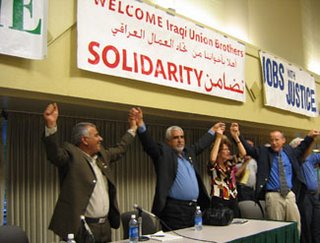
HASSAN JUMA'A AWAD (centre, in light blue shirt) with Iraqi and US union militants at rally in Portland, Oregon. (photo US Labor Against the War).


The leader of one of Iraq’s most powerful trade unions is in Britain this week. Hassan Jumaa Awad al Assadi is the President of the General Union of Oil Employees (also known as the Iraqi Federation of Oil Unions). The GUOE organises over 23,000 oil and gas workers across the south of Iraq, and has been involved in efforts to unite all Iraq's oil workers and unions, in fighting privatisation and the foreign corporate invasion of Iraq.

The Union recently issued a statement to Iraq’s Prime Minister and Oil Minister demanding that the people of Iraq be democratically consulted about the future of Iraq’s oil. New Oil Minister Hussein Al Shahrastani has stated that an energy law will be drafted within the next two months, and passed through parliament by the end of this year. The new law will decide the future of investment and development of Iraq’s oil and gas supplies.

No public consultation or debate has been held regarding the new law.The union has vowed to ensure the failure ‘no matter what the cost be’ of any promulgation of an energy law which promotes privatisation and foreign corporate control of Iraq’s oil sector. International oil companies, supported by the British government, have lobbied for long-term contracts to be signed which would give them control over Iraq’s oil for the first time in more than three decades.

The US government – which also favours such contracts – has also increased its embassy’s efforts to influence the energy law. Oil was a key topic discussed during President Bush’s recent visit to Iraq. The GUOE is opposed to the military occupation of Iraq and to the privatisation of the oil and industrial sectors of Iraq. The Iraqi government recently froze the GUOE’s bank accounts in Iraq and Jordan.
http://www.basraoilunion.org/
http://www.iraqoccupationfocus.org.uk/
Hassan Juma'a is to address an Iraq Occupation Focus meeting on Thursday evening, July 13 at 7pm, at the Indian YMCA, Fitzroy Square, London W1 (near Warren Street or Great Portland Street tubes).


Labels: , , ,

Friday, June 30, 2006

Naftana answers TUC's man

HASSAN JUMA'A AWAD of the Iraqi General Union of Oil Employees, in Los Angeles during a tour last year hosted by US Labor Against the War.
Iraqi union leaders spoke at meetings and had talks with American union leaders including John Sweeney, president of the AFL-CIO unions.
(photo from People's Weekly World, June 25, 2005)


http://www.pww.org/article/articleview/7267/1/275/

THE Iraqi government has frozen the bank account of the General Union of Oil Employees, an independent trade union that has sought to unite oilworkers across Iraq and resist moves to let foreign big business gain control of Iraq's oil wealth.

In response to a call for help to the oilworkers' union, Owen Tudor, head of the TUC's European Union and International Relations Department, said "The TUC is unaware of what has happened to the Oil Workers Union (it doesn't help that they seem only to communicate with small campaigning organisations rather than the global oil workers federation (ICEM) or the global trade union movement (ICFTU)".

Concerning the Iraq government's use of Decree 8750 to intervene in the lawyers union and others, Tudor regretted it, but accused Naftana(Our Oil), the London-based support group for the oilworkers' union of "a massive exaggeration" in describing this as "the September 2005 decree making all trade union activity illegal".

"This is not intended to stop people protesting about Decree 8750, as theTUC, ICFTU and Iraqi unions have been for nearly a year. But hyperbole doesn't help, it sends people off in the wrong direction", the TUC's international officer said.

We have commented on this, and quoted comments by Iraqi academic Sami Ramadani. Now NAFTANA has issued this response to the comments issued by Owen Tudor, which would seem to put paid to the claim that the Iraqi oil union only communicates with "small campaigning organisations". It also makes clear that GUOE and its supporters have taken a principled stand - something which the TUC, if it is to defeat anti-union laws in Britain, as well as Iraq, could learn from.

Almost two years ago in July 2004, the General Union of Oil Employees issued a letter, detailing the formation of the federation and asking for affiliation to ICEM. This was translated into English and sent to Jim Catterson, Director of Organisatiom, at ICEM. This was the firstmajor move from the union towards international recognition, support andprotection. Since then, Hassan Jumaa,
President of the GUOE has met with Jim Catterson in London to further discuss affiliation.

The union has invited ICEM to send a delegation to Basra twice, both on a private fact-finding visit and for the union’s first anti- privatisation conference in May 2005. The GUOE communicates with ICEM, on a regular if infrequent basis. The Union was invited to and sent a delegate to ICEM’senergy industries seminar in Jordan in last April 2006.It is therefore untrue to say that the union has not pursued links withinternational union federations.

The GUOE has tried to forge links with the TUC’s Iraq Solidarity Committee too. The GUOE was represented at the TUC’s Iraqi
Union’s conference in February 2005 by Hassan Jumaa, the union’s president. Upon Hassan’s second visit in December, when Owen Tudor was asked if the solidarity committee could in any way help with Hassan’s accommodation costs, we were told that no assistance could be offered. When we askedif Hassan could attend an Iraq Solidarity Committee meeting last December 2005, we were told,
bluntly and with no explanation or fraternal apology, that it would not be possible for Hassan to attend.

No support has ever been offered to the GUOE from the committee.The above represent attempts by the GUOE to cultivate links with the TUC in the UK, which have been rebuffed.

The GUOE was not created through any political party apparatus – unlike other trade unions in Iraq. It had no international representatives or members in exile. It had no support structure outside of Iraq whatsoeverwhen it was first established. It is a grassroots trade union and the solidarity and support links – both in the UK and internationally -which have been cultivated so far, have been generated and organised, equally, at a grassroots level without the help of political parties orgovernmental organisations.

The GUOE does not take dues from its members as they are too poor to afford them. They have not been able to form an accountancy
and payment processing structure due to being unable to open an account in Iraq.

The union has refused funding from the British Council and receives no funding from any other government or occupation related sources. It has no sponsoring political party to give it any funding either. The unionis in an incredibly vulnerable financial position. The Jordan account was created to process solidarity donations from NGOs, trade unions andanti-war organisations.

For Owen Tudor to not take seriously the predicament that the union is facing displays either ignorance of the situation independent unions arefacing on the ground in Iraq or a wilful disregard for the GUOE’s predicament. Again on the issue of the GUOE ‘only communicating with small campaigning organisations’, the union has in fact, solidarity links with the over 3 million member strong US Labor Against War based in the US, the FIOM – Italy’s national trade union federation, plus trade unions,civil society and anti war groups in Germany, the Philippines, Australia, Canada, Poland, France and Denmark. In the UK, it has the support of the TGWU,
the NUJ, NATFHE and the GMB.

This again points to the false impression Owen has given of the natureof the relationships the GUOE has.Naftana – the UK based support committee for the GUOE has been approved and empowered by the union to act as a channel of information andcommunication with trade unions and civil society organisations worldwide and also to work with the union to help it achieve one of its key aims: combating the privatisation of Iraq’s oil through Production Sharing Agreements in order to keep Iraq’s oil as a public asset to be used for the maximum benefit for All Iraqis from the North to the South.

We regularly issue statements from the union in order to promote itswork and try to keep it safe from attack. Keeping up the flow of information; creating meaningful links with civil society groups, unionsand NGOs; raising funds for the union; facilitating international visits; and crucially, offering advice and up to the
minute information on the plans for oil privatisation to the union have been Naftana’s main tasks.

Naftana is independent of all political parties both within theUK and Iraq and is made up of volunteers, all organising in their spare and
limited time. Naftana would love for the union to have its own fully functioning international relations department so that there would be no need for us to exist and it is our mission to develop this and turn it into a reality.

To sum up, Owen’s statement is factually incorrect and appears to betray personal political disagreements – which Owen is of course free to have- with the GUOE and its support mechanism here in the UK. Some clarity and honesty as to whether his position is representative of the TUC’s International Department and the TUC Iraq Solidarity Committee would be appreciated

.Naftana, June 29th 2006

Over to you, brother.

Labels: , , ,

Tuesday, June 27, 2006

Thanks, Brother...Now how about some solidarity?

NOT content with handing over lucrative government contracts and juicy chunks of public services to big private interests, Blair's New Labour has felt it only right to decorate the rich bosses for showing interest. It was revealed the other week that Riley Bechtel, billionaire head of the American Bechtel Corporation, was awarded a CBE in 2003 for "services to UK-American commercial relations".

Besides moving into London Underground privatisation and taking over the Crossrail project, Bechtel has plans for the nuclear business. The US company has done well from the Iraq war, just as it previously did from doing business with Saddam Hussein, and in Saudi Arabia of course.

Bechtel became an honourary Commander of the British Empire, approved by HM The Queen, on 25 April 2003, a week after his company won a £430 million contract to rebuild Iraqi infrastructure. Jack Straw was Foreign Secretary. There have been suggestions the award was kept quiet at the time to avoid political controversy.

As I passed US firm Haliburton's building at Greenford the other day then came into Hammersmith where Bechtel has it's European HQ, I was thinking what more we can do to raise support for Iraqi trade unionists who are confident they could rebuild their country better without carpetbagging foreign companies, and want to stop their country's oil wealth falling prey to privatisation.

So far the only bit of infrastructure the Americans have been keen on reconstructing have been prisons, and of course their own bases -which are beginning to look rather permanent for a "temporary" occupation.
We heard last year how the General Union of Oil Employees had to chase Halliburton-KBR people out of the southern oil refineris, and since then the union has held a conference against oil privatisation, and taken steps to unite oil workers and other trade unionists across Iraq on this issue.
While maintaining its own independence, the oil union has begun discussing how Iraqi workers can have a distinct, but united, political voice.

Last week we heard that the Iraqi government had intervened, freezing the GUOE's bank accounts. This followed actions against lawyers associations and others. The Iraqi government is keeping Decree 8750 which is aimed against workers right to organise in unions.

Like others, I tried to spread word of this, copying a message from the oil workers' support group here Naftana (Arabic for Our Oil), in the hope we could raise some voices here in solidarity with Iraqi trades unionists. I think, as I've said in more than one meeting, that as we in Britain are fighting against privatisation, as well as an end to anti-union laws, we should form a united front with the Iraqi trade unionists. We're even facing some of the same companies.

I received this message below from the head of the British TUC's International Department:
The TUC is unaware of what has happened to the Oil Workers Union (it doesn't help that they seem only to communicate with small campaigning organisations rather than the global oil workers federation (ICEM) or the global trade union movement (ICFTU), but it is certainly true that Decree 8750 has been used to intervene in the lawyers union and others (note that this organisation and others affected are more professional associations than trade unions, not that that makes the government's actions any better).

However, it is a massive exaggeration to describe Decree 8750 as "the September 2005 decree making all trade union activity illegal", and things are bad enough without exaggerating and giving completely thewrong impression. Unions in Iraq are clearly still functioning, and have been since the Decree was announced (in August by the way).

This is not intended to stop people protesting about Decree 8750, as the TUC, ICFTU and Iraqi unions have been for nearly a year. But hyperbole doesn't help, it sends people off in the wrong direction.

Owen Tudor
, Head of TUC European Union and International
Relations Department
Congress House, Great Russell Street, London WC1B 3LS


Maybe it's because I've just been writing about the fire service, but I get the feeling that if I'd called these people to a fire they'd say I'd rung the wrong alarm, tell me off for exagerrating, then pour cold water over me rather than hastening to put the blaze out.

On "small campaigning organisations", I should point out that it was one of these, Iraq Occupation Focus, which arranged GUOE president Hassan Juma'a 's first trip to Britain, at a time when official trade union links were only being extended to the "official" Iraqi Trade Union Federation which had a full-time officer here.
It was as a result of his trip that Naftana was set up, and that the TUC invited Hassan Juma'a along with other union leaders to a seminar in Congress House about Iraq. There I felt the privatisation issue raised by Hassan was played down by officialdom (maybe because there were elections coming up). But it was Owen Tudor who, if I'm not mistaken, encouraged lay union members to go ahead with an Iraq Trade Union Solidarity Campaign, suggesting they could do more campaigning than the TUC itself.

Still, feeling a half-hearted TUC response was better than none, I forwarded Owen Tudor's letter to friends and fellow-activists, and this has brought the comment below from Sami Ramadani, an Iraqi political exile from Saddam Hussein, now teaching in London University. I think it blows away the bureaucratic fog and lets us see issues more clearly, so I'm glad Sami says to circulate it:

The head of the TUC European Union and International Department, Owen Tudor, has written a letter criticising Iraq's oil workers' union, for not building links with certain international union federations, and lambasting solidarity organisations for issuing statements alerting the trade unions and general public to the escalating anti-trade union measures and oil privatisation plans in Iraq.

Instead of directing his fire at the anti-trade union measures in occupied Iraq, Owen Tudor prefers to level a false accusation against a besieged trade union representing impoverished workers, languishing under a ruthless occupation. He also takes a swipe at "small" solidarity organisations in Britain and USA, and engages in diversionary nitpicking and making light of the grave problems facing the Iraqi people and trade unions.

But despite Owen Tudor's attempt to cloud the issues and downplay the seriousness of the problems facing Iraq's genuinely independent trade unionists, the facts are plain and simple to understand. The Iraqi government has, in the past few months, accelerated the implementation of Decree 8750. The Iraqi Ministerial Council approved Decree 8750 in August 2005 (probably not published in the official gazette till September) promising "a new paper on how trade unions should function, operate and organise," dissolving one government committee and replacing it with a new ministerial committee that includes the minister for National Security, to be in charge of Labour and Social Rights, and stating that the new committee would control all trade union funds.

Using wording rivalling the deviousness of the Saddam regime's 1987 anti-trade union law, decree 8750 does not ban trade unions. In 2004 US administrator Paul Bremer issued a notorious directive, still in effect, reviving Saddam's 1987 anti-union decree, which also did not ban trade unions as such, but merely deemed all workers in the state sector to be civil servants. Civil servants were of course banned from joining trade unions. Similarly, decree 8750 is worded such that it effectively makes all union activity illegal.

The decree states that the new ministerial committee "must take control of all monies belonging to the trade unions and prevent them from dispensing any such monies." How trade unions can function legally when it is illegal to dispense a penny on their activities, only Owen Tudor knows. He also knows how to stay calm and not resort to "hyperbole" when "Unions in Iraq are clearly still functioning, and have been since the Decree was announced."

In English, this means that his TUC department will not launch a serious campaign to defend Iraq's independent trade unionists until they all stop functioning. While the country burned and cities were at the receiving end of trigger-happy US Marines, US air and land bombardment, and occupation-induced terrorist attacks, the government proceeded this year with the implementation of the anti-union policies and decrees. As if it was not bad enough that his TUC department did not campaign to defend the Iraqi lawyers' and writers' unions, Owen Tudor tries to downplay nakedly anti-union measures by describing properly constituted unions, with elected officers, as "more professional associations than trade unions."

In April the government accelerated the implementation of its 8750 anti-union decree. Contrary to Tudor Owen's accusations of "hyperbole," the Naftana statement below understates the scale of the problem facing Iraqi trade unions by highlighting the actual freezing of the accounts of only the oil workers' union. The government decree in fact ordered control over the accounts of all trade unions (including those close to the government).

I find it astonishing that he chooses to accuse the oil workers union, whom the TUC officially invited to Britain last year, of not communicating with international union federations. He knows very well that the oil workers' union has been trying very hard to establish such contacts in the face of insidious, but polite and patronising disregard. He also knows that this union is financially strapped -(the price of true independence under occupation)- and relies heavily on its supporters in Britain to communicate its news in English to the British and world trade union movement.

Instead of publicly criticising the union, he should be writing to them expressing concern at the news of freezing their account, ascertaining the full facts and offering financial and other help. He should also be asking them how the TUC could help the union's planned second anti-privatisation conference in Basra.It is deeply regrettable that some in the TUC international department prefer to turn a blind eye to certain international events, which are seriously threatening trade unionists abroad, if such events are deemed to be politically embarrassing to Blair's government. For them Iraq is building a democracy, and strangling independent trade union activity does not fit in with that fictitious Blairite image of Iraq, an image designed to lull trade unionists into silence about the gravity of the situation in Iraq, and thwart calls for the swift withdrawal of the US and British occupation forces.

In the name of supporting a fictitious democratic process, they are in effect helping to crush democratic activity. And by not exposing the consequences of the Blairite (Thatcherite) alliance with the Bush administration, some in the TUC international department are, probably with good intentions, helping prolong the occupation of Iraq and privatisation and theft of Iraqi oil and other wealth by the transnationals.
In doing this, they are also damaging the reputation and proud record of most of Britain's unions, strongly opposed to the war and continuing occupation of Iraq. Instead, Tudor Owen should also be alerting Britain's unions to the fact that the Iraq's oil minister is preparing the ground for signing privatisation agreements, deceptively called Production Sharing Agreements, with the transnational oil barons.

The TUC is perhaps not aware that the occupation authorities have spent millions of dollars on so called civil society and other 'sweetheart' organisations to prop up activities designed to draw attention away from the war crimes of the occupation forces and plans to privatise Iraq's oil and main industries. The implementation, probably selectively, of Decree 8750 will hit the genuinely independent organisations hardest, because they rely heavily on the pennies they collect from impoverished workers and donations collected by solidarity organisations .

Decree 8750 is aimed at strangling the truly independent trade unions and other mass organisations. International solidarity helps them stay independent and to resist pressures to turn them into 'sweetheart' unions, docile apologists of the occupation and the transnationals.

Best wishes,
Sami Ramadani

See previous blog, Iraqi government attacks oil union:
http://randompottins.blogspot.com/2006/06/iraq-government-attacks-oil-union.html

Labels: , , ,

Wednesday, June 21, 2006

Iraq government attacks oil union

WORKERS RESISTING OIL WEALTH RIP-OFF

IRAQ's shiny new "democratic" (or denominational) government has shown its teeth to please its master, and taken a bite from the only people who are really uniting Iraqis for freedom, and against the corporate rip-off off the people's wealth - the trade unions.

Naftana (Our Oil) - the UK Support Committee for the General Union of Oil Employees says it has confirmed reports that the Iraqi regime has frozen all the bank accounts of the Iraqi oil workers' union, both abroad and within Iraq.

The committee says the Iraqi regime's decision follows a series of anti-union measures, including the disbanding of the council of the lawyers' union, freezing the writers' union accounts and the September 2005 decree making all trade union activity illegal. For that anti-union act the regime used the pretext of promising the promulgation of a future law to 'regulate' trade union organisations and their activities.

"This action follows in the footsteps of US administrator Paul Bremer", says a Naftana press release. "In 2004 Paul Bremer, the occupation's then pro-consul in Iraq, declared trade union activity in the state sector illegal. That decision re-enacted Saddam Hussain's 1987 decree banning workers' unions in the state sector by declaring them to be 'civil servants' rather than 'workers'."

The Oil Workers' Union has played a leading part in opposing IMF-backed measures which raised Iraq's domestic fuel prices out of reach of poorer people, and aim to take its resources into the hands of big foreign companies. As Naftana's spokesperson Ewa Jasiewitz says:

"Iraq's enormous oil wealth is being groomed for Production Sharing Agreements, which would transfer effective control over all aspects of oil policy, production and marketing to multination oil companies. The oil workers' union is one of the most effective opponents of this policy, organising an anti-privatisation conference last year and another one to come this year".

The GUOE organises over 23,000 oil and gas industry workers Naftana was set up by UK activists after contact with the GUOE, and is in regular contact with the leadership of the union. In August 2003 the union halted oil exports for two days as a protest over low wages. The GUOE is independent of any political party or union federation.GUOE executive committee members, including its President, were part of the opposition against Saddam Hussein's dictatorship, and many were imprisoned by the regime.

The GUOE is opposed to the military occupation of Iraq and to the privatisation of the oil and industrial sectors of Iraq. The GUOE is a successor to the Southern Oil Company Union (SOCU), set up immediately after the fall of the Saddam regime. In October 2003 union activists kicked US company KBR out of oil industry workplaces.

  • GUOE president Hassan Juma'a is due to visit London next month and will speak at various meetings, including Iraq Occupation Focus on July 13, 7.30 at the Indian YMCA, Fitzroy Square, W1 (nearest tubes Warren Street or Great Portland Street.

For more information on GUOE visit http://www.basraoilunion.org/

For Iraq Occupation Focus: http://www.iraqoccupationfocus.org.uk/

For news alerts from Naftana: naftana-subscribe@lists.riseup.net

Labels: , , ,

Tuesday, November 08, 2005

Iraqi Oil Union Leader visits UK on anti-privatisation mission


KEEPING FIRM HAND ON THEIR CHILDREN'S FUTURE, BY KEEPING WESTERN FIRMS' HANDS OFF THEIR OIL.
Basra oil worker


Hassan Juma'a Awad, President of the Iraqi Federation of Oil Unions (IFOU) formerly known as the General Union of Oil Employees, Basra (GUOE) will be touring the UK next month. Hassan has been invited to the UK for Iraq Occupation Focus’ ‘Voices from Occupied Iraq’ Teach-In on November 26th and the Stop The War Coalition’s International Peace Conference on December 10th

The Union has stated that ‘The privatisation of the oil and industrial sectors is the objective of all in the Iraqi state/government. We will stand firm against this imperialist plan that would hand over Iraq's wealth to international capitalism such that the deprived Iraqi people would not benefit from it…we are taking this path for the sake of Iraq's glory even if it costs us our lives.’

It was announced last month that the General Union of Oil Employees in Basra was being joined by other local based oil unions.

"In accordance with present experiences of Iraqis as part of embodying the practice of democracy for the new phase, we announce with God's blessing the formation of theFederation of Oil Unions in Iraq, with its centre in Basra, composed of unions representing the oil sector in Basra, Meisan, and DhiQar, as aFederation specialised in all aspects of the oil sector and part of themovement of Iraqi labour unions. At this moment as we announce the establishment of the Federation, its doors are open to all workers in the oil sector throughout Iraq from the north to the south and we welcome the support of all civil society organisations to this federation which is in the service of the publicinterest.God disposes,
The Executive Committee of the Federation of Oil Unions in Iraq, Basra 12/10/2005"

If the invocation of the Almighty strikes us as strange for a modern trade union, we might recall that the Durham Miners Gala always includes a service in the cathedral. Trade unionists acknowledging religious beliefs need not necessarily mean letting the religious Establishment hold sway in the union, and having union leaders who pray to the Almighty is arguably better than having leaders who think they are the Supreme Being. Anyway, we have enough agreement on what needs doing in this world to agree to differ about the next one.

The call to unite oil workers north and south is plainly against the sectarianism and division which imperialism hoped would ennable it to carve up Iraq and its oil industry. It is reported that oilworkers at Kirkuk in the north are holding discussions with a view to joining the federated union. Already the IFOU claims to be the most powerful trade union in Iraq, with over 23,000 oil workers across 3 provinces in nine state oil and gas companies. It is independent of all current trade union federations in Iraq.

Those hacks who have flocked behind Blair's war with the excuse that British troops are Iraq's "liberators" from Saddam Hussein, and that those resisting occupation are all Ba'athists, will not like to get their head round statements from the oil union's supporters:
"The Union has consistently held a ‘Troops Out Now’ policy, calling for an immediate withdrawal of all occupation forces from Iraq. Many of the Union’s executive committee were persecuted by the Baath dictatorship. Awad himself was jailed three times by the regime.

It goes on:

"The Union has on two separate occasions halted oil exports through strike action over unpaid wages, repressive Baathist managers and officials in the Ministry of Oil and land allocations for employees. It has successfully reconstructed infrastructure, port equipment, drilling rigs and pipelines without the help of foreign companies. It also succeeded in cancelling the last two tiers of the Occupation’s Order 30 wage-table and raising the minimum wage for Iraqi oil workers from 69,000 Iraqi Dinar (£20) per month to 102,000 ID (£35) per month. It has also negotiated the return of 1000 foreign workers in favour of the employment of local Iraqi workers".

With mass unemployment in Iraq because of war and sanctions, these foreign workers were brought in by Halliburton, the US octopus, trying to replace regular staff with non-union, contract labour, and to make out that Iraqis could not run their own industry.

When Hassan Juma'a Awad came here before, I attended a TUC-run conference at Congress House where he was one of the speakers. Unfortunately much of the time in our workshop was taken up by some Communist Party members and allies challenging the right of another Iraqi union representative to be there, and wanting to know why Iraqi trade unionists had more than one federation. But in the afternoon session, which they did not attend, Hassan Juma'a managed to tell us about his union's battles with both old regime management and firms like Halliburtons, and their determination to oppose privatisation.

Pointing out that some of the same companies invading Iraq had already moved into British public services, I said we were all in the same struggle, and that instead of us telling Iraqi trade unionists how to do things, maybe when it came to chasing out the corporate invaders they could teach us a few things! In the final plenary Hassan Juma'a did not get to speak, and the privatisation issue was not mentioned.

I guess it had been an achievement getting the TUC to invite Hassan Juma'a. There was an election coming in Britain, and Labour needed the unions back in line. We heard from Harry Barnes of the Labour Friends of Iraq, which together with the Iraq Federation of Trade Unions has provided a cover for union leaders making their peace with Blair and the occupation. Any enthusiasm at the conference was provided with a safe outlet in union fundraising.

But Hassan Juma'a was able to meet a number of trade unionists on that visit, and made a rousing speech at the Stop the War Conference which helped wake the anti-war movement to pay more positive attention to trade unions. Iraq Occupation Focus, which hosted Hassan Juma'a's first visit has him lined up to speak at its "Voices from Iraq" teach in on 26 July at University of London Union. He will stay on for the big international peace conference in December.

Ewa Jasiewicz, Co-Convenor of the IFOU Support Committee ‘Naftana’ (meaning ‘Our Oil’) said, ‘Hassan’s second visit to the UK is a wake-up call. Iraq’s oil has not yet been privatised, and the IFOU are in a position, physically, strategically and historically to make sure that it never will be. This union needs our maximum support’.

Finally, whenever controversial speakers come from somewhere like Iraq, you can usually count on some opponent wanting to know "who is paying their fare, where is the money coming from for all this?" The organisers of course have to worry more seriously about the same questions! A number of left-wing or peace groups and trade union branches are sponsoring the IOF Teach In, but more sponsorship and donations will be welcomed. Meanwhile it is possible Hassan Juma'a will be available while he is here for other meetings.

Contacts:

Ewa Jasiewicz or Sabah Jawad, Naftana, UK Support Committee for the IFOU mailto:IFOUfreelance@mailworks.org or sabah.jawad@idao.org

See http://www.basraoilunion.org/ for more information and background on the union.

For information on the Iraq Occupation Focus teach in, how to register and/ or make a donation, see www.iraqoccupationfocus.org.uk or e-mail iraqfocus@riseup.net

Labels: , , , ,