Saturday, August 11, 2012

Lives Restored

http://www.inpressbooks.co.uk/media/catalog/product/cache/1/image/600x/9df78eab33525d08d6e5fb8d27136e95/f/i/five_leaves_-_from_revolution_to_repression.jpg

NEW BOOK from Five Leaves brings back lives cruelly ended,

and a legendary concert is still remembered.

http://ecx.images-amazon.com/images/I/419F8BV63FL._SL500_AA300_.jpg

TOMORROW is the 60th anniversary of one of the most shameful episodes in the history of Soviet so-called socialism, the "Night of the Murdered Poets", on August 12, 1952, when thirteen prominent Russian Jews were executed after a mockery of a trial behind closed doors, and using confessions extracted by beatings and torture.

Not all were poets, but all had been involved in the Jewish Anti-Fascists Committee set up to mobilise solidarity with the Soviet Union in the war against Nazi Germany. The idea for this had originally come from two leaders of the Jewish socialist Bund in Poland, Henryk Ehrlich and Victor Alter, who had been captured and imprisoned in the USSR, then released after the Nazis invaded, only to be jailed again and executed as "Nazi spies". It is possible the Stalinist authorities were concerned that the two had sought the truth about the Katyn forest massacre or that they had been in touch with left-wing dissidents still imprisoned.

News of the killing of the two Bundists had caused international outcry, but the Soviet regime may have hoped this would be forgotten with the needs of the war, and by sending a high-profile Jewish delegation abroad to win support.

It was during a Jewish Anti-Fascist Committee event chaired by Albert Einstein in New York on July 8, 1943 that the singer Paul Robeson and his wife Eslanda met two of the Soviet visitors, playwright Shlomo Mikhoels and poet Itzik Feffer, at that time a colonel in the Red Army to which he was atached as a war correspondent.

After the war, the very international links which had been an asset of the Soviet Union began to be seen as suspect. The country had entered a nationalist phase which affected all aspects of culture. Whereas Lenin had spoken highly of the internationalist aspect of Jewish contributions to the movement, a campaign began in 1949 against "rootless cosmopolitans".


Although Stalin and the Stalinist parties -even, to their cost, those in the Middle East - had supported the creation of the State of Israel, it is said the Kremlin was rattled by the enthusiasm shown by Soviet Jews.


However, Shlomo Mikhoels had been murdered months before this, in what was contrived to look like a car crash, but was arranged on orders from the highest level. Itzik Feffer was then arrested and followed by others, though it would take time work out why they were being held, build up a case against them, and extract as many concessions as could be.

Meanwhile all the outside world knew were rumours.


So it must have caused some consternation to the authorities when Paul Robeson, not just an internationally reknowned singer, but a communist and unquestionable friend of the Soviet Union, arrived in Moscow in June 1949, as a star guest for celebrations of the 150th anniversary celebration of the birth of Russian poet Alexander Pushkin, but asked about another poet, his friend Itzik Feffer.

The officials told him that Feffer was holidaying in the Crimea, but would see him as soon as he got back. There now began a frantic effort with the help of doctors to plump up Feffer, who was emaciated after three years in prison, and make him look more like someone who had just come back from holiday. When the two men met, Feffer indicated that the room was bugged, and that he could not say much, but managed to convey to Robeson something of what was happening to him and others.


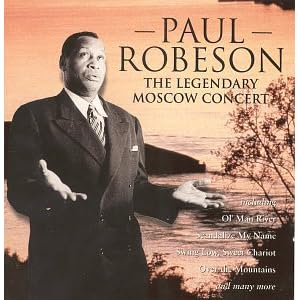
In his concert at Tchaikovsky Hall on June 14, 1949, which was broadcast around the country, Robeson asked the audience for silence, and spoke in tribute to his friends Feffer and Shlomo Mikhoels. He then began to sing, in Yiddish, the Vilna partisan song - Zag nit keynmol, az du geyst dem letstn veg, - Never Say That You Are Going on the Last Way.

Alas, back in the 'States, confronted by reporters asking questions about antisemitism in the Soviet Union, Robeson reluctant to concede anything which might be used for the Cold War, denied having seen anything of it. The US government launched its anti-communist witch hunt and took away Robeson's passport. Many others, some of whom had probably been at that Anti-Fascist rally in 1943, lost their livelihoods. Feffer and his co-defendents lost their lives, being executed on August 12, 1952 at the Lubyanka prison.

They were posthumously rehabilitated in 1955.


Paul Robeson's concert, including Zag nit keynmol, is available on record, and I'm reliably assured his Yiddish pronunciation is as good as his singing voice, but unfortunately his spoken words seem to have been lost. Also I notice that You Tube and various websites, including those of folksong publishers, describe the Vilna Partisan Song as the song of the Warsaw ghetto revolt. I suppose it is too much to expect American readers and listeners to remember the names of two east European capitals, and I am not going to raise outdated Litvak-Polak differences!

http://claude.torres1.perso.sfr.fr/GhettosCamps/Disques/Mitsui.html

Instead, I will sing the praises of Nottingham-based publishers Five Leaves, who last year rose to the occasion of the anniversary of the Battle of Cable Street with several titles, and this year have with superb timing got the anniversary of the Night of Murdered Poets to launch a new anthology of Soviet Jewish writing. Here is their announcement:

Sunday 12 August: 2.00-5.00pm

"From Revolution to Repression"


An international event held by Five Leaves and the Jewish Music Institute commemorating 60 years since Stalin executed the cream of Soviet Yiddish writers and others from the Jewish Anti-Fascist Committee.


Gennady Estraikh, Associate Professor at NYU will speak on "Why did Stalin murder Yiddish writers?", and Robert Chandler, translator of Life and Fate will speak about Vasily Grossman and Isaak Babel.


Music from the Soviet Jewish world: Polina and Merlin Shepherd.


School of Oriental and African Studies, lecture theatre G2, Thornhaugh Street, Russell Square, London WC1H 0XG
Admission free, light refreshments provided.


In the early years of the Russian Revolution previously forbidden literature flourished. Jews in the Soviet Union founded new magazines, publishing houses and literary movements. In the 1920s they produced brilliant avant-garde work, written in Yiddish, which sat alongside the best of European modernism. Later, Yiddish writers had to respond to the twists and turns of Stalin's rule in their struggle to be creative, to make a living and, when the purges started, to survive. Little of this work has been translated into English, despite writers like David Bergelson, Peretz Markish and David Hofshteyn having a large readership among Yiddish speakers internationally.


During World War Two the Jewish Anti-Fascist Committee (JAFC) was set up in the Soviet Union, bringing together scientists, writers, actors and other intellectuals. In 1948 the JAFC was closed down and many of its leading activists arrested. After a long period of imprisonment thirteen members of the JAFC were executed on 12 August 1952, including most of the writers represented in the book.


From Revolution to Repression includes translations of fiction and poetry, some modernist, some socialist realist, by several of the writers who were executed or died in prison. The book outlines the individual and collective history of the authors and gives an overview of Soviet Yiddish literature. It is published to commemorate the 60th anniversary of the executions.
The editor and main translator of From Revolution to Repression was the South African academic Joseph Sherman who taught at the Oxford Centre for Hebrew and Jewish Studies. He died before the book was completed. Gennady Estraikh (New York University) contributes a short memoir of Joseph Sherman.
Info: myra@fiveleaves.co.uk


http://www.fiveleaves.co.uk/events.html

Labels: , , , ,

Saturday, November 19, 2005

Ninety Years On, still with us in song


NINETY years ago, Joe Hill - an immigrant, working-class organiser, and songwriter whose songs have gone round the world - was killed by firing squad in the State of Utah, after what most people regarded as a frame-up trial.
He was born Joel Hägglund on Oct. 7, 1879, to a devout Lutheran family in Gävle, Sweden. His father, Olaf, worked on the railways Both his parents enjoyed music and often led the family in song. As a young man, Hill composed songs about members of his family, attended concerts at the workers' association hall in Gävle and played piano in a local café.
In 1887, Joel's father died from an injury at work, and the kids had to quit school to support themselves. Nine-year old Joel worked in a rope factory and later as a fireman on a steam-powered crane. Stricken with skin and joint tuberculosis in 1900, he moved to Stockholm in search of a cure and worked odd jobs while receiving radiation treatment and enduring a series of disfiguring operations on his face and neck. Two years later, his mother Margareta Katarina Hägglund, died after also undergoing a series of operations to cure a persistent back ailment.
With her death, the six surviving children sold the family home and set out on their own. Four of them settled elsewhere in Sweden, but the future Joe Hill and his younger brother, Paul, booked passage to the United States in 1902. He worked at odd jobs in New York before striking out for Chicago, where he worked in a machine shop, got fired and was blacklisted for trying to organize a union. He went to Cleveland, and was in San Francisco during the Great Earthquake of April 1906.
He was working on the docks in San Pedro in 1910 when he joined the Industrial Workers of the World (IWW), and became secretary for the San Pedro local. He also began writing songs like "The Preacher and the Slave" and "Casey Jones—A Union Scab." These appeared in the IWW's "Little Red Song Book". Joe Hill had a song for every working man or woman.
In 1911, Joe was in Tijuana, Mexico, part of an army of several hundred wanderin hoboes and radicals who sought to overthrow the Mexican dictatorship of Porfirio Diaz, seize Baja California, emancipate the working class and declare industrial freedom. They held out six months before, divided and weakened, the last 100 rebels were driven back across the border by the Mexican army.
In 1912, he was active in a "Free Speech" coalition in San Diego resisting a police decision to close the downtown area to street meetings. He also turned up to support railway construction workers on strike in Brritish Columbia, writing more songs, before returning to San Pedro to assist a strike of Italian dockworkers.
The San Pedro dockers' strike brought Joe's first recorded trouble with the police. Arrested in June 1913 he was held for 30 days on a vagrancy charge. He said he had been "a little too active to suit the chief of the burg".
On Jan. 10, 1914, Joe showed up at a Salt Lake City doctor's at 11:30 p.m. asking to be treated for a gunshot wound. He said an angry husband had accused him of insulting his wife. But earlier that evening, in another part of town, a grocer and his son had been killed. One of the assailants was wounded in the chest by the younger victim before he died. Joe's injury therefore tied him to the incident. The uncertain testimony of two eyewitnesses and the lack of any corroboration of Joe's alibi convinced a local jury of his guilt, though neither witness was able to identify him conclusively and the gun used in the murders was never found.
The campaign to exonerate and save Joe Hill drew in prominent trade unionists and was supported by millions of people around the world. Even President Wilson appealed. But powerful copper mining interests were determined to stop union organising in the state of Utah. The Utah Supreme Court, refused to overturn the verdict and the Utah Board of Pardons refused to commute Joe Hill's death sentence.
In a last letter to former miners' union president and famous IWW leade Big Bill Haywood, Joe Hill wrote:

"Goodbye Bill:
I die like a true rebel. Don't waste any time mourning, organize!

It is a hundred miles from here to Wyoming. Could you arrange to have my body hauled to the state line to be buried?
I don't want to be found dead in Utah."

It seems Joe Hill did die like true rebel. A member of the firing squad testified that Joe himself had shouted the order to "Fire!"
http://www.aflcio.org/aboutus/history/history/hill.cfm

But Joe Hill's body didn't lie mouldering in the grave. It was sent to Chicago where it was cremated. Joe had written a poem asking that his ashes be scattered around the world, that flowers might blossom. They were purportedly sent to every IWW local. In 1988 it was discovered that one envelope had been seized by the US Postal Service in 1917 because of its "subversive potential." The envelope, with a photo affixed captioned: "Joe Hill murdered by the capitalist class, Nov. 19, 1915," as well as its contents, was deposited at the National Archives. After some negotiations, the last of Hill's ashes was turned over to the I. W. W. in 1988.

Labels: ,

Friday, November 18, 2005

The Ballad of Joe Hill

On November 19, 1915, as working men were being sent to slaughter each other for rival imperial powers, working class hero and songwriter Joe Hill was executed by firing squad in the state of Utah.

In 1925, Alfred Hayes wrote a poem about Joe Hill entitled "I Dreamed I Saw Joe Hill Last Night", but sometimes just called "Joe Hill". Hayes's lyrics were turned into a song in 1936 by Earl Robinson.
It has been sung by Paul Robeson and Pete Seeger, and by the Irish singer Luke Kelly. Probably the best known version today was sung and recorded by Joan Baez in 1969, and featured in the film by Joe's fellow-Swede Bo Widerborg in 1971. Bob Dylan has said that Joe Hill's story helped inspire him to write his own songs.

But the lyrics as sung have sometimes varied, as the ballad was passed down over the years, sung at benefit concerts, and meetings, around campfires or in pubs.

I dreamed I saw Joe Hill last night,
Alive as you and me.
Says I "But Joe, you're ten years dead"
"I never died" said he,
"I never died" said he.
"In Salt Lake, Joe," says I to him,
him standing by my bed,
"They framed you on a murder charge,"
Says Joe, "But I ain't dead,"
Says Joe, "But I ain't dead."

"The Copper Bosses killed you Joe,
they shot you Joe" says I.
"Takes more than guns to kill a man"
Says Joe "I didn't die"

And standing there as big as life
and smiling with his eyes.
Says Joe "What they can never kill
went on to organize,
went on to organize"

From San Diego up to Maine,
in every mine and mill,
where workers fight,
to defend their rights,
That's where you find Joe Hill,
it's there you find Joe Hill!

I dreamed I saw Joe Hill last night,
alive as you and me.
Says I "But Joe, you're ten years dead"
"I never died" said he,
"I never died" said he.

-----------------------------------

And now, below, a poem that seems as relevant today as in 1915. On a personal note, my great-grandfather as a boy was an unwilling conscript for the Czar, and my Dad was driven by poverty and unemployment as a lad to become a soldier for the British Raj. So, should I ever be a soldier....

Should I Ever Be a Soldier
By Joe Hill

1879.10.7-1915.9.19

We're spending billions every year
For guns and ammunition.
"Our Army" and "our Navy" dear,
To keep in good condition;
While millions live in misery
And millions died before us,
Don't sing "My Country 'tis of thee,"
But sing this little chorus.

Should I ever be a soldier,
'Neath the Red Flag I would fight;
Should the gun I ever shoulder,
It's to crush the tyrant's might.
Join the army of the toilers,
Men and women fall in line,
Wage slave of the world! Arouse!
Do your duty for the cause,
For Land and Liberty.

And many a maiden, pure and fair,
Her love and pride must offer
On Mammon's altar in despair,
To fill the master's coffer.
The gold that pays the mighty fleet,
From tender youth he squeezes,
While brawny men must walk the street
And face the wintry breezes.

Why do they mount their gatling gun
A thousand miles from ocean,
Where hostile fleet could never run
-- Ain't that a funny notion?
If you don't know the reason why,
Just strike for better wages,
And then, my friends -- if you don't die
-- You'll sing this song for ages.

Labels: ,

Guantanamera and Gate Gourmet: Going for a Song?


PAULINE BRADLEY(left) at Robert Tressal
("Ragged Trousered Philanthropists")
event in Hastings

Capitalism takes what we produce, spoils or diminishes it, and sells it back to us, if we can afford the price. Not just cars and houses, but our dreams, our culture and, once it has disposed of them, our heroes (look at all those Che tee shirts).

North London singer-songwriter and trade unionist Pauline Bradley has come upon a particularly galling little injustice. Pauline writes:

"Have you seen that stupid advert for Burger King where the (quiet) voice sings '£1.99, they're only £1.99' to the tune of GUANTANAMERA? I expect you know the history of that song, and that torture and imprisonment now happens "Where the Palm Trees grow" in Jose Marti's beautiful part of Cuba.

"The song is copyrighted. I’ll read you what a songbook says
'Guantanamera, Words by Jose Marti, Music Adaptation by Hector Angulo and Pete Seeger, copywright 1963 and 1965 by Full River Music Incorporated, New York, USA. All rights for the British Commonwealth of nations excluding Canada and Australasia and the Republic of Eire controlled by Harvey Music Ltd, In Form Place, London, W8. All rights reserved, International Copyright Secured.'

"I know this because I wanted to record my communist spirited version but when I saw the copyright I gave up! Re my music see http://www.paulineb.co.uk/. I wear many hats but (for better or for worse) I always have the same name. So it looks as though Burger King have pinched it, and aren’t they part of Texas Pacific who fund Gate Gourmet?".

Indeed they are, Pauline.

And I think the authors and adaptors of Guantanamera would be as scathing about the way that US-owned firm has treated its workers as about the US tyrants' torture cages. Why should these capitalists be allowed to use the tune to sell their burgers, when a singer like Pauline can't bring its spirit up to date?

OK, so whatever creative genius came up with the "only £1.99" line probably thought only of the well-used football chant "There's only one......" etc, rather than remembering it had an original. But they should be told. I mean, the football crowds only "sang" for their own pleasure (if no one else's), whereas the commercial is after all, for ...commercial gain.

Maybe it's not too late for someone to have a word with the copywright holders, and the advertisers And meanwhile I hope I'm not breaking any confidences or copywrights by revealing Pauline Bradley and Cristina Roe's version:

Guantanamera
Words by Jose Marti – Music and original song words adapted by Hector Angula and Pete Seeger.
Adapted in 2005 by Pauline Bradley and Cristina Roe
Chorus
Guantantamera,
guajira Guantantamera,
Guantantamera,
Guajira Guantanamera
Verse:
Yo soy en hombre sincero
De donde crece la palma (x2)
Y antes de morir me quiero Echarmis versos del alma
Chorus
Verse:
I am a sincere man from where the palm trees grow (x2)
And before I die my heartfelt verses I’ll throw
Chorus

Verse:
George Bush is not so sincere,
And neither is Tony Blair
For they have turned Guantanamo
Into a living nightmare
It’s Cuban sands have been sullied
Only the dammed now go there.
Chorus
I see the prisoners lying

Shackled in chains
I hear them screaming from torture
The barbed wire strains
Without their lawyers or families
Their cries are in vain
Chorus x2

Labels: