Tuesday, May 17, 2011

People's Strruggle, Public Enemy, Private Army

It was a costly victory for the Palestinians, with at least fifteen people reported killed and dozens more seriously injured, as Israeli forces opened fire at demonstrators on the Gaza and Lebanon borders and failed to prevent people getting into the occupied Golan Heights area. There were more demonstrations in the West Bank.

It was a victory, because while the State of Israel and its supporters were officially celebrating its independence at the weekend, millions of people around the world were seeing Israeli troops trying to stop people returning to their country, and hearing the word Nakba - catastrophe, by which Palestinians designate the loss of their homeland, and mention of which the Israeli authorities have tried to ban in media and schools.

Yesterday, Israeli forces were conducting house to house searches in the Druze town of Majd el Shams in the Golan amid reports that hundreds of infiltrators had got through the unrecognised "border" there and were still around. (Israel unilaterally annexed the Golan from Syria without international agreement). One man gave himself up to Israeli police after saying he had caught a bus to Tel Aviv, in the company of uniformed soldiers, and gone to visit his father's old house which the family had to leave in 1948.

Israeli officers were facing questions as to how they failed to anticipate the Palestinian mass action, or prevent the successful infiltration. "Israeli leaders believe that the simultaneous appearance of thousands of civilians marching towards three sensitive borders in different parts of the country suggested a co-ordinated campaign", reports Matthew Kalman in The Independent.
http://www.independent.co.uk/news/world/middle-east/israel-left-reeling-after-deadly-border-breach-2285027.html

This brings to mind the observation attributed to Groucho Marx that "Military intelligence is a contradiction in terms".

The upsurge in mass struggle was heralded by the agreement between Hamas and Fatah, itself a response to popular demand particularly from younger Palestinians who are impatient to take their place in the "Arab Spring". The idea of an unarmed march to the borders was discussed and planned in publications and on Facebook. The May 15 anniversary of the Israeli state's declaration was an obvious date for timing the action. As is the prospect of even bigger action in September, when the Palestinians intend to make the long overdue proclamation of their own state and expect international recognition.

Kalman continues:

Acknowledging that Sunday's events were "not good", Lieutenant-General Benny Gantz, the chief of staff of Israel's armed forces, praised his troops for not inflicting higher casualties in what rapidly developed into an impossible situation.

Alex Fishman, a commentator at the Hebrew daily Yedioth Ahronoth, said: "What we witnessed yesterday on the Syrian border was a failure." He warned of "more attempted mass marches into Israeli territory... Marches and flotillas to implement the right of return will gather more and more momentum."

"The state of Israel has a systemic problem," Mr Fishman said. "Except for deterrence, it has no means to prevent tens and hundreds of thousands of Palestinians – who succeed in getting organised and in realising the dream of return with their own feet – from breaking across its borders."


What both Palestinians and historically-minded Israelis know is that sixty-five years ago it was British forces that were the bad guys as they tried to prevent shiploads of Jews disembarking on the shores of Palestine in another "co-ordinated campaign". The Brits had law and the force of the British Empire behind them, but within a year they were on their way out of Palestine. The Israeli state is not going to go sailing away. But it will sooner or later be forced to make room for a Palestinian state and recognise the rights of the Palestinians. Prolonging the agony by refusing to recognise this only increases misery and bloodshed on both sides, even if it is the Palestinians who are suffering most of them.

Still Public Enemy

For now, the Israeli government with typical chutzpah intends to answer complaints filed at the UN with its own complaints against both Lebanon and Syria. It feels encouraged to adopt this stance because, unlike the British in the 1940s, it can still count for now on support from Washington.

" The White House on Monday accused Syria of inciting deadly border clashes between Israeli troops and Palestinian demonstrators, saying Damascus was trying to distract attention from its own violent crackdown on protests. White House spokesman Jay Carney expressed regret for the loss of life in confrontations on Israel's frontiers with Syria, Lebanon and Gaza on Sunday but said Israel "has the right to prevent unauthorized crossing at its borders."

"We urge maximum restraint on all sides," Carney told reporters on Air Force One as President Barack Obama flew to Tennessee. Israeli troops opened fire at three separate border locations to prevent crowds of demonstrators from crossing, killing at least 13 people.

Syrian media reports said Israeli gunfire killed two people after dozens of Palestinians infiltrated the Golan Heights from Syria, along a front line that has been largely tranquil for decadeshe White House put the onus on the government of Syrian President Bashar al-Assad for the violence that broke out on the Israeli-Syrian border. Carney said the administration was "strongly opposed to the Syrian government's involvement in inciting yesterday's protests in the Golan Heights."

"Such behavior is unacceptable and does not serve as a distraction from the Syrian government's ongoing repression of demonstrators in its own country," he said. "It seems apparent to us that this is an effort to distract attention from the legitimate expressions of protest by the Syrian people, and from the harsh crackdown that the Syrian government has perpetrated against its own people," he added.

http://www.haaretz.com/news/diplomacy-defense/u-s-accuses-syria-of-inciting-israel-border-clashes-1.362125

But with the upheavals taking place in the Arab world, expressed also in the Palestinian upsurge and pressure on leaders to show unity, America may have to decide before long whether it can really afford to keep indulging Israeli leaders' intransigance.

...With Private Army

MEANWHILE in another part of the Middle East, as Mark Mazzetti and Emily B.Hager have reported in the New York Times, a notorious American figure has reappeared

ABU DHABI, United Arab Emirates — Late one night last November, a plane carrying dozens of Colombian men touched down in this glittering seaside capital. Whisked through customs by an Emirati intelligence officer, the group boarded an unmarked bus and drove roughly 20 miles to a windswept military complex in the desert sand.

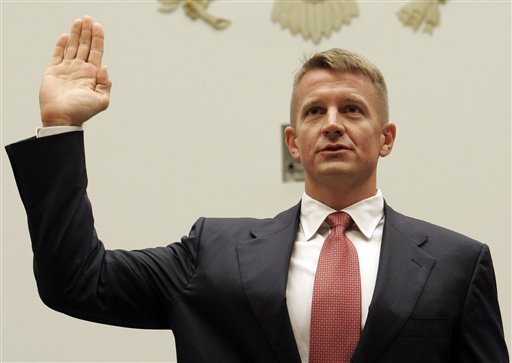
The Colombians had entered the United Arab Emirates posing as construction workers. In fact, they were soldiers for a secret American-led mercenary army being built by Erik Prince, the billionaire founder of Blackwater Worldwide, with $529 million from the oil-soaked sheikdom.

Mr. Prince, who resettled here last year after his security business faced mounting legal problems in the United States, was hired by the crown prince of Abu Dhabi to put together an 800-member battalion of foreign troops for the U.A.E., according to former employees on the project, American officials and corporate documents obtained by The New York Times.

The force is intended to conduct special operations missions inside and outside the country, defend oil pipelines and skyscrapers from terrorist attacks and put down internal revolts, the documents show. Such troops could be deployed if the Emirates faced unrest in their crowded labor camps or were challenged by pro-democracy protests like those sweeping the Arab world this year.

The U.A.E.’s rulers, viewing their own military as inadequate, also hope that the troops could blunt the regional aggression of Iran, the country’s biggest foe, the former employees said. The training camp, located on a sprawling Emirati base called Zayed Military City, is hidden behind concrete walls laced with barbed wire. Photographs show rows of identical yellow temporary buildings, used for barracks and mess halls, and a motor pool, which houses Humvees and fuel trucks. The Colombians, along with South African and other foreign troops, are trained by retired American soldiers and veterans of the German and British special operations units and the French Foreign Legion, according to the former employees and American officials.

In outsourcing critical parts of their defense to mercenaries — the soldiers of choice for medieval kings, Italian Renaissance dukes and African dictators — the Emiratis have begun a new era in the boom in wartime contracting that began after the Sept. 11, 2001, attacks. And by relying on a force largely created by Americans, they have introduced a volatile element in an already combustible region where the United States is widely viewed with suspicion.

The United Arab Emirates — an autocracy with the sheen of a progressive, modern state — are closely allied with the United States, and American officials indicated that the battalion program had some support in Washington.

“The Gulf countries, and the U.A.E. in particular, don’t have a lot of military experience. It would make sense if they looked outside their borders for help,” said one Obama administration official who knew of the operation. “They might want to show that they are not to be messed with.”

(It is not clear whether the US government wants to be officially associated with Blackwater's mercenaries. There are supposed to be restrictions on US companies training foreign nationals. Blackwater, now R2, has been paying fines for its activities in Jordan. But perhaps it is handy to have a US force for which the Obama administration does not feel obliged to answer to the UN or Congress).

For Mr. Prince, the foreign battalion is a bold attempt at reinvention. He is hoping to build an empire in the desert, far from the trial lawyers, Congressional investigators and Justice Department officials he is convinced worked in league to portray Blackwater as reckless. He sold the company last year, but in April, a federal appeals court reopened the case against four Blackwater guards accused of killing 17 Iraqi civilians in Baghdad in 2007.

To help fulfill his ambitions, Mr. Prince’s new company, Reflex Responses, obtained another multimillion-dollar contract to protect a string of planned nuclear power plants and to provide cybersecurity. He hopes to earn billions more, the former employees said, by assembling additional battalions of Latin American troops for the Emiratis and opening a giant complex where his company can train troops for other governments.

Knowing that his ventures are magnets for controversy, Mr. Prince has masked his involvement with the mercenary battalion. His name is not included on contracts and most other corporate documents, and company insiders have at times tried to hide his identity by referring to him by the code name “Kingfish.” But three former employees, speaking on the condition of anonymity because of confidentiality agreements, and two people involved in security contracting described Mr. Prince’s central role.

The former employees said that in recruiting the Colombians and others from halfway around the world, Mr. Prince’s subordinates were following his strict rule: hire no Muslims. Muslim soldiers, Mr. Prince warned, could not be counted on to kill fellow Muslims.

...

Mr. Prince made the deal with Sheik Mohamed bin Zayed al-Nahyan, the crown prince of Abu Dhabi and the de facto ruler of the United Arab Emirates. The two men had known each other for several years, and it was the prince’s idea to build a foreign commando force for his country.

Savvy and pro-Western, the prince was educated at the Sandhurst military academy in Britain and formed close ties with American military officials. He is also one of the region’s staunchest hawks on Iran and is skeptical that his giant neighbor across the Strait of Hormuz will give up its nuclear program.

“He sees the logic of war dominating the region, and this thinking explains his near-obsessive efforts to build up his armed forces,” said a November 2009 cable from the American Embassy in Abu Dhabi that was obtained by the anti-secrecy group WikiLeaks.

For Mr. Prince, a 41-year-old former member of the Navy Seals, the battalion was an opportunity to turn vision into reality. At Blackwater, which had collected billions of dollars in security contracts from the United States government, he had hoped to build an army for hire that could be deployed to crisis zones in Africa, Asia and the Middle East. He even had proposed that the Central Intelligence Agency use his company for special operations missions around the globe, but to no avail. In Abu Dhabi, which he praised in an Emirati newspaper interview last year for its “pro-business” climate, he got another chance.

......

People involved in the project and American officials said that the Emiratis were interested in deploying the battalion to respond to terrorist attacks and put down uprisings inside the country’s sprawling labor camps, which house the Pakistanis, Filipinos and other foreigners who make up the bulk of the country’s work force. The foreign military force was planned months before the so-called Arab Spring revolts that many experts believe are unlikely to spread to the U.A.E. Iran was a particular concern.

(my emphasis - Charlie Pottins)

An Eye on Iran

Although there was no expectation that the mercenary troops would be used for a stealth attack on Iran, Emirati officials talked of using them for a possible maritime and air assault to reclaim a chain of islands, mostly uninhabited, in the Persian Gulf that are the subject of a dispute between Iran and the U.A.E., the former employees said. Iran has sent military forces to at least one of the islands, Abu Musa, and Emirati officials have long been eager to retake the islands and tap their potential oil reserves.

The Emirates have a small military that includes army, air force and naval units as well as a small special operations contingent, which served in Afghanistan, but over all, their forces are considered inexperienced.

In recent years, the Emirati government has showered American defense companies with billions of dollars to help strengthen the country’s security. A company run by Richard A. Clarke, a former counterterrorism adviser during the Clinton and Bush administrations, has won several lucrative contracts to advise the U.A.E. on how to protect its infrastructure.

Some security consultants believe that Mr. Prince’s efforts to bolster the Emirates’ defenses against an Iranian threat might yield some benefits for the American government, which shares the U.A.E.’s concern about creeping Iranian influence in the region.

“As much as Erik Prince is a pariah in the United States, he may be just what the doctor ordered in the U.A.E.,” said an American security consultant with knowledge of R2’s work.

full report:
http://www.msnbc.msn.com/id/43036162/ns/world_news-the_new_york_times/t/secret-uae-desert-force-set-blackwaters-founder/

Labels: , , , , ,

Friday, February 26, 2010

Croatia to Bolivia, via Ireland ?

MICHAEL DWYER
liked guns, and guns finished him -at 24.

EDUARDO ROSZA FLORES
fought and killed in Croatia, became hero of Right in Hungary, his death in Bolivia may have been rough justice, but it was justice none the less.


Murder as a multi-national business


PEOPLE are still asking how the Israeli hit-team in Dubai was able to use three Irish passports as well as British ones, but some people are also asking about an "Irish connection" with a right-wing separatist conspiracy in BOLIVIA.

Almost a year ago. on April 16, 2009, a young Irishman called Michael Dwyer was shot dead in a Santa Cruz hotel room by Bolivian police pursuing plotters responsible for a bomb attack on a cardinal, and allegedly planning to kill President Evo Morales. Santa Cruz is the wealthiest province in Bolivia, with big natural gas resources. Right-wing rebels want to detach it from the Morales regime's plans to help the country's indigenous poor, or to overthrow the regime altogether.

The Bolivian government is also struggling with the multinational companies like Shell Petroleum over its efforts to make the country's resources serve the people.

Before he went to Bolivia, Michael Dwyer was employed by a company called Integrated Risk Management Services (IRMS), based at Naas, Co.Kildare, which among other things works with the Garda providing security for Shell's Corrib gas project pipeline and the landfall at Glengad beach in Erris, County Mayo, which attracts environmental protests. Complaints have been made about security men not wearing proper identification, and it was said Michael Dwyer worked as a team leader without the appropriate license from the Private Security Authority.

There have been complaints too about rough treatment of protesters, and the sinking of a campaigner's fishing boat, though of course the company denies any part in this (and the incident happened after Michael Dwyer's death in Bolivia).

IRMS has links with security work in other countries, which involves providing armed personnel. Michael Dwyer had gone to Bolivia for a training course in armed guard and bodyguard work, and his parents insist their son had no interest in politics, though judging by various photographs that have appeared he was certainly interested in firearms.

Dwyer may have been influenced by another IRMS employee, Tibor Revesz, a founder of the Szekler Legion, right-wing Hungarian nationalists who say they are fighting for autonomy for Magyars in Romania. An ad on their website asked for volunteers to help the fight for Santa Cruz. On November 17 2008, Dwyer reportedly travelled out with Revesz, and two other Hungarians, both former IRMS staff. Another man he had met in Ireland, Elod Toaso, was also arrested in Bolivia.

But the leader of the group, also shot dead in the hotel incident, was Eduardo Rózsa-Flores, who was born in Bolivia but spent much of his younger life in Hungary, where his father had come from. He was even a Young Communist at university. But after this he took up journalism, beginning with the Cuban news agency Prensa Latina, before using his Spanish fluency to send items to the BBC Spanish service, and then going to work for the Barcelona paper La Vanguardia , as a correspondent from Eastern Europe.

About this time he also joined Opus Dei, the right-wing Catholic society, having previously been a member of the Budapest Jewish community (his mother was Jewish) and later he was to announce his conversion to Islam, possibly with a view to work in Iraq. By then he had changed his trade from mere journalism.

Reporting the war in ex-Yugoslavia, he volunteered to join Croatian forces, raising an "international brigade" of a hundred volunteers and mercenaries, who fought at Osijek and Vukovar. Franjo Tudjman promoted him major, and he went on to become a colonel,of "special forces".

Christian Wurtenberg, a Swiss journalist,decided to join Flores' outfit to investigate rumours of drug and gun-trafficking, and to get the low-down on fascists and mercenaries, and who was paying them. Unfortunately, after a few weeks among them, he let a Spanish TV reporter in on what he was doing, and said he would soon be going back to Switzerland.

Days later, the Spanish reporter, Julio Cesar Alonso and a Portuguese televeision reporter, Joso Pinto Amaral, were taken from Zagreb's Hotel Intercontinental to the headquarters of the Croatian secret police, and interrogated. Flores then said there was a Swiss mole in his organisation who was going to be "got rid of".

The reporters travelled to Osijek hoping to tip off Wurtenburg, only to be met by Flores who told them with a grin "By the way, we've got a loss - Christian. The Swiss problem has been sorted out." According to the autopsy at the Osijek hospital, Christian Wurtenberg "was killed on 6 January 1992 as a result of mechanical action with a blunt weapon and later strangulation with hands and rope". Flores claimed later that Wurtenberg was murdered by "Chetniks" (Serbs) but strangling was not their usual method -prisoners more often had their throats cut.

Wurtenberg's computer went missing and his diary was returned to his family with vital pages ripped out. On 13 January, British photographer Paul Jenks and a colleaugue Hassan Amini, visited Flores' unit o ask questions about what had happened to Wurtenberg. The man they met was Stephen "Frenchie" Hannock who, in response to Jenk's persistent questions said "who knows ... who cares. I dont, for one and I know a lot more than you."

Four days later Paul Jenks was shot through the head at the front line in Briest, near Osijek. Officially he was killed by a Serbian sniper hidden some 900 metres away in the Serbian held village of Tenski-Antunovac, but the indications were that the range was far shorter than 900 metres, and the bullet did not enter his head from the direction of the sniper. It's thought that Flores' unit had offered to escort the British photographer to the front, then shot him at close range. A BBC TV documentary sought to establish that the identity of his suspected killer was known and that he was still at liberty.

"Germany's Secret Balkan's Plan" SEARCHLIGHT July 1992
Journalists from across Europe have wanted to lift the lid on the freelance killers operating in Croatia. For Christian Wurtenberg and Paul Jenks, ...
serbianlinks.freehosting.net/dogs.html

See also:
http://www.telegraph.co.uk/news/worldnews/southamerica/bolivia/5185198/My-meeting-with-the-man-accused-of-plotting-the-assassination-of-Evo-Morales.html


Eduardo Flores went on to write books and become a celebrity on the Hungarian Right, and has had glowing obituaries from people like the fascist Jobbik organisation, which has also been organising in Britain. The Bolivian police may not have smashed the conspiracy yet. But perhaps they have achieved a sort of justice for Paul Jenks and Christian Wurtenburg

The Irish government has demanded an international inquiry into the death of Michael Dwyer. But on November 20, Bolivian organisations delivered a letter to the Irish Foreign Affairs ministry in Dublin, asking for a full public investigation into the work of Integrated Risk Management Services, and rightwing terrorist groups in Europe, and the connections they have with our country, Bolivia."

There was a time when friends of mine who were entitled to both British and Irish passports said the Irish passport was very handy for travelling in places where Brits were regarded as former colonialists, even possible spies or mercenaries. Alas, when cluster bombs have been shipped through "neutral" Shannon, and Irishmen turned up in decidedly sinister company, it may no longer have an advantage or be greeted with the same friendly welcome.

IRISHMAN HELD OVER ‘BOLIVIAN PREZ PLOT’
Suspect awaiting extradition

BY GERARD COUZENS
news@irishmirror.ie

POLICE in Brazil have arrested an Irishman suspected of being linked to an alleged terror plot against Bolivia’s President Evo Morales. Security services detained him on an international arrest warrant issued by Bolivian authorities as he boarded a flight to Portugal.

Yesterday the man was being held in jail in Brazil awaiting extradition to Bolivia.
He was named locally as Muhammed Jasser and described as an Irish passport holder.
Reports from Bolivia last night suggested authorities believe he was Iraqi-born and may hold dual Irish-Iraqi nationality.

Labels: , , , ,

Tuesday, January 19, 2010

Blackwater - CIA's dirty work and wet jobs

http://thetruthorthefight.files.wordpress.com/2009/09/erik-prince-07-1002.jpg

BLACKWATER-Xe's Erik D. Prince - CIA's "Christian crusader"?

DID five American mercenaries walk free from justice for killing unarmed Iraqi civilians because the US authorities feared their links with the Central Intelligence Agency(CIA) might be brought out into the glare of publicity by a court case?

The five men employed by Blackwater Worldwide - now known as Xe - were accused of killing at least 14 people when they opened fire at close range in a busy Baghdad street two years ago. Altogether 17 people were killed, and twenty wounded. The Blackwater men, who hd been escorting American VIPs to the airport, claimed they were acting in self-defence. But none of those killed were armed.

The trial on manslaughter and fiearms charges was due next month. But in a 90-page memorandum opinion published late on New Year’s Eve, Judge Ricardo Urbina, of the Washington Federal District Court, dismissed the charges and condemned the prosecution for “reckless violation of the defendants’ constitutional rights”.

Survivors of the shooting were shocked, and the Iraqi authorities said they would pursue their own prosecution. They have barred Blackwater - which changed its name to Xe last year - from working in Iraq. Many people here too have understandably commented that the US judge's decision shows up a racialist attitude in which the lives of Iraqis and other 'lesser breeds' are not considered of value, or at least not compared to the 'rights' of gun-toting Americans.

But there is more to it than that.

Blackwater-Xe is not just any old firm, and it does not just provide "security guards", as our media pretend, making them sound like doorkeepers and night-watchmen. Based in Moyock, North Carolina, not far from the Fort Bragg home of the 'Green Berets', the company gets 90 per cent of its work from government, two-thirds of it in no-bid contracts. It provides training for army and police personnel, it provides "security guards", and it also provides a cover for illegal operations which the US government and even the CIA would not want to claim.

This could include actions in 'friendly' countries, like Germany, with or without the host government admitting it knows what is going on.

http://www.youtube.com/watch?v=scEUhh4bsvQ

A court case might also have drawn attention to what is behind widespread killings in Iraq, and more. As in an earlier hearing last year:

'Guards employed by Blackwater, the US security company, shot Iraqis and killed victims in allegedly unprovoked and random attacks, it was claimed yesterday.

A Virginia court also received sworn statements from former Blackwater employees yesterday alleging that Erik Prince, the company’s founder, “views himself as a Christian crusader tasked with eliminating Muslims and the Islamic faith from the globe”.

They also accused the company of following a policy of deliberate killings and arms dealing and of employing people unfit or improperly trained to handle lethal weaponry.

In Baghdad yesterday, some Iraqis said they believed that the case was a last chance for justice and an opportunity for America to divorce the behaviour of its military from the private guards.

Farid Walid, who was shot in Nisour Square two years ago during a massacre that killed 17 Iraqis, said: “Everybody here knows of cases where Blackwater guards shot innocent people without a second thought. They are a symbol of the occupation. Nobody will forget. But Iraqis might think at least a little differently of America if the killers are put in prison.”

Far from being put in prison, they have not even gone into the dock.

As for their boss Erik Prince, whatever his private status as a businessman or beliefs as a "crusader" he also claims to be a CIA operative, a “vetted asset”, with a mission to build “a unilateral, unattributable capability” to hunt down and kill al-Qaeda militants for the US Government. Presumably he would have said so under oath if necessary in court.

http://www.timesonline.co.uk/tol/news/world/middle_east/article6742135.ece

http://www.timesonline.co.uk/tol/news/world/us_and_americas/article6952756.ece

http://www.timesonline.co.uk/tol/news/world/us_and_americas/article6945254.ece

Now a story appearing in the magazine Vanity Fair says that in 2004 the CIA sent a team from Blackwater to Hamburg to kill a Syrian-born German citizen suspected of helping fund al Qaeda. The mission was kept secret from the German government, which had been investigating the man for years.

"Among the team's targets, according to a source familiar with the program, was Mamoun Darkazanli, an al Qaeda financier living in Hamburg who had been on the agency's radar for years because of his ties to three of the 9/11 hijackers and to operatives convicted of the 1998 bombings of U.S. embassies in East Africa," writes Vanity Fair's Adam Ciralsky.
"The CIA team supposedly went in 'dark,'' meaning they did not notify their own station -- much less the German government -- of their presence; they then followed Darkazanli for weeks and worked through the logistics of how and where they would take him down,"
reports the magazine.

It says the Bush administration had a list of assassination targets, and the CIA wanted to include A Q Khan, a Pakistani nuclear scientist.Iranian nuclear scientist
Massoud Ali-Mohammadi was killed by a bomb outside his home as he left for work at the university on January 12, and the Iranian government is blaming US and/or Israeli intelligence of being behind the attack, though oppositionists claimed the scientist as a supporter, putting suspicion in the government's direction.

Although the attempt on Darkazanli was called off, German MPs are asking what their government did or did not know, and prosecutors in Hamburg have reportedly begun an investigation into the alleged assassination plot.

German authorities had investigated Darkazanli but never charged him. In 2004 he was arrested to meet a Spanish extradition request, but released nine months later.

The German news magazine Der Spiegel has now taken up the story, although a former CIA man insists they only planned to kidnap and interrogate their "suspect", not to kill him.

http://www.silobreaker.com/cia-had-secret-plan-to-kidnap-germansyrian-suspect-in-hamburg-5_2263156758409117702

http://www.silobreaker.com/mamoun-darkazanli-11_11262400

German politicians either side of the Bundestag are unhappy with the idea that a foreign agency, supposedly a friendly one, could plan an operation on their soil, without bothering to inform their government, and aimed at killing or kidnapping a German citizen, whoever it was. The CIA station officers said it might have been allright in South America, but not in a west European country. Presumably that is why the Agency planned to do it behind a company like Blackwater. And if they contemplated such action in Germany, who is to say they would not do it anywhere else?

Labels: , , ,