Friday, December 07, 2012

Will New Spring follow Islamist Winter?


REVOLUTIONARY SOCIALISTS on march in Damietta, northern Egypt

 SOCIALISTS and trade unionists who have taken to the streets against right-wing governments n Egypt and Tunisia are asking for international support.

In Egypt, President Mohammad Morsy tried to use his enhanced status after brokering the Gaza ceasefire as the cover for a deal with the International Monetary Fund and to give himself dictatorial powers such as people thought they had seen off with Hosni Mubarak.

As the tents of protest went up again in Tahrir Square, teachers and textile workers trade unions called strikes against the government. Demonstrators have clashed not only with riot police but with  the president's supporters in the Ikhwan, the Muslim Brotherhood. Demonstrators who stormed a Brotherhood office say they found an arms cache there.

Some of the Muslim Brotherhood members who turned out against protesters are not just ordinary supporters but armed squads, also including Salafi thugs such as have carried out sectarian attacks and provocations in several countries in the name of their extreme version of Islam.

In the chaos and excitement of the clashes the Revolutionary Socialists reported:    
 “We are mourning the death of Taha Magdy, who was killed by Brotherhood thugs. We are ready to offer hundreds of martyrs for the sake of our revolution,” they declared on Facebook. A woman member was kidnapped. "Comrade Ola Shaoba was attacked by MB last night and now still in hospital. She was not just beaten but captured also and let go, many are still held by MB as if we are prisoners of war!!" - via Gigi Ibrahim.


Later it was reported that Taha, though wounded, was still alive.
"Apology and correction: The Revolutionary Socialist movement apologizes for spreading the news of the martyrdom of comrade Taha Magdy based on the report of the officiating doctor at one of the government hospitals. The safety of our comrade has been confirmed..." 

Another four people were reportedly killed in the clashes, including a member of the Socialist Progress Party. And from Reporters Without Frontiers comes this report:


Al-Hosseiny Abu Deif, an experienced newspaper reporter, was rushed to hospital after being hit in the head by a rubber bullet fired at close range at around 1 a.m. today and is said to be in a critical condition.

“Witnesses say the president’s supporters deliberately targeted and attacked journalists,” Reporters Without Borders said. “We call on President Morsi to order an investigation into the circumstances of these attacks and to punish those responsible. As president, he must ensure the safety of all of his fellow citizens, including journalists.

“We also call on the president to rescind the 22 November decree granting himself extraordinary powers, and not hold a referendum on the draft constitution in its current form. The Constituent Commission must amend the draft in order to provide more protection for freedom of expression and information.”

A witness told Reporters Without Borders that Morsi supporters deliberately targeted Deif, who works for the newspaper Al-Fagr. Five minutes before he was shot from a distance of just two metres, he showed colleagues photos of the president’s supporters with sophisticated weapons. His camera was stolen after he was shot, as colleagues went to his aid.

 From Tunisia,  where workers are resisting austerity measures and unemployment such as led to the overthrow of the old regime, comes this message:
"Today 06/12/2012 a general strike in Kasserine, Gafsa, Sidi Bouzid and Sfax. We organized a big march protesting against Ennahdha government's militia which attacked unionsts in Tunis last tuesday in head office of Union General de Travailleurs Tunisien. Yesterday the officers of UGTT met and announced a general strike for next Thursday 13/12/12. The decision won't be reviewed unless the gvt admits these militias are illegal and takes the decision to stop them acting in the name of the revolution."
Mohamed Sghaier Saihi UGTT Kasserine


AMONG those joining the struggle in Egypt have been thousands of workers from the giant textile plant of Misr Spinning in Mahalla al-Kubra. 
 Workers rallied as they ended their shift and were joined by townspeople in a march which quickly swelled to more than 5,000 strong.
As the protestors reached Shoun Square in the town centre they were attacked by supporters of the Muslim Brotherhood’s Freedom and Justice Party, who threw fireworks at them. The demonstrators answered with stones and molotov cocktails.

http://en.rsf.org/egypt-president-s-supporters-06-12-2012,43766.html

One of the Egyptian trade unionists active in the struggle has sent this message to friends in London:


Dear friends,


On 17 November I was invited to speak at the Unite the Resistance Conference in London, and I asked you for your solidarity with the workers’ movement in Egypt. Today we need your solidarity more than ever.
Activists have been fighting to overthrow the Constituent Assembly which represents no-one except the Muslim Brotherhood. Morsi then brought out his Constitutional Declaration which makes him like a god or a new pharaoh, who controls all the institutions of the state, and means he cannot be challenged. One of his aims was to protect the Shura Council [the upper house of parliament] from dissolution, as well as the Constituent Assembly, so that he could get the new constitution passed. But he didn’t count on the anger of the Egyptian people, who have come out in their hundreds of thousands to protest in the streets against his Constitutional Declaration, and to show their refusal to participate in the creation of a new dictatorship.
As you are protesting against austerity, unemployment and poverty in Britain, we will be on the streets in Egypt, trying to achieve the goals of our revolution.
We are all united for bread, freedom and social justice.
Hind Abd-al-Gawad


  • Rush messages of solidarity to the Egyptian independent unions via EFITU (efitu.union@hotmail.com – please copy to menasolidarity@gmail.com)
  •  
  • For more  background information and to keep up with events visit the Middle East and North Africa Solidarity Network website: 
    http://menasolidaritynetwork.com/
    Earlier this year, al Jazeera broadcast a fascinating view of life in the Mahalla factory:
    The Factory - Revolution Through Arab Eyes - Al Jazeera English

    Al Ahram editorial on decline and fall of Muslim Brotherhood:
    http://english.ahram.org.eg/NewsContentP/4/59933/Opinion/The-decline-and-fall-of-the-Muslim-Brotherhood.aspx


    Labels: , ,

    Friday, November 09, 2012

    Torchlit Triumph, and a Woman of Valour

    TWO WOMEN who "did their bit". Left, Colette Aboulker, decorated in Algiers, and Right, Noor Inayat Khan, murdered in Dachau.
    SEVENTY years ago, Allied forces under the overall command of General Dwight David Eisenhower invaded north-west Africa, the Maghreb, under Operation Torch. British-led forces of the Eighth Army had defeated Rommel's Afrika Korps at El Alamein, and begun driving the Axis forces back from the borders of Egypt. By landing in the West the mainly American forces of Torch could join in clearing the Nazi and Italian forces out of the southern side of the Mediterranean, and prepare for invasion of Europe.

    A big question facing them was what to do about the French. After the fall of France in June 1940 the Germans had left Marshall Petain's collaborator regime at Vichy in control of southern France, and of France's overseas departments and territories. Algeria, with its large European settler population, was a French colony, and neighbouring Morocco and Tunisia were counted as protectorates.

    Though elsewhere General De Gaulle's Free French were fighting on the Allied side, and in France itself there was the Resistance, French forces in north Africa were firmly under Vichy command, and the Navy particularly after its ships were scuttled at Mers el Kebir was bitterly anti-British. As for the settler population, seeing its privilege rested on racism, many were far-Right even without Nazi encouragement, and belonged to fascist militias.

    Yet the United States, which had maintained diplomatic relations with the Vichy government, and carried on trading with it in Algeria, was reluctant to trust De Gaulle or disrupt colonial rule overmuch in Algeria.

    Nevertheless, on November 8, 1942, as the Allied landings began, a band of no more than about 400 poorly-armed rebels, some of them with military experience, others students and even schoolboys, set out to seize strategic buildings in Algiers, taking over the main post office, the police headquarters, telephone exchange and governor's palace, so as to completely disrupt the Vichy authorities and so far as posible neutralise or hinder resistance to the Allied invasion.

    Many wore armbands falsely identifying themselves as civic defence volunteers, and leaders had fake orders authorising them to take over buildings. Once inside the central police headquarters a group took phone calls from the real volunteers, wanting to know what was going on, and summoned them to an emergency meeting. Arriving at the headquarters the officers were allowed in, and escorted to the cells where they were locked up for the duration!

    The majority of the insurgents were Algerian Jews, some of them demobbed from the French army after France fell, others young people like Jose Aboulker, a 23 year old medical student who had contact with the underground Communist Party. Jose's sister Colette helped run the family house as headquarters on the night of the uprising. Later at the end of the war she was awarded the Croix de Guerre for her services nursing war wounded.

    Although the Jews of Algeria had a history going back to Roman times, and had taken in both Berber converts and those expelled from Spain, in 1870 under the Cremieux Decree they were entitled to French citizenship, and thus came to be educated and think of themselves as French. This loyalty was not rewarded by amity from the settlers however, many of whom jealously guarded their status with a hatred of them both as natives and as Jews. There were anti-Jewish pogroms in several Algerian cities towards the end of the 19th century, after the Dreyfus Affair for instance, and in 1898 the antisemite Edouard Drumont, author 'La France Juive' was elected a deputy for Algiers.

    In the 1930s Jacques Doriot's fascist Parti Populaire Francaise established a section in Algeria, and obtained funding from fascist Italy for it. Colonel de la Roque's Croix de Feu movement, not initially anti-Jewish, became such as it expanded among Algerian whites. One of the first actions of the Vichy regime was to abolish the Cremieux Decree in October 1940, and the following year its commissar for Jewish affairs, Xavier Vallat, arrived in Algiers to supervise enforcement of anti-Jewish measures seizing property, excluding people from jobs and profesions, and even expelling Jewish pupls from the schools.

    General Maxime Weygand, the governor who signed the schools order, thought he might win support from native Algerians by suggesting that Muslim pupils might take the places of the Jews. It did not happen, and anyway Arabs were not impressed. As Ferhat Abbas, later a leadeer of the independence struggle, said:  
    "That which you do to the Jews of Algeria, so perfectly assimilated to French civilisation, is of your own intitative and not that of the enemy who never sought the abrogation of the Cremieux decree. Your racism goes in all directions. Today it is exercised against the Jews. It is exercised every day against the Arabs"
    The conclusion they drew from the abrogation of the Cremieux Decree was that you could not entrust your freedom to collaboration with the French.


    The Vichyites could not get their own way in Morocco, where King Mohammed V insisted that his Jewish subjects did not come under French law, nor in Tunisia. But in Algeria the European population was largely inclined to welcome the measures, and but for logistic problems it is possible the Nazis would have been able to extend their Final Solution to that part of the Maghreb by arranging the deportation of Algerian Jews. As it was, thanks to the action on November 8, Algerian Jews were not only spared but made their contribution to final victory, by helping throw the Asix forces out of north Africa..         

     Not that the November 8 "putschists" were all Jewish. Among those who played a distinguished part were a group of high school students from the Lycee Ben Aknoun led by a cadet called Bernard Pauphilet. Surrounding the Villa des Olives they captured not only General Alphonse Juin, the commander in chief of French forces in north Africa, but Admiral Francois Darlan, the number two in the Vichy regime, who had been visiting his son in hospital in Algiers. Robert Murphy, the US consul in Algiers, rushed over to the villa with a letter from President Roosevelt. Darlan stalled, even managing to get a message out to his forces ordering resistance to the Allied invasion, In the end the terms of surrender ennabled Darlan to become governor, ruling Algeria with the Americans' support,

    Not only that but the anti-Jewish measures remained after Algeria was "liberated", and so did the forced labour camps in the desert where Spanish Republicans, International Brigade veterans, Algerian political prisoners were held. When Darlan was assassinated by a young Frenchman, his successor General Giraud ordered the round-up of "suspects" , among them Jose Aboulker, and their despatch to these camps, while the Americans refused to interfere. It was not till a year after Algeria's "liberation" by the Allies that the prisoners from these Vichy camps began to be freed.

    I'll be talking about the Algiers rising and its unsatisfactory aftermath at a meeting on Sunday evening, which by an appropriate coincidence also happens to be Remembrance Sunday. So if you want something to take away the taste of the statesmen's hypocrisy while still honouring those who fought, you're welcome to come along.
            
    Jewish Socialists' Group meeting

    Sunday 11th November, 7.30pm 

    MIC Centre 81-103 Euston Street NW1 2EZ (between Euston and Euston Square stations)

    "Lighting the Torch, Algiers November 8 1942"


    Noor Inayat Khan 

    STILL on the subject of remembrance, and of light -because that is what her name Noor means,  a memorial was unveiled in London's Gordon Square gardens yesterday to one of the bravest women of World War II, Noor Inayat Khan,

    The daughter of a Sufi Muslim family from India, and said to be a descendant of the 18th century prince Tippu Sultan who resisted the British, Noor Inayat Khan was born on January 1, 1914, in Moscow, where her father was working. Later the family moved to England and then to France where Noor studied music and medicine, before becoming a successful children's writer.

    In May 1940 the Germans invaded France, but Noor and her mother and sister got to England just before France collapsed, and here Noor joined the Women's Auxiliary Air Force, training as a wireless operator. That together with her fluent French led to her recruitment by the Special Operations Executive(SOE).

    Given the codename "Madeleine" she was flown to France on 16th June 1943, She joined a Resistance network in Paris, After members of this group were arrested by the Gestapo, her superiors fearing it had been infiltrated by a Nazi spy instructed "Madeleine" to return home. However she insisted that as she was the only radio operator left with the group she should stay, and keep SOE informed of what was happening. She tried to rebuild the Prosper group as it was called.

    Noor was arrested in October and taken to Gestapo Headquarters. She was interrogated and although she remained silent they discovered a book in her possession where she had recorded the messages she had been sending and receiving. The Gestapo broke her code, and sent false messages to London, which ennabled them to capture three more secret agents landed in France.

    Noor was taken to Germany and imprisoned at Karlsruhe. In the summer of 1944, Noor, and three other SOE agents, Yolande Beekman, Eliane Plewman and Madeleine Damerment, were moved to Dachau Concentration Camp. The four women were murdered by the SS on 12th September, 1944. In 1949 Noor Inayat Khan was posthumously awarded the George Cross.

    See also:
    http://randompottins.blogspot.co.uk/2006/01/agent-madeleine-princess-nora.html

     Her monument has been a long time coming, but welcome and timely, in a period of crisis, when the hatred and prejdices that led to the regime she fought and which murdered her and millions of others, are being whipped up again by the evil and unscrupulous. In honouring the memory of Noor Inayat Khan, as of the Algiers rebels and all who fought fascism, let us pledge to ensure that they did not die in vain.   .   

    Labels: , , ,

    Wednesday, October 31, 2012

    Teachers in Fight for Freedom


    https://blogger.googleusercontent.com/img/b/R29vZ2xl/AVvXsEjiyhGV_7kL1h9Wstce47Rm54Jsvhnv7iqEFV-ymQF7SfLdvWjYoFcybKgmWf1EDFuzsAnvD1rqd3jraI8U5djrhB87E_qqNAo0mxaFmia8piGXejAhym0EsEeeu1v_1z6LnNsEEg/s1600/barmayday2011.jpg BAHRAINIS at London May Day rally

    THE struggle in Bahrain was given a further tightening yesterday with the Interior Ministry announcing a ban on all protest gatherings, and threatening legal action against opposition groups that organise anti-government demonstrations.

    Coming a year after the authorities cracked down with martial law, the move seems to have worried the regime's Western backers, whether because they are finding it harder to defend the repression or fear that tightening the screw too much mean it is near to breaking. The British government issued a statement expressing "concern" at what it called an "excessive" blanket ban.

    Sheikh Rashid al-Khalifa, the interior minister, said that "repeated abuse" of the rights to freedom of speech and expression could no longer be tolerated. In future protests would only be permitted once security and stability were sufficient to maintain national unity.

    The interior ministry said that any "illegal rally or gathering would be tackled through legal actions against those calling for and participating in it".

    Bahrain's part in the Arab spring –  the "Pearl Revolution" – was brutally ended last March, when  Saudis and other forces moved in to help restore order. People were killed, and doctors who treated wounded protesters been put on trial for conspiracy. But the embers have ben smouldering since and flared up again recently with demonstrators chanting "Down with Hamad", the king.

    Opposition parties say a full crackdown would mean throwing more people in jail and risking a bigger confrontation, as well as embarassing allies. More than two thirds of Bahrainis are Shi'a Muslims who have faced discrimination, and might look to Iran for support. But Bahrain hosts the  US Navy's 5th Fleet, as well as providing ship repair and engineeting facilities in the Gulf, and has links with the US and Britain.
    .

    "I am concerned that the government of Bahrain has decided to ban all rallies and public gatherings until further notice," said UK Foreign office minister Alistair Burt,  "We understand the government's concerns about maintaining law and order, especially when faced with increasingly violent protests, but a blanket ban of this nature is excessive. Peaceful protest is a democratic right. I hope the Bahraini government will rescind this measure as quickly as possible. I also call on protesters to desist from violent protest. Violent acts should be condemned publicly by prominent members in society."

    http://www.guardian.co.uk/world/2012/oct/30/bahrain-opposition-protests-ban?INTCMP=SRCH

    On 21 October an appeal court upheld the guilty verdict against the Bahraini Teachers’ Association (BTA) leaders, Mahdi Abu Dheeb and Jalila al-Salman, but reduced their prison sentences to five years and six months respectively. Mahdi and Jalila, respectively President and Vice-President of BTA, were arrested in 2011 after supporting calls for reform in Bahrain. Whilst in detention they were subjected to torture and forced to sign “confessions”.

    In September 2011, a military court convicted them of attempting to overthrow the ruling system by force and inciting hatred of the regime. The report of the Bahrain Independent Commission of Inquiry last year found that the authorities had grossly exaggerated, if not manufactured, many claims brought against thousands of ordinary people who had been caught up in the February 2011 Arab Spring protests. Mahdi and Jalila’s only “crime” was to have the temerity to promote respect for the values of solidarity, equality and democracy.

    The teachers' union network Education International (EI) is urging trade unionists and supporters of democractic rights to increase pressure on the Bahraini Government to respect human and trade union rights. "EI calls on authorities to immediately and unconditionally release Mahdi, to ensure that Jalila does not serve any of her remaining sentence, and to drop all charges against them".

    http://www.labourstart.org/solidarityforever/index.php?campaign=1613

    Former Bahraini MP Ali Aswad will be giving an update on what has happened to Mahdi Abu Deeb and Jalila al Salman, as well as the wider picture of teachers, trade union and democratic rights in Bahrain, when he addresses a meeting in the House of Commons on November 12.

    Ali Alaswad was an MP from the largest opposition party Al Wefaq. Elected in October 2010 , he resigned along with 17 other MPs in February 2011, in protest at the violent crackdown against pro-democracy demonstrators. During the period of martial law he left Bahrain after he was targeted by the regime and now lives in London where he continues his work for democracy in Bahrain.

    At the meeting on "Teachers and the Arab Spring" he will be speaking alongside Mohamed Sghaier Saihi, an executive member of the UGTT union federation in Tunisia. The Tunisian vistor is from , Kasserine province, which was a hotbed of the Tunisian revolution, and where he is regional spokesman for the teachers’ union. He will speak about the Tunisian revolution and the continuing waves of strike and protests against the Islamist Ennahda party led government, which combines religious conservatism with neo-liberal economic. policies. Read more here: http://menasolidaritynetwork.com/2012/10/21/tunisia-revolutions-heartland-in-revolt-again/

     Other speakers are Mary Compton, a member of the National Union of Teachers(NUT) here and editor of Teachersolidarity website, just back from a delegation to Egypt; and Anne Alexander of the MENA solidarity network which has organised the meeting.  The joint chairs of the meeting will be Labour MP Katy Clark and Nick Grant, a member of the NUT national executive.

    MONDAY November 12, 7.30pm

    Eyewitness reports from Tunisia, Egypt and Bahrain

    Committee Room 8, House of Commons, SW1A 2TT

    Speakers:
    Mohamed Sghaier Saihi: UGTT union federation, teachers’ spokesman in the Kasserine region
    Mary Compton: NUT activist and editor of Teachersolidarity website, recently returned from a delegation to Egypt
    Ali Alaswad: Resigned MP from al Wefaq Party, Bahrain
    Anne Alexander: MENA Solidarity Network

    Chairs:
    Katy Clark, MP and Nick Grant, National Executive member, NUT

    (NB  It is always advisable to arrive early to events at the Houses of Parliament to allow time for queuing at security and getting to the committee room).

    Labels: , , ,

    Saturday, September 22, 2012

    Union Freedom, Morocco Bound


    SAID ELHAIRECH held in prison since June 16, and demonstration, stranded Comarit-Comanay seafarers, in May. 

    TRADE UNIONISTS in Spain and France have joined those in several African countries in raising their voices in support of jailed Morocan dockers' leader Said Elhairech, who has been held in prison since June 16.

    Said, general secretary of Moroccan dockers union, Union des Syndicats UMT des Transports, was arrested in Casablanca on unfounded charges, including one relating to national security.
    Three months later he is still being held in prison in the Moroccan capital of Rabat awaiting trial. He has already been denied bail.

    The Spanish unions Transportes, Comunicaciones y Mar of the Unión General de Trabajadores and Servicios a la Ciudadanía of the Comisiones Obreras took part in a demonstration outside the Moroccan embassy in Madrid on September 14  to demand Elhairech’s release. They tried to hand over to the Moroccan ambassador a letter of protest, but embassy officials were hostile and refused to accept it. They left the letter on a desk within the building.

    In Paris, the Force Ouvrière union also staged a protest outside the Moroccan embassy and presented officials with a letter.

    Before his arrest Said Elhareich had been involved in high-profile cases, assisting in defending the rights of stranded Moroccan seafarers following the bankruptcy of the Comarit-Comanav ferry company, and securing a collective agreement in November for dockers in the Eurogate terminal in Tangiers.

    The International Transport Workers Federation(ITF) believes the accusations against Said have been created in order to wage an attack on the trade union work of himself and his colleagues. "As such they amount to an attack on trade union rights in general in Morocco", it says..


    The European Transport Workers’ Federation, the ITF’s European arm, passed a resolution at its dockers’ section meeting in Brussels on 13 September, condemning “the fact that the Moroccan government has so far ignored the appeals coming from unions from all around the world to free Said”, Delegates agreed to contribute to the ITF campaign to win justice for the Moroccan brother.  They also appealed to the Court of Rabat to reconsider its decision to imprison Elhairech.

    Meanwhile, unionists from across the Africa region, including ITF Africa’s women trade unionists, have sent approximately 3000 messages of solidarity demanding Elhairech’s release.
    For more information and details of how to get involved, visit:

     http://www.itfglobal.org/campaigns/free-said.cfm


    Labels: , ,

    Wednesday, December 28, 2011

    And yet, still it moves!


    SPRING scene from Regueb, 'the land of free people', Tunisia. (photo by Fawzi Chihaoui)

    AS the year draws to a close the enemies of the Arab peoples may be assuring themselves that the "Arab Spring' is all over bar the shooting, as reaction clamps down brutally in Egypt, while Islamic parties there and in Tunisa taste the fruits of others struggle and sacrifice. The Saudis have shown willing to put all that Western hardware to use in Bahrain.

    In Libya the new regime brought forth by NATO help has promised sharia law, and a "freedom" that could make people nostalgic for the tyrrany of Gaddafi. There, as in Iraq after western "liberation", the oil companies are not the only ones taking advantage of opportunities. Al Qaida is reportedly moving into new quarters nearer Europe, and anyone who believed the imperialist guff about "winning the war on terror" may yet wonder why outfits like MI6 and the CIA are called "intelligence" services.

    It is too soon to call what is going to happen in Syria, with or without interference from the West, whose sanctions are making people suffer more, or the Arab League, which send a human rights team headed by a Sudanese general accused of war crimes in Darfur.

    In Israel, the movement for social justice inspired by Tahrir Square has folded its tents without, for the most part, its leaders worrying how it could achieve anything without acknowledging the rights of the neighbours Or perhaps the leaders did worry, and decided to settle for more modest advances, such as jobs for themselves in the establishment political parties which, including Labour, have created the mess.

    Now, while settlers and ultra-Orthodox battle as to who can best finish Israel's pretence of modern democracy, the military come to the fore again with their panacea; whatever is happening in the rest of the world, never mind the Middle East - "Let's bomb Gaza!". They may think they can get away with it again, especially in an American election year, but counting on the Mid West instead of the Middle East, they may have miscalculated.

    The Palestinians are no longer as divided as they were, and nor is the Egyptian border safe. Israel may try to compensate for loss of its Turkish ally by discovering the Armenian Holocause and the plight of the Kurds, but making propaganda is not the same as taking positions on the ground. As for the Arab masses, having shed their blood for changes in their own countries, they are not going to forget the Palestinians, nor forgive any regime, be it nationalist or Islamic in garb, that accepts humiliation in the name of compromise.

    As to what is happening in the countries of the 'Arab Spring', we can see that in spite of any setbacks or suppression, this revolution is still moving, and its character is being decided, not by outside pundits or even political leaders, but by the people taking part.

    In Tunisia, the combination of political dictatorship and economic neo-liberalism offering no hope led to a young man setting fire to himself and igniting the revolt. The aspiration to work and a future remains, and with it the awakening of women and awareness of minorities are aspects to which some attention has been drawn. Attacks on synagogues, whether perpetrated by Salafis or others, were seen as the work of saboteurs of the revolution, and the new Tunisian leader has urged Jews who left the country during past Middle East tension to return. It may be just a gesture but that does not mean it is insignificant.
    http://www.guardian.co.uk/world/2011/oct/20/tunisia-elections-women-grow-anxious
    http://www.guardian.co.uk/commentisfree/2011/dec/27/equality-legacy-arab-spring

    If women in Tunisia are anxious, in Egypt they have been enraged by police brutality, which forced US secretary of State Hilary Clinton to take her distance from Washington's allies. Rather than be intimidated, the women turned out in huge, almost unprecedented numbers in solidarity with their sisters.
    http://www.youtube.com/watch?v=EKRe-MONpN0

    While an important aspect of democratic revolution in Egypt is the establishment of works committees and free trade unions, it is also interesting to see how the struggle to determine the revolution's character finds a microcosmic echo in a battle within a professional body, in this case the doctors' union.
    http://english.ahram.org.eg/News/24533.aspx

    As in Bahrain, it seems the medical professionals in Egypt too are taking blows from the state for asserting their independence and duty to come to the aid of their people injured ghting for freedom.
    http://english.ahram.org.eg/~/NewsContent/1/64/30199/Egypt/Politics-/We-are-targeted-by-police-and-army-for-treating-de.aspx

    It was the historical failure of Egypt's bourgeoise to establish a democracy free from corruption and undertake modern development which doomed the country to decades of military rule, from Nasser's "Arab Socialism" through to Mubarak's regime. Replacing khaki with cleric's garb, or a coalition of both, will not deliver social justice. The Egyptian working class, so often brave in struggle, must have a political voice.

    One group which has emerged are the revolutionary socialists, and they seem to have aroused the fear and hatred of both the regime and the religious reactionaries. For their part they are refusing to be silenced or intimidated, and this seems to be enlarging the hearing they receive . While we don't know enough yet to comment on their policies, let us hope the fears they arouse among the witch-hunters are justified!

    It may even give people on the Left here something to think about.

    http://www.socialistworker.co.uk/art.php?id=27066
    http://english.alarabiya.net/articles/2011/12/28/184999.html
    http://www.youtube.com/watch?v=oPmmrBF5rSo&feature=share

    Labels: , , ,

    Sunday, October 16, 2011

    Remembrance in Paris

    ANNIVERSARIES are not always occasions to honour with pride, some of them are shameful. It was fifty years ago, on October 17, 1961, that hundreds of people were killed by the police, not in some dark corner of Africa or under a brutal Middle Eastern dictatorship, but in Paris, the 'city of light', under the French Fifth Republic.


    France's day of shame came because, like other colonial powers, it had not extended its famed liberte, egalite et fraternite to all those it ruled. In Algeria people were fighting for freedom in their own way, attempting to wrest their country from the Army and the settlers. The war spilled over into mainland France. In August 1958 four policemen were killed in Paris, and the Prefect of Police ordered massive raids on Algerians living in the area, during which 5,000 of them were detained, many of them being held in the Vel' d'Hiv stadium.


    That was where the police had rounded up Jews for deportation during the Occupation. But if anyone started talking about that, Prefect of Police Maurice Papon displayed no sign of embarassment. Why should he?

    In the next few years Papon established a special auxilary force, many of its recruits themselves Algerians, to pursue vendetta against suspected militants. There were reports of torture. The Algerian FLN waged its own campaign against police and alleged collaborators, and against rival political or trade union activists. In August 1961 it resumed bombings against the police. The enraged police increasingly attacked anyone they thought looked Algerian, sometimes hitting people who weren't even from the Maghreb.


    On October 2, during the funeral of a policeman killed by the FLN, Papon proclaimed: "For one hit taken we shall give back ten!" That same day visiting Montrouge police station he told officers they need not worry too much about what they were permitted to do by the law. "You also must be subversive in the war that sets you against others. You will be covered, I give you my word on that."


    Three days later the prefecture of police announced in a press statement the introduction of a curfew from 8.30 p.m. to 5.30 a.m. in Paris and its suburbs for "Algerian Muslim workers", "French Muslims" and "French Muslims of Algeria" (all three terms used by Papon, although the approximately 150,000 Algerians living at the time in Paris were officially considered French and possessed a French identity card.


    The French Federation of the FLN called upon all Algerians in Paris to demonstrate peacefully against the curfew, widely regarded as a racist measure, on October 17. Thousands of riot police were mobilised to stop them, metro stations were closed, homes were raided overnight, and some 11,000 persons were arrested, and transported by bus to the same internment centers used under Vichy. Others including Moroccans and Tunisians, were taken to police stations.

    About 4,000 to 5,000 people managed to march from the Place de la Republique to Opera, peacefully, before being blocked by the police. The demonstrators turned back, but at the Rex Cinema the police opened fire into the crowd, then charged them. Several people were killed.


    Elswehere, Algerians were thrown off bridges into the Seine and drowned, while others were beaten up and killed by "welcoming committees" of cops waiting for them at the police stations or detention places. It is not known how many people were killed that day, or in the following days when corpses kept turning up in the river. One witness said at least 200. The prefecture of police said just two. A French government commission in 1998 admitted 48, but those who have investigated found even official documents listed more than that.


    A group of police who were sickened by what they had seen said:
    " What happened on 17 October 1961 and in the following days against the peaceful demonstrators, on which no weapons were found, morally forces us to bring our testimony and to alert public opinion... All guilty people must be punished. The punishment must be extended to all of the responsible people, those who give orders, those who feign of letting it happen, whatever their high office may be... Among the thousands of Algerians brought to the Parc des Expositions of the Porte de Versailles, tens have been killed by blows from rifle butts and pickaxe handles... In one of the extremity of the Neuilly bridge, groups of policemen on one side, CRS on the other, moved slowly towards each other. All the Algerians captured in this huge trap were knocked out and systematically thrown in the Seine. A good hundred people were subjected to this treatment... [In the Parisian police headquarters], torturers threw their victims by tens in the Seine which flows at only a few meters from the courtyard, to keep them from being examined by the forensic scientists. Not before having taken their watches and money. Mr. Papon, prefect of the police, and Mr. Legay, general director of the municipal police, assisted to these horrible scenes... These indisputable facts are only a small part of what has happened in these last days and what continues to happen. They are known by the municipal police. The extortions committed by the harkis, the district special brigades, the brigades des aggressions et violences are not secret any more. The little information given by the newspapers is nothing compared to the truth... We do not sign this text and sincerely regret it. We observe, not without sadness, that the current circumstances do not allow us to do so..."

    The authorities were more concerned with finding out the anonymous authors than with investigating, let alone punishing, the crimes about which they spoke.


    In 1944 many police had taken part in the rising which opened Paris to its liberators. But during the Cold War years those seen as sympathetic to the Left were likely to find their careers blocked, while others who had been notorious collaborators and outright fascists were welcomed back.


    Maurice Papon would be their man, and them his. Before the war, Papon had served the French colonial regime in Syria in a security intelligence role. Returning to France in November 1940 he chose to join Marshall Petain's Vichy regime, and was appointed to the prefecture of the Gironde region, in charge of Jewish Affairs. He worked with the Nazi SS arranging the deportation of Jews from Bordeaux to Drancy, and on to Auschwitz, and he administered Vichy laws enabling him to sell off land and businesses which had been Jewish-owned.


    De Gaulle met Papon in September 1944, and somehow though his wartime role can not have been secret, the Vichyite Papon was able to pass himself off as a good patriot for long enough to get new jobs in post-war France and then Algeria. He was made prefect of Constantine in October 1949, spent some time putting down nationalists in Morocco in 1954, then returned to Constantine in 1956, where his authority was soon associated with repression, detention camps and torture.


    On March 13, 1958, policemen demonstrated in the courtyard of police headquarters - later to be where bodies of Algerians were piled - demanding special high risk payments because of the war. Encouraged by a right-wing deputy called Jean-Marie Le Pen, 2,000 of them tried to storm the National Assembly, to shouts of "Sales Juifs! A la Seine! Mort aux Fellaghas!" ("Dirty Jews, into the Seine!, Death to the Algerian rebels!"). The next day Maurice Papon was appointed Prefect of Police.


    The attack on "sales juifs" may have been aimed at politicians they did not like, but it was also a tradition for the French Right going back to the time of Dreyfus, and strong among both Vichyites and the colons in Algeria. Racist police had also more than once attacked people in working class Jewish neighbourhoods after chasing back Communist demonstrations.


    On February 8, 1962 the Paris police under Papon's leadership attacked just such a demonstration, which had been called against the right-wing OAS terrorists. Police blocked nearby streets at both ends before charging the crowd. Demonstrators tried to take refuge in the entry of the Charonne metro station, but police pursued them into the station and hurled heavy iron plates (used around the bases of trees and on metro vents) down onto demonstrators in the stairwells. Eight people were crushed to death or died from skull fractures and a ninth died from wounds in hospital. All of the dead, except a sixteen year-old boy, were members of the CGT unions. A massive funeral demonstration drew between quarter and a half million participants. The dead are buried in the Pere Lachaise cemetery near the Mur des Federes. Police blamed the violence on the demonstrators.


    Papon had meanhile been awarded the Legion of Honour by De Gaulle. Forced out of his police position after the kidnap and murder of Moroccan oppositionist Mehdi Ben Barka, Papon was found another job as director of Sud Aviation, the French builders of Concorde, again owing to De Gaulle's support. After May 1968, he became a deputy, and then Minister of the Budget from 1978 under prime minister Raymond Barre and president Giscard d'Estaing.


    On May 6, 1981 details about Vichy past emerged, when Le Canard enchaîné published documents signed by Papon which show his responsibility in the deportation of 1,690 Bordeaux Jews to Drancy internment camp from 1942 to 1944. After a very long investigation, this led to his eventual 1995 to 1998 trial and conviction for crimes against humanity. In 1998, he was stripped of all his decorations after his conviction for crimes against humanity. Sentenced to ten years, Papon was released on ill-health grounds a few years later. He died at home aged 96.


    If some things are a matter of shame, there are those like the anonymous "republican policemen" who testified to what they knew, and those who insist on remembering the victims and uncovering the truth, and that is a matter for pride. Among writers who have pursued the truth about the 1961 Paris massacre and related events is Jean-Luc Einaudi (see reference below). Another is the historian and Socialist Party senator David Assouline. This evening there is going to be a commemoration of the Paris massacre and honour to its victims, organised by among others, the Association of Maghhrebi Workers in France and the Union of French Jews for Peace, who say:

    Fifty years ago on October 17, 1961, during the war in Algeria, the FLN had organized a peaceful demonstration in the streets of Paris to support the cause of Algerian independence. Hundreds of Algerians - men, women and even children - were brutally massacred. While many bodies were recovered from the Seine, others littered the sidewalk in front of the Rex cinema, while 50 dead bodies were piled in the courtyard of the police headquarters in Paris. Remember that the Prefect of the time was a ... Maurice Papon, the same man who was convicted of crimes against humanity for his role in the deportation of Jews from Bordeaux during World War II, when he was Secretary General of the prefecture of the Gironde. Between the anti-Semitic atrocities and massacre of Algerians - designated at the time as "French Muslims' - Papon and France, both of them, showed a continuity in their hate crimes. This year, October 17 will mark the 50th Anniversary of the "Great Ratonnade" a prelude to the independence of Algeria. A demonstration, called by the UJFP and many other associations, will be held to commemorate this dark recent history of France.

    See you Monday, October 17 to 18 hours before the Rex cinema at the corner of the Boulevard Bonne Nouvelle, and the Rue du Faubourg Poissonnière (M ° Bonne Nouvelle).

    http://www.ujfp.org/

    http://openlibrary.org/authors/OL69187A/Jean-Luc_Einaudi

    http://www.david-assouline.net/

    Labels: , , , ,

    Friday, September 02, 2011

    Algerian Memories

    WITH Libya's NATO-backed rebels still not confirmed in power or able to restore things like water supplies, it was a bit alarming to hear them threatening neighbouring Algeria by saying it was guilty of "an act of war" simply by allowing members of the Gaddafi family to take refuge.
    Particularly as some of the Libyans are reputedly from the same Afghan war jihadi background as already gave Algeria such grief.

    It is also a bit nauseating to see Sarkozy and co. licking their chops at the prospect of big contracts and oil concessions in Libya, while people there are still desperate for life's essentials.

    Those who remember what France was like when it was the colonial power in the Maghreb, and the fascist Jean-Marie Le Pen one of many officers waging war and terror against the Algerian people may also remember the name Henri Alleg. He was one of the French Algerians who did stand up for the Algerian people's rights, and his book La Question, (1958) describing how he was tortured by the French paratroops, was banned in France, but became an international seller. The second edition had an introduction by Jean-Paul Sartre. I was still at school when I got hold of a copy of Alleg's book and so I'd guess he contributed to my lasting political outlook.

    It was with particular pleasure therefore that I received the latest issue of Socialist History , no.39, which is commemorating the 1954-62 Algerian struggle and has an interview with Henri Alleg, still a member of the French Communist Party, although not uncritical. As well as telling us more about the Algerian struggle from his angle, it reveals the fascinating (for me!) fact that Alleg was born in 1921 neither in France nor Algeria, but in the East End of London.

    I was also interested by what he has to say about Jose Aboulker, whose name I knew from reading about the 1942 Algiers rising against the Vichy. Timed to coincide with the Allied Operation Torch and landings in Algeria, this succeeded beyond the rebels' dreams in that they captured the Vichyite Admiral Darlan - only to have the Americans put Darlan in charge of Algeria and keep the rebels and leftists locked up. Perhaps this is why US and British histories often don't mention it.

    What I had not realised was that Aboulker went on to emerge as a left-wing deputy and spoke out about the post-war Setif massacre, and Algerians' aspirations for independence.

    This issue of Socialist History also has articles on Franz Fanon, and on Algerian immigrant workers in France, and a first-hand account by Rose Appel of experience in a Nazi labour camp.

    Those who like me have seen the reluctance of many on the Left to acknowledge the ill-treatment of liberation fighters by SWAPO in Namibia will be please d to see an article by Henning Melber "On the limits to liberation in Southern Africa" which deals frankly with this.

    Labels: , ,

    Tuesday, February 22, 2011

    Going, going,.....Gaddafi. But business going on.

    MUAMMAR GADDAFI has appeared on Libyan TV to disprove rumours sustained among others by British Foreign Secretary William Hague that he had fled the country. Venezuela had already denied that he was there. But with the Libyan dictator already dependent on foreign mercenaries, and air strikes ordered against his own people, how much longer can his regime prolong Libya's agony by trying to cling on?

    Over 400 people have reportedly been killed already in Libya. Not much reliable news is being allowed to leak out, but two Libyan jets and some helicopters landed in Malta yesterday, with air force officers -two said to be colonels - saying they had fled after refusing orders to bomb civilians.

    There were reports of air strikes on two places near Tripoli, Misurata and Azawiya, and even on suburbs of the capital itself. The two planes in Malta may have been those sent to Benghazi to carry out similar attacks before deciding to defect.

    Much of Benghazi had reportedly already been taken over by rebels, with some army units coming over to the people. In Tripoli itself some districts were barricaded, as residents prepared to resist foreign mercenaries rampaging through the streets shooting people.

    Today's Guardian quotes Ali Zeidan, of the Libyan League of Human Rights, in Munich: "Protesters gathered for very big street demonstrations. Then at 3am, forces came without any warning and started shooting live ammunition into the crowd. Some of the demonstrators ran, others fell. There were about 60 killed and around 130 injured. It wasn't the police, it wasn't the army, it was Gaddafi's elite guard assisted by paid foreign African fighters.

    ..........

    "Libyans used to be afraid. But after they saw the blood, they aren't afraid anymore, they are angry. Everybody knows somebody who has been killed or injured, everyone is very angry. What Gaddafi's son said made people furious, it's as if the people can just be treated like trash. Now people don't want to go back to what they had for the last 42 years [of Gaddafi's rule]. Now they feel no fear, if there are deaths people accept that we must carry on. Protesters will go to the centre again today and keep demonstrating until the job is done.".

    Souhayr Belhassen, head of the International Federation of Human Rights, said she had gathered accounts from Tunisians and others who had left Libya, describing how property belonging to Gaddafi had been attacked and police stations set alight. "The revolt is heading to the capital," she said. She said senior figures including ambassadors and security forces, were abandoning Gaddafi. "They have jumped ship and the boat is sinking," she said.

    http://www.guardian.co.uk/world/2011/feb/21/libya-protests-blood-fears-gone

    Labels: , ,

    Friday, March 16, 2007

    West of the Sahara, embers could smoulder into renewed flame


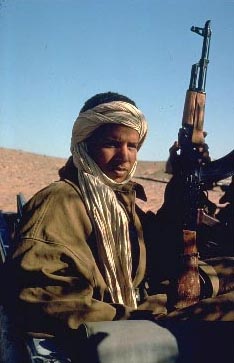
    POLISARIO FIGHTER. If international promises remain unkept, then despite the difficulties, Sahrawis may rise again.

    WITH continuing struggles in the Middle East and the mass killing and suffering in Sudan, it's some time since events west of the Sahara made it into our news media, but maybe that is about to change.

    In the south-western corner of Algeria, around Tindouf, some 100,000 refugees from Western Sahara live in camps. Just like the Palestinians, Sahrawis dream of freedom and a return to their homeland, and the generation that has grown up knowing only exile still keeps that dream, and the will to fight for it, alive.

    At the end of February the movement that has led the Sahrawi struggle for national independence, POLISARIO, celebrated the thirty-first anniversary of its proclamation of a government, the
    Saharan Arab Democratic Republic.

    I remember thirty years ago, going along to a cafe near Paddington station to meet a pleasant and quiet spoken young guy, who wanted to tell me and my left-wing paper's readers about his people's struggle in Western Sahara. The region had seen the departure of Spanish colonial rule, only for people's expectations of freedom to be disappointed when Moroccan troops entered the country from the north, and in alliance with them, Mauritanian forces moved in from the south.

    There had been an infigenous freedom movement, Harakat Tahrir, inspired by anti-colonial struggles across the Maghreb in the late 1950s, which led to Algerian independence in 1962. Though this first movement was crushed by the Spanish rulers in 1970, three years later in May 1973 a band of patriots attacked a small colonial fort, and POLISARIO, the Frente Popular para la Liberación de Saguia el-Hamra y Río de Oro, was born.

    A 1975 UN mission reported that POLISARIO had unrivalled popular support in the country. But that same year, the Spanish government made a secret deal with Morocco and Mauritania, under which they could step into the colonial occupiers' shoes. On October 16, 1976, the International Court of Justice at the Hague rejected Moroccan and Mauritanian claims to Spanish Sahara, and called for a referendum on self-determination. That has still to take place.

    Though Mauritania eventually dropped its claims and withdrew from the territory, Moroccon forces, backed by Western supplies and Saudi money, continued trying to suppress the Sahrawis, while POLISARIO fought back using its popular support and knowledge of the terrain, and aided for a time with weapons from Algeria and Libya. Meanwhile thousands of Sahrawis fled into the Algerian refugee camps. After 15 years, having dragged on into stalemate, the war ended in a UN-brokered ceasefire in 1991. Once again the Sahrawis were promised a referendum on independence, supported by the UN secretary general no less.

    Another sixteen years, thousands remain in exile, those left behind are being rendered a minority by Morrocanisation, and with Moroccan troops still ruling Western Sahara, the ceremonies to mark the anniversary of the republic did not take place in Laayoune, the country's declared capital, but in the small outpost of Tifariti near the Algerian border.

    According to Jacob Mundy, writing in Middle East Report Online, "If it seems that the peace process in Western Sahara has moved at a glacial pace, that is because it has actually moved backwards. From 1981 to 1999, negotiations were premised on a pledge by the late King Hassan II that Morocco would allow and respect a referendum on independence. By the terms of the UN Settlement Plan that underpinned the ceasefire, the UN mission in Western Sahara (MINURSO) tried in vain from 1991 to 1999 to stage such a plebiscite. The referendum seemed to acquire a new lease on life in 1997 when then newly appointed Secretary-General Kofi Annan designated former US Secretary of State James Baker as his personal envoy to Western Sahara. But the referendum, and Morocco’s support for it, essentially died with King Hassan in 1999."

    Paradoxically, it was King Mohammed VI’s dismissal of Interior Minister Driss Basri, seen as signalling a break with past repression in Morocco, that removed the prospect of a referendum, as Jacob Mundy explains. "Part of Basri’s job under Hassan, besides torturing and 'disappearing' dissidents, was to fix elections. If he could get over 90 percent of Moroccans to approve a constitution, he could surely induce 120,000 Sahrawis to choose integration into Morocco. By mid-1999, however, it was clear that Basri’s tactic -- peopling the voter rolls with Moroccans posing as Sahrawis -- had failed".

    Meanwhile, the UN Security Council had seen itself forced to intervene in East Timor, after a referendum on independence there was drowned in bood by the Indonesian army and its sponsored gangs of thugs. It feared the same kind of thing might happen in Western Sahara. UN secretary general Kofi Annan
    reported in 2000 that several arguments had been raised against continuing with the 1991 plan, and that “even assuming that a referendum were held…if the result were not to be recognized and accepted by one party, it is worth noting that no enforcement mechanism is envisioned by the settlement plan, nor is one likely to be proposed, calling for the use of military means to effect enforcement.” In other words, if Morocco lost the referendum and decided to ignore the result, there was nothing you could do about it.

    Mundy, a Ph.D student at Exeter University, notes that Polisario has come under pressure to accept a scheme proposed by James Baker, and apparently endorsed by King Mohammad, according to which Morocco would grant limited autonomy to local Saharan leaders. But he believes the Sahrawi leaders will come under opposite pressure from their own people, particularly the young, to renew the struggle. (This apparently despite the probability that besides facing US opposition, they would nowadays be unlikely to get Libyan or Algerian support).

    " The great success of POLISARIO’s founding fathers is that they fostered a political movement that is now self-sustaining and, more importantly, self-motivating. But that is part of the problem. Having reared younger Sahrawis on the slogan “All the homeland or martyrdom,” the POLISARIO elite is now hostage to its own rhetoric. It has become a practical and logical impossibility for POLISARIO’s leadership to compromise the fundamental goal of independence. To do so would mean that they are no longer POLISARIO; and if they were no longer POLISARIO, then their constituents -- Western Saharan nationalists -- would have no further use for them.

    "On October 31, 2006, the Security Council passed Resolution 1720, 'reaffirming its commitment to assist the parties to achieve a just, lasting and mutually acceptable political solution, which provides for the self-determination of the people of Western Sahara.' In other words, and despite the nod to “self-determination,” nothing will be forced upon Morocco. The Security Council, here guided by Morocco’s key allies France and the United States, wants a “mutually acceptable” agreement between POLISARIO and Morocco that is negotiated and implemented voluntarily. Out of one side of its mouth, the Security Council calls for a vote on independence; out of the other side, it tells POLISARIO it will not compel such a poll. By clear implication, the Security Council’s conditions for peace in Western Sahara demand that self-determination be sacrificed'.

    "Though POLISARIO is feeling international pressure to compromise, it is feeling more internal pressure to fight back -- literally. The same cold logic that gives Morocco comfort generates frustration among Western Saharan nationalists. The refugees, in particular, are keenly aware that their cause is boxed into a corner.

    "Tensions have already boiled over in Moroccan-occupied Western Sahara, where there were unprecedented demonstrations in May 2005. Unlike previous manifestations of Sahrawi discontent, these protests openly called for independence, rather than more rights or more jobs. Since then, the rallies have degenerated into daily minor confrontations between Sahrawi youths and Moroccan security forces. The trajectory of the unrest, known to Sahrawis as the May intifada, is not apparent, in part because of a near blackout of international coverage imposed by Morocco. But Sahrawis are being pushed to contemplate more drastic measures. For the time being, the youths are heeding the calls for non-violence coming from the older activists. Should Moroccan repression escalate, however, POLISARIO could be unable -- or unwilling -- to stop elements of its military stationed along the 1991 armistice line from attempting to draw Moroccan troops’ fire.

    "POLISARIO is caught between two antagonistic pressures, autonomy and intifada. How the movement navigates these pressures in the coming months will determine the future of Western Sahara.

    "Routine Moroccan quashing of a small demonstration in Laayoune provided the spark that ignited the Sahrawi intifada in May 2005. Yet the underlying causes of the non-violent independence movement come from 30 years of living as a divided population, suffering violent repression and being ignored by the international community and, on top of all that, socio-economic marginalization -- the “Moroccanization” of Western Sahara. The demonstrations of May 2005 came as a shock not only to most observers of the conflict, but to many Sahrawi nationalists as well.

    "The red, green, white and black colors of POLISARIO, once rarely seen in Moroccan-controlled Western Sahara, have become the symbol of Sahrawi resistance, whether spray-painted onto school walls -- in the shape of the POLISARIO flag -- or braided into the hair of young girls.

    "Though not lacking in militancy, the intifada has not gathered sufficient momentum to impel a major rethinking of policy either in the Moroccan palace or at the Security Council. Coercion, of course, plays a large role. A debilitating number of key Sahrawi activists, young and old, languish in Moroccan jails, occasionally teetering on the edge of death after prolonged hunger strikes. But Moroccan security men keep the Western Sahara story out of the global media by refraining from massive displays of force and confining themselves to more intimate and targeted acts of violence. These extrajudicial policing measures are aimed squarely at known activists, as well as their friends and family. The website of the Sahrawi Association of Victims of Grave Violations of Human Rights Committed by the Moroccan State is replete with documented examples of police brutality and “confessions” obtained under severe duress. Another spark could set Western Saharan towns ablaze".

    http://www.merip.org/mero/mero031607.html

    Labels: ,

    Monday, October 30, 2006

    Life and death of Mehdi Ben Barka

    MEHDI BEN BARKA

    A socialist kidnapped and murdered 41 years ago has returned to haunt the screen and point the accusing finger at the three "Western democracies" and one pro-Western Arab kingdom whose security services were involved in his murder.

    Serge Le Peron's film J'ai vu tuer Ben Barka (November 2005)now showing in Britain as "I Saw Ben Barka Get Killed", is a film noir thriller about a real kidnapping and murder, that of Moroccan left-wing leader Mehdi Ben Barka, who was "disappeared" in Paris by French secret scrvice agents working with the Moroccan security police.

    The film actually starts with another death, that of Georges Figon, a crook and con-man (played by Charles Berling), who was employed to ensnare Ben Barka with talk of a film to be made. Figon later fell out with his employers over payment, and started talking to journalists, film-makers and anyone else about what he knew. When he was due to be called as a witness in the trial of secret service men his body was found in a pool of blood at his home. The official reports said "suicide" , but whoever arranged it made a mistake by leaving the wrong gun. The film goes back over Figon's story, that he did not get to tell in court. I haven't seen it yet, though I am told it is a good movie well worth seeing.

    But of course, whatever the artistic use of this side-view, the really important figure is that of Ben Barka himself. *

    Born in 1920 in a poor neighbourhood of Rabat, the son of a low-ranking civil servant, Mehdi Ben Barka was the first Moroccan to obtain a degree in mathematics from a French university. A leader in the nationalist Istiqlal party which led Morocco to independence, he found his hopes for democracy and development in conflict with the monarchy and right-wing, and quit with others to form the National Union of Popular Forces, UNFP, now known as Socialist Union of Popular Forces(USFP).

    Exiled in 1963, the Moroccan opposition hero became an international figure. In Algiers he met Che Guevera, Malcolm X, and Amilcar Cabral, leader of African guerrillas fighting Portuguese colonial rule in Cape Verde and Guinea. Like them he was to be assassinated.

    Due to chair the first Tricontinental Conference planned for January 1966 in Havana, Ben Barka told a press conference, "the two currents of the world revolution will be represented there: the current which emerged with the October Revolution and that of the national liberation revolution".
    He said the struggles against colonialism and Apartheid would be linked with support for Cuba against US imperialism.

    Here, in an interview in 1999, Ben Barka's son Bachir takes up the story:
    "On Friday 29th October 1965, at 12.30 pm, Mehdi Ben Barka, my father, had an appointment at the Brasserie Lipp, on the boulevard Saint Germain, in Paris, with a journalist, a film producer and a scriptwriter, to discuss the preparation of a film about national liberation movements in Africa, Asia and Latin America. The film was to be shown at the opening of the Tricontinental Conference in Havana in January 1966. The title of the film was to be Basta!

    "This appointment was a trap. Before his arrival at the Brasserie, my father was stopped by two French policemen, who showed their police cards and asked him to follow them. He got into their official car. He was calm and confident. But in this car were other individuals, an agent, or "honourable corespondent" according to the conventional expression, of the SDECE, that is to say the French secret services, and a criminal, a henchman. The SDECE agent was wearing a false mustache and a wig so that my father, who knew him, would not recognize him.

    "The car moved off in the direction of the suburbs to the south of Paris, to Fontenay-le-Vicomte to be precise, and stopped in front of the house of a notorious gangster, Georges Boucheseiche. From this point on, I would say, certainties end and speculation begins as to what then happened to my father. What is known is that General Oufkir, the Moroccan Minister of the Interior, was informed that the "parcel" had been delivered. His deputy, commander Ahmed Dlimi, was also informed. The following day, they both arrived in Paris.
    There were various comings and goings at the house. We do not know exactly who by, but we do know that from this time on we lose all trace of my father. We can suppose that he was assassinated, but we don't know who who killed him, nor how, nor the whereabouts of his corpse. Was the corpse kept in France, or was it sent to Morocco? Or else, as some people claim, was the Mossad, the Israeli secret services, charged with getting rid of it? To this day, 34 years after the events, we still have no definite answers to these questions.
    From the outset, the elimination of my father was one of the political objectives of the Moroccan authorities. This objective resulted in several attempted assassinations and two official death sentences. The ideas my father developed were seen as a political alternative to those of the regime which had shown it's bankruptcy socially and economically.

    "The Moroccan regime was not alone in this affair. It was helped from within the French secret services and by the crooks who worked for them. Coordinated action between French and Moroccan police had already been used against the Moroccan opposition in France. There was also involvement by the Mossad which gave at least "logistical" support to the Moroccan secret services in the perpetration of the crime. Numerous investigations carried out in Israel, in France, and in the United States enable us to confirm categorically the involvement of the Mossad in this affair. From 1967 onwards, revelations in the Israeli press about the involvement of the Mossad in the assassination of my father indicate that this led to an important crisis in the government and even to the resignation of the Israeli Prime Minister at that time.

    "One can also assume that the CIA was involved in one way or another. My father was preparing, in 1965, the Tricontinental Conference which was to bring together representatives of national liberation movements and progressive parties from Africa, Asia and Latin America. At the time, many African countries were still under colonial rule. Apartheid still held sway in South Africa. Portugal still had it's colonial possessions and even in those countries which had gained their independence, important mass struggles were developing. The Havana conference was to lay the basis for concerted solidarity action between these different struggles. Mehdi Ben Barka was the Chairman of the committee preparing this initiative and his activity could not escape the attention of the most powerful imperialist country. The conference was held in January 1966 but, unfortunately, without the man who had prepared it".
    http://www.marxist.com/appeals/ben_barka/interview.html

    In Morocco there was a general strike over Ben Barka's disappearance, which testifies both to his popularity, and the people's reasonable assumption that their government's skulduggery was involved.

    Israeli Connection: No Bul

    In September 1966 a sensational Israeli magazine called Bul reported that Israel's Mossad secret service, working through a Moroccan Jewish businessman based in Europe, had helped organise Ben Barka's kidnap for the Moroccan secret police. Bul means "bullseye" , and for scoring this one the magazine had all its copies seized. Editors Maxim Gilan and Shmuel Mor were tried in secret, on charges of endangering state security, and jailed.
    Whether or not he had known about the operation, Prime Minister Levi Eshkol was worried about the effect on Israel's international relations, and tried to suppress information, but internal conflict in both the secret state and political leadership ensured the story was leaked not just to Bul but to the international press, and so Israeli papers followed.
    Mossad and Moroccan Internal Security Minister Muhammad Oufkir had got to know each other. In 1961, after a Mossad-run ship carrying Moroccan Jews to Israel went down with the loss of 44 lives General Oufkir cracked down, rounding up and torturing members of the Zionist underground Misgeret, but no Mossad agents were caught. After King Hassan II came to the throne the Moroccan authorities began facilitating emigration. In 1965 General Oufkir was secretly brought to Israel by David Kimche of Mossad. He asked for the Israeli agency's help in tracking down and murdering Ben Barka.
    (see Israel's Secret Wars, Ian Black and Benny Morris, 1991).

    American angle (or Angleton?)

    If Charles de Gaulle was exasperated to find the SDECE agents sometimes following what seemed like their own policy rather than his, it may be not just because old habits died hard for right-wing agents, veterans of the struggle over Algeria, but because they looked up to a higher authority than their own government- the American CIA.

    Around the time of Ben Barka's kidnapping the Israeli Mossad was moving into closer working with the CIA. The US agency's James Jesus Angleton, notorious for plotting false-flag operations and political coups, was keen to involve them.

    In his early days as a leader of Moroccan independence Ben Barka had caught the eye of the US State Department which wanted to replace French influence. He was invited to Washington to meet with top government officials and Congressmen. But when he was accused of plotting against the king, and even more when he started supporting Cuba and talking about the October Revolution, the interest was bound to change.

    Time magazine reported in its international edition of December 29, 1975, that in 1964 Minister Oufkir had asked the U.S. ambassador in Rabat for U.S. help in "bringing Ben Barka before a Moroccan court." The magazine said this request was relayed to CIA headquarters in Europe, but "there is no evidence that the CIA ever accepted the invitation." The CIA may bring people in but is not noted for getting them to court.

    In June 2001 a retired Moroccan secret policeman Ahmed Boukhari stated that three CIA agents had been assigned to the Moroccan Counter-Subversion police bureau in Rabat from 1960 to 1967. Boukhari, said a CIA agent known to him as "Colonel Martin" followed the preparations to abduct Ben Barka and would have known about his death. According to Boukhari, Ben Barka had died during interrogation in a villa south of Paris. He said Ben Barka's body was then taken back to Morocco and destroyed in a vat of acid. The acid vat, whose plans were reproduced by the newspapers, had been constructed under instructions from "Colonel Martin", who had learnt this technique for making corpses disappear while working in the Shah's Iran in the 1950s.

    According to another account, Ben Barka's body was encased in concrete and buried outside Paris, except for the head which General Oufkir took back to show the Moroccan king. Whatever the grisly truth, the body has not been found.

    On March 1, 1976, Bachir Ben Barka, requested documents pertaining to his father under the Freedom of Information act. The CIA, in a reply dated August 11, 1976, referred to 1,846 pertinent documents, but later declined to release them, citing "national security". While a few documents were later sent to the applicant, the vast majority have never been released. Since Boukhari's statements on US involvment, Human Rights Watch has made several requests to the US authorities to release the files they have.

    * This is not the first film inspired by the Ben Barka story. The affaire has inspired fictional thrillers. But more important, Moroccan-born Simone Bitton, best-known here for her film Mur, about people either side of Israel's "security fence" or Apartheid wall, has directed a film called Ben Barka; The Moroccan Equation, about Ben Barka's life and significance as a political leader, rather than just the circumstances of his death.
    http://www.frif.com/new2003/ben.html

    Labels: ,