SOME of the places in the world whose people play the most important part in our lives through actual wealth creation (as distinct from conspicuous consumption, or the hocus-pocus trick of transposing billions of debt owed peoples and profit bonuses for private individuals), are places seldom heard of.
There are places deep in the heart of Africa where kids are made to crawl into unsafe mines for an ore called Coltan, from which tantalum can be extracted to end up in cellphones, game players and other gadgets used by your kids, and for all I know in this laptop I am using. The UN says the trade fuels wars, but then the wars help provide the captive child labour, and somehow the Western companies involved in purchasing ore or supplying weapons manage to keep their hands clean.
Unlike the makeshift mines and holes dug out of the ground of eastern Congo, the world's biggest gold and copper mine is one gigantic hole and an underground mine which make up Freeport, in West Papua, owned jointly by
US-based Freeport McMoRan, Indonesian subsidiary
PT Freeport Indonesia and their Anglo Australian partner, Rio Tinto.
West Papua is the western half of the island we used to call New Guinea. Its straight
-line border shows the colonial past, when this was Netherlands New Guinea. With UN approval it was taken over by Indonesia, which has encouraged its own settlers there, while the formerly Australian-administered eastern side together with adjoining islands forms the state of Papua-New Guinea.
Papuans who don't accept the carve-up come into conflict with the Indonesian military, as seen in the report which a friend in Australia has forwarded from the news site New Matilda:
20 Oct 2011
Troops Open Fire On Papuan Gathering
The Indonesian military and police opened fire late yesterday on a gathering of West Papuan leaders. At least one person is believed to have been killed and hundreds have fled the capital
The Indonesian military and police started shooting at around 2:37pm West Papua time, yesterday 19 October. Information about what exactly transpired are still sketchy but at least one person was shot (believed dead), scores have been arrested, hundreds have fled to the hills and jungle surrounding the capital, and the capital is in a state of lockdown.
A Papuan priest who was fleeing the shooting contacted New Matilda to report that an army truck passed him carrying Papuan participants who had been present at the Third Papua Congress. According to the witness they were "covered with blood" and had been "beaten and shot".
The violence erupted at the conclusion of the Third Papuan Congress, a three-day gathering held at the Taboria oval (Zaccheus Field) in Abepura, during which Papuan leaders declared their independence from the Indonesian state.
As many as 20,000 West Papuans met, danced and debated how to achieve their civil and political rights. For three days the atmosphere had been tense. The venue was ringed by Armed Personnel Carriers, military trucks and Barracudas — a type of armed jeep favoured by the paramilitary police. Machine guns were trained on the participants and thousands of soldiers and paramilitary police armed with automatic weapons were present.
Published on
newmatilda.com (
http://newmatilda.com)
Some earlier reports show an important dimension to what's happening in West Papua. Here are excerpts:
16 Aug 2011 Enough, Say West Papuan Workers To Freeport
Indigenous Papuans who provide the labour that keeps the world's largest gold and copper mine operational have gone on strike to pressure Freeport into wage negotiations, report Alex Rayfield and Claudia King
Recently trouble at the mine flared up again, as around 12,000 Indonesian and Papuan Mine workers and contractors went on strike, joined by local indigenous leaders. Walking off a job has never been so hard, Yan Ampnir told us. When he decided to join the mine workers’ strike in the remote Indonesian province of Papua, it was not a simple case of heading out the gate and driving home to his family. It involved a gruelling 40-mile trek down a roller-coaster road that plunges 8400 feet down from the vertiginous cloud-cloaked mountain walls of Tembagapura, the remote mine base camp, to the sprawling swamp lowlands of Timika.
Tembagapura is a company town. The only people who live there are mine workers. After long shifts in the Grasberg open pit or in the underground mine, workers are bussed on four-wheel drive trucks back to Timika or the US lookalike suburb of Kuala Kencana, replete with shopping malls, manicured lawns and street lights, all carved out of the middle of the jungle. So, when the company refused to bus the workers outside the Indonesian military- guarded mine area, Ampnir and his compatriots picked up their bags and started walking.
 Strike leaving Tembagapura. SPSI collection. |
Seventeen hours later the first group arrived in Timika; tired, wet, cold and hungry. Eight days later the strike ended. In the process some 12,000 mine workers (of a total workforce of 23,000) halted production at the world’s largest gold and copper mine, inflicting a loss of US$95,000 per day on US-based Freeport McMoRan, Indonesian subsidiary PT Freeport Indonesia and their Anglo Australian partner, Rio Tinto.
After a quick search online, Albar Sabang, the local union branch secretary, hands us an Excel spreadsheet. On it is a list of pay scales. Sabang is a mechanic who fixes heavy machinery like bulldozers and excavators. He has worked for PT Freeport Indonesia since 1994 and earns US$3.00 per hour. He is one of the highest paid local employees out of a group PTFI calls "non-staff". Others earn as little as $1.80 per hour, a wage that rose 98 per cent after a similar workers strike in April 2007.
Sudiro (his only name) is a softly spoken tall Javanese man, unassuming in person. He is the local SPSI (Seluruh Pekerja Serikat Indondesia — or All Indonesian Workers Union) chair of the Freeport Mine Workers Union, an affiliate with the national SPSI network. Recently sacked by PT Freeport Indonesia for organising workers, he only just got his job back. "Of all the Freeport mines", Sudiro tells us, "PT Freeport Indonesia is the most profitable. It has the lowest production costs. But workers are paid the lowest salaries. We are even paid less than Freeport mine workers in Mongolia and the Democratic Republic of Congo. That’s not right."
Freeport is emblematic of much that is wrong in West Papua.
The company’s Contract of Work was signed in 1967, two years before the Act of Free Choice was concluded, a referendum that was supposed to give the indigenous West Papuans a chance to say whether they wanted to be independent or part of Indonesia. In fact, there was no vote. Instead, 1022 West Papuans, less than 0.01 per cent of the population, were corralled into camps and told to "vote" for integration with Indonesia or have "their tongues cut out". But it was not just the Indonesian government that consented to democratic fraud writ large; the US, Australian and European governments were also not prepared to contest the election or risk stability in the region for what one US Embassy source at the time called a handful of "Stone-Age illiterate tribal groups".
The biggest prize of all was Freeport.
Suharto declared the company a national asset and instructed the military to guard the mine, which led to a long history of human rights violations, including un-investigated mass killings, theft of Papuan land and massive environmental degradation — all of which has led to ongoing violent and nonviolent resistance.
This was the era before the notion of "free, prior, and informed consent" became best practice for extractive industries. According to local indigenous landowners, they still feel that they have not been consulted or their rights respected.
As the Amungme people’s sacred mountain is consumed, tailings are dumped in the Ajkwa River at the rate of 200,000 tons a day. The result: over 30,000 hectares of rainforest have been wiped out and huge levee banks built to stop Timika from being smothered by sludge waste. In the process, Freeport became a lightning rod for all Papuan grievances.
18 Aug 2011
Freeport Cracks Down On West Papuan Unions
.
"We are not valued as human beings. We are treated as an instrument of the company. Our goal is to get to a position where we are treated as human," says union organiser Sudiro.
According to miners interviewed in July 2011, many workers are forced to take out bank loans to pay for basic needs and to support their families. After retirement, some must seek alternative types of income. Yet when workers attempt to raise these issues with Freeport management, they have received warning letters in return.
"It seems like the company sees us as the troublemakers. But," says Sudiro, referring to workers’ contributions to gold and copper production, "we are the solution-makers."
SPSI PT Freeport Indonesia is one local branch of the national labour union federation of Indonesia. The organisation has represented PTFI mine workers in 16 Collective Labor Agreements (CLA) dating back to 1977. But until recently it functioned as little more than a rubber stamp for company policies.
Freeport has a history of suppressing workers’ rights and union organising. Under Suharto, independent labour organising was prohibited. Those that tried were often killed or spent years in jail. But over the past decade, as political space has slowly opened up, Sudiro and other workers have been quietly organising.
Campaigns to educate fellow mine workers about their rights and the role of unions in protecting workers seem to be paying off. Reflecting on worker participation in the recent strike, Sudiro says, "The workers finally opened their eyes and minds to the situation. The company cannot stop this. We have woken up. We will never go back to how we were treated before the strike."
Nevertheless, SPSI Freeport members continue to face threats and intimidation from the company. When two of the union members travelled to Jayapura to seek advice from Papuan leaders, they were followed by Indonesian security forces who have long been paid by Freeport to guard the mine.
9 Oct 2011
Striking Mine Workers Face Death Threats
West Papua's striking mine workers continue their standoff at Freeport's Grasberg mine despite increasing danger and the presence of a foreign security firm. Setyo Budi reports
'At 10pm on 11 September, the chief negotiator in West Papua’s ongoing Freeport strikes was sitting alone on the veranda of his house. Sudiro had spent all day with Freeport Indonesia management, bargaining for a wage rise for the members of his union — the All Indonesia Workers Union (SPSI) Freeport division. Suddenly a bowl that was sitting on a table close to him was hit by a bullet and shattered. The shot was a clear warning to Sudiro: if he continues to fight for wage parity for the workers at Freeport’s Grasberg mine, he will be killed.
"I was surprised when I got home that night and told that our leader was shot [at]," Albar Sabang from the SPSI told New Matilda in a phone interview. "We don’t know who shot him. The gunman used a silencer."
The shooting took place on the same day the union received a letter from Freeport management requesting the union "not propagate a strike action and recruit workers to join the strike".
Talks between the SPSI and Freeport management over the 2011-2013 contract terms took place from 21 July to 19 August this year. The parties failed to reach an agreement and the deadline was extended to 26 August with the same result. In the beginning the union bargained for a wage increase from US$1.50-$3 to US$35-$200 per hour. This demand was decreased to $30-$100 per hour during negotiations, and is now at $12-$37.50 per hour. Last year, the company gave the workers only a 3 per cent wage increase.
As the negotiation went into deadlock, the union called a month-long strike, which started on 14 September. The strike now continues for a second month and this week Freeport was forced to halt production at the mine after a pipe carrying gold and copper to the port was severed.
The workers demand a parity wage with their comrades who work in other Freeport mines in North and South America. Freeport workers in West Papua receive the lowest wages of all Freeport workers — lower than workers in Mongolia or the Congo.
In a letter that was forwarded to New Matilda, SPSI argues that their demands are based on the fact that Freeport Indonesia has profited more than its sister companies in Peru, Chile, Arizona and New Mexico. Their skills are equivalent to their fellow workers in those mining areas, and profit margins are believed to be as high as 60 per cent. Their working conditions are harsher and more dangerous, and the price of gold, copper and silver has significantly increased.
Freeport’s Grasberg mining complex is one of the world’s largest single producers of both copper and gold, and contains the largest recoverable reserves of copper and the largest single gold reserve in the world.
In an interview via email, Sabang describes the terrain and working conditions at the mine:
"The mining area is located up to 4200 metres above sea level that require the workers to take an hour journey by busses, and trams. The weather in the area is cold, and misty, especially in Grasberg open pit area, and rains heavily all day. They have to wear four layers of clothes to work. They have to work five days to seven days a week. They have to work up to 10 hours a day. For those who work in the Maintenance Department, sometimes have to work from 12 to 14 hours a day."
From the beginning of the negotiations, relations between the two parties were uneasy. In a letter to the Indonesian Minister of Mining and Energy dated 16 September, Freeport management accused the union of "intimidating and threatening those who did not participate in the strike". The letter also said that the workers’ demand to have to have a "wage increase equals to workers in the developed countries is irrational".
The letter continues: "If [the wage increase] takes place it will affect our national economy, as [it] will create high inflation and our country competitiveness in the international market."
In the same letter, Freeport management told the minister "to avoid a great loss, it will recruit temporary workers to replace those who were on strike". These workers are to be employed in the operational field and maintenance.
In his reply to Freeport management dated 21 September, the director general of coal and minerals, Thamrin Sihite, said the Indonesian government "understands the situation, and allow Freeport Indonesia to use sub-contractors to replace the striking workers". This decision resulted in the death of one worker, Petrus Amayiseba, and 10 others were injured when the police (who had been hired by Freeport) opened fire at them during a scuffle on 10 October when striking workers tried to prevent replacement workers from travelling to the mine. Amayiseba’s death triggered solidarity protests across Indonesia and was condemned by Amnesty International.
There was another shooting incident on 15 October when a busload of workers was riddled with bullets and three workers were killed. On the same day, Leo Wandagau, a 34-year-old striking worker who was a victim of the shooting incident on 10 October, reportedly died in the local hospital.
Since the shooting incidents union officials have received threats from the police. On 11 October, the police commander in Mimika, Edward Siregar, allegedly told Sudiro "let’s see who is more powerful, your organisation or the police. I will finish you and your followers off".
The strike has had a huge impact on Freeport Indonesia’s operation. It is reported that the company has lost 1361 metric tons of copper and 5000 ounces of gold a day because of the strike. As well, the Indonesian government is reportedly losing about US$8.2 million dollars a day in taxes, revenue and dividends.
Unlike Freeport, which only pursues an economic interest, the Indonesian government also has political interests in the region. The Freeport mining area has been used by the government as a foreign diplomacy bargaining chip against the West Papuans’ desire for independence. For the Indonesian military the mine has also been a source of revenue.
Al Jazeera reports that Freeport has illegally paid individual soldiers and policemen to secure the Grasberg complex and its staff. A report by Global Witness revealed that an additional $10 million had been paid directly to individual military and police commanders between 1998 and 2004. This included payments of $247,000 between May 2001 and March 2003 to General Mahidin Simbolon, who was responsible for the 1999 East Timor massacre, and monthly payments throughout 2003 to the police Mobile Brigade, which is known for numerous serious human rights violations, including extrajudicial killings, torture, rape, and arbitrary detention.'
GUESS WHERE THAT PRIVATE SECURITY FIRM IS FROM...
'During the strikes, Freeport management has intimidated the workers via local media and text messages and visited the workers’ houses and asked them to go back to work.
Now, they have also employed the private British security firm Securicor — which merged with Group 4 Falck in 2004 to form G4S (Group Four Securicor). G4S came to prominence in Australia in 2008 over the death of an Australian Aboriginal man, Mr Ward, in the back of one of its transport vans. The firm has also been the subject of controversy over its treatment of immigration detainees here.
An SPSI official told New Matilda that Securicor officers have intimidated the striking workers and operated beyond their working areas. SPSI also said that on 23 September Securicor and police officers went to the SPSI office in Freeport to arrest one of the members, Jimmy Deda, but were stopped by other workers. On the same day Securicor and Freeport management brought in temporary workers to replace the striking workers in Mile 38.
In response to their prolongation of the strike action, Freeport Indonesia has sacked all SPSI officials and taken over SPSI headquarters at the mine. In a letter dated 5 October, management wrote to Sudiro, "We would like to request a house on Tembagapura St number. 380 that was provided for SPSI last year by October 8. If the house is not emptied, we will pack all documents and stationaries".
The workers’ struggle in Freeport is a struggle for justice; a struggle that is shared by many West Papuans. It is a struggle against greed and the powerful elites in Jakarta and Papua that have made West Papuans poor. The natural resources have become curse for the local population. For this reason, the seven tribal chiefs who represent the population of Freeport areas wrote a letter on 25 September to support the striking workers. They too threaten to "close the mines" unless the workers’ demands are met.
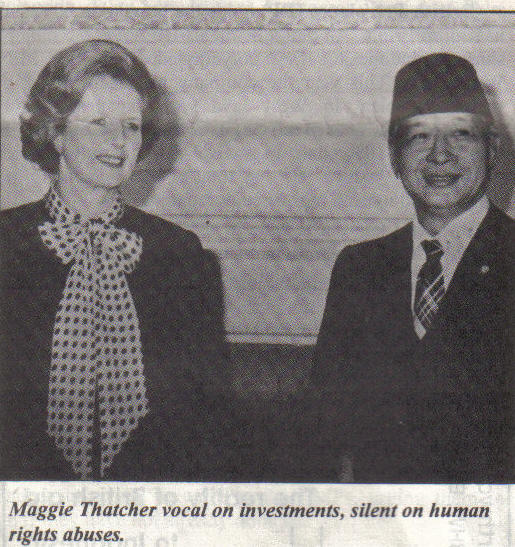
The Suharto dictatorship was backed and supported by the United States, and supplied with arms and equipment by Thatcher's Britain. The relationship with the Indpnesian military did not end there or with her, notwithstanding Robin Cooke's famed wish that British foreign policy should contain a "moral dimension". Under the Labour government, Indonesian officers came to train at the Shrivenham military academy, and attended courses at Hull University subsidised by the British taxpayer.
http://www.guardian.co.uk/world/1999/sep/19/indonesia.easttimor1
Labels: Indonesia, trade unions