Wednesday, May 20, 2009

Oh Lord! Reputation, Reputation, Reputation! The cost of Taylored legislation.

TWO members of the House of Lords have been suspended by their peers as a result of being exposed as willing to get parliamentary bills amended in return for payments. Lord Truscott and Lord Taylor of Blackburn are the first to be removed from the house since 1642

Lord Truscott, a former energy minister, and Lord Taylor of Blackburn,author of reports on education, and a consultant to British Aerospace, were exposed by undercover reporters from the Sunday Times back in January. Posing as lobbyists, they recorded Lord Taylor saying that he was ready, willing and able to manipulate the parliamentary system, and had done so, to help big business procure amendments to the law that would suit its interests.

The paper accused four Labour peers of "sleaze". they persisted in saying they had done nothing wrong. Two have now been reprimanded, and Taylor and Truscott suspended. Truscott resigned from the Labour Party a week ago, Taylor's membership has been suspended. The Lord's committee on privileges which made the recommendation that the two should be removed had not intially thought the House could do this, or needed to. But it changed its mind.

In a debate on the recommendation the leader of the Lords, Lady Royall, said innocent peers were being "shouted at in the street" because of the damage done to the reputation to the upper house by the affair. Members had been left feeling "sullied". Royall said: "We are at a dark moment for democracy. The trust that people place in parliament and parliamentarians has sunk like a stone. People's disgust at parliament is palpable."

Royall said she thought suspending the two peers was "appropriate, fair and just". She said she was "proud" to belong to the Lords, but that the "cash-for-amendments" affair had damaged the reputation of all members.
Quoting Cassio's speech from Othello – "Reputation, reputation, reputation! Oh, I have lost my reputation! I have lost the immortal part of myself, and what remains is bestial" – she went on: "I'm saddened when the reputation of this house is sullied. I know members on all sides of this house have felt stained and ashamed of the disrepute to which this house has been brought."

The true price of this affair may soon be felt far more widely than the disgraced peers. Baron Taylor of Blackburn is a director of Drax Power, and an advisor to several companies, one of which, Experian credit, agreed on Janury 29 that he should retire. But particular attention is focussing on his consultancy for British Aerospace, which as an arms producer has been looked after both by Tories and Labour. And on Blackburn MP Jack Straw, whom papers describe as a friend of Lord Taylor.

Seeing Taylor's name in the news takes me back about 40 years, to when as a "mature" student at Lancaster University and leading light of the Socialist Society I came across some correspondence from another Lord, not a backstreets boy from Blackburn, but a backwoods Tory, the 19th Earl of Derby, who as pro-chancellor of the University had written to vice chancellor Charles F.Carter expressing his concern about troubles on t'campus. Things might not have seemed serious at Lancaster, but he had given a lift the other night to Ted Heath who had told him "the anarchists have taken over Balliol".

Being naturally interested in what our betters had to say, we published a special issue of "Spark", our Socialist Society magazine (named pretentiously after a certain Russian publication), with Lord Derby's correspondence., with the headline "I was Ted Heath's Chauffeur" or something like that. Unfortunately I have not kept a copy. But in the row which broke out, with complaints of breached confidence, threats of discipline, and accusations of aristocratic influence, students stormed the university council meeting and occupied the senate chamber. The 19th earl had a heart attack, I believe. Since the university council was supposed to link the university with the outside world, students asked how representative it was. "Why are there no women on it?" asked one, while others like myself wanted to know if it had any trades unionists. At this, a member of the council said "Yes, I'm a trade unionist". It was a Labour councillor from Blackburn, by the name of Tom Taylor.

One swallow does not make a Spring, and one union man in its upper body did not prevent Lancaster University digging in its heels the following year against union recognition for its low-paid women cleaners. That led to a strike, and another student occupation, and though the university eventually conceded recognition, it also moved against a whole group of lecturers in the English department, with no obvious connection except they were seen ss left-wing and the most senior of them, Professor David Craig, had written a song for the women cleaners. The prolonged struggle which erupted over this is another story, except that it broke a truce the National Union of Students (NUS) had quietly made with the Tory government, and eventually brought an NUS officer up to lead a demonstration, a young fellow called Jack Straw.

That year, 1972, Tom Taylor became deputy pro-chancellor at Lancaster. Then in 1977 he became both chairman of Norweb electricity and of a government committee on Education, going on to produce the Taylor Report on problems in universities.
Jack Straw was selected in 1977 to stand for Labour in Blackburn, where Barbara Castle was due to stand down.

Straw has been both Home Secretary and Foreign Secretary, and was tipped as a contender for Labour leadership and therefore prime minister. There are people who have been gunning for him from more than direction, including American warmongers who resented his visits to Iran as Foreign Secretary and his remark that their plans to bomb the country were "nuts". They spread the story that Straw was taking this stand because he had too many Muslims in his constituency. This may be one reason he was demoted from Foreign Secretary.

But for now, the attention will be on the relationship with Lord Taylor and British Aerospace. Former British diplomat Craig Murray who stood against Straw in his constituency has been blogging away at this.

Even when Labour was in opposition it helped the Tories avoid a report fom the National Audit Office which said the Thatcher-initiated al Yamama arms deal had cost too much. Then when Labour got in, Foreign Secretary Robin Cook's "ethical dimension" to foreign policy was soon ignored when it came to sending Hawk aircraft to Indonesia. More recently it was Straw as justice minister supposedly charged with stopping corruption who was able to stop investigations into British Aerospace, though it was Tony Blair who said upsetting the Saudis might be bad for national security.

Something else I remember from the early 1970s was the Bishop of Blackburn and the Chief Constable of Lancashire joining forces to launch the Festival of Light and moral crusades. I don't know whether they had much influence on business and politics. The Lancashire Evening Telegraph thinks Taylor may lose his status as a freeman of Blackburn. He is also a freeman of the City of London. What may be interesting now is to go back over some of the legislation which the House of Lords has amended, and some of their rulings, seeing what interests may have been involved. It need not have been just the four involved.

http://www.theregister.co.uk/2009/01/30/lord_register_row/


http://www.thisislondon.co.uk/news/article-23410665-details/How+BAE+and+a+rather+mysterious+Labour+peer+get+rich+as+our+troops+die/article.do

Labels: , , ,

Saturday, October 22, 2005

Subversives and Conspirators


picture Westmorland Gazette, http://www.thisisthelakedistrict.co.uk/

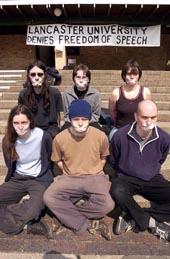
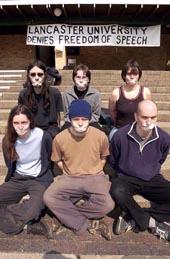
These are Lancaster's "George Fox 6", students who were found guilty of "aggravated trespass" because they invaded the George Fox conference centre at their own university and leafletted against a business conference being held there by firms like Shell and British Aerospace. Lancaster University Vice Chancellor Paul Wellings insisted on the prosecution, accusing the leafletters of "intimidation".

The Six, four of them current students, one a Lancaster graduate and the sixth a member of St. Martins College (affiliated to the Uni) have had costs of £300 each awarded against them as well as being given conditional discharges for two years meaning that if they re-offend, the punishment for this conviction can be looked at again. Two of the six are now subject to proceedings aiming to apply Criminal Anti-Social Behaviour Orders (CRASBOs) against them, which may well prevent them from ‘associating’ with each other - to do so would then become a criminal offence, all because they demonstrated about the commercialisation of research and the presence of some of the worlds biggest and most unethical businesses being on campus. http://www.thescam.org.uk/

Looking at Lancaster's links with the military industrial complex, and the rise of "strategic studies" at the university, I recalled the conference on police-military co-operation in "counter-insurgency" held at the University in the early 1970s. My fellow Lancaster graduate Nigel Todd, now a Newcastle Labour councillor, has reminded me of "Robert Moss (so called 'security' expert) who regaled the gathering, which we gatecrashed, with the view that joint Police-Military operations were essential because the country was under threat from serious terrorists, including the Clay Cross Councillors!"

For those too young to remember, the Labour councillors at Clay Cross, in Derbyshire had not smuggled explosives from the mines and quarries to guerrillas operating in the Peak District. They did supply milk to the local schoolchildren, in defiance of the Tory government which had abolished it. They refused to implement the Tory Housing Finance Act, and somehow contrived not only to keep down rent and rates but to give council workers a big pay increase.
For this they were dragged before the courts, surcharged and barred from office.As Clay Cross councillor David Skinner (brother of MP Dennis) remarked::
"Our opposition was based on being honest with ourselves andthe people who put us there and because, even in local government, it is possible to assist in changing society. To hear most councillors talk one would imagine they are incapable of organising resistance to the impositions of the central government. If all the Labour councils followed the example of Clay Cross it would be impossible to carry out the Housing Finance Act".

Using local government to defend working people and even help in changing society! How fantastic that idea must seem today, when we look at our local councils loyally serving Blairite policies, shedding services and privatising. How old-fashioned. People might actually think it was worth voting.
But back to our "security expert" Robert Moss. He was an associate of Brian Crozier in operations linking the mucky work of CIA and MI6 spooks with helpful journalists and sympathetic academics. Forum World Features, which planted suitable material in the media, begat the Institute for Study of Conflict, which was then reborn as the Research Institute for the Study of Conflict and Terrorism (RISCT), whose director Professor Paul Wilkinson of Aberdeen University often popped up as a government advisor and media expert on "counter-terrorism".
Moss also joined Crozier in the National Association for Freedom, NAFF, along with Norris McWhirter, Michael Ivens of Aims of Industry, and Winston Churchill, junior, MP. But two particular items stand out on the Robert Moss CV. He worked for the Economist Foreign Report, and was Economist correspondent in Chile, producing a book "Chile's Marxist Experiment"(1974), supposed to justify General Pinochet's 1973 coup against the elected President Allende, which brought mass arrests, torture and murder.
These right-wing specialists in countering "subversion" boasted of their part in plotting the downfall of Labour government, and they hoped, smashing the power of trade unions. It was a speech written for Margaret Thatcher that earned her the title "Iron Lady" and Robert Moss an invitation to Chequers.
We should not get carried away by conspiracy theories, but nor should we ignore evidence of real conspiracies.

Labels: ,

Saturday, October 15, 2005

Trespass on the Corporate Campus


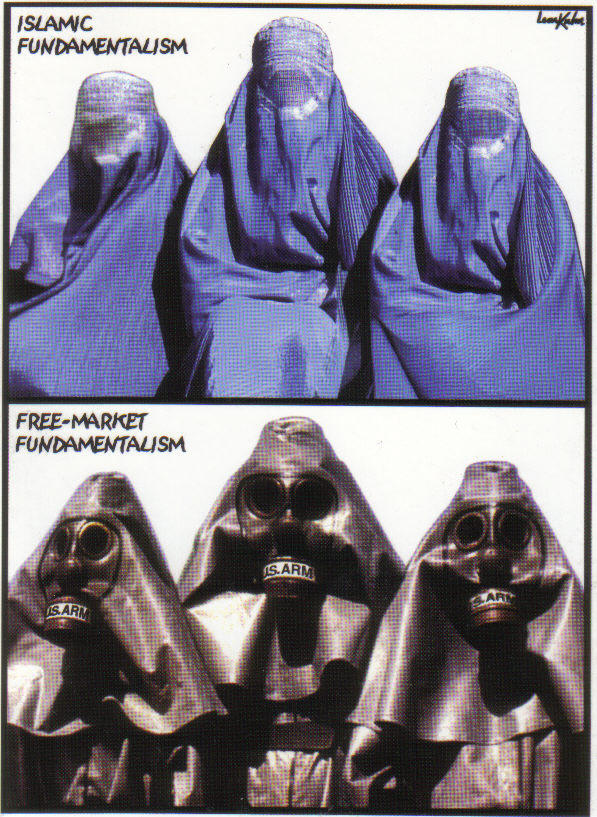
The picture is a card designed by Leon Kuhn for Artists Against the War.

If you haven't yet met Leon selling his cards at various events, you can find out more at www.ellipsis.com/aatw
or e-mail artistsagainstthewar@hotmail.com
If you fancy using the picture please ask Leon. And buy some cards!


I have wanted an excuse to spread it for some time, and this time I thought it might illustrate the topic.

The card depicts "Islamic Fundamentalism" and "Free Market Fundamentalism".

The government, media and a right-wing think tank want to outlaw "extremism" on campus. But the government and academic authorities are keen to welcome another set of violent characters.


"Trespass" on the Corporate Campus

SIX students at Lancaster University have been fined £300 each and bound over to keep the peace, for the crime of "aggravated trespass". What they did, a year ago, was to gatecrash and leaflet a 'Corporate Venture' confernce at the university's George Fox conference centre, aimed at bringing together big business corporations and academics to "spin ideas" at one another.
It's ironic really. The hall is named after George Fox, the 17th century Quaker, who was jailed at Lancaster in 1660 for speaking his mind on peace and refusing to swear allegiance to the monarchy. The "George Fox Six" distributed leaflets objecting to the presence of companies like Shell and British Aerospace, with their warlike connections, and to growing commercialisation of university research.

Nowadays you can say almost what you like about the monarchy, but show disrespect for big business and you are asking for trouble.

The National Union of Students backed the students, and the Association of University Teachers branch at Lancaster urged the university to drop the charges, but the vice-chancellor insisted on prosecuting., at the same time assuring complainers that as a "criminal matter" it was "up to the courts". Notwithstanding all those notices which warned "trespassers will be prosecuted", trespass used to be a civil matter. But the students were charged under Section 68 of the Criminal Justice and Public Order Act 1994. (Introduced with all that fuss about all-night raves by good old Michael Howard, but strengthened by New Labour). This makes it clear that the offence stands only if the landowner considers that trespass has take place.

Behind Lancaster University's determination to come down hard on protestors lies more than its own policies. Education Minister Ruth Kelly has called for university vice-chancellors to crack down on "extremists", having previously called on the seats of learning to work more closely with business.

As the Lancaster students union says: "It’s part of what the government call the ‘third mission’, a project which enables universities to provide support to businesses at little or no cost, paving way for corporate sponsorship of research projects. The spin on the university website puts a ‘local community’ gloss on this, but in fact the biggest investors in Lancaster University and vice versa are huge multinationals such as arms manufacturers BAE Systems, who were at the Corporate Venturing conference with a host of others including GM companies Unilever and DuPont, Shell (guilty of shooting environmental protesters in the Niger Delta), and the Carlyle Group, who bring rich oil interests together such as the Bush and Bin Laden families. Hardly a leg-up for the ‘local community’ or even local businesses. Rather than supporting communities, it’s trans-national corporations such as these which are fuelling the flames of war, environmental destruction and privatisation which are destroying and impoverishing communities worldwide. . If students really want to make poverty history, we could start by looking at how our degrees are paid for". (Cara Simpson in SCAN, Lancaster students union news)

We might note that while the Lancaster students were facing trial it was being admitted that British Aerospace spent billions on backhanders and other inducements (such as providing prostitutes) to secure arms contracts from the Saudis. This ranged from bombers down to riot control batons. It is a fair guess that some of their hardware also reached the Taliban and Saddam Hussein. But the government which backs British Aerospace is protecting us and our "democratic way of life" from extremism and terror!

Incidentally, I've noticed a strange transformation in British entrepeneurs, if the police and judiciary are to be believed. Those hard-faced pugnacious tough guys in suits we saw in the Thatcher era ("No such thing as society!"), selling hardware to Saddam Hussein, have apparently become meek and timid souls who flutter in panic if some kid enters their midst proffering a leaflet. At least, that's what we gather from the judgments in the Windrush Communications (business conferences on Iraq) and Lancaster cases, where no evidence was given of damage,threats or violence, and yet protestors were accused of "intimidating" conference guests by leafletting. It's all part of the Orwellian doublespeak by which peace protestors are dealt with as "terrorists" and the arms trade is linked with "peacekeeping". Room for an academic thesis or two there, I think.

Academic Detachment

When I was at Lancaster as a mature student in the early 1970's, Vice-Chancellor Charles F.Carter, an economist, was said to admire the Masachusetts Institute of Technology and was already keen on developing the university's reputation in the field of business. There was a Business School with departments of Financial Control, Operational Research(OR) and Marketing, attracting postgraduate students from industry.. I remember a Maths student friend taking OR as his second subject referring to the uni as "Galgate Poly". (Galgate was a nearby mill village, now sans mill). Very witty, if somewhat snobbish and outdated now that all our polytechics have been reclassified as unis.

I don't know whether Lancaster University's dispute with women cleaners over union recognition, or battle the following year over victimisation of "Marxist" academics (the "Craig Affair") enhanced or hindered its claims to offer management expertise. But both these rows may have hidden another tussle quietly going on in the background.

In my first year on campus I became one of the student representatives on the Board of Senate. This newfangled participation was bitterly resented by some entrenched academics, and regarded with some distrust, or at least a lack of enthusiasm, by many students. But anyway, I thought I'd give it a go if only to see how things run. Among the perks was an all-expence paid weekend conference at a grand old country hotel near Keswick in the Lake District.
On the night we sat down to a good three-course meal, with wines. I was treated to a large post-prandial brandy by my prof, and relaxed into a big soft armchair in suitably soporific mood to enjoy the donnish wit and repartee of the academics debating whether the university needed a committee to oversee outside-funded research projects for ethical and academic standards. When someone mentioned utility someone else said "I rather thought the definition of 'academic' was 'of no possible use to anybody'". It was all good fun, a privilege to be in such company, and sinking further into my armchair I would not have dreamed of spoiling it.

"Did you realise what it was all about?", asked Bob our student union leader as we broke for coffee. I murmured something guiltily, realising I might not have grasped everything. Bob told me that the Politics Department wanted to set up a "strategic studies centre" which could independently pursue research funding. "Why do you think Charlie Carter said 'General Reynolds, what do you think?'"?
I'd missed it. Whatever his admiration for American univerisities, which had been up to their neck in the Vietnam war, Vice Chancellor Carter was a Quaker and unlike co-religionist Richard Nixon, he evidently still oberved some of their limits. Professor Philip Reynolds, head of the Politics Department, had come from the University of Wales at Aberystwyth, where they held NATO seminars. Some Lancaster politics students who did well were invited there for a treat,(computer) wargaming.

In 1974, amid rumours of coup plots and generals talking about counter-insurgency there was an out-of-term seminar at Lancaster about how the military and police could cope with civil unrest and disorder. By then I was working on a major construction site and most students would have been on holiday, but we managed to get someone into the conference, and the full story, (including how one "expert" regarded dissident Labour councillors at Clay Cross, Derbyshire as "terrorists"), on to the front-page of Workers Press. Leaving work that evening I was very proud to see my comrades at the site gate selling the paper with its headline about the "civil war" plans at Lancaster!

"General" Reynolds eventually succeeded Charles F.Carter, and in 1990 the University got its Centre for Defence and International Strategic Studies, based in Cartmel College. Professor Martin Edmonds became its director. His particulour interests are weapons systems and the Far East. As an example, a report on South Korea's first arms exporting deal, supplying electronic and other componets for Turkish artillery, says "The arms providers, Samsung Techwin, were congratulated by Martin Edmonds, director at Lancaster University's Centre for Defence and Strategic Studies, who said South Korea's 'extravagant efforts obviously have borne fruit'. http://www.caat.org.uk/information/magazine/1001/shorts.php

In January 2004, the CDISS decamped from Lancaster to Henley on Thames, which is handier for London and probably more congenial for Home Counties brasshats. It's new address is Centre for Defence & International Security Studies, The Court House, Northfield End, Henley-on-Thames, Oxfordshire RG9 2JNTel: +44 (0) 1491 843134Fax: +44 (0) 1491 412082
Email: info@cdiss.orgInternet: http://www.cdiss.org/
The publications director is a former political researcher from Lancaster University, Pauline Elliott.

Edmonds has now been replaced by Major-General(retd) Jonathan Bailey, former durector general of the Army's Development and Doctrine, particularly concerned with weapons procuremnt. CDiSS says its mission is "to be a catalyst for innovative focus on a range of defence and security issues and to foster harmony between academia, government and industry in order to promote unity of effort".
http://www.cdiss.org/

Apart from the international arms trade another interesting part of the CDISS is a programme on "revolutionary warfare and counter-insurgency". In my day blimps and "Daily Telegraph " readers would have had a fit if someone told them Lancaster had fostered a department teaching "revolutionary warfare"'! But times change, and this programme aims " to identify the successes and failures of strategies and tactics deployed against revolutionaries and terrorists by democratic states and to make recommendations for both the present and the future".

The programme is headed by Colonel Richard Cousens, former Director of Defence Studies for the British Army, described as "a Counter Revolutionary Warfare specialist with practical experience as an infantry officer. He completed seven operational tours in Northern Ireland with the Light Infantry and served in Hong Kong and Brunei with the Gurkhas. He led the Counter Insurgency instructional team at the British Army Staff College and has studied the relationship between Peacekeeping and Counter Revolutionary Warfare theory. He has had command experience in the counter insurgency environment as a platoon, company and battalion commander."

All of this must make him just the man to impress one of the Centre's associates, Joan Hoey, of the Economist Intelligence Unit.. As "Joan Philips" she was a leading member of the Revolutionary Communist Party, "Living Marxism"s Balkan expert (who ridiculed the idea that Serb nationalists had massacred thousands of people), and secretary of the RCP's front Campaign Against Militarism. Unfortunately the list of members and associates seems to have disappeared from the CDSS website, but when I last saw it, most of her fellow associates appeared to be former NATO and allied military personnel. Hoey and her comrades used to sneer at "laptop bombardiers". Now she can rub shoulders happily with real brigadiers.

Labels: , ,